
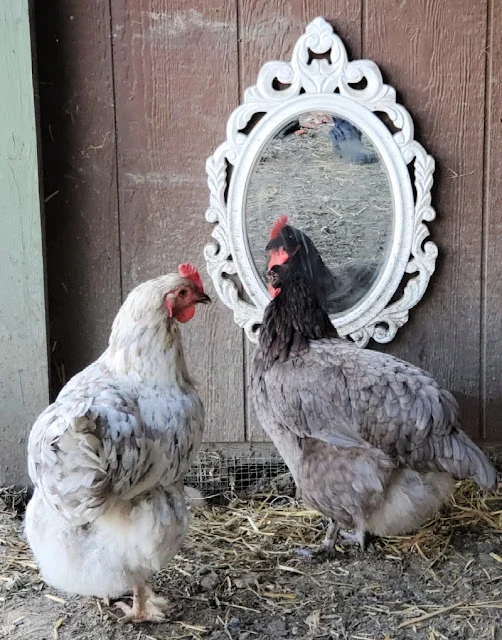
The long-standing scientific boundary between "higher" mammals and "lower" vertebrates is undergoing a significant shift as new research indicates that chickens may possess a level of self-awareness previously thought to be reserved for only a handful of species. Recent studies focusing on the behavioral responses of roosters to their own reflections have challenged the traditional parameters of the Mirror Self-Recognition (MSR) test, suggesting that the cognitive abilities of poultry have been historically underestimated. For decades, the ability to recognize oneself in a mirror has been considered a hallmark of advanced intelligence, linked to empathy and complex social structures. While primates, dolphins, and elephants have famously passed these tests, the domestic chicken (Gallus gallus domesticus) is now entering the conversation, providing a new perspective on avian neurobiology and the evolution of consciousness.

The catalyst for this renewed interest in poultry cognition is a series of experiments that moved away from the traditional "mark test" and toward ecologically relevant behaviors. While human toddlers typically begin to recognize their reflections at approximately 18 months of age, and species such as great apes and cleaner wrasse fish have shown similar capabilities, chickens have historically struggled with the standard MSR criteria. However, researchers now argue that the failure of certain species to pass the mark test—where a colored dot is placed on an animal’s body in a location only visible via a mirror—may be due to the test’s design rather than a lack of self-awareness. By utilizing the natural alarm-call instincts of roosters, scientists have uncovered evidence that these birds can distinguish between their own reflections and the presence of a rival or companion.
The Evolution of the Mirror Self-Recognition Test
The Mirror Self-Recognition test was first developed by psychologist Gordon Gallup Jr. in 1970. The premise was straightforward: if an animal looks in a mirror and uses the reflection to groom or touch a mark on its own body that it cannot see directly, it possesses a "concept of self." For half a century, this test served as the gold standard for animal intelligence. Chimpanzees and orangutans were the first to pass, followed by bottlenose dolphins, Eurasian magpies, and Asian elephants.

However, the MSR test has faced growing criticism for being overly reliant on visual and motor functions specific to primates. Animals that rely heavily on olfaction, such as dogs and cats, or those that do not possess the tactile appendages necessary to "touch" a mark, often fail the test despite showing high levels of cognitive complexity. Furthermore, many species perceive a mirror reflection as a stranger, leading to aggressive displays or social signaling rather than self-directed behavior. This is particularly true for territorial animals.
To address these limitations, a 2023 study published in the journal PLOS ONE by researchers from the University of Bonn and Ruhr University Bochum sought to adapt the test to the natural social behaviors of the chicken. Instead of using a red dot, which a chicken might ignore or fail to associate with its "self," the researchers focused on the rooster’s innate drive to protect its flock through vocalizations.

Methodology: The Rooster Alarm Call Experiment
The logic of the new research hinged on a specific behavioral trait: roosters only sound an alarm for aerial predators when they believe other chickens are present. This "audience effect" is a sophisticated survival strategy. A rooster that spots a hawk will crow loudly to warn its hens, but if the rooster is alone, it remains silent to avoid drawing the predator’s attention to itself.
In the controlled experiment, researchers placed a rooster in a divided enclosure. In the first scenario, the rooster was alone. In the second, another rooster was visible behind a clear pane of glass. In the third, a mirror was placed in the division, reflecting the test subject’s own image. To simulate a threat, the silhouette of a hawk was projected onto the ceiling of the enclosure.

The results were striking. When another rooster was visible, the test subject emitted an average of 1.33 alarm calls per trial. When the rooster was entirely alone, the call rate dropped significantly. Crucially, when the rooster was presented with its own reflection in the mirror, it remained as silent as it did when it was alone. Despite seeing a "chicken" in the mirror, the rooster did not treat the reflection as a social companion or a rival that needed warning. This suggested the bird recognized the reflection as "self" and understood that no other audience was present to receive a warning.
Chronology of Avian Intelligence Findings
The journey toward understanding chicken cognition has been building for decades, moving from the "bird brain" stigma to a realization of complex social lives.

- 1970s-1990s: Studies focused primarily on the "pecking order" and basic reinforcement learning. Chickens were viewed largely as instinct-driven organisms with limited memory.
- 2000s: Research began to show that chickens possess "object permanence"—the understanding that an object still exists even when it is out of sight. This is a cognitive milestone that human infants reach around six months of age.
- 2008: The Eurasian magpie became the first non-mammal to pass the MSR mark test, opening the door for avian self-recognition studies.
- 2013-2017: Studies on "Fresh Eggs Daily" and other poultry observation platforms popularized the use of mirrors as "boredom busters" in coops. Observations by poultry experts, including Lisa Steele, noted that hens often preened in front of mirrors, a behavior associated with self-maintenance rather than social aggression.
- 2023: The landmark PLOS ONE study provided the first rigorous behavioral evidence that roosters differentiate between a reflection and a conspecific (another member of the same species).
Sensory Perception and the Vision Factor
To understand why chickens might pass a behavioral mirror test while dogs fail, one must look at their sensory biology. Chickens are highly visual creatures. Their eyes are located on the sides of their heads, providing a wide field of vision, and they possess a fourth color receptor (tetrachromacy) that allows them to see ultraviolet light. This superior vision is their primary way of navigating the world, making them prime candidates for visual self-recognition.
In contrast, dogs and cats prioritize scent. A dog may not recognize its visual reflection because the reflection lacks a corresponding smell. Recent "sniff tests" for dogs—using changed scents of their own urine—have suggested that canines possess a "olfactory self-recognition" that the visual mirror test simply cannot capture. For chickens, the mirror provides the exact type of data they use to identify others in their flock: visual patterns, movement, and posture.

Comparative Data: Who Passes the Test?
The list of animals that have successfully demonstrated self-recognition is growing, but it remains exclusive. The following data highlights the success rates and methods used across species:
- Chimpanzees: Pass the mark test with a success rate of nearly 75% in adult subjects.
- Bottlenose Dolphins: Use mirrors to inspect marks on their bellies and fins, showing high levels of curiosity.
- Asian Elephants: One famous subject, "Happy" at the Bronx Zoo, used a mirror to touch an "X" painted on her head.
- Cleaner Wrasse: A small fish that passed the mark test by scraping its body against rocks to remove marks it saw in a mirror.
- Ants: Some studies suggest certain ant species attempt to clean blue dots off their heads when viewing their reflection.
- Chickens (Roosters): Passed the "Audience Effect" test, showing 0% alarm calls when viewing their reflection vs. high call rates with live companions.
Implications for Animal Welfare and Ethics
The revelation that chickens may be self-aware carries profound implications for the global poultry industry. Currently, billions of chickens are raised in industrial settings where cognitive stimulation is rarely a priority. If these birds are capable of recognizing themselves, it suggests a level of internal experience and potentially a capacity for boredom, frustration, and psychological distress.

Ethologists argue that if chickens possess a "concept of self," their welfare requirements must be re-evaluated. This includes the implementation of environmental enrichment. Mirrors, which were once seen as simple toys, are now being viewed as tools for cognitive engagement. In small-scale backyard farming, mirrors are often used to reduce stress in "lone" birds or to provide a sense of security.
However, there is a caveat. In highly territorial roosters, a mirror can sometimes trigger aggression if the bird fails to recognize the reflection. Scientific consensus suggests that while many chickens pass the cognitive threshold, individual temperament and social environment play a role in how they interact with reflective surfaces.

Scientific Skepticism and Future Research
Despite the compelling results of the rooster study, some members of the scientific community remain cautious. Skeptics argue that the lack of an alarm call might not necessarily prove self-recognition. It is possible, they suggest, that the rooster simply perceives the reflection as a "strange" bird that does not behave like a real companion—perhaps because it mimics every move perfectly—and thus the rooster becomes confused or suspicious rather than self-aware.
Future research aims to combine the mark test with behavioral cues. For example, if a rooster sees a mark on its reflection and then attempts to scratch that same spot on its own body, the evidence for self-awareness would be undeniable. Researchers are also looking into whether hens, who do not give the same type of aerial alarm calls as roosters, have different ways of demonstrating self-recognition.

Conclusion: Redefining the "Bird Brain"
The study of chickens and mirrors is more than a curiosity; it is a fundamental challenge to the hierarchy of intelligence. By proving that a common farm bird can navigate the complexities of self-reflection, science is closing the gap between humans and the rest of the animal kingdom. The domestic chicken, often dismissed as a mere commodity, is proving to be a creature of significant cognitive depth.
As more data emerges, the "bird brain" label is being replaced by a respect for avian neurobiology. Whether through the silent observation of a hen preening in a coop mirror or the calculated silence of a rooster facing a simulated hawk, the evidence is pointing toward a consistent conclusion: the lights are on, and someone is home. The capacity for self-recognition in chickens serves as a reminder that intelligence is not a linear ladder, but a diverse and complex web of adaptations. Moving forward, the inclusion of mirrors in poultry management may transition from a luxury enrichment to a recognized necessity for the mental well-being of these surprisingly sophisticated birds.
