
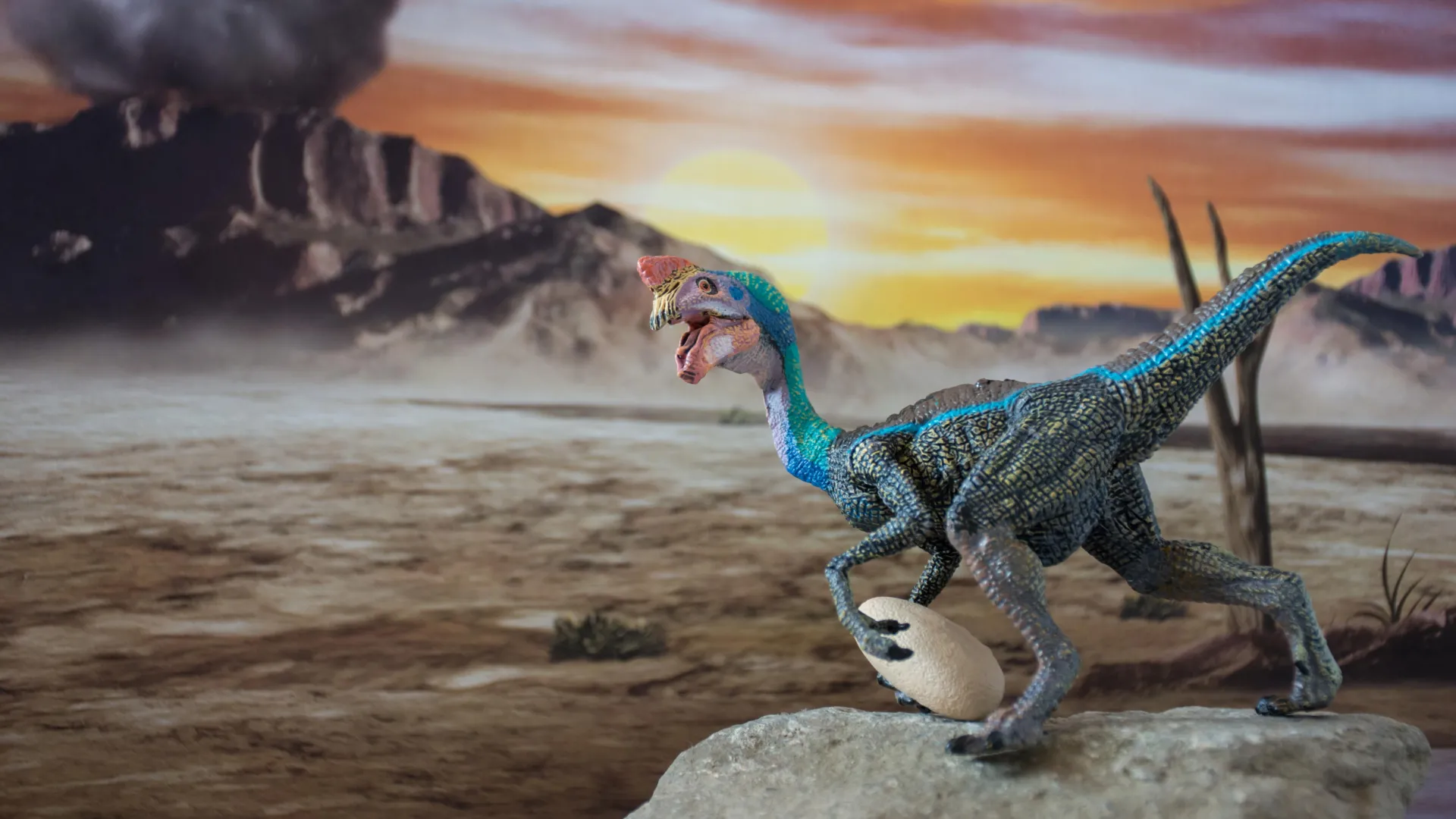
For decades, the precise methods by which oviraptors, those fascinating bird-like yet flightless dinosaurs, nurtured their offspring from egg to hatchling remained a significant enigma in paleontology. The central question revolved around whether these theropods relied on ambient heat from their environment, akin to modern crocodilians, or if they actively warmed their clutches directly, foreshadowing the brooding behaviors of extant birds. A recent and comprehensive study published in Frontiers in Ecology and Evolution has cast considerable light on this enduring debate, offering compelling evidence for a sophisticated, hybrid incubation strategy.
Unveiling the Mechanisms of Dinosaur Parental Care
The innovative research, spearheaded by a team based in Taiwan, employed a novel interdisciplinary approach, integrating advanced heat transfer simulations with meticulous physical experiments. Their objective was to construct a robust model for understanding the thermal dynamics of oviraptor incubation. This involved not only the reconstruction of a life-sized oviraptor model and a realistic nest but also a direct comparison of their findings with the well-documented incubation patterns observed in modern avian species. The meticulous methodology allowed researchers to test how heat energy propagated through clutches of eggs under varying conditions, providing unprecedented insights into the reproductive biology of these ancient creatures.
Dr. Tzu-Ruei Yang, a distinguished associate curator of vertebrate paleontology at Taiwan’s National Museum of Natural Science and the senior author of the study, highlighted a pivotal discovery: "We show the difference in oviraptor hatching patterns was induced by the relative position of the incubating adult to the eggs." This statement underscores the critical role of the parent’s physical interaction with the nest, even if not a direct, full-contact brooding. Complementing this, first author Chun-Yu Su, who contributed to the research while attending Washington High School in Taichung, added a crucial quantitative dimension: "Moreover, we obtained an estimate of the incubation efficiency of oviraptors, which is much lower than that of modern birds." This efficiency gap, while notable, does not diminish the effectiveness of the oviraptor strategy but rather points to a divergent evolutionary path.
A Deep Dive into Oviraptor Paleontology and Behavior
The genus Oviraptor, meaning "egg thief," was famously (and inaccurately) named in 1924 after the discovery of a specimen near a Protoceratops nest, initially presumed to be raiding the eggs. Subsequent discoveries, particularly the remarkable fossilized specimens found in brooding postures atop their own nests in the Gobi Desert in the 1990s, definitively overturned this misconception. These fossils revealed oviraptors as diligent, attentive parents, rather than thieves, cementing their reputation as some of the most compelling examples of dinosaur parental care. These discoveries, largely from the Djadochta Formation in Mongolia, showcased oviraptorids like Citipati and Oviraptor philoceratops preserved directly on their clutches, with their limbs spread, covering the central eggs. This evidence laid the groundwork for the modern understanding of their reproductive strategies and provided the inspiration for the current study’s detailed reconstructions.
The model developed for this study was specifically based on Heyuannia huangi, an oviraptor species that thrived approximately 70 to 66 million years ago during the Maastrichtian stage of the Late Cretaceous period in what is now southern China. This particular species, estimated to be about 1.5 meters (5 feet) long and weighing around 20 kilograms (44 pounds), constructed distinctive semi-open nests characterized by eggs arranged in multiple, often concentric, rings. This specific nest architecture, clearly visible in fossil records, became a central element in the researchers’ experimental design.
Methodological Innovation: Recreating a Prehistoric Nursery
To accurately simulate the incubation process, the research team meticulously engineered a full-scale replica of the oviraptor and its nest. The dinosaur’s torso was crafted from polystyrene foam and reinforced with a wooden frame, then carefully padded with cotton, bubble paper, and fabric to realistically mimic the soft tissues of the brooding adult. The eggs, a critical component of the experiment, presented a unique challenge. Unlike the eggs of any living species, oviraptor eggs possess distinct morphologies and shell thicknesses. To overcome this, researchers ingeniously fabricated the eggs from casting resin, striving to approximate the thermal properties and physical dimensions of actual oviraptor eggs as closely as possible. For the experiments, two clutches were arranged in double rings, precisely mirroring the fossil evidence unearthed from various oviraptorid sites.
"Part of the difficulty lies in reconstructing oviraptor incubation realistically," acknowledged Su. "For example, their eggs are unlike those of any living species, so we invented the resin eggs to approximate real oviraptor eggs as best as we could." This dedication to realistic physical modeling, combined with sophisticated computational fluid dynamics, allowed for a nuanced exploration of heat distribution within the nest.
Heat Dynamics, Nest Design, and Asynchronous Hatching
The core of the experimental phase involved testing how both the presence of the adult oviraptor and prevailing environmental conditions collectively influenced egg temperatures and, consequently, potential hatching outcomes. The results revealed a fascinating interplay of factors.
In simulated colder conditions, with a brooding adult present on the nest, significant temperature variations were observed within the egg clutch. Specifically, the outer ring of eggs exhibited temperature differences of up to 6°C (10.8°F) compared to the inner eggs more directly covered by the parent. Such substantial thermal gradients within a single nest are highly indicative of asynchronous hatching, a phenomenon where eggs hatch at different times, often over several days or even weeks. This strategy can be advantageous in environments where resources might be scarce or unpredictable, allowing parents to feed and care for offspring as they emerge.
Conversely, when the simulations were run under warmer environmental conditions, the temperature variation across the outer ring of eggs drastically reduced to approximately 0.6°C (1.08°F). This stark contrast suggests a crucial role for ambient heat, particularly solar radiation, in moderating and homogenizing egg temperatures within the nest. In warmer climates, sunlight likely provided a significant supplementary heat source, helping to even out thermal differences and potentially leading to more synchronized hatching.
Dr. Yang elaborated on this point, drawing parallels with other ancient and modern reptiles: "It’s unlikely that large dinosaurs sat atop their clutches. Supposedly, they used the heat of the sun or soil to hatch their eggs, like turtles. Since oviraptor clutches are open to the air, heat from the sun likely mattered much more than heat from the soil." This perspective aligns with a broader understanding of dinosaur reproduction, where larger species might have employed strategies more akin to modern crocodilians or megapodes, utilizing geothermal or solar heat for incubation. However, the oviraptor study introduces a more active parental role than a purely passive environmental incubation.
Dinosaur vs. Bird Incubation: A Tale of Two Strategies
A significant portion of the study focused on comparing the oviraptor’s incubation strategy with that of modern birds. The vast majority of avian species employ what is known as Thermoregulatory Contact Incubation (TCI), a highly efficient method where adults sit directly on their eggs, transferring body heat through specialized brood patches. For TCI to be successful, several conditions must be met: the adult must maintain consistent physical contact with all eggs, serve as the primary heat source, and meticulously regulate temperatures to ensure optimal embryonic development.
The research unequivocally demonstrated that oviraptors likely could not have fully met these stringent conditions. Their distinctive ring-shaped egg arrangement, a feature clearly evidenced in fossil records, inherently prevented the adult from maintaining direct, consistent contact with every single egg simultaneously. The physical geometry of the nest, with eggs splayed outwards, would have made comprehensive TCI practically impossible.
"Oviraptors may not have been able to conduct TCI as modern birds do," Su concluded. Instead, the evidence strongly suggests that these dinosaurs practiced a form of "co-incubation," a collaborative effort between the brooding adult and environmental heat sources. While this method might have been less thermally efficient than the highly specialized TCI of modern birds, it was remarkably well-suited to the oviraptor’s unique nesting style, which appears to have evolved from entirely buried nests (common in earlier dinosaur lineages) to the semi-open, ring-shaped structures observed in Heyuannia huangi.
Dr. Yang underscored the evolutionary significance of this distinction, emphasizing that different strategies are adaptations to specific ecological niches: "Modern birds aren’t ‘better’ at hatching eggs. Instead, birds living today and oviraptors have a very different way of incubation or, more specifically, brooding. Nothing is better or worse. It just depends on the environment." This perspective is crucial for understanding the diverse reproductive strategies that evolved throughout dinosaur history and the complex interplay between biology, behavior, and environment.
Broader Implications for Dinosaur Parental Care and Evolution
While the study offers profound insights, the researchers responsibly acknowledge certain limitations. Their results are derived from a reconstructed nest and experiments conducted under modern environmental conditions, which inherently differ from the Late Cretaceous period. The climate, atmospheric composition, and flora of 70-66 million years ago would have undoubtedly influenced incubation dynamics. Furthermore, the researchers postulate that oviraptors likely had significantly longer incubation periods than most modern birds, a factor that could also influence hatching success and parental investment. The incubation period for many non-avian dinosaurs is thought to have spanned several months, compared to weeks for most birds, demanding sustained parental commitment.
Despite these considerations, the study represents a monumental leap forward in our comprehension of oviraptor reproduction and, by extension, the broader tapestry of dinosaur parental care. By ingeniously combining physical modeling with sophisticated simulations, the research has opened exciting new avenues for exploring the reproductive strategies of extinct organisms. This interdisciplinary approach not only provides tangible answers to long-standing paleontological questions but also establishes a robust methodology for future investigations into dinosaurian life cycles.
The implications extend beyond oviraptors, contributing to the ongoing understanding of the evolutionary transition from non-avian dinosaurs to birds. The shared trait of parental care, particularly brooding behavior, reinforces the deep phylogenetic link. However, the distinct incubation mechanism of oviraptors highlights that this evolutionary path was not linear but involved diverse adaptations, each fine-tuned to specific ecological pressures. It suggests that while the tendency towards avian-like parental care was present, the mechanism continued to evolve and diversify.
Finally, the study carries a profound message of encouragement and inspiration, particularly for the scientific community in Taiwan. "It also truly is an encouragement for all students, especially in Taiwan," concluded Dr. Yang. "There are no dinosaur fossils in Taiwan, but that does not mean that we cannot do dinosaur studies." This statement powerfully articulates the global, collaborative nature of scientific inquiry, demonstrating that intellectual curiosity and rigorous methodology can transcend geographical boundaries and the presence or absence of local fossil records. It serves as a testament to the fact that groundbreaking contributions to paleontology can emerge from any corner of the world, fostering a new generation of scientists eager to unlock the secrets of Earth’s ancient past.
