
The 2026 winter avian survey in southern Manitoba concluded this February, providing critical data on the distribution, health, and behavioral patterns of several key raptor and boreal species. Over the course of five days, from February 23 to February 27, a specialized birding expedition traversed diverse ecosystems—ranging from the agricultural plains southwest of Winnipeg to the dense boreal transition zones near Lac du Bonnet. The mission aimed to document wintering owl populations and evaluate the impact of local weather patterns on avian visibility and foraging success. Despite challenging meteorological conditions during the early stages of the survey, the expedition successfully identified a wide array of species, including the Snowy Owl (Bubo scandiacus), the Northern Hawk Owl (Surnia ulula), and the Barred Owl (Strix varia), while also noting significant sightings of non-raptor species indicating a healthy winter ecosystem.

Geographic and Ecological Context of the 2026 Survey
Manitoba serves as a vital wintering ground for numerous Arctic and boreal avian species. The province’s unique position at the convergence of the prairie, boreal forest, and aspen parkland biomes creates a mosaic of habitats that support a high density of owls. In particular, the areas surrounding Winnipeg and the eastern boreal fringe are renowned for providing the necessary rodent populations and perching structures required by wintering raptors.
The 2026 survey occurred during a period of fluctuating visibility and wind speeds, factors that heavily influence the detection of "sit-and-wait" predators like the Snowy Owl. Observers noted that while high winds often drive these birds to seek shelter in ground-level drifts or behind structures, calmer periods reveal their presence on elevated vantage points such as hydro poles and haystacks.

Chronology of Field Observations: February 23–27, 2026
The expedition commenced on February 23 with a preliminary briefing and logistical coordination. Participants established a baseline for the trip, focusing on the specific environmental markers that indicate owl presence in the Red River Valley and the Canadian Shield transition.
Initial Challenges and Urban Raptor Populations
On February 24, the field team encountered "blustery" conditions characterized by blowing snow and reduced visibility south of Winnipeg. An initial sweep of the Oak Bluff region, typically a stronghold for Snowy Owls, yielded no sightings of the species, as the birds likely sought refuge from the wind. However, the resilience of ground-foraging birds was evident; the team documented a covey of Grey Partridge (Perdix perdix) foraging along the roadside, demonstrating the species’ ability to exploit cleared areas during heavy snow.

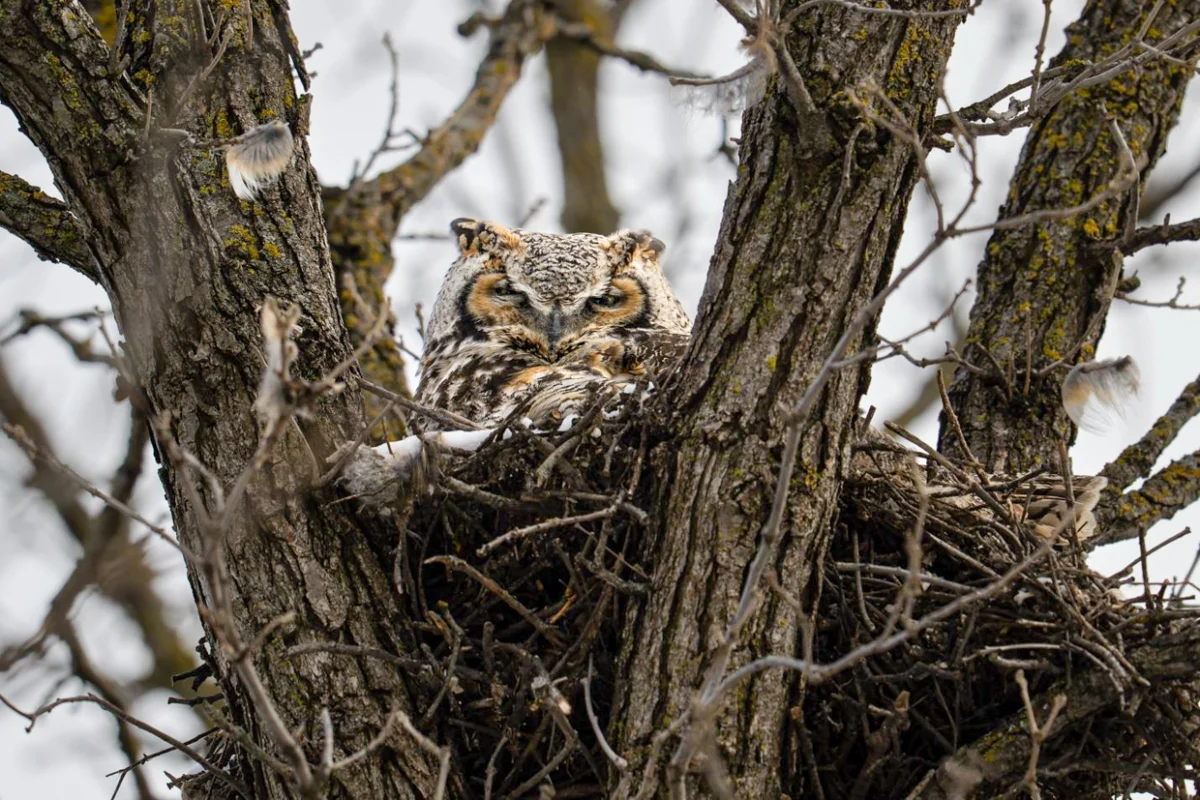
The survey shifted to Bunn’s Creek Centennial Park, where the sheltered environment provided more favorable conditions. The team observed a nesting pair of Great Horned Owls (Bubo virginianus). The female was documented remaining "tight" on the nest despite significant tree sway caused by the wind, while the male maintained a sentinel position nearby. This observation highlights the early nesting cycle of Great Horned Owls in Manitoba, which often begins in late winter. During this period, a Pileated Woodpecker (Dryocopus pileatus) was also observed excavating a cavity in close proximity to the owls, suggesting a level of interspecies tolerance during the winter months.
The day concluded with an educational symposium featuring Dr. Jim Duncan, a renowned expert on Great Grey Owls. Dr. Duncan presented findings from his long-term research on owl biology and conservation, accompanied by "Oska," an educational bird. Such presentations provide essential context for field observations, linking individual sightings to broader population trends and conservation efforts.

Boreal Transition and Northern Hawk Owl Clusters
On February 25, the focus shifted northeast toward Libau and Lac du Bonnet. This transition from prairie to boreal forest significantly increased the diversity of sightings. The team recorded 17 Sharp-tailed Grouse (Tympanuchus phasianellus) and approximately 30 Snow Buntings (Plectrophenax nivalis) along the Libau corridor.
The highlight of the day was the documentation of multiple Northern Hawk Owls. Unlike many other owl species, the Northern Hawk Owl is diurnal, making it an excellent subject for behavioral study. One specimen was observed hunting near smoldering brush piles, a behavior likely intended to capture rodents flushed out by the heat or human activity. On Maple Creek Road, another Northern Hawk Owl was found perched on a hydro pole, exhibiting the characteristic "tame" behavior of the species as it remained undisturbed by the survey vehicle.

Further north, in a coniferous forest near Lac du Bonnet that had recently been affected by wildfire, the team observed three Northern Hawk Owls in close proximity. Post-fire habitats are known to be highly productive for this species, as the removal of underbrush increases the visibility of prey. The day ended with sightings of Pine Grosbeaks, Redpolls, and White-breasted Nuthatches at local feeders, alongside a friendly encounter with White-tailed Deer in Pinawa.
Success in the Agricultural Fringes and Urban Parks
February 26 marked the most successful day for Snowy Owl observations. Improved weather conditions allowed for the detection of five Snowy Owls southwest of Winnipeg. The majority were identified as juveniles, with one adult female also recorded. The prevalence of juveniles in the region is often an indicator of a successful breeding season in the Arctic, followed by a winter irruption.

In the southern reaches of Winnipeg, the team documented a dark-morph Rough-legged Hawk (Buteo lagopus) successfully capturing and consuming prey. This sighting is significant as it confirms the continued presence of this Arctic breeder in the Manitoba winter landscape.
Later in the day, the survey moved to Harris Park, where a Barred Owl was located with the assistance of "mobbing" behavior from American Crows (Corvus brachyrhynchos). Mobbing is a vital auditory cue for researchers, as songbirds and corvids often vocalize aggressively to harass and reveal the location of a roosting predator. Additionally, the team recorded three Red-bellied Woodpeckers (Melanerpes carolinus) in the park. Historically considered a vagrant in Manitoba, the Red-bellied Woodpecker has seen a steady increase in local populations, a trend many ornithologists attribute to shifting climate patterns and the availability of bird feeders.

The survey concluded at FortWhyte Alive, where the team observed a pair of Bald Eagles (Haliaeetus leucocephalus) at a nest site. The male was seen delivering scavenged food to the female, providing a rare look at winter pair-bonding and territorial maintenance.
Supporting Data and Population Trends
The 2026 data, when compared to historical records from the Manitoba Breeding Bird Atlas and eBird, suggests a stable wintering population for several key species. The Northern Hawk Owl sightings were particularly robust this season. While the Great Grey Owl—Manitoba’s provincial bird—remained elusive during this specific window, the sightings of Northern Hawk Owls in burned-over areas underscore the importance of forest fire cycles in maintaining avian biodiversity.

The increase in Red-bellied Woodpecker sightings aligns with a 20-year trend of northward range expansion for several Carolinian species. Researchers suggest that milder winters and increased urbanization are allowing these birds to survive in latitudes that were previously inhospitable.
Analysis of Implications and Conservation
The results of the 2026 survey emphasize the importance of maintaining diverse habitats within and around urban centers. Parks like St. Vital and Harris Park act as critical "islands" of biodiversity for owls and woodpeckers, providing food and shelter in an otherwise developed landscape.

Furthermore, the documentation of juvenile Snowy Owls provides a snapshot of the health of the Arctic tundra ecosystem. Because Snowy Owl reproductive success is tied directly to lemming cycles, a high number of juveniles in Manitoba suggests a "boom" year for prey in the north.
Conclusion
The five-day avian survey of February 2026 successfully mapped a cross-section of Manitoba’s winter birdlife. From the resilient Great Horned Owls nesting in the wind to the Northern Hawk Owls patrolling the boreal fringe, the expedition provided valuable insights into how these species navigate the challenges of a Canadian winter. As climate patterns continue to shift and habitats evolve, consistent monitoring through professional surveys and citizen science remains the most effective tool for ensuring the long-term conservation of Manitoba’s iconic owl populations. The data gathered during this period has been uploaded to the eBird global database, contributing to the international effort to track and protect avian species worldwide.
