
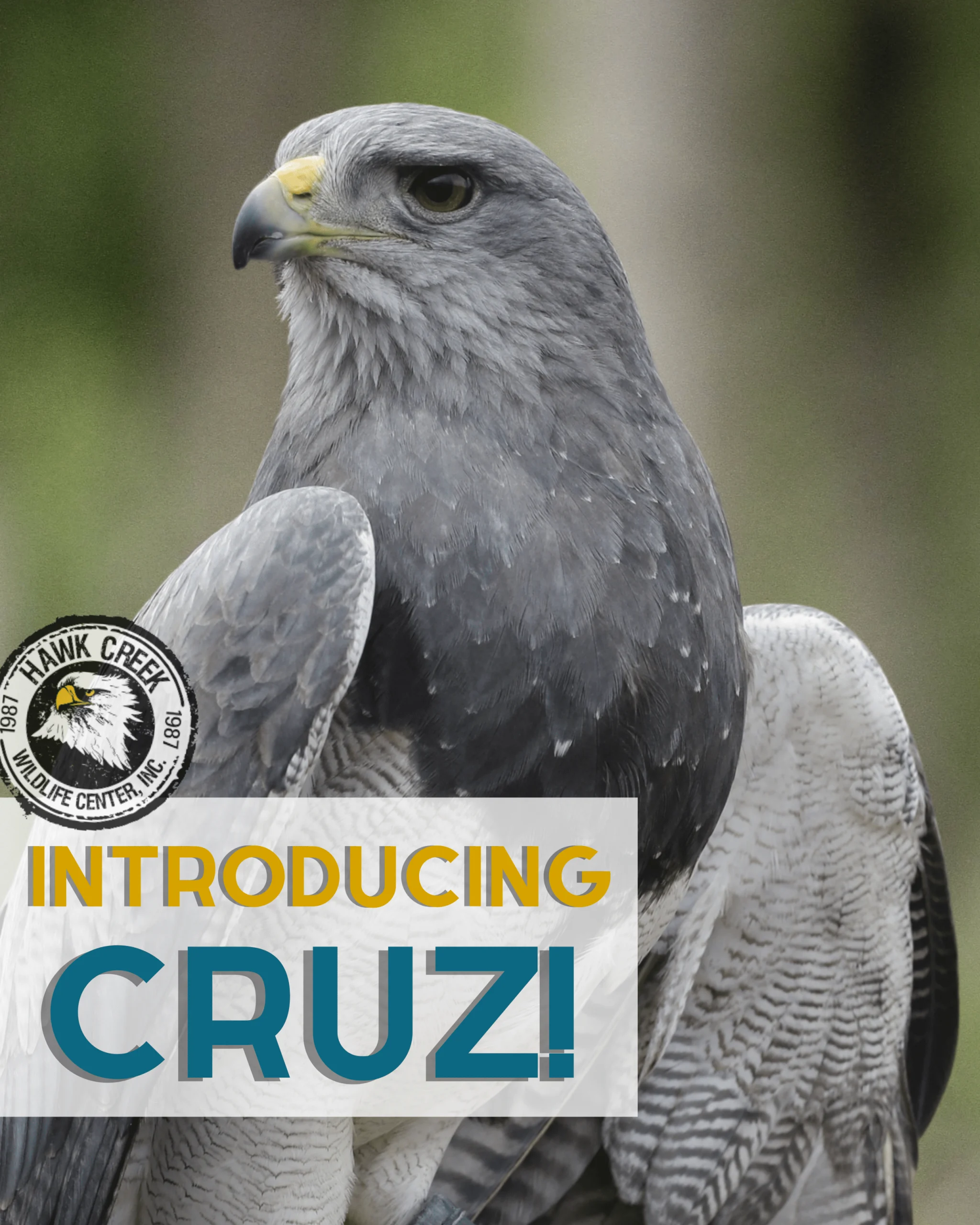
Hawk Creek is thrilled to announce the arrival of its newest avian resident, a magnificent specimen of the Black-chested Buzzard-eagle, a species also recognized by the names Chilean Blue Eagle, Patagonian Eagle, and Gray Buzzard Eagle. Within the Hawk Creek sanctuary, this remarkable raptor will be known affectionately as Cruz. This introduction marks a significant moment for the organization and the community, offering an unparalleled opportunity to observe and learn about a species rarely encountered in the United States. The arrival of Cruz is not an isolated event but the culmination of a dedicated, ongoing partnership focused on advancing global eagle conservation.
A New Apex Predator Joins the Hawk Creek Family
The Black-chested Buzzard-eagle (Geranoaetus melanoleucus) is a powerful bird of prey native to the vast, elevated open landscapes of South America. Its impressive wingspan and keen eyesight are essential tools for survival in its natural habitat, which spans from the Andes Mountains to the Patagonian steppes. These birds are primarily diurnal hunters, dedicating a substantial portion of their day to soaring through the skies in search of sustenance. Their diet is varied, reflecting their adaptability within their ecosystem, and commonly includes small mammals such as degus (Octodon degus), a rodent species endemic to Chile, as well as larger prey like invasive European hares (Lepus europaeus), which can significantly impact local flora and fauna.
The introduction of Cruz to Hawk Creek provides a unique educational platform. Many species of eagles and buzzard-eagles are facing increasing pressures in their native ranges due to habitat loss, agricultural encroachment, and climate change. By bringing a representative of this understudied species to a U.S.-based sanctuary, Hawk Creek aims to foster a deeper understanding and appreciation for these vital predators and the ecological roles they fulfill. The ability to observe such a bird up close, in a controlled and educational environment, is invaluable for inspiring conservation action and scientific inquiry.
Forging Global Partnerships for Conservation
This significant acquisition and the broader conservation initiatives it represents are made possible through a vital partnership between Hawk Creek and leading eagle conservationists at Sia, located in Oklahoma. Sia, an acronym for the Comanche Ethno-Ornithological Initiative, is dedicated to the preservation and study of raptors, particularly those with cultural and ecological significance to indigenous communities. This collaboration underscores Hawk Creek’s commitment to supporting a diverse array of eagle conservation programs operating on a global scale.
The partnership with Sia allows Hawk Creek to not only house and display species that are seldom seen in the United States but also to actively contribute to the research and protection of these birds in their natural habitats. This exchange of expertise and resources is crucial for addressing the complex challenges faced by raptor populations worldwide. Through Sia’s network and specialized knowledge, Hawk Creek gains access to species that are critical for conservation education and research, enabling them to broaden their outreach and impact.
A Legacy of Shared Expertise and Rare Species
This is not the first time Hawk Creek has enriched its collection and educational offerings through its alliance with Sia. Previously, the sanctuary introduced Jara, a Short-toed Snake Eagle (Circaetus gallicus), and Onyx, a Verreaux’s Eagle (Aquila verreauxii). The Short-toed Snake Eagle, found across parts of Europe, Asia, and Africa, is a specialist predator known for its remarkable ability to hunt venomous snakes. Verreaux’s Eagle, on the other hand, is an iconic species of African rocky outcrops and mountains, renowned for its powerful flight and preference for hunting rock hyraxes.
The presence of these diverse raptors, each with its unique ecological niche and conservation status, highlights the breadth of Hawk Creek’s commitment to avian conservation. These introductions serve as powerful educational tools, allowing visitors to learn about the intricate relationships within different ecosystems and the threats that jeopardize the survival of these magnificent birds. The shared expertise between Hawk Creek and Sia ensures that these animals are not merely exhibits but ambassadors for their wild counterparts, embodying the urgent need for global conservation efforts.
Wild Earth Event: A Deep Dive into Eagle Conservation
To further amplify the message of eagle conservation and celebrate the arrival of Cruz, Hawk Creek is hosting a special "Wild Earth" event on May 13th. This event will feature a distinguished guest speaker, William "Two-Raven" Voelker, a globally recognized eagle conservationist and the driving force behind Sia. Voelker, also known by his Comanche name Waha Thuweeka, brings a unique interdisciplinary perspective to ornithology, blending scientific research with a deep understanding of indigenous ecological knowledge.
Voelker’s presentation at the Wild Earth event promises to be an insightful exploration of the multifaceted world of eagle conservation. Attendees will have the opportunity to learn about the ongoing challenges faced by eagle populations across the globe, the innovative strategies being employed to protect them, and the critical role that community engagement and scientific research play in these efforts. His background, rooted in the Comanche Ethno-Ornithological Initiative, offers a valuable perspective on the historical and cultural significance of raptors, further enriching the understanding of their conservation needs. The event is poised to be a cornerstone for public education and engagement, fostering a deeper connection between the community and the natural world.
The Significance of Understudied Species
The Black-chested Buzzard-eagle, while possessing several common names, remains relatively understudied compared to some of its more widely recognized eagle relatives. This lack of extensive research presents both a challenge and an opportunity. The challenge lies in the potential for critical ecological information to remain undiscovered, hindering targeted conservation strategies. The opportunity, however, is to contribute significantly to scientific knowledge through careful observation and dedicated study.
By introducing Cruz and other rarely seen species, Hawk Creek and Sia are actively contributing to filling these knowledge gaps. The presence of these birds allows for direct observation of their behavior, dietary habits, and physiological needs, providing valuable data that can inform conservation policies and practices. This commitment to studying and showcasing understudied species is a testament to their dedication to a holistic approach to conservation, recognizing that every species plays a vital role in the health of its ecosystem.
Supporting Data and Ecological Context
The ecological niche occupied by the Black-chested Buzzard-eagle in South America is characterized by its open, often arid or semi-arid, high-altitude environments. These regions, such as the Patagonian steppe and the Andean foothills, are subject to specific environmental pressures, including changing land-use patterns and the impacts of climate change. The presence of degus as a primary food source highlights the interconnectedness of species within these ecosystems. Degus are social rodents that play a role in soil aeration and seed dispersal. Disruptions to their populations, whether through predation by eagles or other environmental factors, can have cascading effects throughout the food web.
The inclusion of European hares in the diet of the Black-chested Buzzard-eagle is also noteworthy. While invasive species can pose significant threats to native biodiversity, in some instances, apex predators can play a role in regulating their populations. Understanding these predator-prey dynamics is crucial for effective ecosystem management. Data from ornithological surveys in South America indicate that the Black-chested Buzzard-eagle has a wide distribution but faces localized threats, including habitat degradation and, in some areas, direct persecution. Conservation efforts often focus on protecting large tracts of suitable habitat and mitigating human-wildlife conflict.
Broader Implications for Conservation Education
The collaborative efforts between Hawk Creek and Sia exemplify a model for effective conservation outreach. By pooling resources, expertise, and access to rare species, these organizations can achieve a greater impact than they might individually. The introduction of Cruz and other exotic raptors serves multiple purposes:
- Public Awareness: It draws attention to the plight of birds of prey globally and the importance of their conservation.
- Educational Enrichment: It provides a tangible link for the public to learn about diverse ecosystems and the challenges faced by their inhabitants.
- Scientific Contribution: It facilitates opportunities for research and data collection on species that are difficult to study in their native environments.
- Inspiration for Future Generations: It aims to ignite a passion for wildlife and conservation in younger audiences, fostering a commitment to environmental stewardship.
The success of such programs hinges on their ability to translate the observation of individual animals into a broader understanding of ecological principles and conservation imperatives. The educational materials and programs developed around species like Cruz are designed to go beyond simple identification, delving into the complex relationships and environmental factors that influence their survival.
A Look Ahead: The Future of Raptor Conservation
The ongoing partnership between Hawk Creek and Sia, marked by the arrival of Cruz, signifies a commitment to a proactive and globally-minded approach to conservation. As climate change continues to reshape ecosystems and human activities intensify their impact on wildlife, the role of organizations dedicated to protecting these species becomes increasingly critical. The ability to share knowledge, resources, and passion across borders is essential for tackling the complex challenges of biodiversity loss.
The Wild Earth event on May 13th, featuring Waha Thuweeka a.k.a. William "Two-Raven" Voelker, represents a pivotal moment in this ongoing endeavor. It is an opportunity for the public to engage directly with leading conservationists, gain insights into the realities of protecting endangered species, and understand how they can contribute to these vital efforts. The presence of Cruz at Hawk Creek is more than just the addition of a new resident; it is a powerful symbol of global cooperation and a beacon of hope for the future of eagle conservation. By fostering understanding and inspiring action, Hawk Creek and Sia are working to ensure that these majestic birds continue to grace the skies for generations to come.
