
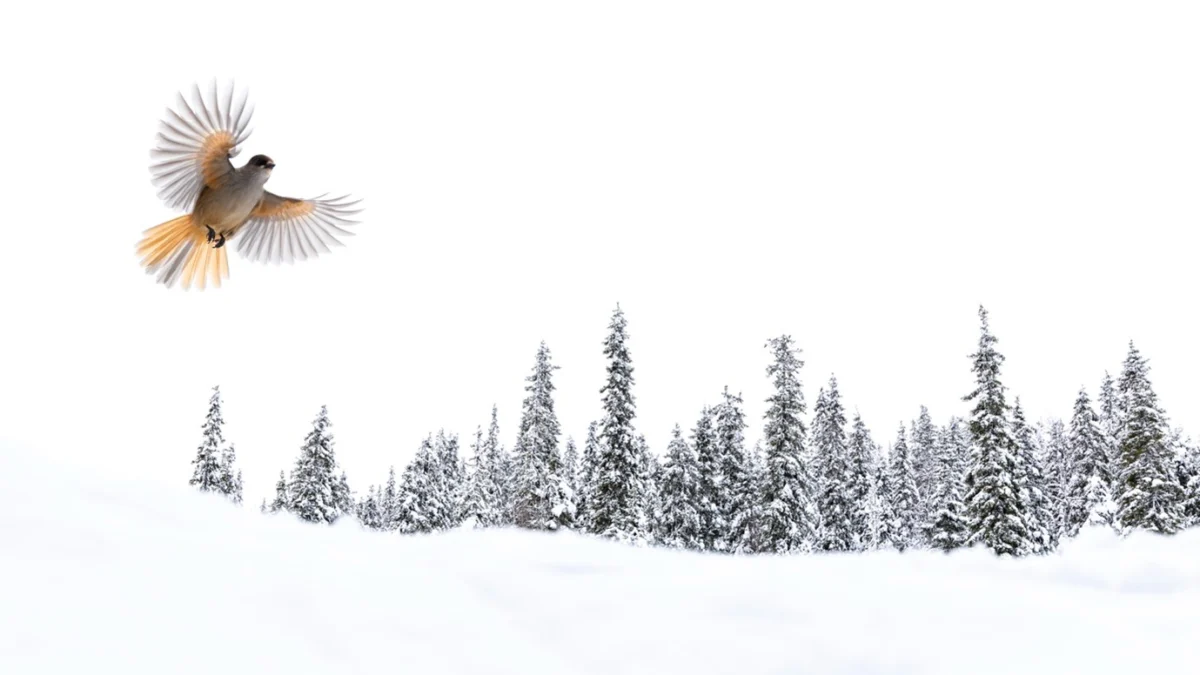
Finnish-based nature photographer Stefan Gerrits has cultivated a distinctive artistic vision, transforming the often stark and challenging landscapes of the Nordic countries into profound photographic statements. His work transcends mere documentation, offering a deeply personal interpretation of the North, where vastness, silence, and subtle light become central themes. Gerrits’s philosophy, elegantly encapsulated by the adage "less truly becomes more," is a testament to the power of high-key photography and minimalism in evoking profound emotion and connection.

A Nordic Vision Unveiled: The Essence of Gerrits’s Philosophy
For Gerrits, the Nordic region—encompassing its profound calmness, the ethereal interplay of light and shadow, and the pervasive silence—is more than a geographical location; it’s a state of being, a unique way of perceiving and experiencing the world. He describes an "emptiness that brings peace," where snow, darkness, and extreme cold converge with simplicity and a sense of timelessness. This deeply felt connection to the environment informs his photographic output, characterized by a minimalistic, imaginative, and two-dimensional aesthetic that is flat, graphic, and inherently quiet. His images invite viewers to pause, reflect, and engage with nature’s subtle grandeur, filtering out the superfluous to highlight the essential.

The Philosophy of "Less is More": Deconstructing Minimalism in Nature Photography
Minimalism, as an artistic movement, emerged in the mid-20th century, advocating for simplicity, geometric forms, and the reduction of art to its fundamental properties. In photography, this translates into compositions that strip away non-essential elements, creating visual purity and focusing the viewer’s attention intently on the subject. Gerrits embraces this principle not as a mere stylistic choice but as a deliberate strategy to amplify emotional resonance. He explains that minimalism in his work isn’t about absence, but about "revealing more by removing what are, in my opinion, distractions." This approach fosters a sense of "space" — not only for the subject to exist unburdened by clutter but also for the viewer to engage in quiet contemplation. The psychological impact of such compositions is significant; by reducing visual noise, the brain can process the image more deeply, leading to a stronger emotional response and a more memorable experience.

Illuminating the Essence: The Art of High-Key Photography
Central to Gerrits’s evocative style is his proficient use of high-key photography. This technique involves intentionally overexposing an image to create a predominantly bright, often stark white or light-toned scene, with minimal shadows and a narrow tonal range. While technically challenging, especially in preserving detail, high-key imagery often conveys a sense of optimism, ethereal beauty, and purity. For Gerrits, it’s not merely a technical setting but a creative decision to generate the specific "feeling" he associates with the North. In environments frequently blanketed in snow or characterized by muted winter light, high-key photography naturally complements the minimalist ethos, allowing subjects like a Siberian Jay (f/8.0, 1/1250s, ISO 3200, +2 EV) or Common Cranes (ISO 260, f/2.8, 1/1600 sec, +2 EV) to emerge with striking clarity against luminous backgrounds. The deliberate overexposure elevates the image beyond reality, imbuing it with an imaginative, almost dreamlike quality that aligns perfectly with his interpretative vision.

From Field to Frame: Practical Applications of Minimalist Techniques
Gerrits offers practical insights into achieving his signature simplicity, emphasizing that these are "guiding ideas" rather than rigid rules, acknowledging the fluid nature of creative expression. His methodology involves a systematic, three-step process:

-
Simplifying the Composition: The Three Steps to Clarity:
Gerrits advocates for a progressive approach to simplicity, starting with a "clean frame" centered around a single visual focal point. This initial step is about identifying the core subject and minimizing surrounding elements. The next stage involves iterative removal of distractions. This can occur in the field through subtle adjustments—changing position, tilting the camera, or adopting a low angle to exclude an unwanted background or foreground. Framing a subject against natural, neutral backdrops like snow or an overcast sky is a common strategy. If perfection isn’t achieved during capture, post-processing becomes the final step. Techniques like cropping, simplifying tones, or selectively erasing distracting elements are employed to ensure only what strengthens the image remains. This meticulous attention to detail ensures that every element serves a purpose, making the image "stronger, more emotional, and thus more memorable." The Western Capercaillie captured in its wintery environment (f/4.5, 1/320s, ISO 3200, +2 EV) exemplifies this refined simplicity, where the bird stands out against an uncluttered, muted backdrop. -
Beyond the Spectrum: The Power of Monochrome and Black & White:
The decision to convert an image to monochrome or black and white is a powerful creative choice, not a default. Gerrits advises photographers to consider whether color is integral to the subject’s impact. While vibrant subjects like butterflies might lose their essence in grayscale, others thrive. A Mountain Hare in winter, for instance, with its predominantly white fur and minimal color accents (soft pinkish ears, yellow paw bits), is an ideal candidate. In such cases, a monochrome approach can profoundly "amplify the mood, the silence, the harmony, and the focus" of the image. Gerrits frequently utilizes tools like Silver Efex Pro, known for its precise control over contrast, structure, and black-and-white tonality, to craft images that resonate with depth and timelessness, as seen in the Mountain Hare (f/5.6, 1/1000s, ISO 800, +4/3 EV) subtly concealed beneath a dwarf birch. Even seemingly mundane subjects like barnacles can be transformed into striking high-key monochrome art through inversion (f/9.0, 1/1250s, ISO 400, -8/3 EV inverted), demonstrating the versatility of this approach.
-
Structural Elegance: Geometric Shapes and Lines:
Basic geometric forms are foundational to minimalistic design and photography. Angles, triangles, circles, and lines offer clarity, structure, and balance, guiding the viewer’s eye and establishing strong visual anchors. Gerrits consciously frames his images around distinct shapes or even fragments of them—a curve suggesting a half-circle, or a single line. These elements not only direct focus but also contribute to a sense of scale and order within the frame. The slender stem supporting a Bearded Reedling (f/4.0, 1/640s, ISO 1000, +2 EV) becomes a compelling vertical line, while the delicate forms of two Banded Demoiselles (f/5.0, 1/80s, ISO 250, +5/3 EV) waiting for the sun can create a subtle, almost symmetrical composition against a soft background. -
Rhythm and Harmony: Repetition and Symmetry:
Repetition, whether symmetrical or mirrored, is a highly effective tool in minimalist photography for creating rhythm, order, and visual intrigue without introducing clutter. A series of similar shapes, lines, or multiple identical subjects can become captivating, even "hypnotic." This technique lends itself well to nature, where patterns abound. The image of Common Guillemots "locked in a silent conversation" (f/4.0, 1/400s, ISO 160, +7/3 EV) exemplifies this, where the repeated forms of the birds create a harmonious, almost meditative visual flow. Similarly, the powerful vertical composition of a Drake Mackerel (f/4.0, 1/80s, ISO 400, +5/3 EV) utilizes a singular, strong shape in isolation, almost a form of self-repetition in its starkness.
-
The Breath of Space: Negative Space and Isolation:
Gerrits places significant emphasis on "negative space," which he aptly terms "breathing space" around a subject. This strategic inclusion of expansive, often empty, areas in an image not only enhances its aesthetic appeal but also intensifies the subject’s isolation, elevating the artwork to a more artistic and minimalistic plane. He posits that isolation in minimalist photography strengthens the viewer’s connection with the subject, guiding both the eye and mind towards a single focal point. Because minimalist images contain so few elements, the chosen subject must carry substantial emotional weight and create a "wow effect." This is often achieved by selecting subjects that embody fragility, vulnerability, rarity, danger, mystery, or solitude. Elusive or endangered species, such as the Great Gray Owl captured on freshly fallen snow (f/8.0, 1/2500s, ISO 8000, +5/3 EV) or a Willow Grouse (f/4.0, 1/500s, ISO 640, +2 EV) peeking from behind snow, inherently evoke a stronger emotional response due to their scarcity and mystique. Crucially, negative space doesn’t necessarily mean a uniform white or black expanse; it can be a visually interesting, uniform environment that supports the subject without competing for attention. The White-throated Dipper (f/16.0, 0.3s, ISO 50, +2/3 EV) placed small within the frame, surrounded by the silky waves of a river, perfectly illustrates this concept, where the simplicity of the setting complements, rather than detracts from, the subject. Even the fleeting glimpse of a Brown Bear on the run (f/11.0, 1/8s, ISO 100, +7/3 EV) can be imbued with a sense of vastness and solitude through thoughtful use of surrounding space.
The Evolution of a Vision: Stefan Gerrits’s Journey

Stefan Gerrits’s journey as a nature and wildlife photographer spans over a decade, marked by a continuous evolution of his distinctive style. Born in Sambeek, Netherlands, his relocation to Sundsberg, Kirkkonummi, in southern Finland, profoundly influenced his artistic direction, immersing him in the very landscapes that define his work. Beyond capturing stunning images, Gerrits is a respected figure in the photographic community. He leads photo tours across the Nordics, both independently and in collaboration with organizations like NatureTalks (NL), sharing his expertise and passion with aspiring photographers. His insights are also sought after at various events where he regularly speaks. His work has garnered international recognition, appearing in numerous European magazines, and he held a critically acclaimed solo exhibition in Helsinki titled "imaginature." This exhibition served as a powerful showcase for his signature style—imaginative, minimalistic, and two-dimensional—underscoring his commitment to presenting nature in its "simplest, most honest form," prioritizing "function over form."
Broader Implications: Minimalism’s Role in Modern Nature Photography

Gerrits’s approach challenges the often-busy, detail-oriented style prevalent in much of nature photography. In an era saturated with visual information, his minimalism offers a refreshing counterpoint, inviting viewers to slow down and engage with imagery on a deeper, more reflective level. This artistic choice has significant implications:
- Deeper Emotional Engagement: By stripping away distractions, Gerrits’s work fosters a more direct and profound emotional connection between the viewer and the subject. The simplicity forces contemplation, allowing the inherent beauty or plight of the animal or landscape to resonate without interference.
- Redefining Beauty: It broadens the definition of "beautiful" in nature photography, emphasizing mood, atmosphere, and form over intricate detail or vibrant color. This encourages appreciation for the subtle, often overlooked aspects of the natural world.
- Artistic Statement: His style makes a powerful artistic statement about perception and presence. It suggests that true understanding often comes from focused attention and the willingness to see beyond the obvious.
- Educational Value: For aspiring photographers, Gerrits’s methods provide a valuable framework for developing a personal style, encouraging intentionality and creative problem-solving in composition and post-processing.
- Conservation Advocacy: By highlighting the fragility and isolation of species, particularly those in harsh or remote environments, his work subtly underscores the importance of conservation, drawing attention to these creatures through an artistic lens.
This vision aligns seamlessly with publications like Nature Vision Magazine, which focuses on photography, stillness, and the creative process, further amplifying the reach and impact of such thoughtful photographic practices.

Conclusion: A Call for Intentionality
Ultimately, Stefan Gerrits’s mastery of high-key photography and minimalism serves as a powerful reminder for both photographers and viewers: to slow down, to truly look, and to be intentional in what we choose to observe and present. His work challenges the conventional, daring to leave things out and trusting that "what remains is enough and powerful." In his own words, "what’s not in the frame says just as much as what is: about the subject, the moment, the feeling, and about the one behind the camera – you." This philosophy underscores the transformative potential of selective vision, inviting a deeper, more introspective engagement with the natural world.
