
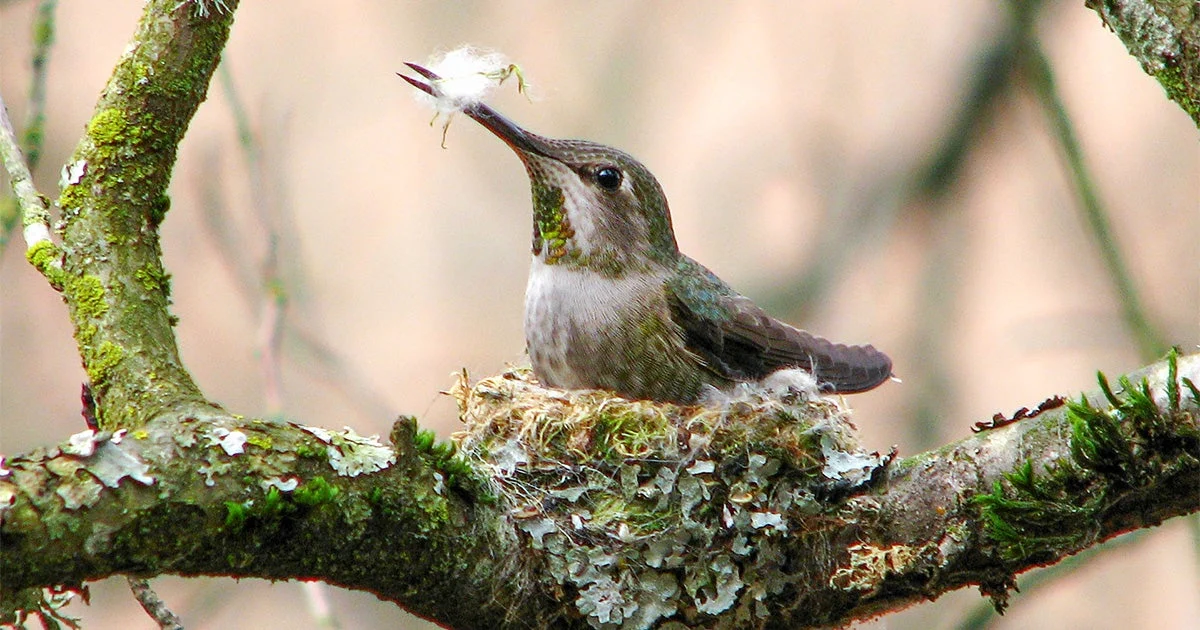
In an extraordinary testament to the power of dedicated citizen science, Oregonian Beverly LaBelle, without any formal scientific training, has likely amassed the most extensive individual dataset on Anna’s Hummingbird nesting habits, all within the once-overlooked expanse of Portland’s Oaks Bottom Wildlife Refuge. Her meticulous observations, spanning over a decade, have yielded invaluable insights into these iridescent avian residents, painting a vivid picture of their urban adaptation, challenges, and resilience in a rapidly changing world. LaBelle’s work, driven by pure passion and an unwavering commitment, stands as a beacon for what sustained local engagement can achieve in the realm of ecological understanding and conservation.
A Decade of Dedicated Observation: Unveiling Avian Secrets
Since 2012, Beverly LaBelle has been the vigilant guardian and chronicler of Anna’s Hummingbird ( Calypte anna) nests in Oaks Bottom. Her method is as charming as it is effective: each year’s hummingbird mothers are named alphabetically, starting with "Abby" for the first nest found, "Brenda" for the second, and so on, looping back to "A" if her discoveries exceed 26. Armed with little more than a mirror affixed to a long stick, keen eyesight, and an exceptional ear for the subtle chirps and whirs of these tiny birds, LaBelle has located and documented over 350 active nests. This remarkable tally is believed to surpass the findings of any single individual, including professional ornithologists, making her a singular figure in hummingbird research.
LaBelle’s extensive dataset is a treasure trove of information, detailing everything from the preferred tree species for nesting to the precise location, timing, success rates, and re-nesting efforts for each individual nest. This self-initiated, long-term study provides a unique, granular perspective on the species’ reproductive biology within an urban environment. "All data collecting is important," LaBelle emphasizes, acknowledging the urgency of her work. "Especially in a world where the climate is changing too fast for species to recover." Her findings offer a critical baseline and reveal ongoing trends that are crucial for the long-term survival and thriving of Anna’s Hummingbirds.
Oaks Bottom: A Sanctuary Forged by Community Action
The stage for LaBelle’s groundbreaking research, Oaks Bottom Wildlife Refuge, is itself a story of community triumph and ecological restoration. When LaBelle first moved to Portland in the early 1980s, the site was far from the protected natural haven it is today. Located along the Willamette River in Southeast Portland, the area was a neglected dumping ground, scarred by 400,000 cubic feet of construction waste and strewn with various forms of refuse. Despite its degraded state, LaBelle, then a beginner birder, quickly recognized the latent ecological richness of the 163-acre expanse of meadows, wetlands, and forest.
In the absence of initial municipal support, local residents took matters into their own hands. Neighbors began organizing clean-up efforts, clearing debris and establishing informal trails. LaBelle vividly recalls attending one such event in the early ’80s, where volunteers were cautioned about the abundance of discarded needles. The turning point arrived in 1984 when a group of local naturalists boldly posted 40 "rogue" "Wildlife Refuge" signs around the Bottom, a defiant act that captured local media attention and began to shift public perception. This grassroots advocacy ultimately compelled the City of Portland to officially sanction the efforts, formally designating Oaks Bottom as the city’s first wildlife refuge in 1988. Today, Oaks Bottom stands as a vibrant urban ecosystem, providing critical habitat for over 175 bird species, beavers, otters, and various amphibians, showcasing the profound impact of citizen-led conservation initiatives.
The Evolution of a Lifelong Passion into Scientific Pursuit
LaBelle’s journey into systematic hummingbird research began subtly. A fellow birder first piqued her interest in the 1990s, informing her that Anna’s Hummingbirds nested in the refuge. At that time, spotting a hummingbird was a rare and celebrated event for birding groups. In 2003, LaBelle found her first hummingbird nest independently within Oaks Bottom, igniting a deeper fascination. She became a frequent visitor, observing and photographing the metallic green birds and their delicate nests. However, her informal observations transformed into a rigorous scientific endeavor only after an encounter with a park worker who informed her that going off-trail required a research permit.
This bureaucratic hurdle, rather than deterring her, spurred LaBelle to formalize her passion. Securing the necessary permit from the city, she began compiling comprehensive annual reports in 2012. These reports, detailing her extensive findings, are submitted to Portland Parks and Recreation and the Northwest Ecological Research Institute (NERI), a volunteer-run nonprofit dedicated to field studies of regional flora and fauna. This institutional partnership has lent credibility and scientific rigor to her work, bridging the gap between amateur enthusiasm and professional research.
Char Corkran, Vice President of NERI, speaks with immense admiration for LaBelle’s capabilities. "Bev is just a super observant human being, and she’s capable of really focusing her attention," Corkran notes. "That has become this astonishing set of data she’s collected, just out of pure love of doing it." Corkran, who first met LaBelle decades ago during a wildlife survey in Mt. Hood National Forest, highlights LaBelle’s enduring dedication: "When she enjoys something and sees it as valuable, Bev just keeps doing it." Indeed, NERI’s assessment, based on published literature, suggests that LaBelle’s study is the longest-running continuous investigation into the nesting habits of Anna’s Hummingbirds by any individual.
The Anna’s Hummingbird: An Urban Success Story (and its Perils)
Anna’s Hummingbirds, typically residents of the Pacific Coast, have expanded their range significantly northwards and inland over the past few decades. This expansion is largely attributed to human activities, specifically the widespread planting of ornamental, nectar-rich plants and the proliferation of backyard nectar feeders, which provide crucial food sources during colder months. Consequently, in places like Portland, Anna’s Hummingbirds have become year-round residents, nesting remarkably early in the year, with some activity beginning as early as January.
Their nests are marvels of avian engineering: tiny, cup-shaped structures, barely an inch tall, meticulously woven from moss, lichen, and spiderwebs, often cemented with saliva and adorned with bits of bark or leaves for camouflage. These delicate cradles typically rest on a horizontal tree branch. The eggs, no larger than a pinky fingernail, incubate for approximately 16 days. This early nesting strategy, while advantageous in some respects, also exposes them to the vagaries of Portland’s winter weather, a critical vulnerability that LaBelle’s data illuminates.
During a rainy February morning, accompanying LaBelle on her route, her unwavering enthusiasm was palpable. A retired printing industry professional, she navigates the landscape with a seasoned ease, recounting tales of past mudslides, beaver activity impacting nesting sites, and the surprising success of nests in invasive Clematis vines. Her keen eye and ear proved invaluable during the interview: within moments of discussing potential nesting activity, a hummingbird zipped by, collecting spiderwebs, then landed in a perfectly formed, moss-laden cup – a new nest for the year’s list. "We found one together!" LaBelle exclaimed, her delight infectious. The observation process is painstaking; once the bird departs for more material, the camouflaged nest becomes almost invisible. LaBelle meticulously records the location, approximate height, and branch direction, adapting her observation methods – from her mirror-on-a-stick for lower nests to binoculars for higher ones – to ensure minimal disturbance.
Challenges and Emerging Insights from LaBelle’s Data
While the discovery of each nest holds a "sacred quality" for LaBelle, the study is not without its heartbreaks. Anna’s Hummingbirds’ early nesting season makes them particularly susceptible to Portland’s harsher winter weather. LaBelle’s 2024 report, for instance, documented a severe deep freeze that tragically decimated many birds and their nests. The data reveals fluctuating success rates: in 2023, 16 out of 41 identified nests successfully fledged young, while in 2024, only 5 out of 25 nests succeeded. Across the first 13 years of her study, the overall success rate for LaBelle’s identified nests stands at 46.7 percent.
Beyond weather, predation is a significant factor in nest failure, though LaBelle has also recorded nests abandoned due to severe weather, the presumed death of the adult female, or accidental incidents like falling branches. One of the most painful losses she documented was when a park worker, in an effort to curb illegal camping, unknowingly limbed a tree containing an active nest. "It’s been hard, and this last year has been one of the hardest," LaBelle admitted, momentarily contemplating the continuation of her work. Yet, her profound connection to the birds ultimately draws her back.
Intriguing mysteries also emerge from her long-term observations. For years, LaBelle noticed instances where eggs or newly hatched nestlings would vanish overnight, leaving the nest otherwise pristine. While squirrel predation was a possibility, it seemed unlikely given the delicate nature of the disappearances. This led to a collaborative theory with Char Corkran. Corkran discovered a 1996 study from Arizona suggesting that female Anna’s Hummingbirds can exhibit aggression towards each other when nests are located too closely. Comparing this with LaBelle’s data, they found that some of the failed Portland nests were indeed much closer than those in the Arizona study. This compelling hypothesis suggests a potential for intraspecific competition, a previously under-documented aspect of Anna’s Hummingbird nesting behavior. To confirm this, they are considering deploying trail cameras, which, if successful, could represent a "huge discovery" in the field of ornithology. Such an insight underscores the unparalleled value of LaBelle’s consistent, minute-by-minute tracking of nest developments over many seasons.
Broader Implications: Citizen Science as a Cornerstone of Conservation
LaBelle’s work perfectly encapsulates the profound impact of citizen science. This collaborative approach, where members of the public contribute to scientific research, has become an increasingly vital component of modern conservation efforts. It allows for the collection of vast amounts of data over extended periods and across wide geographical areas, often at a fraction of the cost of traditional scientific expeditions. More importantly, it fosters a deeper connection between communities and their local ecosystems, transforming passive observers into active stewards.
The Northwest Ecological Research Institute (NERI) plays a crucial role in validating and disseminating LaBelle’s findings. By providing a scientific framework and institutional backing, NERI helps to elevate LaBelle’s passion project into a credible scientific resource, allowing her data to contribute to broader ecological understanding and conservation strategies. Her study has already yielded significant implications: LaBelle has documented a subtle but consistent trend toward earlier nesting, a phenomenon potentially linked to rising January temperatures in Portland. Concurrently, she has observed a slight upward trend in nest success rates. In a report for the journal of the Oregon Birding Association, Corkran hypothesized that these changes could be due to warming temperatures reducing the impact of deep freezes on early nesters, or perhaps to females adapting by spreading out their nesting territories to mitigate inter-female aggression.
The long-term nature and richness of LaBelle’s data offer unique opportunities for future research into climate change impacts on urban wildlife, predator-prey dynamics, and intraspecific competition. Such localized, longitudinal studies are exceptionally rare and provide invaluable context that broader surveys often miss.
Securing the Legacy: A Call to Future Generations
At 72, Beverly LaBelle’s hearing has begun to change, posing a challenge to the continuation of her unique observational method. She is now actively seeking individuals who possess a similar dedication and keen observational skills to help carry on the nest surveys. "I don’t know how to find someone who would want to make that commitment, or anyone that interested in observing nesting hummingbirds," she muses, highlighting the rare blend of patience and passion her work requires.
LaBelle’s journey began without a specific grand scientific objective, but as she and Corkran have learned, the act of paying close attention to the natural world inevitably yields discoveries. Corkran points to another impactful citizen science outcome from the Mt. Hood wildlife survey LaBelle once contributed to: a volunteer unexpectedly discovered a group of Oregon spotted frogs, representing the last known population of a declining subspecies once widespread throughout the Willamette Valley. "How cool is it that we just happened to stumble upon that?" Corkran exclaims. "There’s so many discoveries to be made."
Beverly LaBelle’s extraordinary dedication to Anna’s Hummingbirds in Oaks Bottom Wildlife Refuge serves as a profound inspiration. Her work underscores the immense value of curiosity, persistence, and a deep love for the natural world. She encourages anyone who finds joy in a particular species or natural environment to follow their instincts and simply observe. "That could turn into possibly finding out something that no one else has ever found," LaBelle concludes, reminding us that some of the most significant scientific contributions can emerge from the quiet, unwavering commitment of an impassioned individual. Her legacy will undoubtedly continue to enrich our understanding of these remarkable birds and the urban ecosystems they call home.
