
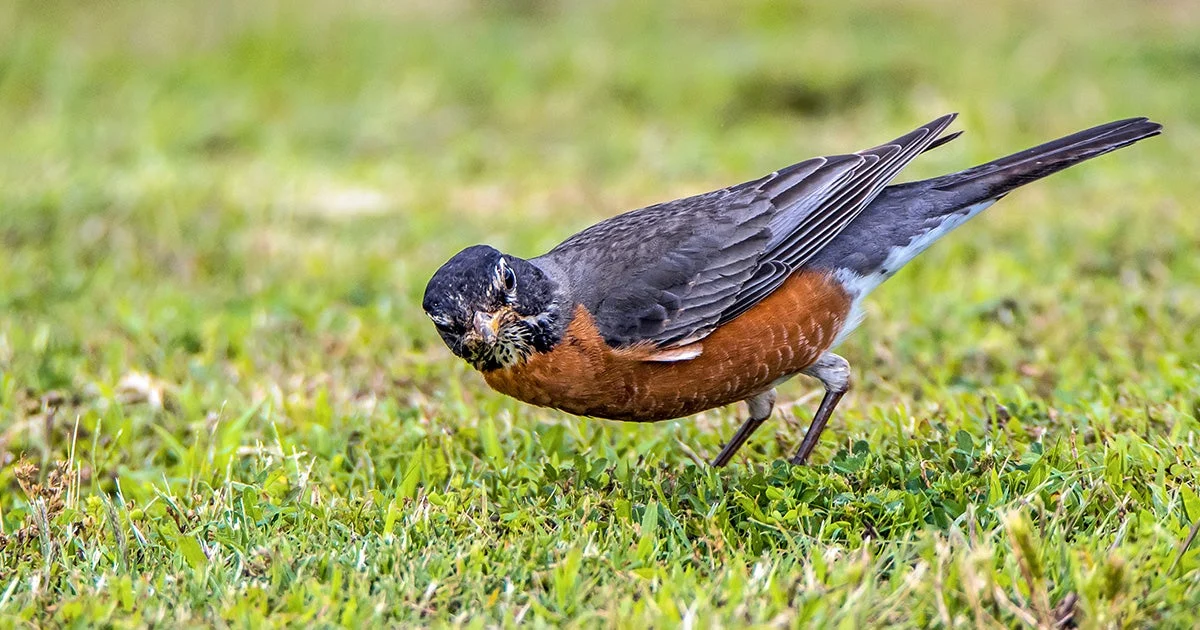
From the common American Robin to the elusive Kiwi and the stealthy owl, birds possess an astonishing array of specialized senses and behaviors that enable them to locate sustenance hidden beneath the earth’s surface. This diverse toolkit, honed over millions of years of evolution, challenges human-centric perceptions of the world and reveals a rich, multi-sensory environment that most people can barely imagine, underscoring the profound adaptability of avian species.
The Robin’s Enigma: A Scientific Debate on Subterranean Foraging
The familiar sight of an American Robin meticulously hopping across a lawn, suddenly pausing to cock its head before plunging its bill into the ground to extract a wriggling worm, has long captivated observers. For decades, the precise mechanism behind this seemingly simple act remained a subject of scientific debate, highlighting the complexities of understanding avian sensory perception. The question of how the early bird truly gets the worm, particularly when its prey resides largely out of sight underground, has driven significant ornithological inquiry.
Early scientific inquiry into the robin’s foraging strategy largely pointed towards visual cues. A seminal study published in The Condor in 1965, conducted by researchers who observed robins in various natural settings, concluded that these birds primarily relied on sight. The hypothesis was that robins peered into worm burrows, which acted as "peepholes" into the underground realm, identifying occupied tunnels before striking. This visual-centric view became widely accepted, shaping the understanding of robin behavior for nearly three decades and influencing popular depictions of the species’ foraging habits.
However, subsequent research began to challenge this singular explanation, introducing a new dimension to the robin’s sensory world. In 1995, a comprehensive study conducted by researchers at the University of Windsor in Ontario, Canada, and also published in The Condor, presented compelling evidence for the dominance of auditory cues. This study meticulously designed experiments where worms were presented to robins in conditions that eliminated visual, olfactory, and tactile stimuli. Even under these controlled constraints, the robins demonstrated significant success in locating the hidden prey. Crucially, when white noise was introduced to mask ambient sounds, the birds’ foraging success dramatically declined. This finding strongly suggested that robins were listening for the subtle vibrations or rustling sounds produced by worms as they moved underground or dragged vegetation into their burrows, rather than merely seeing them. Worms themselves, according to biologist Graham Martin, do not make sounds, but their movements and interactions with the soil and vegetation generate faint acoustic signals that are perceptible to sensitive avian ears.
Graham Martin, a retired biologist from the University of Birmingham in England and a leading authority on avian senses, underscores the difficulty humans face in comprehending such sensory experiences. "We see the world in a very particular way, which is not shared by the majority of birds," Martin explains in his book, Bird Senses. "They live in a different world to what we do." This human bias, where our dominant senses of sight and hearing often overshadow other sensory modalities, likely contributed to the initial overemphasis on visual foraging in robins.
Today, the scientific consensus leans towards a more integrated approach, suggesting that robins likely employ both sight and sound, adapting their strategy based on environmental conditions. On a bright, calm morning, visual cues might play a larger role, while in dim light or noisy conditions, auditory detection could become paramount. The distinctive head-cocking posture of a foraging robin, therefore, might not solely be an act of listening for subterranean prey, but also a strategic maneuver to position an eye for scanning the sky for aerial predators, demonstrating the multi-tasking nature of avian sensory processing. This dual interpretation highlights the sophisticated and adaptive sensory integration that characterizes avian life, far exceeding our conventional understanding.
A Symphony of Senses: Beyond Human Perception
The robin’s story is but one illustration of the extraordinary sensory capabilities that define the avian world. Birds navigate and exploit environments that would be utterly impenetrable to humans, often leveraging senses far more acute or entirely different from our own. These adaptations represent millions of years of evolutionary refinement, allowing birds to thrive in diverse ecological niches.
The Power of Sound: Owls’ Acoustic Precision
Consider the owl, a nocturnal predator renowned for its silent flight and lethal hunting prowess. Unlike humans, who would struggle to hear a vole tunneling beneath a foot of snow, owls possess an auditory system exquisitely adapted for this very task. Their facial discs, specialized arrangements of stiff feathers around their eyes, act like parabolic satellite dishes, funneling faint sound waves directly to their ears. These ears are often asymmetrical, with one ear opening positioned higher than the other. This asymmetry creates a slight time difference in how sound reaches each ear, allowing the owl to triangulate the exact location of prey with remarkable precision, even in complete darkness. Studies on barn owls (Tyto alba) have shown they can pinpoint the source of a sound with an accuracy of less than one degree, a feat unparalleled in the animal kingdom, enabling them to strike hidden prey with deadly accuracy. This bio-acoustic marvel is a prime example of how evolution has sculpted specific sensory organs to meet specialized ecological niches, making them incredibly efficient hunters in low-light conditions.
Vision Beyond Our Spectrum: The Ultraviolet World
While human vision is limited to the visible light spectrum (red to violet), many birds, including a vast majority of passerines, possess photoreceptors capable of perceiving ultraviolet (UV) light. This "fourth primary colour" opens up an entirely new dimension of visual information, making their world vibrantly more colourful and detailed than ours. For birds, UV vision is crucial for various functions:
- Foraging: Some fruits and berries reflect UV light, making them stand out against foliage. Insects often have UV patterns, making them easier prey against backgrounds that appear uniform to human eyes.
- Mating: Plumage that appears drab to human eyes can display intricate UV patterns, which are vital for species recognition and mate selection. These "secret" signals can convey information about health, fitness, and genetic quality.
- Predator Avoidance: Certain predators or their droppings might have UV signatures, providing early warnings to potential prey.
- Navigation: Polarized UV light patterns in the sky, particularly around the sun, can assist in navigation, a critical ability especially during long migratory journeys.
This expanded visual spectrum fundamentally alters how birds perceive their environment, from discerning subtle differences between individuals of the same species to locating food sources that are invisible to us.
Panoramic Views: The Wide Field of Vision
Furthermore, the placement of avian eyes often differs significantly from humans. Our forward-facing eyes provide excellent binocular vision for depth perception, but at the cost of a narrow field of view (around 180-200 degrees). Many birds, particularly prey species like sparrows, pigeons, and many shorebirds, have eyes positioned laterally on the sides of their heads. This arrangement grants them an almost panoramic field of view, sometimes exceeding 300 degrees, allowing them to detect predators approaching from almost any direction. While this reduces their binocular overlap and thus depth perception directly in front, their rapid head movements compensate, creating a "flow-through" perception of the world, as Graham Martin describes. "We see the world as in front of us, and we move constantly into the world and it disappears behind us," Martin notes. "Whereas the vast majority of birds, they flow through the world." This adaptation is a critical survival mechanism, enabling constant vigilance against threats in an unpredictable environment, optimizing their chances of detecting an approaching hawk or fox.
The Tactile Hunters: Remote Touch and Subterranean Sensors
Beyond sight and sound, a remarkable "remote touch" sense allows many birds to detect hidden prey through vibrations and pressure changes in the substrate. This specialized sense is facilitated by highly sensitive nerve endings known as Herbst corpuscles.
Herbst Corpuscles: Nature’s Bio-Sensors
These specialized mechanoreceptors are densely packed at the tips of the bills of various bird species, particularly those that probe soft substrates like mud or wet sand. Herbst corpuscles detect minute pressure fluctuations and vibrations, allowing birds to essentially "feel" movements in their immediate surroundings. When a worm, mollusk, or crustacean moves through the substrate near a bird’s bill tip, the slight displacement of water or sediment creates pressure waves that are instantly registered by these sensors. This allows for precise localization of prey without direct visual contact.
Shorebirds: Masters of the Mudflats
Shorebirds, such as sandpipers, plovers, and godwits, are quintessential examples of tactile hunters. Their long, slender bills are perfectly adapted for probing deep into mudflats and sandy beaches. As they systematically probe, their Herbst corpuscles constantly scan for the tell-tale vibrations of hidden prey. This strategy allows them to efficiently "hoover up" vast quantities of calories from seemingly barren stretches of intertidal zones, playing a crucial role in coastal ecosystems. A study published in Science in 2008, focusing on tactile foraging in sandpipers, detailed the intricate neurological pathways involved, demonstrating how these birds can create a detailed "tactile map" of their foraging grounds based on these minute pressure changes.
Intriguingly, recent research suggests that this "remote touch" capability might not be exclusive to birds. A study conducted by researchers at Queen Mary University of London in late 2023 provided evidence that human hands, too, possess a similar, albeit less developed, form of remote touch. The study found that human fingertips can detect vibrations transmitted through objects, allowing for a degree of "sensing at a distance," drawing parallels to the sophisticated mechanisms found in shorebirds. This discovery opens new avenues for understanding human sensory perception and could have implications for robotic design, prosthetics, and even haptic feedback systems.
Kiwis: The Olfactory Probers
The flightless Kiwis of New Zealand, while not shorebirds, share a superficially similar appearance with their long, slender bills. These nocturnal omnivores have evolved a unique two-pronged approach to subterranean foraging. Their bill tips are richly endowed with Herbst corpuscles, granting them excellent remote touch for detecting grubs, worms, and other invertebrates. What truly sets kiwis apart, however, is their olfactory prowess: they are the only birds in the world with nostrils located at the very tip of their bills. This anatomical marvel allows them to smell food underground, providing an additional, highly effective sensory channel for locating hidden prey in the dense forest litter where they forage. This combination of remote touch and tip-of-the-bill olfaction makes kiwis exceptionally adept at exploiting their hidden food sources, particularly in their dimly lit, forest floor environment.
American Woodcocks: Woodland Shorebirds and Their Flexible Bills
The American Woodcock, despite its preference for woodland habitats, is technically classified as a shorebird, retaining many of the specialized adaptations of its beach-dwelling relatives. Its long, probing bill is tipped with a dense concentration of Herbst corpuscles, allowing it to efficiently locate earthworms, its primary food source, in soft forest soils. A particularly remarkable adaptation of the woodcock’s bill is its flexible upper mandible. This unique articulation allows the bird to open the tip of its bill while it is still buried in the ground, effectively creating a "tongs" or "slurping" mechanism to grasp and extract worms without having to withdraw its entire bill from the soil. This efficiency is crucial for a bird that consumes its body weight in worms daily, making every second count during foraging.
The Curious Case of the Woodcock Dance: Worm Charming
Beyond sensory detection, some birds employ intriguing behavioral strategies to coax hidden prey to the surface. The American Woodcock is renowned for a peculiar, rhythmic dance involving rocking back and forth and putting weight on one foot, often referred to as "worm charming" or "foot-trembling." While its precise function has been a subject of credible speculation, the prevailing theory is that these movements generate vibrations in the soil. These vibrations are thought to mimic the sounds of rainfall, which typically prompts earthworms to surface to avoid drowning, or perhaps even approaching subterranean predators (like moles), prompting an escape response from the worms, making them easy pickings for the woodcock.
This avian "worm charming" behavior has surprising parallels in human culture. Graham Martin highlights the practice of "worm charming" or "worm fiddling" in the United Kingdom, a traditional rural sport that has even spawned the annual World Worm Charming Championships in Willaston, Cheshire, England. Since its inception in 1980, this quirky competition draws participants from across the globe, competing to lure the greatest number of worms to the surface within a designated time from a 3×3 meter plot. Participants typically use instruments like pitchforks, which they stab into the ground and then bang or vibrate with another tool. The resulting vibrations, much like those potentially generated by the woodcock’s dance, are remarkably effective at drawing worms to the surface. This intriguing convergence of avian and human behavior underscores a fundamental biological principle: vibrations can be a powerful stimulus in the subterranean world.
The Wider Avian Sensory Spectrum: Olfaction and Beyond
While less common than in kiwis, olfaction plays a significant role in the foraging strategies of other bird groups. Vultures, for instance, possess a highly developed sense of smell, allowing them to detect the faint scent of decaying carcasses from miles away, guiding them to crucial food sources. Species like the Turkey Vulture (Cathartes aura) are particularly adept, using their large olfactory bulbs to detect mercaptan gas, a byproduct of early decomposition. Procellariiformes, a group including albatrosses and petrels, also have an exceptional sense of smell, which they use to locate patchy food sources like krill and fish oil slicks on the vast open ocean, as well as to navigate back to their remote breeding colonies. Studies have shown their ability to detect dimethyl sulfide (DMS), a gas produced by phytoplankton, which indicates areas of high marine productivity and thus potential food.
Even in species where olfaction isn’t a primary foraging tool, it can contribute to other life functions, such as identifying individual birds, recognizing nest sites, or detecting predators. The ongoing research into avian senses continues to uncover new layers of complexity, challenging long-held assumptions about bird behavior and demonstrating the vast, untapped potential for scientific discovery in this field.
Implications for Conservation and Understanding Our World
The profound differences between human and avian sensory perception carry significant implications, not only for our understanding of the natural world but also for conservation efforts. As Graham Martin succinctly puts it, "Most people think the world as they see it is the way it really is." Birds, with their ability to perceive UV light, hear imperceptible sounds, or feel vibrations through the earth, offer a powerful reminder of the limitations of our own sensory apparatus.
Understanding these unique sensory worlds is critical for effective conservation. For example, anthropogenic noise pollution from human activities can interfere with the acoustic foraging strategies of birds like robins and owls, reducing their hunting success and potentially impacting population dynamics. Light pollution, particularly from urban areas, can disorient nocturnal migrants who rely on celestial cues, some of which may be perceived in the UV spectrum. Habitat degradation that alters soil composition, moisture levels, or introduces contaminants can directly impact the ability of tactile foragers like shorebirds and woodcocks to find food, disrupting crucial trophic interactions.
Furthermore, appreciating the diverse sensory experiences of birds fosters a deeper respect for biodiversity and the intricate web of life. It encourages us to look beyond our own limitations and recognize the myriad ways in which different species interact with and interpret their environment. By studying these "different worlds," we gain invaluable insights into evolutionary biology, sensory ecology, and even potential bio-inspiration for technological advancements, such as designing more effective sensors or navigation systems. The ongoing scientific endeavor to unravel these avian secrets continues to reveal that we have a vast amount to learn from our feathered neighbors, reminding us that the natural world is far richer and more complex than our human senses alone can convey.
