
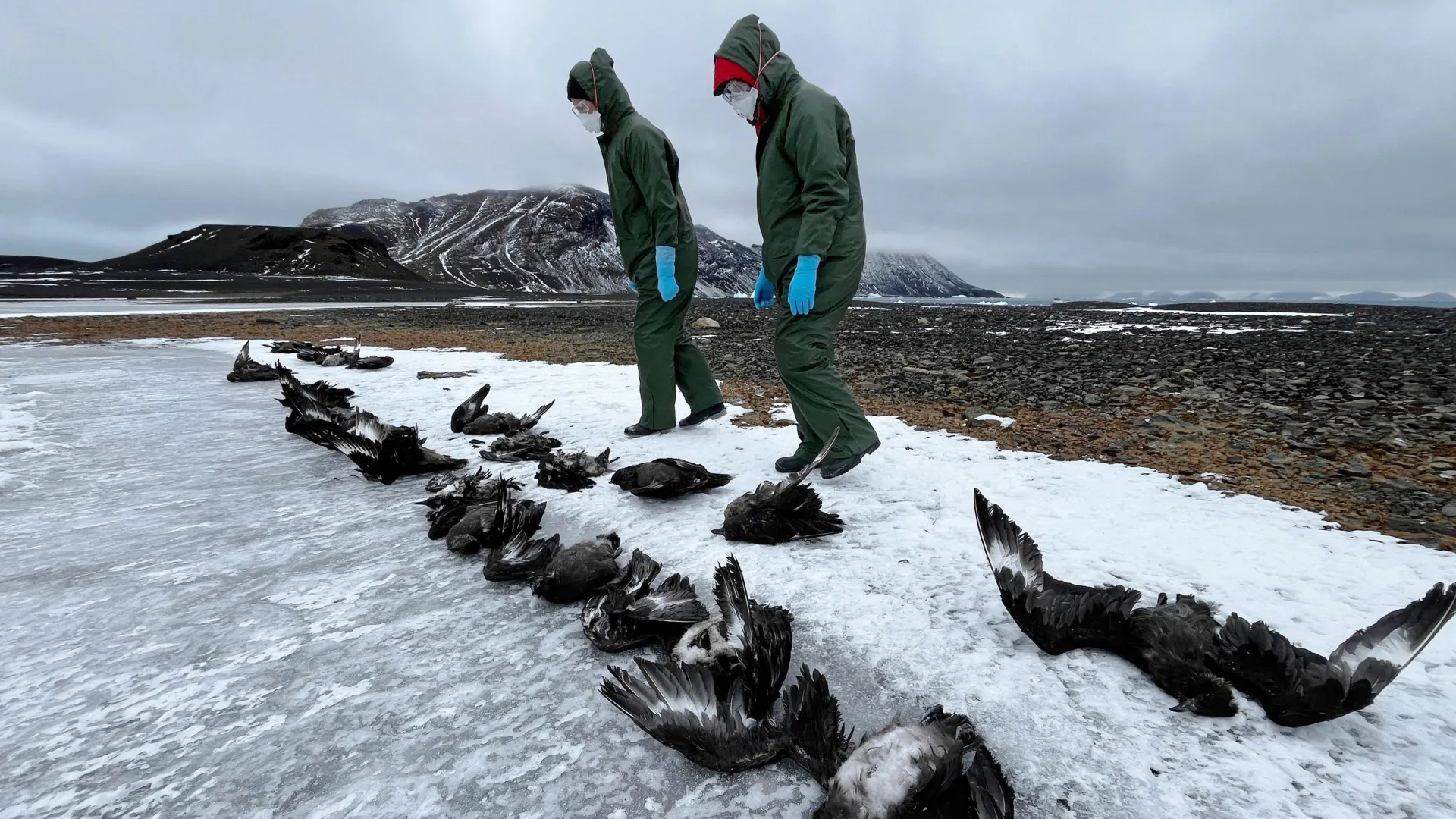
More than 50 skuas, robust seabirds integral to the Antarctic ecosystem, succumbed to the highly pathogenic avian influenza (HPAI) virus H5N1 during the austral summers of 2023 and 2024. This tragic event marks the first definitively confirmed wildlife die-off attributed to H5N1 on the pristine, isolated continent, signaling a grave new challenge for its unique biodiversity. The groundbreaking findings, which confirm the viral infection as the direct cause of death, emerged from an intensive study spearheaded by Erasmus MC in The Netherlands and the University of California, Davis, and were recently published in the esteemed scientific journal Scientific Reports.
A Stark Warning from the Southernmost Continent
The confirmation of H5N1 as the cause of a mass mortality event in Antarctic wildlife represents a critical turning point in the global spread of this virulent pathogen. For years, scientists have watched with growing apprehension as H5N1 devastated bird populations across continents, drawing ever closer to the Antarctic Convergence. The continent, often considered Earth’s last great wilderness, has until now largely escaped the direct, confirmed impact of this particular strain. The confirmed deaths of over five dozen skuas underscore that this protective barrier has been breached, introducing an unpredictable and potentially devastating new stressor to an ecosystem already grappling with the profound effects of climate change, increased tourism, and the threat of invasive species.
Skuas are large, brown seabirds, closely related to gulls, predominantly inhabiting the cold, often desolate, polar and subpolar regions. Their ecological role is multifaceted and crucial: they are formidable predators, preying on other birds and their eggs, and equally adept scavengers, vital for cleaning up carcasses across the often-harsh Antarctic landscape. This scavenging behavior, while essential for ecosystem health, is paradoxically identified by researchers as a primary factor increasing their risk of exposure to and subsequent spread of the H5N1 virus across the continent. Their wide-ranging movements and interactions with diverse species position them as potential vectors, capable of transmitting the virus over significant distances within the Antarctic region.
Tracing the Path of a Global Foe: H5N1’s Relentless March
The H5N1 strain, specifically the highly pathogenic clade 2.3.4.4b that has dominated recent outbreaks, has a notorious and destructive history. Its journey from a localized threat to a global menace is a chilling testament to the interconnectedness of global ecosystems and the consequences of intensive agricultural practices.
-
The Genesis of a Pandemic Strain: The virus was first identified in 1996 on a domestic goose farm in Southeast China. Initially, it circulated predominantly within poultry populations, causing significant economic losses and sporadic human infections. However, its high mutation rate and ability to reassort genes allowed it to adapt, eventually spilling over into wild bird populations. This spillover marked a pivotal moment, as wild birds, particularly migratory species, became unwitting carriers, facilitating the virus’s spread far beyond its initial geographic confines.
-
From Poultry Farms to Wild Bird Migrations: From its Asian origins, H5N1 embarked on a relentless global expansion. It traversed Europe, the Middle East, and Africa, causing widespread mortality events in various wild bird species and occasional outbreaks in poultry farms. The virus then crossed the Atlantic, arriving in North America in late 2021, where it rapidly established itself, leading to unprecedented die-offs in both wild birds and commercial poultry operations. The sheer scale of its impact was staggering, with hundreds of millions of poultry culled and countless wild birds succumbing to the disease.
-
South American Precedent: A Grim Warning: The virus’s arrival in South America in 2022 sounded an even louder alarm for Antarctica. The H5N1 strain caused massive mortality events among marine mammals along the coasts of Peru, Chile, Argentina, and other nations. Tens of thousands of sea lions and elephant seals perished, exhibiting severe neurological symptoms mirroring those observed in birds. This devastating precedent highlighted the virus’s capacity to jump species barriers and cause widespread death in immunologically naive populations, a critical concern for Antarctica’s largely isolated fauna. By early 2024, the presence of H5N1 in the Antarctic region was no longer a hypothetical threat but an unfolding reality.
The Antarctic Expedition: Unraveling the Mystery
Prior to the recently published study, scientists had detected H5N1 in a dead kelp gull and two skuas found in January and February 2024. While these detections confirmed the virus’s presence, they did not definitively prove it was the cause of death, leaving a critical gap in understanding the true impact. The March 2024 expedition was designed to bridge this gap.
-
On-Site Investigations and Necropsies: Shortly after the peak breeding season for skuas and penguins, a dedicated research team, comprising experts from Erasmus MC and UC Davis, embarked on a comprehensive investigation across the South Shetland Islands, the northern Weddell Sea, and the Antarctic Peninsula. This ambitious expedition visited ten distinct sites, meticulously examining wildlife. Their methodology involved the collection of tissue and environmental samples from sick or deceased animals, followed by thorough necropsies (animal autopsies) to ascertain the precise cause of death. The team investigated the remains of various species, including gentoo penguins, Adélie penguins, and Antarctic fur seals. Crucially, H5N1 was not identified as the primary cause of death in these species during this specific survey, suggesting a focused impact on skuas at the time of the expedition.
-
Confirming the Viral Culprit: "We knew there were animals with the infection, but this is the first study to show they died of the viral infection," affirmed co-senior author Ralph Vanstreels, a wildlife veterinarian affiliated with the UC Davis One Health Institute within the Weill School of Veterinary Medicine. He emphasized the critical distinction: "It’s an important distinction in the early days of an outbreak." As the expedition progressed, the pattern became unmistakably clear. "As the expedition progressed, it became obvious quickly that skuas were a major victim," Vanstreels noted. The virus was definitively detected in skuas at three key locations: Hope Bay, Devil Island, and, most significantly, Beak Island. The latter site bore witness to a substantial die-off of South Polar Skuas.
-
The Agony of Infection: Neurological Impacts: First author Matteo Iervolino, a Ph.D. candidate at Erasmus MC in Rotterdam, described the stark reality: "We diagnosed high pathogenicity avian influenza as the cause of death for nearly all of the dead skuas we found at Beak Island." He added, with palpable concern, "There, I could really see with my eyes the impact this virus can have on these populations." The clinical signs observed in infected birds painted a grim picture of suffering. Vanstreels characterized the situation as a "crisis in animal suffering." H5N1, particularly the clade 2.3.4.4b, is neurotropic, meaning it attacks the brain, leading to severe neurological symptoms. Infected skuas exhibited disturbing behaviors such as twisted necks, unusual body stretching, walking or swimming in circles, crashing into objects, and even falling out of the sky. These incapacitating symptoms not only cause immense pain but also render the birds unable to feed, navigate, or escape predators, accelerating their demise.
Broader Ecological Implications: A Looming Catastrophe?
The confirmed H5N1 die-off in skuas raises profound concerns for the broader Antarctic ecosystem. While penguins and seals were not confirmed to have died from H5N1 in this study, the possibility of future spillover events remains a critical threat. Antarctic wildlife populations are considered "immunologically naive," meaning they have had little to no prior exposure to such a virulent pathogen, making them potentially highly susceptible.
-
Vulnerable Antarctic Fauna: The continent is home to vast colonies of penguins (Adélie, Chinstrap, Gentoo, Emperor), albatrosses, petrels, and various seal species (Weddell, Crabeater, Leopard, Fur seals). Many of these species live in dense colonies, a characteristic that could facilitate rapid viral transmission. For instance, penguins, which breed in enormous numbers, could face catastrophic losses if the virus gains a foothold within their rookeries. The highly social nature of many Antarctic species, coupled with their often-limited genetic diversity, makes them particularly vulnerable to novel pathogens.
-
The Domino Effect on the Food Web: Skuas, as both predators and scavengers, occupy a vital niche in the Antarctic food web. A significant decline in their numbers could have cascading effects throughout the ecosystem. Increased numbers of unconsumed carcasses could alter nutrient cycling, and a reduction in skua predation could impact the populations of their prey species, though such complex interactions are difficult to predict. The presence of a highly pathogenic virus also introduces an additional layer of stress to populations already contending with habitat loss due to melting ice, changes in prey availability from overfishing, and the accumulation of pollutants. The cumulative impact of these stressors could push already fragile populations towards greater instability.
The Human Footprint: A Virus Unleashed
The current H5N1 crisis in Antarctica is inextricably linked to human activities, a fact highlighted by the researchers. The virus’s emergence and global spread serve as a stark reminder of the "One Health" concept, which recognizes the interconnectedness of human, animal, and environmental health.
-
From Industrial Farms to Global Pandemics: The initial containment failure within the poultry industry allowed the virus to establish itself firmly in wild bird populations. As corresponding senior author Thijs Kuiken, a professor at Erasmus MC, lamented, "We let the virus slip out through our fingers when it first emerged in the poultry industry." He continued, "Once it got into wild bird populations, we lost ability to control this virus. Now it’s established in wild bird populations in all the continental regions of the world except Oceania." This unchecked circulation in wild birds has created a permanent reservoir for the virus, making eradication virtually impossible and ensuring its continued threat to diverse species globally.
-
Human Health at Risk: While the primary focus is on wildlife, the zoonotic potential of H5N1 remains a significant public health concern. Of the approximately 1,000 reported human cases globally, roughly half have been fatal, underscoring the virus’s severe pathogenicity in humans. Although direct human-to-human transmission has been rare and inefficient, the widespread circulation of H5N1 in wild birds and its increasing ability to infect mammals raise the specter of viral evolution that could lead to a strain more transmissible to humans, potentially triggering a new pandemic. The infection of dairy cows, mink, foxes, bears, otters, and various other mammals underscores the virus’s adaptability and the broad host range it has acquired. This persistent threat necessitates robust surveillance not only in wildlife but also at the human-animal interface, particularly in regions where people interact closely with poultry or potentially infected wild animals.
An Urgent Call for Vigilance: Safeguarding Antarctica’s Future
The arrival and confirmed impact of H5N1 in Antarctica add another layer of complexity to the continent’s already formidable conservation challenges. The study issues an urgent call for intensified surveillance and monitoring efforts to track the virus’s trajectory and mitigate its potential spread.
-
The Challenge of Outdated Data: A significant hurdle in assessing the true impact of this die-off is the scarcity of contemporary population data for Antarctic skuas. The last comprehensive census of these birds dates back to the 1980s, when researchers estimated approximately 800 breeding pairs. Without updated numbers, it is exceedingly difficult to accurately gauge the demographic significance of 50 or more skua deaths, or to predict the long-term viability of their populations. This data deficit highlights a broader need for continuous, robust ecological monitoring across the continent.
-
Strengthening Biosecurity and International Collaboration: The unique environment of Antarctica is governed by the Antarctic Treaty System, which mandates environmental protection. Organizations like the International Association of Antarctica Tour Operators (IAATO) already implement stringent biosecurity protocols for visitors to prevent the introduction of invasive species. The H5N1 threat necessitates an immediate re-evaluation and potential enhancement of these protocols, focusing on preventing human-mediated transmission of the virus, even inadvertently. This includes meticulous cleaning of gear, strict waste management, and protocols for approaching wildlife.
The funding for the HPAI Australis Expedition, provided by IAATO and Ocean Expeditions, alongside support from the European Union, Consejo Superior de Investigaciones Científicas (CSIC), and PTI Global Health, underscores a collective recognition of the gravity of the situation. However, sustained, long-term international collaboration is crucial. This involves sharing scientific data, coordinating research efforts, and developing harmonized response strategies among all nations involved in Antarctic research and tourism. "Everything points toward this virus spreading further," Kuiken warned. "If nobody is watching, we won’t know what is happening." The confirmed H5N1 die-off in Antarctica serves as a stark, unequivocal signal that the world’s southernmost wilderness is no longer immune to global pandemics, demanding an immediate and coordinated global response to safeguard its irreplaceable wildlife.
