
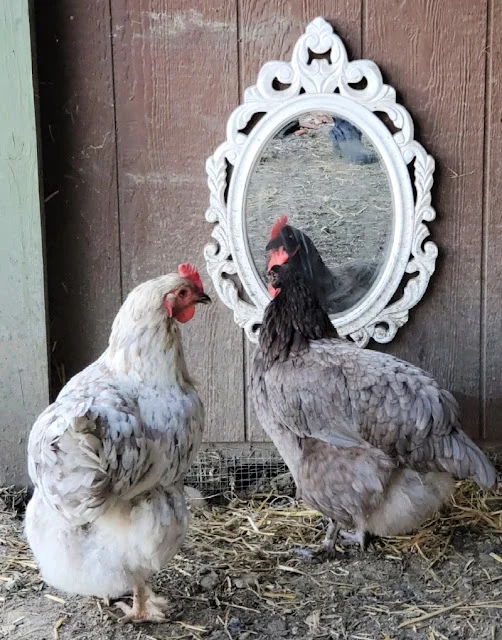
Recent scientific inquiries into the cognitive capabilities of Gallus gallus domesticus, the common domestic chicken, have yielded groundbreaking evidence suggesting that these birds possess a level of self-awareness previously thought to be reserved for only a handful of highly intelligent species. By adapting the traditional "mirror test" to account for the specific social behaviors of poultry, researchers have observed roosters demonstrating the ability to distinguish their own reflections from other members of their species. This discovery challenges long-standing assumptions regarding avian intelligence and adds to a growing body of evidence that the "bird brain" is far more sophisticated than historically acknowledged in both popular culture and traditional biological frameworks.

The Evolution of the Mirror Self-Recognition Test
To understand the significance of recent findings involving chickens, it is necessary to examine the history of the Mirror Self-Recognition (MSR) test. Developed in 1970 by psychologist Gordon Gallup Jr., the MSR test has served as the gold standard for determining whether an animal possesses self-awareness. In the classic version of this experiment, an odorless dye or sticker is placed on a part of the animal’s body that it cannot see without the aid of a mirror. If the animal looks in the mirror and attempts to touch or remove the mark on its own body, it is interpreted as a sign that the animal understands the reflection is a representation of itself.
For decades, only a select group of animals passed this test, including chimpanzees, orangutans, bottlenose dolphins, Eurasian magpies, and Asian elephants. Human children typically do not pass the test until they reach approximately 18 months of age. However, the MSR test has faced criticism for being biased toward species that rely heavily on vision and possess the dexterity—such as hands or trunks—to touch a mark. Species that rely on olfaction (smell), such as dogs and cats, or those that lack the physical means to investigate a mark, often "fail" the test despite showing other signs of complex cognition.

Redefining the Parameters for Avian Subjects
The recent breakthrough regarding chicken self-recognition stems from a 2023 study published in the journal PLOS ONE, conducted by researchers at the University of Bonn and Ruhr University Bochum in Germany. Recognizing that chickens might not respond to the traditional "mark test"—perhaps due to a lack of interest in the mark or a different social priority—the research team, led by Sonja Hillemacher and Inga Tiemann, designed an experiment based on the natural communication behaviors of roosters.
Roosters are known to utilize specific vocalizations to protect their flock. When a rooster perceives a threat from a predator, such as a hawk or a fox, it emits a distinct alarm call to warn other chickens. Crucially, this behavior is social; a rooster will almost always sound the alarm if other chickens are present, but it will remain silent if it believes it is alone, as calling out would unnecessarily attract the predator’s attention to itself. This "audience effect" provided the perfect framework for testing whether a rooster perceives its reflection as another bird or as itself.

Chronology of the Rooster Mirror Experiment
The research team conducted a series of controlled trials involving 58 roosters to observe their reactions to various visual stimuli. The experiment was structured in several distinct phases to isolate the variables of social presence and self-recognition.
In the first phase, a rooster was placed in a divided compartment. On the other side of a transparent mesh, another rooster was visible. When a silhouette of a hawk was projected onto the ceiling, the test rooster emitted frequent alarm calls, fulfilling its role as a protector for the visible companion.

In the second phase, the companion rooster was removed, and the mesh was replaced with a mirror. When the hawk silhouette was again projected, the test rooster remained largely silent. Despite seeing a "chicken" in the mirror, the subject did not react as if another bird were present. Researchers concluded that the rooster did not perceive the reflection as a social "audience," but rather recognized it as itself—or at least as an entity that did not require a warning.
To ensure that the silence in front of the mirror wasn’t simply due to stress or confusion, a third phase was conducted. A mirror was placed in the compartment, but a second rooster was placed behind it, hidden from view but detectable through smell or sound. In this scenario, the test rooster still remained silent when the hawk appeared. This indicated that for a rooster to sound an alarm, the "audience" must be visually perceived as a distinct, separate individual.

Supporting Data and Statistical Observations
The data collected during these trials showed a stark contrast in behavior. In the presence of a live, visible companion, the roosters emitted an average of 1.33 alarm calls during the hawk’s appearance. In contrast, when alone or in front of a mirror, the number of alarm calls dropped to near zero (0.01 per trial).
These findings are particularly significant when compared to previous attempts to use the classic mark test on chickens. In earlier studies, researchers placed red or yellow marks under the beaks of chickens. The birds largely ignored the marks in the mirror, leading many to conclude they lacked self-awareness. The 2023 study suggests that the "failure" was not a lack of cognition, but a lack of ecological relevance. A chicken may not care about a spot on its feathers, but it cares deeply about the social implications of a predator’s presence.

The study also highlighted the reliance of chickens on visual cues. Despite having a keen sense of hearing, the roosters in the study did not sound alarms based on the proximity of a hidden bird they could hear but not see. This reinforces the idea that their social world is primarily visual, making the mirror a particularly potent tool for testing their self-perception.
Expert Reactions and Scientific Analysis
The implications of this research have resonated throughout the scientific community. Dr. Onur Güntürkün, a co-author of the study and a prominent biopsychologist, noted that the results suggest self-recognition is more widespread in the animal kingdom than previously believed. The study challenges the "taxonomic hierarchy" that places mammals and certain large-brained birds like crows and parrots at the top of the intelligence scale while dismissing common poultry.

"This shows that we must adapt our tests to the natural behavior of the species we are studying," Güntürkün stated in a response to the findings. "If an animal does not pass the mark test, it does not necessarily mean it lacks self-awareness. It may simply mean the test is not meaningful to that animal’s life."
Other ethologists have pointed out that chickens have long demonstrated complex social structures, known as "pecking orders," which require the ability to recognize and remember dozens of individual flock members. The ability to recognize oneself is a logical extension of the ability to recognize others.

Broader Impact and Ethical Implications
The discovery that chickens likely possess self-awareness has significant implications for animal welfare and the agricultural industry. Worldwide, billions of chickens are raised for meat and eggs, often in intensive confinement systems. If these birds are proven to have a level of consciousness that includes self-identity, the ethical arguments for providing them with environmental enrichment and more humane living conditions become significantly stronger.
For backyard poultry keepers and hobbyists, this research validates long-standing anecdotal observations. Many keepers have reported that chickens enjoy looking in mirrors, often using them as a tool for preening or as a source of comfort. In the context of "boredom busters," mirrors are frequently added to coops to provide mental stimulation. Understanding that the birds may be "checking themselves out" rather than simply looking at a stranger changes the way owners interact with and provide for their flocks.

Furthermore, the study opens the door for similar research into other domestic species. If chickens—often considered the "baseline" for avian intelligence—pass a modified mirror test, it stands to reason that ducks, turkeys, and geese may also possess similar levels of self-perception. Currently, ducks are often given mirrors to reduce loneliness, under the assumption they believe the reflection is a companion. However, based on the rooster studies, this assumption may need to be reevaluated.
Conclusion: A Shift in Avian Perspective
The narrative of the "simple-minded" chicken is rapidly being replaced by a more complex understanding of avian neurobiology. The success of the modified mirror test demonstrates that intelligence is not a linear scale, but a diverse set of adaptations tailored to an organism’s environment and social needs.

As researchers continue to explore the boundaries of animal cognition, the domestic chicken serves as a reminder that even the most common animals can surprise us with their depth. The silence of a rooster in front of a mirror is not a sign of a lack of thought, but rather a sophisticated internal calculation—a realization that the "other" bird in the glass is merely a reflection of the self. This shift in perspective ensures that the study of animal consciousness will continue to evolve, moving away from human-centric benchmarks toward a more inclusive understanding of the sentient world.
