
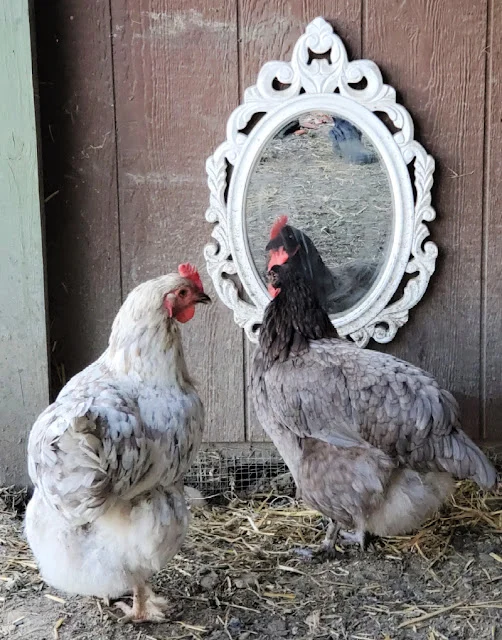
The long-standing scientific assumption that self-awareness is a trait reserved for a select group of highly intelligent mammals is being challenged by new research into the cognitive abilities of domestic poultry. For decades, the "mirror test" has served as the gold standard for determining whether an animal possesses a sense of self. While primates, dolphins, and elephants have historically passed this test, chickens were long dismissed as lacking the necessary neurological complexity for self-recognition. However, a series of innovative studies, including recent findings published in the journal PLOS ONE, suggests that roosters may indeed recognize their own reflections, utilizing a specialized "social alarm" mechanism that bypasses the limitations of traditional testing methods.

The Evolution of Mirror Self-Recognition Testing
The concept of Mirror Self-Recognition (MSR) was first pioneered by psychologist Gordon Gallup Jr. in 1970. The traditional "mark test" involves placing a colored dye or sticker on a part of the animal’s body that it cannot see without the aid of a mirror. If the animal investigates the mark on its own body after seeing its reflection, it is deemed to possess self-awareness—the understanding that the image in the mirror is "me" rather than another individual.
While great apes, such as chimpanzees and orangutans, passed the test with ease, other species struggled. Human children typically do not pass the mirror test until approximately 18 months of age. For many years, dogs and cats were categorized as failing the test, though modern researchers argue this is due to a "sensory bias." Dogs, for instance, rely primarily on olfactory (smell) cues rather than visual ones to identify themselves and others. Consequently, a visual-only test may not accurately measure a canine’s self-concept.

Chickens, however, are highly visual creatures. Despite this, they consistently failed the traditional mark test. Scientists observed that chickens would often peck at the mirror or ignore the mark entirely. This led to a reevaluation of the testing criteria: perhaps the failure was not due to a lack of intelligence, but rather a lack of interest in the "mark" itself. Unlike primates, chickens do not have hands to touch a mark, and they may not find a small spot of dye relevant to their survival or social standing.
Methodology: The Social Alarm Signal Study
To address these limitations, researchers Sonja Hillemacher, Inga Tiemann, and Onur Güntürkün developed a more ecologically relevant experiment for roosters. Their study shifted the focus from a physical mark to a natural behavioral instinct: the alarm call.

In the wild and in domestic settings, roosters serve as the guardians of the flock. When a rooster spots an aerial predator, such as a hawk, it emits a specific vocalization to warn other chickens to take cover. Crucially, roosters are strategic with these calls. If a rooster is alone, it typically remains silent when a predator appears, as sounding an alarm would only draw the predator’s attention to itself without benefiting any kin or mates. The alarm call is a social signal intended for an audience.
The researchers utilized this "audience effect" to test self-recognition. The experiment involved 58 roosters and a controlled environment featuring a mirror and a silhouette of a hawk projected onto the ceiling. The study followed a strict chronological sequence of scenarios:

- The Control (Alone): The rooster was placed in a compartment by himself. When the hawk silhouette passed overhead, the rooster remained largely silent, confirming that they do not warn themselves of danger.
- The Audience (Peer Present): A second rooster was placed in an adjacent compartment, visible through a clear glass pane. When the hawk appeared, the test rooster emitted significantly more alarm calls, fulfilling its social role of warning a peer.
- The Mirror Test: The clear glass was replaced with a mirror. If the rooster perceived the reflection as another bird, he should have sounded the alarm. However, the results showed that the roosters remained silent, just as they did when they were alone.
The statistical data from the study revealed that roosters emitted an average of 1.33 alarm calls when a visible peer was present, but this dropped to nearly zero when only a mirror was present. This suggests that the roosters did not interpret the reflection as a rival or a flock mate, but rather as themselves, or at least as an entity that did not require a warning.
Chronology of Avian Cognitive Research
The path to proving avian self-awareness has been decades in the making. The shift in scientific perspective can be traced through several key milestones:

- 1950s–1960s: The term "bird brain" was popularized as a derogatory descriptor for low intelligence, based on the fact that birds lack a layered cerebral cortex found in mammals.
- 2004: Research into crows and ravens demonstrated that corvids possess tool-making abilities and can solve multi-step puzzles, rivaling the problem-solving skills of great apes.
- 2008: The first evidence of a non-mammal passing the mirror test was recorded in magpies. Researchers used the mark test, and the magpies successfully used the mirror to investigate a sticker placed on their throats.
- 2017–2019: Studies into the "pecking order" and social recognition showed that chickens can recognize up to 100 individual faces of their own species and remember positive or negative interactions with them.
- 2023: The PLOS ONE study provided a new framework for testing MSR in species that do not respond to the traditional mark test, placing chickens in the spotlight of cognitive ethology.
Supporting Data and Sensory Analysis
The ability of chickens to pass a modified mirror test is supported by their complex sensory biology. Chickens possess highly developed eyesight, with the ability to see a broader range of colors than humans, including ultraviolet light. Their eyes are located on the sides of their heads, providing a nearly 300-degree field of vision.
While their sense of smell is functional, it is not their primary mode of navigation or social identification. This makes them ideal candidates for visual-based cognitive testing. Furthermore, chickens possess a sophisticated communication system consisting of at least 30 distinct vocalizations. These range from "food calls" that alert others to a high-value snack to specific alarms for ground versus aerial predators. The fact that a rooster can discern when to use these calls based on the presence of a reflection indicates a level of "perspective-taking" previously thought impossible for poultry.

Broader Implications for Animal Welfare and Industry
The confirmation of self-awareness in chickens has significant implications for both the agricultural industry and domestic poultry keeping. If chickens are self-aware, the ethical considerations regarding their housing and treatment become more urgent.
Behavioral Enrichment
The use of mirrors in chicken coops has been a common practice among backyard enthusiasts for years. Mirrors are often marketed as "boredom busters" to prevent feather picking and other stress-induced behaviors. The scientific validation of mirror recognition suggests that these mirrors are not merely providing the illusion of company, but are engaging the birds’ cognitive faculties. For a solitary bird, a mirror might provide a sense of social security; for a flock, it may serve as a source of mental stimulation.

Industrial Standards
In commercial poultry farming, birds are often kept in high-density environments with minimal stimulation. The discovery that chickens possess a sense of self and the ability to recognize individuals could lead to new welfare regulations. If birds can experience boredom and possess a "self-concept," the lack of environmental complexity in factory farms could be viewed as a form of psychological distress.
Scientific Skepticism and Future Research
Despite the compelling results of the rooster alarm-call study, some members of the scientific community remain cautious. Critics argue that the silence of the roosters in front of the mirror might not definitively prove "self-awareness." It is possible, they suggest, that the roosters were simply confused by the reflection or that the mirror image lacked certain "telltale" signs of a real bird, such as a specific scent or subtle movement patterns that a mirror cannot perfectly replicate.

However, the researchers involved in the study maintain that the "audience effect" is a robust measure. By failing to warn the reflection, the rooster demonstrates a distinction between "self" and "other" that is the very definition of the mirror test’s intent.
Conclusion: Redefining the "Bird Brain"
The research into chicken self-recognition is part of a broader movement to bridge the gap between human and animal intelligence. As testing methods become more sophisticated and tailored to the specific behaviors of different species, the list of "self-aware" animals is likely to grow.

For the domestic chicken, often seen as a mere commodity in the global food chain, these findings offer a new level of respect. They are not simply driven by instinct, but are capable of complex social calculations and a degree of self-reflection. Whether it is a hen preening her feathers in a coop mirror or a rooster strategically choosing when to sound the alarm, the evidence points toward a mind that is far more "aware" than previously imagined. The "bird brain" is no longer a symbol of simplicity, but a testament to the diverse and intricate ways that life on Earth perceives itself.
