
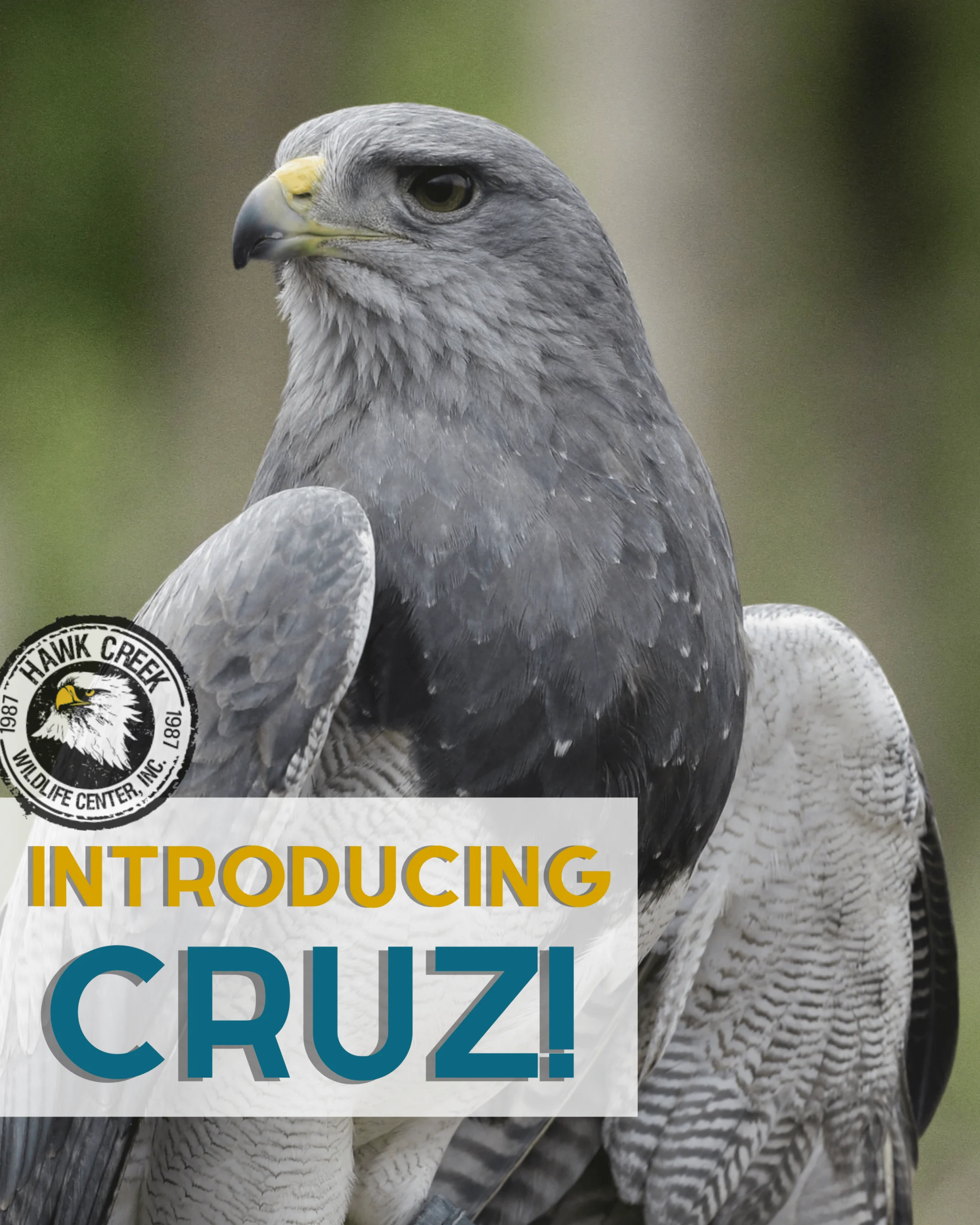
Hawk Creek Nature Center has unveiled its latest ambassador, a magnificent Black-chested Buzzard-eagle, affectionately named Cruz. This striking raptor, known across its native South American range by a variety of names including the Chilean Blue Eagle, Patagonian Eagle, or Gray Buzzard Eagle, represents a significant addition to Hawk Creek’s educational outreach programs. The introduction of Cruz underscores the nature center’s commitment to showcasing and educating the public about avian species that are rarely encountered within the United States, thereby fostering a deeper appreciation for global biodiversity and conservation efforts.
The Black-chested Buzzard-eagle (scientific name: Geranoaetus melanoleucus) is a large bird of prey native to the open, elevated regions of South America, inhabiting diverse environments from the Andes Mountains to the Patagonian steppes. These impressive raptors are characterized by their broad wingspan, powerful build, and distinctive dark plumage on their chest, contrasting with lighter undersides. Their hunting strategy involves soaring high in the sky, utilizing keen eyesight to spot prey on the ground. Their diet primarily consists of small to medium-sized mammals, such as degus, viscachas, and cavies, as well as reptiles and, in some areas, introduced species like the European hare, which can have significant ecological impacts.
The acquisition of Cruz was facilitated through a vital partnership between Hawk Creek Nature Center and leading eagle conservationists at Sia in Oklahoma. This collaboration is instrumental in expanding Hawk Creek’s capacity to educate the public about eagles and their conservation needs. Through this alliance, Hawk Creek actively supports a range of global eagle conservation initiatives and gains access to species that offer unique educational opportunities, bridging the geographical gap for local communities. Previously, this partnership has enabled the introduction of other remarkable raptors to Hawk Creek, including Jara, a Short-toed Snake Eagle (Circaetus gallicus), and Onyx, a Verreaux’s Eagle (Aquila verreauxii). These introductions have provided invaluable chances for visitors to learn about the specialized adaptations and ecological roles of these extraordinary birds.
A Deeper Look at the Black-chested Buzzard-eagle
The Black-chested Buzzard-eagle is a formidable predator, playing a crucial role in maintaining ecological balance within its native habitats. Its hunting prowess is a testament to its evolutionary adaptations. With a wingspan that can reach up to 2 meters (approximately 6.5 feet), these eagles are capable of covering vast distances in search of food. Their powerful talons and sharp beaks are well-suited for capturing and subduing prey. The species’ preference for open, elevated areas means they are often observed soaring on thermals, allowing them to survey large territories efficiently.
The ecological significance of Geranoaetus melanoleucus extends to its role in controlling populations of its prey. In areas where invasive species, such as the European hare, have been introduced, the Black-chested Buzzard-eagle can act as a natural biocontrol agent, helping to mitigate the negative impacts these non-native animals can have on local flora and fauna. The presence of such apex predators is often an indicator of a healthy ecosystem.
The Strategic Partnership with Sia and the Comanche Ethno-Ornithological Initiative
The ongoing collaboration between Hawk Creek Nature Center and Sia in Oklahoma is foundational to the successful introduction of rare avian species and the advancement of conservation education. Sia, recognized for its commitment to eagle conservation, operates under the broader umbrella of the Comanche Ethno-Ornithological Initiative, highlighting a deep respect for indigenous knowledge and traditional ecological practices in understanding and protecting birds of prey.
William "Two-Raven" Voelker, a globally recognized eagle conservationist and a key figure at Sia, is at the forefront of these efforts. His expertise, often shared under his Comanche name, Waha Thuweeka, bridges scientific research with cultural understanding. Voelker’s involvement signifies a holistic approach to conservation, recognizing the intrinsic value of birds of prey not only for their ecological functions but also for their cultural and spiritual significance.
This partnership is not merely about species display; it is about fostering a comprehensive understanding of the challenges faced by eagles worldwide. These challenges include habitat loss due to agricultural expansion and urbanization, pesticide contamination affecting prey populations, and direct persecution. By bringing species like Cruz to Hawk Creek, the aim is to translate these global issues into tangible, relatable experiences for the public.
An Upcoming Educational Event: Wild Earth
The introduction of Cruz coincides with an important educational event hosted by Hawk Creek Nature Center. On May 13th, the center will host its "Wild Earth" event, an occasion designed to immerse the community in the natural world and deepen their understanding of conservation. A highlight of this event will be the presence of William "Two-Raven" Voelker.
Voelker is scheduled to deliver a presentation that will delve into the intricacies of eagle conservation. Attendees can anticipate a comprehensive discussion covering the current state of eagle populations globally, the specific threats they face, and the innovative strategies being employed to protect them. His talk will undoubtedly draw upon his extensive experience and the work of Sia, offering insights into both the biological and cultural dimensions of raptor conservation. This event provides a unique opportunity for the public to engage directly with an expert in the field, ask questions, and gain a firsthand perspective on the critical work being done to safeguard these majestic birds.
The "Wild Earth" event serves as a platform to educate and inspire action. By providing access to species like Cruz and experts like Voelker, Hawk Creek aims to cultivate a generation of informed and engaged environmental stewards. The event’s focus on conservation underscores the interconnectedness of all living things and the responsibility humans have in preserving the planet’s biodiversity.
Supporting Data: Global Raptor Population Trends and Threats
Globally, many eagle species are facing significant population declines, leading to their classification as vulnerable or endangered by organizations such as the International Union for Conservation of Nature (IUCN). For instance, the Philippine Eagle (Pithecophaga jefferyi), one of the largest and most powerful eagles, is critically endangered, with an estimated population of only a few hundred breeding pairs remaining, primarily due to deforestation and hunting. The Bald Eagle (Haliaeetus leucocephalus) in the United States, while having made a remarkable recovery thanks to conservation efforts like the ban on DDT, serves as a powerful example of how dedicated action can reverse negative trends.
The threats impacting raptors are multifaceted and often interconnected:
- Habitat Loss and Degradation: As human populations grow and land use intensifies for agriculture, logging, and urban development, natural habitats essential for hunting, nesting, and roosting are fragmented or destroyed. For the Black-chested Buzzard-eagle, this translates to a reduction in the open, elevated areas they require.
- Pollution: Pesticides, particularly organochlorines like DDT, have historically devastated raptor populations by causing eggshell thinning and reproductive failure. While many of these chemicals have been banned in developed countries, they persist in the environment and are still used in some regions. Heavy metals and other industrial pollutants also pose risks.
- Direct Persecution: In many parts of the world, eagles are still hunted or killed by individuals who perceive them as threats to livestock or game birds, or due to unfounded superstitions.
- Climate Change: Shifting weather patterns can alter prey availability and breeding cycles, further stressing already vulnerable populations.
- Electrocution and Collisions: Power lines and wind turbines pose significant risks, leading to direct mortality through electrocution or collisions.
Understanding these threats is crucial for developing effective conservation strategies. The work of Sia, in partnership with institutions like Hawk Creek, is vital in raising awareness and implementing practical conservation measures.
Chronology of Partnership and Introduction
The journey leading to Cruz‘s arrival at Hawk Creek Nature Center represents a structured approach to species introduction and conservation education. While specific dates for the initiation of the partnership with Sia are not publicly detailed in the provided text, the establishment of such collaborations typically involves extensive planning, logistical arrangements, and the fulfillment of stringent animal welfare and regulatory requirements.
- Partnership Formation: The alliance between Hawk Creek Nature Center and Sia in Oklahoma was likely established after a period of mutual recognition of shared conservation goals and educational objectives. This would have involved discussions on species availability, husbandry requirements, and collaborative program development.
- Selection and Acclimation: The specific selection of Cruz, Jara, and Onyx would have been based on their suitability for educational display, their conservation status, and the ability of Hawk Creek to provide appropriate care and habitat. The process of transferring these birds from their native or partner locations to Hawk Creek would have been carefully managed to minimize stress. Acclimation periods in secure enclosures are standard practice to allow the birds to adjust to their new environment, diet, and routine before being introduced to public view.
- Public Introduction: The formal introduction of Cruz to the community, as announced, marks the culmination of these preparatory stages. This unveiling serves as the catalyst for educational programming.
- Upcoming Educational Event: The scheduling of the "Wild Earth" event on May 13th, featuring William "Two-Raven" Voelker, is strategically timed to coincide with the public’s heightened interest following the introduction of Cruz and the other ambassador eagles. This event aims to capitalize on the momentum, offering a deeper dive into the conservation aspects.
This structured approach ensures that the introduction of these magnificent raptors is not only an exciting event for the public but also a meaningful contribution to conservation awareness and education.
Broader Impact and Implications
The presence of Cruz and other exotic raptors at Hawk Creek Nature Center has several significant implications for the community and for broader conservation efforts:
- Enhanced Public Awareness and Engagement: By offering close-up views and educational programs centered around species rarely seen in the U.S., Hawk Creek directly confronts the common perception that conservation issues are distant or abstract. Seeing Cruz firsthand can ignite a passion for wildlife and inspire visitors to learn more about the natural world and its challenges.
- Promoting Global Conservation Ethos: The partnership with Sia emphasizes that conservation is a global endeavor. By showcasing birds from South America and featuring experts like Voelker, Hawk Creek broadens the scope of environmental concern beyond local issues, fostering a sense of shared responsibility for the planet’s biodiversity.
- Educational Value of Understudied Species: The Black-chested Buzzard-eagle, despite its striking appearance and ecological importance, remains relatively understudied compared to more globally recognized raptors. Educational initiatives like this can draw attention to lesser-known species, highlighting the need for continued research and conservation efforts for all avian species, not just those already on the brink of extinction.
- Supporting Conservation Research and Action: The financial and programmatic support Hawk Creek provides to global eagle conservation programs, facilitated by its partnerships, directly contributes to tangible conservation outcomes. This can include funding research, habitat restoration, anti-poaching initiatives, and community engagement projects in the birds’ native ranges.
- Inspiring Future Conservationists: For young visitors, encountering a bird like Cruz can be a formative experience, potentially sparking an interest in ornithology, wildlife biology, or conservation careers. The "Wild Earth" event, with its focus on an expert speaker, further reinforces the idea that dedicated individuals can make a significant difference in protecting wildlife.
The introduction of Cruz at Hawk Creek Nature Center is more than just adding a new resident; it is a strategic move to deepen public understanding, foster global conservation awareness, and inspire a commitment to protecting the planet’s invaluable avian heritage. The ongoing collaboration with Sia and the educational opportunities presented by events like "Wild Earth" are crucial in translating this commitment into impactful action.
