
In 1982, the world was introduced to Gary Larson’s iconic Far Side comic, "Cow Tools," a whimsical illustration depicting a cow standing proudly beside an enigmatic collection of crude, seemingly useless objects labeled as "tools." The humor resonated deeply because it tapped into a universally accepted, if unexamined, premise: cows, with their placid demeanor and perceived lack of sophistication, were simply not intelligent enough to conceive of, let alone create or utilize, tools. This enduring stereotype, embedded in popular culture for over four decades, is now being fundamentally challenged by a remarkable scientific discovery involving a real cow named Veronika, whose actions are prompting a profound reevaluation of bovine cognitive capabilities.
A groundbreaking study recently published in the esteemed journal Current Biology presents the first documented instance of flexible, multi-purpose tool use in a domestic cow, shattering long-held assumptions about livestock intelligence. This discovery suggests that the perceived cognitive limitations of cattle may, in fact, be more a reflection of our observational blind spots and the constraints of their typical environments rather than an inherent lack of mental aptitude.
The Genesis of a Scientific Revelation: Veronika’s Unique Journey
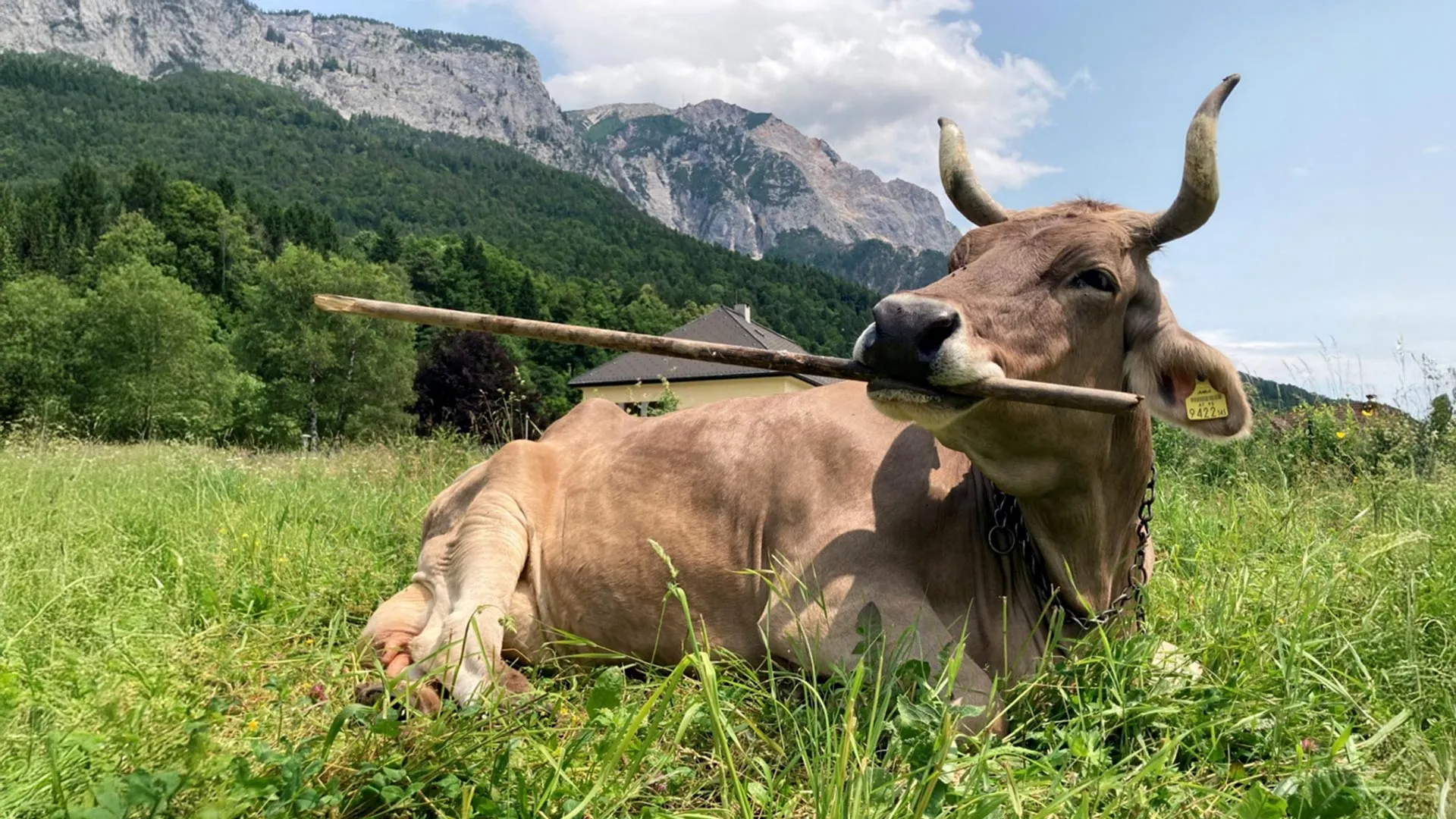
At the heart of this paradigm-shifting research is Veronika, a Swiss Brown cow who enjoys an extraordinarily unconventional life. Unlike the vast majority of her species destined for food production, Veronika lives as a cherished companion animal on the organic farm of Witgar Wiegele, a baker and farmer who considers her an integral part of his family. This unique living situation, characterized by prolonged human interaction and a stimulating environment, is believed to have been a crucial factor in the development of her extraordinary behavior.
More than a decade ago, Wiegele first began to notice an unusual pattern in Veronika’s daily routine. She would deliberately pick up sticks or other objects found in her pasture and meticulously use them to scratch various parts of her body. Initially, these observations might have been dismissed as mere happenstance or an animal simply rubbing against an object. However, Wiegele, intimately familiar with Veronika’s habits, recognized the intentionality behind her actions. This behavior persisted and evolved, eventually catching the attention of researchers when video footage of Veronika’s self-grooming ritual was shared with the scientific community.
Alice Auersperg, a distinguished cognitive biologist at the University of Veterinary Medicine, Vienna, was among the first scientists to review the footage. Her immediate reaction underscored the significance of Wiegele’s observations. "When I saw the footage, it was immediately clear that this was not accidental," Auersperg stated, emphasizing the deliberate and purposeful nature of Veronika’s actions. "This was a meaningful example of tool use in a species that is rarely considered from a cognitive perspective, much less studied for such complex behaviors." This initial assessment marked the pivotal transition from anecdotal observation to rigorous scientific inquiry, setting the stage for a series of structured experiments designed to validate and understand Veronika’s capabilities.
Rigorous Validation: Unpacking Flexible Tool Use
To move beyond anecdotal evidence and scientifically confirm Veronika’s tool-using abilities, the research team, led by Auersperg and Antonio Osuna-Mascaró, devised a series of controlled experiments. Their objective was to ascertain whether Veronika’s actions met the stringent scientific criteria for tool use and, crucially, if her use of objects demonstrated flexibility and adaptability—hallmarks of higher-order cognition.
The primary object chosen for these tests was a standard deck brush, a familiar item in farm environments, which was strategically placed in various positions on the ground. Over multiple trials, researchers meticulously observed Veronika’s interactions, documenting her choices and techniques. The results were compelling and remarkably consistent. Veronika did not simply rub against the brush indiscriminately; instead, she exhibited a clear and deliberate selection process, choosing specific parts of the brush based on her immediate scratching needs and the particular body region she intended to address. Her selections were far from random, indicating a nuanced understanding of the tool’s properties and its application.
"We show that a cow can engage in genuinely flexible tool use," explained Osuna-Mascaró, highlighting the study’s most profound revelation. "Veronika is not just using an object to scratch herself. She uses different parts of the same tool for different purposes, and she applies different techniques depending on the function of the tool and the body region." This observation is critical because it elevates Veronika’s behavior beyond simple object manipulation to a more complex form of tool use, demonstrating a sophisticated level of cognitive processing.
Multi-Purpose Application: A Hallmark of Advanced Cognition
The researchers’ detailed analysis revealed distinct patterns in Veronika’s use of the brush, showcasing a sophisticated understanding of cause and effect and an ability to adapt her technique to varying requirements. For larger, firmer areas of her back, where robust scratching was desired, she consistently opted for the bristled side of the brush. Conversely, for more sensitive regions on her lower body, requiring a gentler approach, she skillfully switched to the smoother, less abrasive handle.
Furthermore, Veronika demonstrated an impressive capacity to adjust her motor movements accordingly. When scratching her upper body, her motions were broader and stronger, maximizing the effect of the bristles. For lower, more delicate areas, her movements became noticeably slower and more precise, indicating fine motor control and an anticipation of the outcome. This ability to differentiate between tool features and adjust motor patterns for specific outcomes is a hallmark of truly flexible, multi-purpose tool use.
In ethology, tool use is precisely defined as the employment of an external object to achieve a goal through physical interaction. Veronika’s actions not only meet this fundamental definition but significantly expand upon it. Her behavior qualifies as flexible, multi-purpose tool use, meaning she skillfully utilizes different features of the same object to achieve distinct outcomes. This advanced form of tool use is exceptionally rare in the animal kingdom. Outside of humans, it has been unambiguously documented in only a handful of non-human species, most notably chimpanzees, who are renowned for their diverse tool-using repertoire, such as using sticks to fish for termites or stones to crack nuts. The addition of a cow to this exclusive list fundamentally alters our understanding of cognitive complexity across species.
Overcoming Physical Limitations: Dexterity Without Hands
A particularly impressive aspect of Veronika’s behavior is her ability to perform these complex actions despite significant physical limitations. Unlike primates, who possess highly dexterous hands and opposable thumbs, cows lack such manipulatory appendages. Veronika must manipulate tools solely using her mouth, an organ primarily adapted for grazing. This anatomical constraint makes her precise and flexible tool use even more remarkable.
Her behavior is classified as egocentric tool use, meaning the tool is directed at her own body to achieve a self-serving goal, in this case, relief from itching or discomfort. While egocentric tool use is often considered less complex than using tools on external objects (allocentric tool use), it still presents considerable challenges, especially for an animal without hands. Veronika’s actions demonstrate careful control over the brush, suggesting an ability to anticipate the physical effects of her movements. She adjusts her grip, the angle of the brush, and the force applied, all to achieve the desired scratching effect on various parts of her body. This level of anticipatory control and fine motor coordination, even when mediated by the mouth, speaks volumes about her cognitive capacities.
Why Veronika? The Role of Environment and Experience
The rarity of Veronika’s behavior naturally raises the question: why her, and why now? The researchers posit that Veronika’s unique living conditions have played a crucial role in fostering her innovative behavior. Unlike the vast majority of cattle, who typically live short lives in highly controlled, often barren, environments focused on production efficiency, Veronika has enjoyed a long life (over a decade, an advanced age for a cow) in a complex, stimulating, and enriched setting.
As a companion animal on an organic farm, she experiences daily, extensive interactions with humans, fostering a deeper bond and potentially facilitating observational learning. Crucially, she has continuous access to a variety of objects in her environment that she can explore, manipulate, and experiment with. These factors – longevity, social enrichment, and environmental complexity – likely created unparalleled opportunities for exploration, innovation, and the development of novel behaviors that are simply not available to most cows.
In essence, Veronika’s story underscores the potential for complex cognitive behaviors to emerge when animals are provided with environments that stimulate curiosity and allow for natural behavioral expression, rather than being confined to conditions that suppress it. The researchers eloquently summarize this point: "[Veronika] did not fashion tools like the cow in Gary Larson’s cartoon, but she selected, adjusted, and used one with notable dexterity and flexibility." They conclude with a poignant reflection that challenges anthropocentric biases: "Perhaps the real absurdity lies not in imagining a tool-using cow, but in assuming such a thing could never exist."
Broader Implications: Rethinking Animal Intelligence and Welfare
This discovery represents a pivotal moment in ethology and cognitive biology. It is the first confirmed case of flexible, multi-purpose tool use in cattle, significantly expanding the known range of species capable of this advanced cognitive feat. More broadly, it adds to a growing body of evidence that challenges the traditional, often dismissive, view of livestock intelligence. For decades, animals like cows, pigs, and chickens have been largely underestimated, their cognitive worlds reduced to basic instincts for feeding and reproduction. This research, however, contributes to a paradigm shift, urging scientists, farmers, and the public alike to reconsider the rich inner lives and cognitive potential of these animals.
The implications extend far beyond academic curiosity. If cows possess such unexpected cognitive flexibility, it raises profound questions about current animal welfare standards in industrial agriculture. Environments that deny opportunities for exploration, learning, and natural behavioral expression could be severely limiting the cognitive development and overall well-being of billions of animals. Understanding and acknowledging the cognitive capacities of livestock could necessitate a re-evaluation of farming practices, moving towards more enriched environments that cater to the animals’ mental as well as physical needs. This might include providing more space, diverse objects for interaction, and opportunities for social learning and problem-solving.
The research team is not stopping at Veronika’s individual case. They are actively exploring which environmental and social conditions are most conducive to the development of such complex behaviors. This comparative research could provide invaluable insights into the interplay between genetics, environment, and cognitive development across species. Furthermore, they are actively encouraging others, particularly farmers and animal caretakers, to report similar observations. Osuna-Mascaró explicitly states, "Because we suspect this ability may be more widespread than currently documented, we invite readers who have observed cows or bulls using sticks or other handheld objects for purposeful actions to contact us." This call for public engagement highlights the possibility that many instances of animal intelligence may simply go unnoticed due to a lack of observation, preconceived notions, or the absence of stimulating environments that allow these behaviors to manifest.
In an age where scientific understanding continually reshapes our perception of the natural world, Veronika the tool-using cow stands as a powerful symbol. She reminds us that the boundaries of animal intelligence are far more fluid and expansive than previously imagined, urging us to approach the animal kingdom with greater humility, curiosity, and a willingness to challenge our most cherished assumptions. The "Cow Tools" comic, once a source of simple humor, may now serve as a testament to the unforeseen depths of animal minds, transforming from a joke into a poignant commentary on human shortsightedness.