
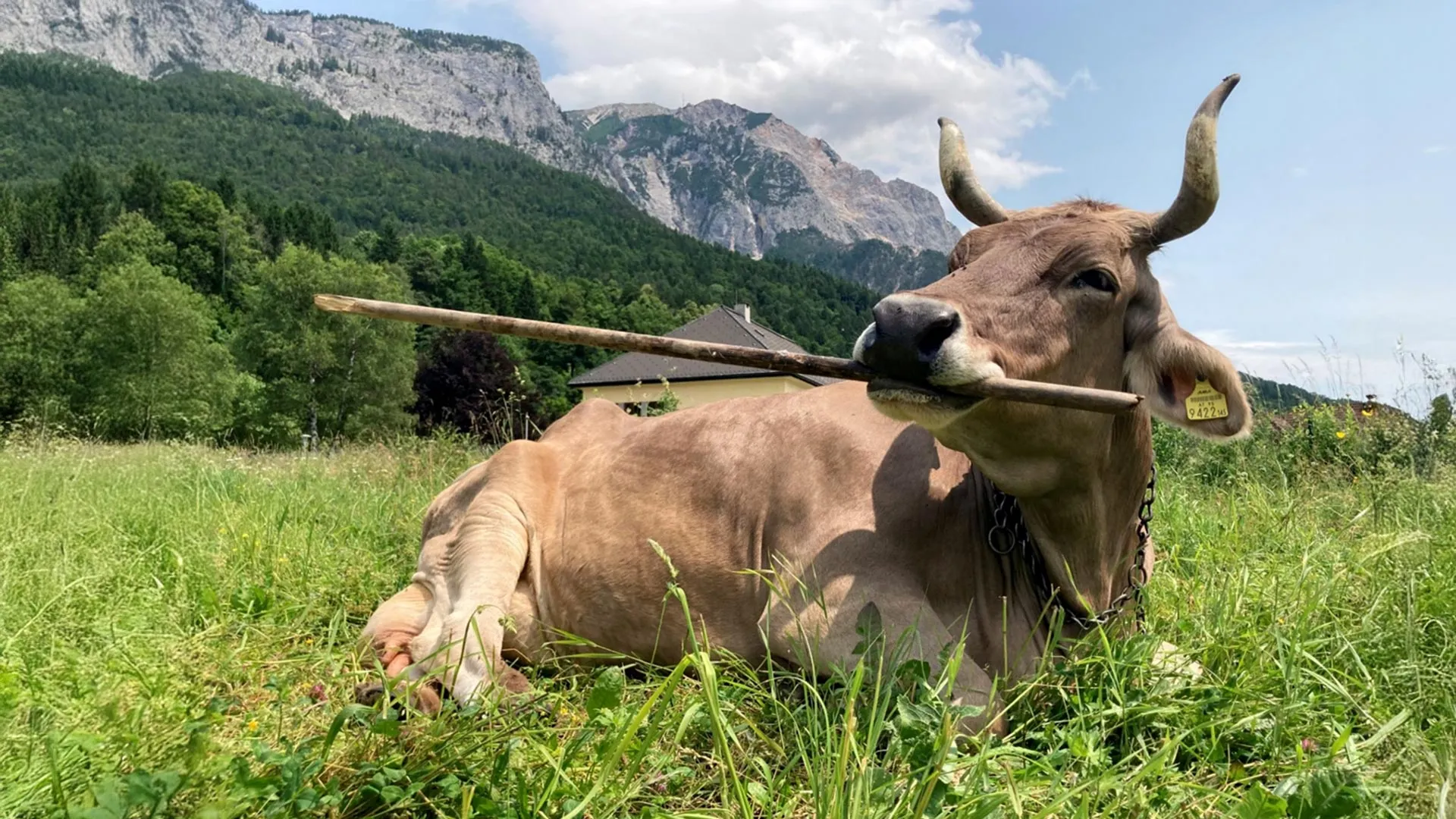
In 1982, cartoonist Gary Larson introduced a famous Far Side comic called Cow Tools. The illustration depicted a cow proudly standing next to a strange collection of useless objects labeled as tools. The humor of the widely popular strip relied on a deeply ingrained, almost universally accepted idea that cows lack the intelligence or cognitive capacity to create or effectively utilize tools. This long-held assumption, often reinforced by scientific literature and popular culture alike, is now being fundamentally questioned, thanks to the remarkable actions of a real-life Swiss Brown cow named Veronika. A groundbreaking study recently published in the esteemed journal Current Biology presents the first scientifically documented case of flexible, multi-purpose tool use in a domestic bovine, suggesting that cattle may possess far greater cognitive capabilities than previously recognized. This revelation not only reshapes our understanding of animal intelligence but also prompts a critical re-evaluation of how we observe, interact with, and even categorize the cognitive lives of livestock.
The "Cow Tools" Legacy and Its Challenge
For decades, the Far Side comic served as a cultural touchstone, humorously encapsulating the popular perception of cows as docile, unintelligent creatures primarily suited for agricultural production. The image of a cow with "tools" like a crude saw, a hammer, and an inexplicably shaped object, all clearly unsuitable for any practical purpose, cemented an anthropocentric view that tool use was a complex behavior beyond the reach of most non-human species, especially those considered "livestock." Scientific consensus largely echoed this sentiment, with research on animal cognition historically focusing on primates, corvids, and a select few other species known for problem-solving and manipulative skills. Cattle, by contrast, have primarily been studied for their physiological and behavioral traits related to farming, with their cognitive abilities often overlooked or underestimated.
However, the findings surrounding Veronika directly challenge this long-standing paradigm. "The findings highlight how assumptions about livestock intelligence may reflect gaps in observation rather than genuine cognitive limits," states Alice Auersperg, a cognitive biologist at the University of Veterinary Medicine, Vienna, and a co-author of the study. Her remarks underscore a crucial point: our understanding of animal intelligence is often constrained by the questions we ask and the environments in which we conduct our observations. In Veronika’s case, a unique living situation provided the ideal crucible for novel behaviors to emerge and, crucially, to be noticed.
Introducing Veronika: A Decade of Unseen Innovation
Veronika is no ordinary farm animal. She is a Swiss Brown cow who has lived for over a decade as a companion animal rather than being raised for conventional food production. Her home is with Witgar Wiegele, an organic farmer and baker who resides in Austria. Wiegele considers Veronika an integral part of his family, providing her with a stimulating and enriched environment far removed from typical industrial farming settings. This close, long-term human-animal bond, combined with her advanced age for a cow, likely played a significant role in fostering her unique behavioral repertoire.
More than ten years ago, Wiegele first began noticing an unusual and persistent behavior from Veronika. She would routinely pick up sticks, branches, or other suitable objects found in her environment and skillfully use them to scratch various parts of her body. Initially, these observations might have been dismissed as playful antics or random movements. However, Wiegele, attuned to Veronika’s individuality, recognized the purposeful nature of her actions. This behavior eventually garnered scientific attention when Wiegele recorded it on video and shared the footage with researchers, leading to the formal investigation.
"When I saw the footage, it was immediately clear that this was not accidental," Auersperg recalls. "This was a meaningful example of tool use in a species that is rarely considered from a cognitive perspective." This initial video evidence served as the catalyst for the systematic scientific inquiry that would ultimately redefine our understanding of bovine cognition.
Rigorous Scientific Scrutiny: Documenting Tool Use
To move beyond anecdotal observation and scientifically validate Veronika’s behavior, the research team, led by Auersperg and Antonio Osuna-Mascaró, devised a series of structured experiments. Their goal was to determine if Veronika’s actions constituted genuine, flexible tool use, or if they were merely a fixed action pattern or a form of self-grooming that incidentally involved objects.
For these controlled tests, researchers introduced a common deck brush into Veronika’s enclosure, placing it in various positions and orientations. They then meticulously observed and recorded her interactions with the brush. The experimental design focused on analyzing several key aspects: whether she consistently selected and manipulated the object, how she adapted her use based on her needs, and if her choices demonstrated an understanding of the tool’s properties.
Across multiple trials, Veronika exhibited remarkable consistency and adaptability. She did not randomly rub against the brush; instead, she consistently chose specific parts of the brush—either the bristled side or the smoother handle—depending on the particular area of her body she wished to scratch. Her selections were not arbitrary; they directly correlated with the needs of different regions of her body, showcasing a sophisticated level of discrimination and intentionality.
"We show that a cow can engage in genuinely flexible tool use," explains Antonio Osuna-Mascaró, a co-author of the study. "Veronika is not just using an object to scratch herself. She uses different parts of the same tool for different purposes, and she applies different techniques depending on the function of the tool and the body region." This distinction is critical for classifying her behavior as true, flexible tool use, moving it beyond simple object manipulation.
Beyond Simple Scratching: Flexible and Multi-Purpose Application
The detailed observations of Veronika’s interactions with the deck brush revealed clear patterns in her approach. For larger, firmer areas of her body, such as her back or flanks, she consistently preferred the bristled side of the brush. This choice allowed her to apply more pressure and achieve a more thorough scratch. Conversely, for more sensitive regions on her lower body, or areas requiring a gentler touch, she switched to the smoother, less abrasive handle of the brush. This deliberate selection based on the desired effect demonstrates a sophisticated understanding of the tool’s different properties and how to leverage them.
Furthermore, Veronika also adjusted the kinematics of her movements. When scratching her upper body, her motions were broader, stronger, and more sweeping, indicative of applying greater force. In contrast, movements directed at lower or more sensitive areas were notably slower, more precise, and controlled, suggesting an anticipation of the tactile feedback and a finely tuned motor response. This combination of selective tool part use and modulated physical application provides compelling evidence for her cognitive flexibility and problem-solving abilities.
Scientifically, tool use is broadly defined as the use of an external object to achieve a goal through physical interaction. Veronika’s actions not only meet this fundamental definition but significantly exceed it. Her behavior qualifies as flexible, multi-purpose tool use, meaning she is capable of utilizing different features of the same object to achieve distinct outcomes. This advanced form of tool use is exceptionally rare among non-human species and has, until now, been clearly documented primarily in chimpanzees, and to a lesser extent, in certain species of birds like New Caledonian crows and some marine mammals. The inclusion of a cow in this elite group marks a significant expansion of our understanding of cognitive complexity across the animal kingdom.
Overcoming Physical Constraints: A Test of Dexterity
Veronika’s tool use is directed at her own body, a behavior known as egocentric tool use. While this form is often considered less complex than allocentric tool use (using tools on external objects or others), it still presents unique and substantial challenges, particularly for an animal like a cow. Unlike primates with dexterous hands or birds with precision beaks, cows lack prehensile limbs. This means Veronika must manipulate tools primarily using her mouth, tongue, and lips—a far less agile set of appendages for fine motor control.
Despite this significant physical limitation, Veronika exhibits remarkable control and dexterity. She skillfully grips the brush with her mouth, adjusting her hold and movements with apparent forethought and precision. Her actions appear to anticipate the effects of her scratching, suggesting a mental model of how the tool interacts with her body. She adjusts her grip strength, the angle of the brush, and the speed of her movements to achieve the desired result, whether it’s a vigorous scratch on her back or a gentle rub on a more delicate area. This ability to adapt her motor program to a specific goal, despite inherent physical constraints, further underscores the cognitive sophistication of her behavior.
The Enigma of Rarity: Why Veronika’s Case is Unique
Given the groundbreaking nature of Veronika’s behavior, researchers are keen to understand why such an ability has not been widely observed in other cattle populations. The study authors believe that Veronika’s unique living conditions and life history are crucial contributing factors. Unlike the vast majority of cattle, who are raised in often monotonous and confined agricultural settings, Veronika has lived a long life (she is over a decade old) in a complex, stimulating, and enriched environment.
Her status as a companion animal means she benefits from daily, varied interactions with humans, fostering a level of cognitive engagement uncommon for livestock. Furthermore, she has constant access to a diverse array of objects within her pasture and enclosure, providing ample opportunities for exploration, manipulation, and spontaneous innovation. These factors—longevity, environmental enrichment, human interaction, and freedom from the intense pressures of industrial farming—likely created an environment where observational learning, experimentation, and the development of novel behaviors could flourish.
The researchers summarize this point eloquently: "[Veronika] did not fashion tools like the cow in Gary Larson’s cartoon, but she selected, adjusted, and used one with notable dexterity and flexibility." They conclude with a poignant reflection: "Perhaps the real absurdity lies not in imagining a tool-using cow, but in assuming such a thing could never exist." This statement serves as a powerful call to humility in our assessment of animal intelligence, urging us to question long-held assumptions.
Broadening the Scope of Animal Cognition
This discovery represents the first confirmed and scientifically documented case of flexible tool use in cattle, significantly expanding the known range of species capable of demonstrating this complex cognitive ability. Its implications extend far beyond the single case of Veronika. It raises the tantalizing possibility that similar behaviors may be more widespread across the animal kingdom, particularly within species historically overlooked for their cognitive potential, but have simply gone unnoticed due to a lack of targeted observation or appropriate environmental conditions.
The study underscores the concept of an "observational gap" in animal cognition research. Many species, especially those categorized as livestock, are rarely studied outside of contexts directly relevant to human economic interests. This narrow focus can lead to biased conclusions about their inherent capabilities. Veronika’s case suggests that given the right environment—one that encourages exploration, problem-solving, and individual expression—animals may reveal cognitive capacities that challenge our conventional classifications.
Ethical and Practical Considerations
The revelation of tool use in cattle carries significant ethical and practical implications. If cows possess greater cognitive flexibility and problem-solving abilities than previously assumed, it prompts a critical re-evaluation of current animal welfare standards and husbandry practices. Recognizing cattle as more cognitively capable, individualistic beings could lead to stronger arguments for providing more enriched environments, opportunities for behavioral expression, and a reconsideration of practices that might cause mental or physical stress.
For the livestock industry, this research could inspire innovations in farm design and management, aiming to provide environments that stimulate natural behaviors and enhance welfare, potentially leading to healthier, less stressed animals. Public perception of cattle may also shift, moving away from the simplistic "food animal" archetype towards a more nuanced appreciation of their complex inner lives. This aligns with a broader societal trend towards greater recognition of animal sentience and intelligence.
Future Directions and Calls for Observation
The research team behind Veronika’s study is not resting on their laurels. They are now actively exploring which specific environmental and social conditions are most conducive to the development of such complex behaviors in cattle. This future research will delve into aspects such as early life experiences, social group dynamics, the presence of specific environmental stimuli, and the role of human interaction in fostering cognitive development.
Crucially, the team is also extending an open invitation to farmers, animal caretakers, and citizen scientists around the world. "Because we suspect this ability may be more widespread than currently documented," Osuna-Mascaró states, "we invite readers who have observed cows or bulls using sticks or other handheld objects for purposeful actions to contact us." This call for wider observation aims to harness collective knowledge and potentially uncover more instances of sophisticated tool use, further enriching our understanding of bovine intelligence and challenging the long shadow cast by that famous Far Side comic.
In conclusion, Veronika the tool-using cow represents a pivotal moment in animal cognition research. She has effectively dismantled a long-standing stereotype and pushed the boundaries of what we believed cattle were capable of. Her story is a compelling reminder that the animal kingdom holds countless undiscovered cognitive wonders, waiting to be revealed when we approach them with curiosity, empathy, and a willingness to challenge our most ingrained assumptions. The era of the "unintelligent cow" is giving way to a new understanding, one where bovine ingenuity is not a punchline, but a profound scientific discovery.