
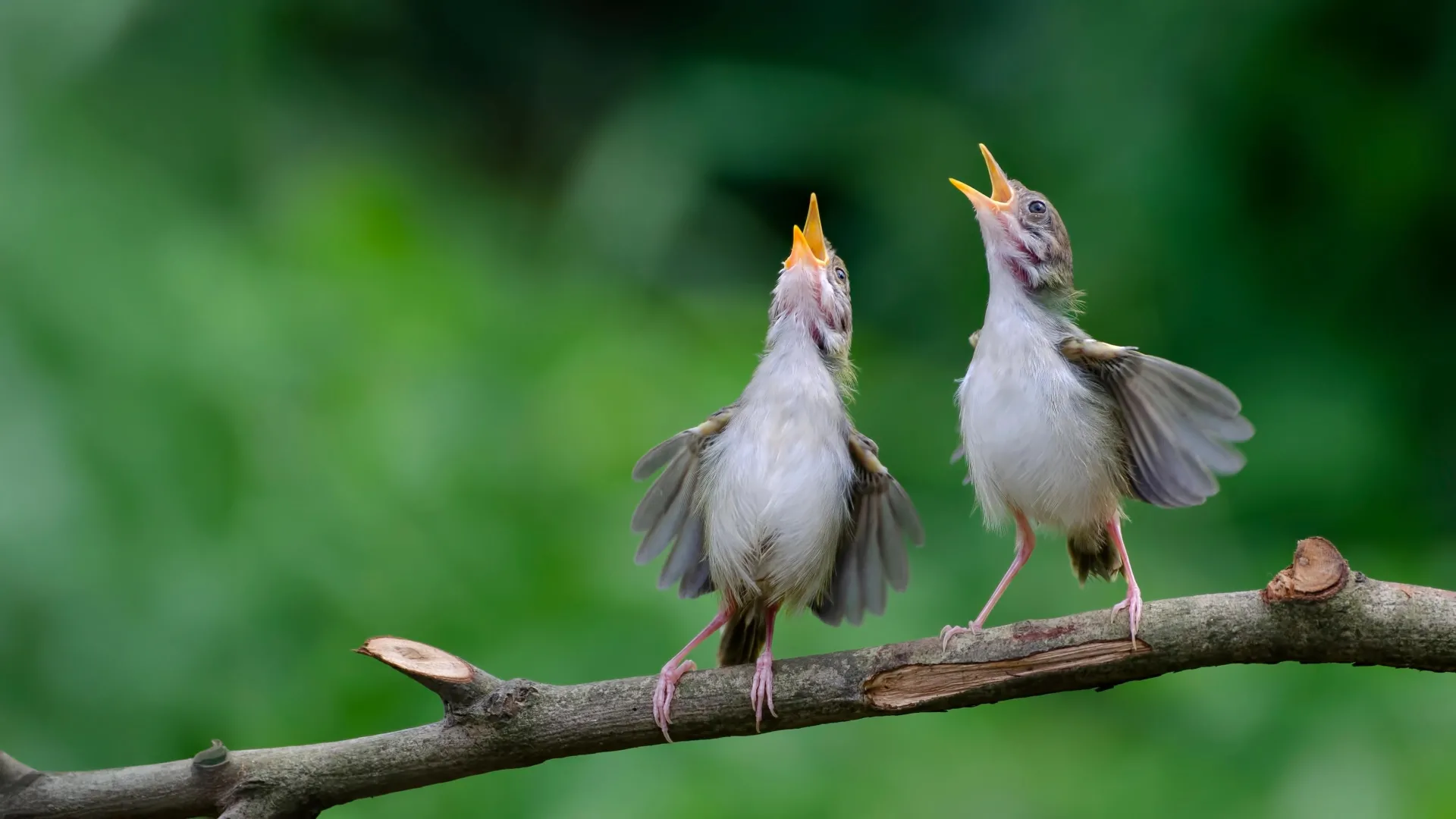
A groundbreaking international study has revealed that avian species, despite vast geographical separation and millions of years of divergent evolution, employ remarkably similar warning calls when confronting a parasitic threat near their nests. This shared vocalization, identified as a distinctive "whine," represents a pioneering discovery in animal communication: the first documented instance of a vocalization that seamlessly combines both learned behaviors and innate, instinctive reactions. Published on October 3 in the prestigious journal Nature Ecology and Evolution, this research offers an unprecedented glimpse into the intricate mechanisms through which natural selection sculpts the development of communication across the animal kingdom. The ambitious project, spearheaded by a collaborative team of scientists from Cornell University in the United States and the Doñana Biological Station in Seville, Spain, stands as one of the most comprehensive investigations ever undertaken into the complex dynamics of brood parasitism.
The Evolutionary Arms Race: Understanding Brood Parasitism
At the heart of this ecological puzzle lies brood parasitism, a reproductive strategy employed by certain bird species, most notably various cuckoos, where they surreptitiously lay their eggs in the nests of other species. The unsuspecting host parents are then duped into raising the parasite’s chicks, often at a catastrophic cost to their own biological fitness. This includes sacrificing their own offspring, whose survival is frequently compromised by the larger, more demanding, or even aggressive parasitic chicks. The evolutionary pressure on host species to detect and deter these parasitic intruders before they can deposit their eggs is immense, driving a continuous arms race of adaptation and counter-adaptation. The ability to recognize and respond to the presence of a brood parasite is therefore a critical survival mechanism for host species, directly impacting their reproductive success and the propagation of their genes.
The researchers meticulously observed and documented the alarm calls of more than 20 distinct bird species spanning four continents – including diverse ecosystems in Australia, China, and Zambia. Their findings consistently pointed to the use of nearly identical "whining" alarm calls, specifically triggered by the presence of parasitic intruders. This convergence in vocalization, despite profound genetic and geographical isolation, immediately signaled a deeper, shared evolutionary root.
A Shared Linguistic Blueprint Across Continents
The uniformity of this warning call across such geographically disparate populations was a primary source of intrigue for the research team. Birds in locations as far-flung as the arid landscapes of Australia, the dense forests of China, and the expansive savannas of Zambia all produced the same distinctive "whine" – a sound that, to human ears, might be described as a drawn-out, nasal vocalization. This striking consistency occurred despite these populations having no conceivable direct contact or shared ancestral learning. This phenomenon points towards powerful selective pressures favoring the evolution and maintenance of this specific acoustic signal.
The study posits a fascinating dual-mechanism explaining this widespread communication. When a bird first hears this particular "whine," its immediate reaction is an instinctive investigation of the sound’s origin. This innate curiosity serves as the initial trigger. During this critical investigative moment, as explained by co-author Damián Blasi, a language scientist at Pompeu Fabra University in Spain, the bird begins to form an association between the distinct sound and the surrounding environmental cues – such as the sight of a cuckoo or other parasitic species, or even the distress signals from other nearby birds. This process, termed social transmission, is fundamental to how the learned component of the call is acquired.
"It’s then, when birds are absorbing the clues around them, that the bird learns when to produce the sound in the future," elaborated James Kennerley, co-lead author and postdoctoral fellow at the Cornell Lab of Ornithology. This dynamic interplay means that while the initial response to the sound is hardwired, the nuanced understanding of when and why to deploy it is cultivated through social learning and observational experience.
Bridging Instinct and Language: A Darwinian Link
The discovery holds profound implications for understanding the evolution of communication itself. William Feeney, an evolutionary ecologist at Doñana Biological Station in Seville, Spain, and another co-lead of the study, highlighted the unique nature of this finding: "The fascinating thing about this call is that it represents a midpoint between the instinctive vocalizations we often see in animals and fully learned vocal units like human words." This "midpoint" suggests a previously unrecognized continuum in communication evolution, bridging what were often considered distinct categories.
The research further revealed that the species most frequently employing this "whining" call are typically found in regions where host-parasite interactions are particularly intense and complex. These are ecological hotspots where the evolutionary stakes are highest for host birds, necessitating robust and reliable communication strategies.
"With birds working together to drive parasites away, communicating how and when to cooperate is really important, so this call is popping up in parts of the world where species are most affected by brood parasitism," Kennerley noted. This suggests that the "whining" call is not merely a passive alarm but an active component in facilitating cooperative anti-parasite behaviors, such as mobbing – a collective defense strategy where multiple birds harass a predator or threat. The result, he concluded, is that "the evolution of the whining vocalization is affecting patterns of cooperative behaviors between birds around the world."
Chronology of a Groundbreaking Study
The journey to this discovery spanned several years, culminating in its publication on October 3 in Nature Ecology and Evolution. While the precise initiation date of the overarching "extensive investigation" into brood parasitism is not specified, such large-scale international collaborations involving field research across multiple continents, data analysis, and peer review typically span many years. The foundational concepts of animal communication and the evolutionary pressures of brood parasitism have been subjects of scientific inquiry for decades, with Charles Darwin himself speculating on the origins of vocalizations and their adaptive significance in his seminal works. This study, however, provides empirical evidence that directly links an innate acoustic element with learned meaning, fulfilling a hypothesis first suggested by Darwin regarding the evolution of signals. The collaborative nature, involving researchers from Cornell University and Doñana Biological Station, underscores the global effort and expertise required to unravel such intricate biological phenomena.
Broader Implications for Communication Science
What makes this research particularly significant, according to the authors, is its unparalleled documentation of a connection between an innate sound and a learned behavioral response. "For the first time, we’ve documented a vocalization that has both learned and innate components, potentially showing how learned signals may have evolved from innate calls in a way first suggested by Charles Darwin," Feeney reiterated. "It’s like seeing how evolution can enable species to give learned meanings to sounds." This observation provides tangible evidence for a theoretical pathway of communication evolution, moving from simple, genetically predetermined calls to more complex, context-dependent vocalizations.
The findings directly challenge long-standing assumptions in scientific circles that often compartmentalize animal communication and human language into entirely separate domains. For decades, the complexity and symbolic nature of human language have been viewed as a distinct evolutionary leap, fundamentally different from the more rigid, instinct-driven vocalizations of other species. This study suggests a more nuanced and continuous evolutionary trajectory. The research team proposes that sophisticated communication systems, including the intricate structures of human speech, may not have emerged ex nihilo but rather through the gradual integration and blending of both instinctive and learned elements over vast stretches of evolutionary time.
This perspective opens new avenues for exploring the neurobiological underpinnings of communication, suggesting that the neural pathways involved in processing and producing these "midpoint" calls in birds might share ancestral homologies with those involved in human language acquisition. It provides a compelling model for how basic, innate sounds could become imbued with flexible, socially transmitted meanings, laying a potential groundwork for the development of syntax and semantics.
Further Context: The Diversity of Avian Alarm Calls and Convergent Evolution
While this study focuses on the "whining" call against brood parasites, it’s important to contextualize it within the broader spectrum of avian alarm calls. Birds employ a diverse repertoire of vocalizations to signal danger, often tailored to the specific type of threat. For instance, aerial predators (like hawks) might elicit short, high-pitched "seet" calls that are difficult to locate, while ground predators (like snakes or mammals) might trigger louder, broadband "mobbing" calls designed to attract others for collective defense. The "whining" call, specifically for brood parasites, highlights a highly specialized adaptation to a particular ecological challenge.
The widespread occurrence of this similar "whining" call across continents is a prime example of convergent evolution – a process where distantly related species independently evolve similar traits or behaviors in response to similar environmental pressures. In this case, the shared pressure is the devastating impact of brood parasitism, driving the independent evolution of a highly effective and universally recognized alarm signal. This suggests that the acoustic properties of the "whine" itself might be inherently effective for signaling this specific type of threat, or that the learning mechanisms involved are evolutionarily ancient and robust.
Future Research and Broader Impact
The implications of this research extend beyond ornithology, touching upon fields like linguistics, cognitive science, and evolutionary biology. Future studies might delve into the specific neural circuits involved in this innate-learned vocalization in birds, potentially offering insights into the neural architecture supporting human language. Researchers could also explore whether similar "midpoint" communication strategies exist in other animal taxa facing analogous ecological challenges.
By illuminating the sophisticated interplay between instinct and learning in avian communication, the Cornell-Doñana study not only enriches our understanding of bird behavior but also offers a profound perspective on the deep evolutionary roots of all complex communication systems, including our own. It stands as a testament to the power of natural selection in shaping the intricate tapestry of life and the remarkable ways species adapt to survive and thrive in their ever-changing environments. The "whining" call, once just another sound in the avian chorus, is now recognized as a critical evolutionary bridge, connecting ancient instincts with the sophisticated learning capabilities that define complex communication.