
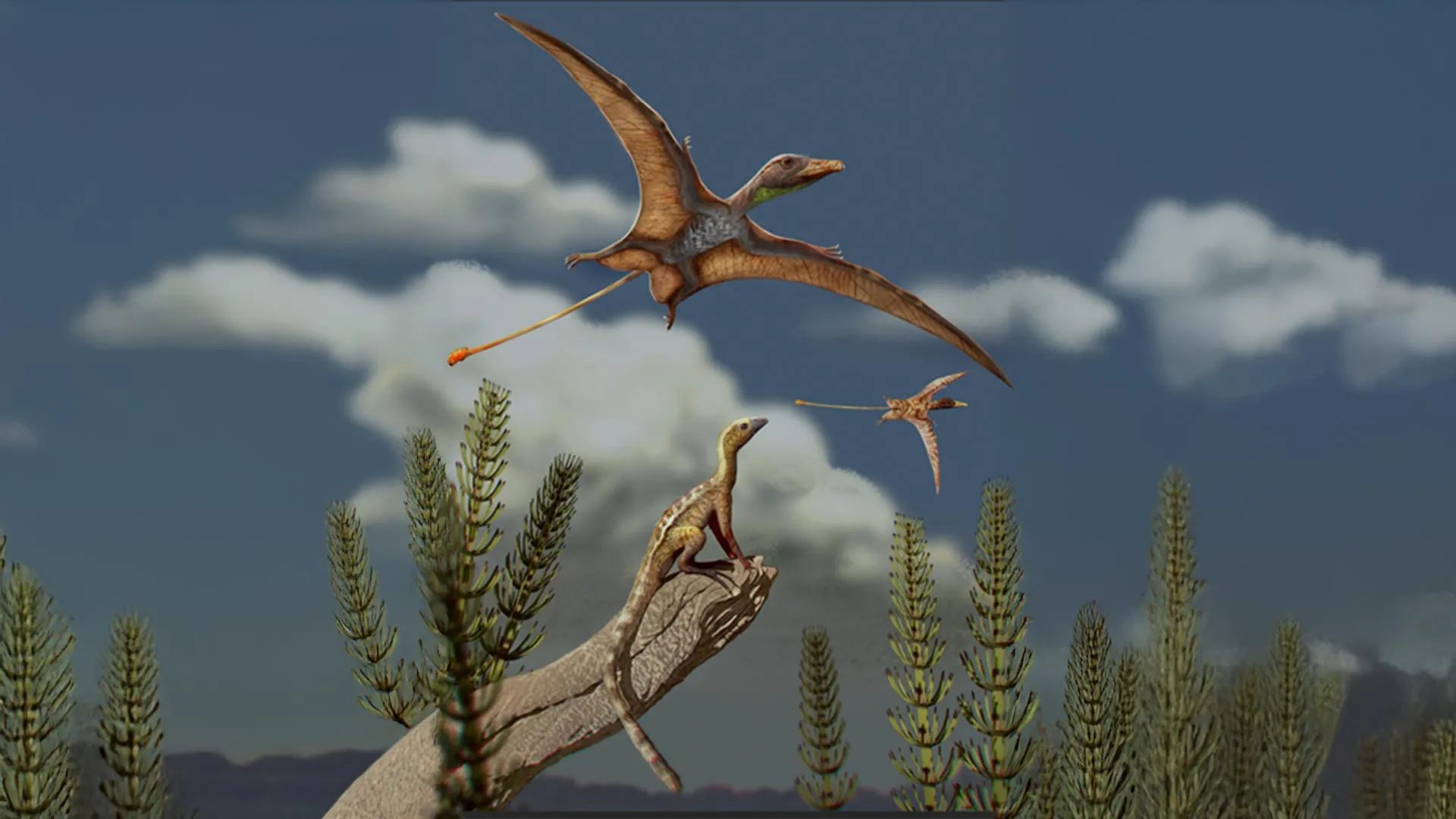
A groundbreaking study by a research group at Johns Hopkins Medicine, spearheaded by an evolutionary biologist, has unveiled compelling evidence suggesting that giant reptiles, known as pterosaurs, developed the intricate ability of powered flight remarkably early in their evolutionary trajectory, dating back as far as 220 million years ago. This discovery presents a stark contrast to the prevailing understanding of avian flight evolution, which posits a more gradual acquisition of this complex locomotion, often associated with the development of larger, more sophisticated brains in the ancestors of modern birds. The detailed findings of this investigation, which utilized state-of-the-art imaging techniques to meticulously examine the internal brain cavities of pterosaur fossils and received partial support from the National Science Foundation, were officially published on November 26 in the esteemed scientific journal Current Biology.
The implications of this research are significant, particularly as they challenge long-held hypotheses regarding the neurological prerequisites for powered flight in vertebrates. According to Matteo Fabbri, Ph.D., an assistant professor of functional anatomy and evolution at the Johns Hopkins University School of Medicine and a lead author of the study, the results strongly reinforce the notion that the enlarged brains observed in birds and their ancestral lineages were not, in fact, a necessary condition for pterosaurs to conquer the skies. Fabbri elaborates, stating, "Our study shows that pterosaurs evolved flight early on in their existence and that they did so with a smaller brain similar to true non-flying dinosaurs." This assertion suggests a distinct evolutionary pathway for flight acquisition in pterosaurs, diverging significantly from the avian model.
Pterosaurs: Ancient Sky Sovereigns with Unexpected Brain Architecture
Pterosaurs, a diverse order of flying reptiles, represent some of the most awe-inspiring creatures of the Mesozoic Era. Fabbri vividly describes them as powerful airborne predators that dominated the skies throughout the age of dinosaurs, ranging dramatically in size from small, sparrow-like forms to colossal species capable of reaching weights of up to 500 pounds and boasting wingspans that could stretch an astonishing 30 feet across. These magnificent creatures are widely recognized as the earliest of the three major vertebrate lineages—alongside birds and bats—to independently achieve the extraordinary feat of powered flight. Their reign spanned over 150 million years, from the late Triassic period to the end of the Cretaceous, marking them as persistent and successful aerialists.
To thoroughly investigate the mechanisms by which pterosaurs acquired this formidable ability and to ascertain whether their evolutionary journey differed from that of birds and bats, the research team embarked on a comprehensive examination of the reptile’s evolutionary history. Their meticulous analysis focused intensely on understanding the shifts in both the shape and overall size of the brain over geological time, with a particular emphasis placed on the optic lobe—a crucial region of the brain fundamentally involved in vision and widely implicated in the complex capabilities required for successful flight. The sheer variety of pterosaur forms, from the long-tailed rhamphorhynchoids of the Jurassic to the short-tailed pterodactyloids of the Cretaceous, underscores the success of their early adoption of flight, allowing them to radiate into numerous ecological niches across the globe.
Unlocking Secrets: CT Scans and the Lagerpetid Connection
The core of this investigation relied on sophisticated methodologies, primarily leveraging advanced computed tomography (CT) imaging and specialized software. These tools enabled the researchers to digitally reconstruct and model the intricate fossilized nervous system structures within the cranial cavities of pterosaur specimens. The team’s strategic focus was directed toward the closest known relative of the pterosaur lineage: the lagerpetid. This enigmatic animal, characterized by its flightless, agile, and likely tree-climbing lifestyle, was first identified by scientists in 2016. Lagerpetids inhabited the Earth during the Triassic period, a critical juncture in evolutionary history spanning approximately 242 to 212 million years ago, preceding the diversification of many well-known dinosaur groups. A subsequent study in 2020 further solidified the lagerpetid’s close evolutionary connection to pterosaurs, establishing it as a pivotal "sister group" for comparative analysis.
The insights gleaned from the lagerpetid fossils proved particularly illuminating. "The lagerpetid’s brain already showed features linked to improved vision, including an enlarged optic lobe, an adaptation that may have later helped their pterosaur relatives take to the skies," explains corresponding author Mario Bronzati, a researcher at the University of Tübingen, Germany. This suggests a pre-adaptation for enhanced visual processing, a trait that would undoubtedly be highly advantageous for an aerial existence. Fabbri further notes that pterosaurs also exhibited enlarged optic lobes, underscoring the consistent importance of superior vision across this evolutionary branch. However, beyond this shared visual adaptation, Fabbri clarifies that the overall shape and size of the pterosaur brain diverged considerably from that of the lagerpetid.
The few similarities observed, coupled with the marked differences, led the researchers to a profound conclusion. Fabbri states, "The few similarities suggest that flying pterosaurs, which appeared very soon after the lagerpetid, likely acquired flight in a burst at their origin." He elaborates on this rapid transformation: "Essentially, pterosaur brains quickly transformed acquiring all they needed to take flight from the beginning." This hypothesis of a rapid, almost instantaneous evolutionary leap into powered flight at the very genesis of the pterosaur lineage stands in stark contrast to the more protracted evolutionary pathways often observed in other complex adaptations. The Triassic period, a time of significant faunal turnover and the emergence of many modern vertebrate groups, appears to have been a crucible for such dramatic evolutionary innovations.
A Tale of Two Flights: Pterosaur vs. Avian Evolution
The evolutionary narrative of modern birds, in stark contrast to that of pterosaurs, is widely understood to have unfolded through a more gradual and incremental process. The scientific consensus posits that avian ancestors progressively accumulated a suite of key physiological and neurological traits over millions of years, eventually culminating in powered flight. This process involved the expansion of crucial brain regions, including the cerebrum (associated with higher cognitive functions), the cerebellum (vital for motor control and coordination), and the optic lobes. These adaptations, initially inherited from earlier non-avian dinosaur relatives, were subsequently further refined and optimized specifically for the demands of aerial locomotion.
Support for this gradualist model of avian flight evolution comes from contemporary research, including a notable 2024 study conducted in the laboratory of Amy Balanoff, Ph.D., an assistant professor of functional anatomy and evolution at Johns Hopkins Medicine. Balanoff’s work specifically highlights the critical importance of cerebellar expansion in the early origins of bird flight. The cerebellum, strategically located at the back of the brain, plays an indispensable role in regulating muscle coordination, balance, spatial awareness, and other complex motor functions—all paramount for the precise control required for flight.
The differing pathways to flight underscore the remarkable plasticity of evolution. While birds honed their flight capabilities through a series of incremental adaptations building upon pre-existing neural architecture, pterosaurs appear to have undergone a more abrupt neurological reorganization that facilitated early and rapid aerial mastery. This divergence provides invaluable insights into the diverse evolutionary pressures and opportunities that can drive the emergence of complex traits in distinct lineages. The debate surrounding "trees down" versus "ground up" theories for the origin of avian flight, for instance, has long fascinated paleontologists, and studies like this one add further layers of complexity and comparative data to such discussions.
Balanoff emphasizes the broader significance of such comparative neurological studies: "Any information that can fill in the gaps of what we don’t know about dinosaur and bird brains is important in understanding flight and neurosensory evolution within pterosaur and bird lineages." Understanding these neurological blueprints provides a window into the cognitive and sensory worlds of extinct animals, allowing researchers to reconstruct not just their physical forms but also their capabilities and behaviors.
Comparative Paleoneurology: Insights From Fossilized Brains Across Species
To further contextualize their findings and broaden the comparative scope, the research team extended their analysis beyond pterosaurs and lagerpetids. They meticulously examined brain cavities derived from other significant fossil groups, including crocodilians (ancestral relatives of modern crocodiles) and various early, extinct birds. This comprehensive comparative approach allowed for a more robust understanding of how pterosaur brain structures fit within the broader panorama of archosaurian (the group containing dinosaurs, birds, and crocodilians) evolution.
Their detailed analysis revealed that pterosaurs possessed moderately enlarged brain hemispheres, a feature that, surprisingly, was comparable to those found in other distinct dinosaur groups. These included the agile, two-legged, bird-like troodontids, a group of predatory dinosaurs that thrived between the Late Jurassic and Late Cretaceous periods, approximately 163 to 66 million years ago. Troodontids are known for their relatively large brains among non-avian dinosaurs, suggesting a certain level of cognitive sophistication. The team also compared pterosaur brain structures to those of Archaeopteryx lithographica, widely recognized as the oldest-known bird, which soared through the skies between 150.8 and 125.45 million years ago. Despite its status as an early bird, Archaeopteryx still retained many reptilian features, including a brain structure that, while more advanced than some dinosaurs, was still relatively modest compared to its modern descendants.
Crucially, these prehistoric species—pterosaurs, troodontids, and Archaeopteryx—differed strongly from modern birds, which exhibit significantly larger and more complex brain cavities. The dramatic encephalization (increase in brain size relative to body size) seen in modern avian lineages is a hallmark of their evolutionary success, enabling advanced cognitive abilities, complex social behaviors, and highly refined flight control. The pterosaur data thus reinforce the idea that large, complex brains, while beneficial, were not a universal prerequisite for the initial conquest of the air.
Looking Ahead: The Future of Flight Evolution Research
Fabbri articulates the critical next steps for future research in this burgeoning field. He emphasizes that significant progress will hinge upon moving beyond mere assessments of brain size and shape to delve deeper into understanding the brain’s internal structural organization. This micro-anatomical perspective, he explains, will be absolutely essential for fully uncovering the precise neural mechanisms that enabled pterosaurs to achieve powered flight. By scrutinizing the internal wiring and connectivity of these ancient brains, paleontologists hope to gain unprecedented insights into the specific neural circuits that governed their remarkable aerial prowess.
Such an in-depth understanding of the internal brain structure will not only illuminate the unique evolutionary path of pterosaur flight but will also contribute to uncovering broader biological principles that govern the evolution of flight across all vertebrate lineages. This could lead to a more nuanced understanding of convergent evolution, where different species independently evolve similar traits (like flight) but potentially through distinct underlying biological and neurological pathways. The multidisciplinary nature of this research, combining paleontology, neurobiology, and advanced imaging, exemplifies the cutting-edge approaches being employed to reconstruct the lives and capabilities of long-extinct organisms.
The current study was made possible through the generous financial support of a diverse array of international organizations, underscoring the collaborative spirit of modern scientific inquiry. Funding support was provided by the Alexander von Humboldt Foundation, the Brazilian Federal Government, The Paleontological Society, Agencia Nacional de Promoción Científica y Técnica, Conselho Nacional de Desenvolvimento Científico e Tecnológico, the European Union NextGeneration EU/PRTR, the National Science Foundation (grants NSF DEB 1754596, NSF IOB-0517257, IOS-1050154, IOS-1456503), and the Swedish Research Council.
In addition to the primary contributions from Matteo Fabbri and Mario Bronzati, a formidable team of scientists contributed their expertise to this landmark research. These esteemed contributors include Akinobu Watanabe from New York Institute of Technology, Roger Benson from the American Museum of Natural History, Rodrigo Müller from Federal University of Santa Maria, Brazil, Lawrence Witmer from the University of Ohio, Martín Ezcurra and M. Belén von Baczko from Bernardino Rivadavia Museum of Natural Science, Felipe Montefeltro from São Paulo State University; Bhart-Anjan Bhullar from Yale University; Julia Desojo from Universidad Nacional de La Plata, Argentina; Fabien Knoll from Museo Nacional de Ciencias Naturales, Spain; Max Langer from Universidade de São Paulo, Brazil; Stephan Lautenschlager from University of Birmingham; Michelle Stocker and Sterling Nesbitt from Virginia Tech; Alan Turner from Stony Brook University; and Ingmar Werneburg from Eberhard Karls University of Tübingen. Their collective efforts have significantly advanced our understanding of one of the most astonishing evolutionary feats in Earth’s history.