
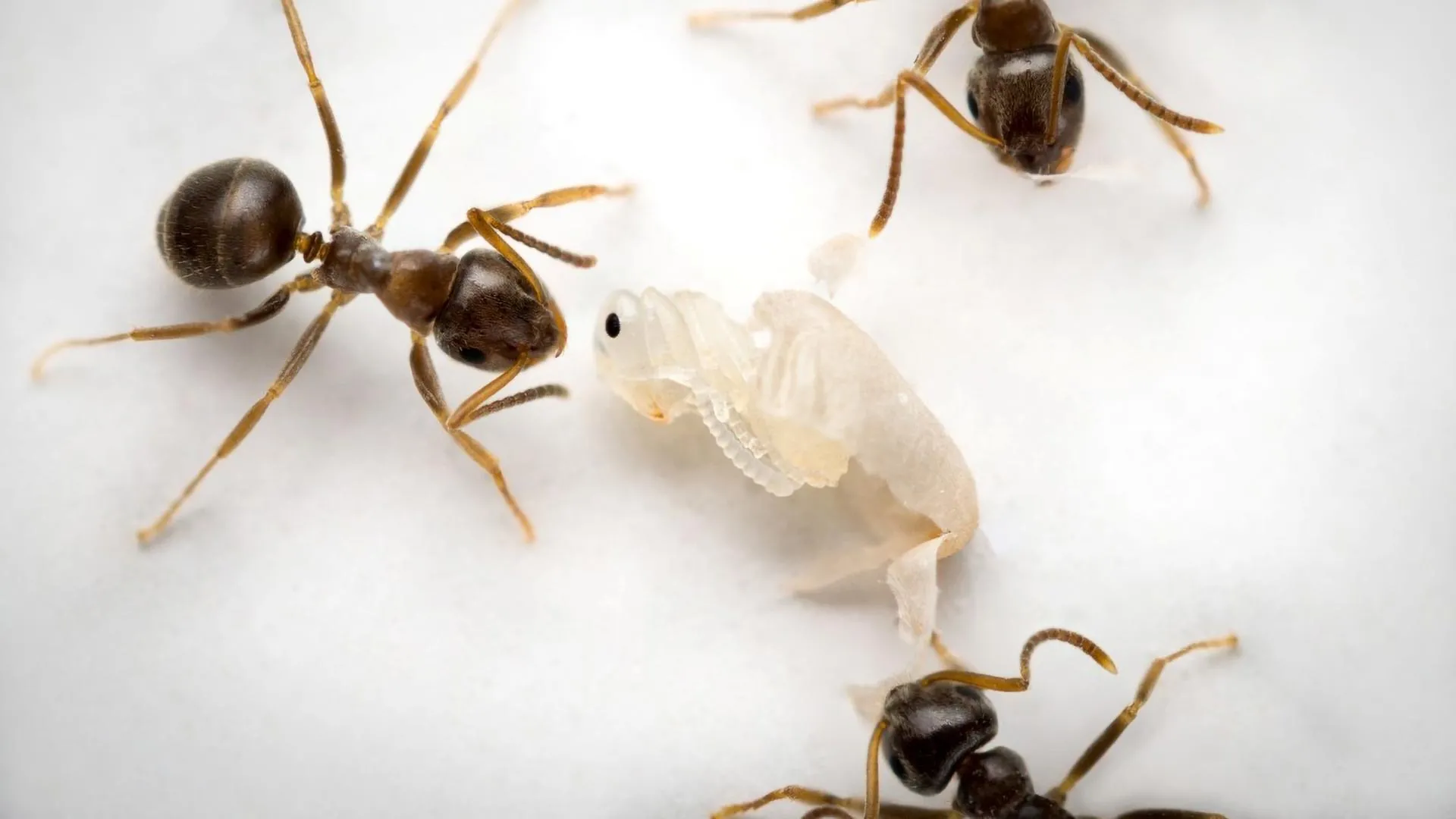
Ant societies exhibit a level of integration so profound that they function as tightly coordinated "superorganisms," where thousands of individuals operate in concert, much like the specialized cells within a single biological body. A groundbreaking study conducted by researchers at the Institute of Science and Technology Austria (ISTA) has unveiled a remarkable mechanism underpinning this collective resilience: terminally ill ant brood release a distinctive chemical odor, akin to the distress signals emitted by infected cells in a multicellular organism. This unique scent serves as an early warning system, enabling the colony to swiftly identify and neutralize infections before they can escalate and threaten the entire collective. The pivotal findings, which shed new light on the sophisticated strategies of social immunity, were recently published in the esteemed journal Nature Communications.
The Superorganism Paradigm: A Foundation for Collective Survival
The concept of an ant colony as a "superorganism" is central to understanding this phenomenon. Coined by entomologist William Morton Wheeler in 1911 and later popularized by E.O. Wilson, this paradigm posits that highly integrated social insect colonies exhibit emergent properties and a division of labor that parallels the organization of a multicellular organism. In an ant colony, the queen is analogous to the germline, dedicated solely to reproduction, while the vast majority of individuals – the worker ants – are somatic cells, performing all other vital functions from foraging and nest maintenance to defense and, critically, healthcare. This intricate coordination ensures the survival and propagation of the collective genotype, often at the expense of individual components.
This deep interdependence means that the health of individual members directly impacts the vitality of the entire colony. Unlike solitary animals, where an individual’s illness primarily affects only itself, a sick member in a dense social colony poses an existential threat to thousands of genetically related nestmates. Pathogens can spread rapidly through close contact, shared resources, and confined living spaces, making robust collective defense mechanisms paramount. Social immunity, a suite of behavioral and physiological adaptations that reduce disease risk within a group, is therefore a cornerstone of social insect survival. Examples range from hygienic behaviors like grooming and waste removal to the production of antimicrobial compounds and the sophisticated signaling now identified in ant brood.
A Counter-Intuitive Alarm: Terminally Ill Pupae Signal Their Demise
A common strategy in many animal species, particularly those living in groups, is to conceal signs of illness. This often serves to avoid ostracization, predation, or exploitation by healthy group members. Ant pupae, however, adopt a radically different and counter-intuitive approach when confronted with an infection they cannot overcome. Instead of hiding their affliction, they actively produce a potent chemical alarm, effectively broadcasting a warning signal to their nestmates about the imminent danger they represent. This act, at first glance appearing as self-sacrifice, is a sophisticated manifestation of kin selection, where an individual’s actions benefit the survival of shared genes within the colony.
Upon detecting this urgent chemical SOS, worker ants spring into action with remarkable speed and precision. They methodically open the infected pupa’s protective cocoon, create minute incisions in its outer surface, and then apply formic acid. This potent natural antimicrobial compound, produced by the worker ants themselves, serves a dual purpose: it effectively kills the virulent pathogens proliferating within the pupa, thereby containing the infection. However, this life-saving intervention for the colony invariably results in the death of the infected pupa.
"What appears to be self-sacrifice at first glance is, in fact, also beneficial to the signaler: it safeguards its nestmates, with whom it shares many genes," explains Erika Dawson, the lead author of the study and a former postdoc in the Social Immunity research group headed by Sylvia Cremer at ISTA. "By warning the colony of their deadly infection, terminally ill ants help the colony remain healthy and produce daughter colonies, which indirectly pass on the signaler’s genes to the next generation." This elegant explanation highlights the evolutionary calculus at play, where the individual’s demise ensures the perpetuation of its genetic lineage through the collective.
This form of altruistic disease signaling represents a previously undocumented mechanism in social insects, adding a critical piece to the puzzle of social immunity. Without such a robust early warning system, a dying ant pupa, rapidly succumbing to pathogens, could transform into a highly infectious reservoir, potentially unleashing a devastating epidemic across the entire colony. By signaling their dire condition at an early, incurable stage, these terminally ill individuals empower the colony to preemptively neutralize the threat before it metastasizes.
The Research Journey: From Observation to Mechanism
The research, a collaborative effort involving chemical ecologist Thomas Schmitt from the University of Würzburg in Germany, embarked on a meticulous investigation to unravel this complex interaction. The team began by observing ant colonies under controlled conditions, noting behavioral changes in response to pathogen exposure. This led to the hypothesis that a chemical signal might be involved in the colony’s response to sick brood.
Identifying the "Find-Me and Eat-Me" Signal:
The scientific journey involved several critical steps. Researchers first had to identify the specific chemical compounds responsible for the alarm signal. Given the need for precision, the team hypothesized that the signal would not be a volatile compound that disperses widely, but rather something directly associated with the pupa. Thomas Schmitt, whose expertise lies in chemical communication in social insects, confirmed this. "Workers can target a single sick pupa among many," Schmitt noted, indicating that "the scent cannot simply diffuse through the nest chamber but must be directly associated with the diseased pupa. Accordingly, the signal does not consist of volatile compounds but instead is made up of non-volatile compounds on the pupal body surface."
Through advanced chemical analysis, the team discovered that two specific components of the ants’ natural scent profile undergo a significant increase in concentration when a pupa becomes fatally infected. These non-volatile hydrocarbons, typically found on the insect cuticle, form the core of the distress signal.
Experimental Validation:
To definitively prove that this altered odor alone triggers the disinfection response, the researchers conducted a crucial experiment. They extracted the unique scent profile from terminally signaling pupae and carefully applied it to healthy, uninfected pupae. The subsequent behavior of the worker ants was then meticulously monitored. "We extracted the smell from the signaling pupae and applied it to healthy brood," Cremer explained. The results were unequivocal: the mere presence of the altered scent was sufficient to provoke the worker ants into initiating the full disinfection protocol—unpacking the treated pupae, making incisions, and applying formic acid. This elegantly demonstrated that the altered odor of terminally infected brood functions as a potent "find-me and eat-me" signal, mirroring the crucial role of similar chemical cues in the immune responses of multicellular organisms.
Why an Early Warning Signal is Indispensable for Immobile Brood
A natural question arises: if sick individuals can simply remove themselves from the colony, why would such a sophisticated chemical alarm system be necessary? Sylvia Cremer clarifies this distinction, explaining that adult ants approaching death typically exhibit self-removal, leaving the nest to die outside the colony, thereby reducing the risk of contamination. Similarly, adult workers exposed to fungal spores are known to practice social distancing, isolating themselves from their nestmates.
However, this critical self-removal option is entirely unavailable to ant brood. Pupae, being immobile and encased in cocoons, are utterly dependent on worker ants for their care and survival. Like infected cells embedded within a body, they lack the agency to move independently and must rely on external intervention for pathogen removal. This physiological constraint highlights the evolutionary imperative for an external signaling mechanism. Developing pupae and infected body cells, despite their vast differences in scale and biological context, face remarkably similar challenges and have converged on analogous strategies: both release specific chemical cues that attract either immune cells or worker ants, enabling these "helpers" to locate and eliminate potential sources of infection. Immunologists refer to this critical communication as the "find-me and eat-me signal," a testament to the universality of such survival strategies across biological systems.
Precision in Signaling: A Balance Between Sensitivity and Specificity
The effectiveness of such an alarm system hinges on its precision. "The signal must be both sensitive and specific," Cremer emphasizes. "It should help to identify all terminally-sick ant pupae but be precise enough to avoid triggering the unpacking of healthy pupae or those capable of overcoming the infection with their own immune system." An imprecise signal could lead to the unnecessary culling of healthy individuals, representing a significant resource loss for the colony. This raises the crucial question of how such a high degree of precision is achieved.
The study revealed a critical nuance in the signaling behavior: not all brood emit this alarm. "Queen pupae, which have stronger immune defenses than worker pupae and can limit the infection on their own, were not observed to emit this warning signal to the colony," Dawson explains. This indicates that queen pupae possess a more robust individual immune response, rendering the collective, albeit fatal, intervention unnecessary. Worker pupae, lacking this superior immune capacity, consistently signaled for help when terminally infected.
This differential signaling underscores the exquisite fine-tuning of the system. By only signaling when an infection is truly beyond individual control and poses an undeniable threat to the colony, the brood ensure that the colony’s drastic response is reserved for genuine, insurmountable dangers. This prevents the wasteful loss of individuals who might otherwise recover, optimizing resource allocation and maximizing overall colony fitness. "This precise coordination between the individual and colony level is what makes this altruistic disease signaling so effective," Cremer concludes.
Broader Implications and Future Directions
The discovery of altruistic chemical disease signaling in ant brood holds profound implications across several scientific disciplines:
Evolutionary Biology and Altruism: This study provides a compelling empirical example of kin selection and altruism in action, where individual sacrifice directly benefits the propagation of shared genes within a highly cooperative society. It deepens our understanding of the evolutionary pressures that drive such complex social behaviors.
Disease Ecology and Social Immunity: The findings contribute significantly to the field of disease ecology, particularly in understanding how social populations manage and mitigate pathogen threats. The detailed mechanism uncovered here could inform research into similar strategies in other social species, from other insects to vertebrates. Understanding these natural defense mechanisms is crucial for predicting and managing disease outbreaks in both wild and managed populations.
Biomimetics and Bio-inspired Innovation: The precision and effectiveness of this ant-derived early warning system offer tantalizing possibilities for biomimicry. Could bio-inspired sensor technologies be developed to detect specific chemical signatures of disease in other contexts, perhaps even in agricultural settings to protect livestock or crops? The concept of a non-volatile, surface-bound chemical signal for pathogen detection could inspire novel diagnostic tools.
Pest Management: While this research focuses on natural ant behavior, a deeper understanding of ant social immunity could indirectly inform more sustainable and ecologically sound pest management strategies. Instead of broad-spectrum approaches, future interventions might leverage or mimic natural communication and defense mechanisms.
Conservation Biology: Ants play vital roles in ecosystems worldwide, acting as keystone species for seed dispersal, soil aeration, and nutrient cycling. Understanding the factors that contribute to their colony health and resilience, such as sophisticated social immunity mechanisms, is essential for their conservation in an era of increasing environmental stressors and pathogen spread.
Ethical Considerations in Animal Research: As with all studies involving living organisms, the researchers adhere to strict ethical guidelines. The article reiterates that "to better understand fundamental biological processes, such as those in behavioral biology, immunology or genetics, research involving animals is essential. No other methods, including in silico approaches, can fully replace these studies. All animals used in the experiments are collected, reared, and handled according to strict legal regulations." This commitment ensures that scientific advancement is pursued responsibly and ethically.
In conclusion, the discovery of this altruistic chemical signaling mechanism in ant brood is a testament to the extraordinary complexity and adaptive brilliance of social insects. It underscores the profound parallels between multicellular organisms and superorganisms, where individual components are integrated into a cohesive whole, leveraging sophisticated communication to ensure collective survival against the constant threat of disease. This work not only enriches our understanding of ant biology but also offers valuable insights into the universal principles of cooperation, immunity, and survival across the biological spectrum.