
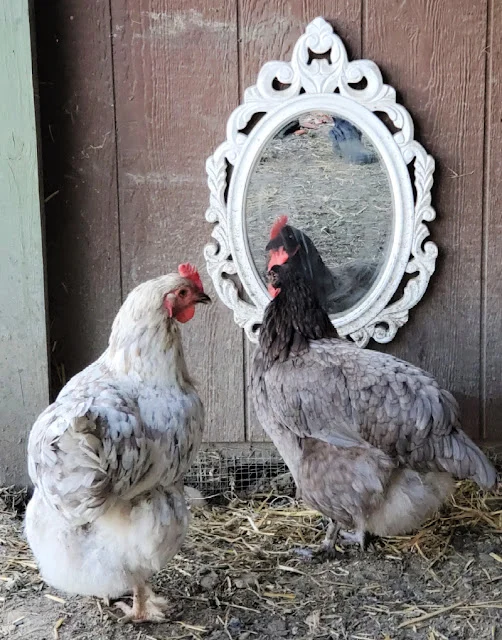
The long-standing scientific boundary between species capable of self-recognition and those deemed to lack such cognitive depth has been challenged by recent longitudinal studies into the behavior of domestic poultry. For decades, the "mirror test" served as the definitive benchmark for determining whether an animal possesses a sense of self. While primates, dolphins, and elephants have historically cleared this hurdle, chickens were long relegated to a lower tier of cognitive complexity. However, new research and behavioral observations suggest that the Gallus gallus domesticus may possess a level of self-awareness that was previously underestimated, necessitating a reevaluation of avian neurobiology and the methods used to measure animal intelligence.

The Evolution of the Mirror Self-Recognition Test
The concept of the mirror test, or Mirror Self-Recognition (MSR), was first developed by psychologist Gordon Gallup Jr. in 1970. The traditional protocol involves anesthetizing an animal and placing a scentless dye or mark on a part of its body that it cannot see without the aid of a reflection, such as the forehead or ear. Upon waking, the animal is presented with a mirror. If the subject investigates the mark on its own body rather than attempting to interact with the reflection as if it were a stranger, it is said to have passed the test. This behavior is interpreted as evidence that the animal understands the reflection is a representation of itself.
Historically, the list of animals that have passed the MSR test is exclusive. It includes great apes (chimpanzees, bonobos, and orangutans), bottlenose dolphins, Eurasian magpies, and Asian elephants. Human children typically reach this developmental milestone at approximately 18 months of age. Conversely, many highly intelligent species, including dogs and cats, consistently fail the traditional MSR test. Scientists argue that these failures may not indicate a lack of self-awareness but rather a sensory mismatch; dogs, for instance, rely more heavily on olfactory cues than visual ones to identify themselves and others.

The 2023 Breakthrough: A New Methodology for Avian Intelligence
In late 2023, a study published in the journal PLOS ONE by researchers at the University of Bonn and other institutions proposed that the traditional "mark test" might be fundamentally flawed when applied to chickens. The researchers argued that chickens, which are highly visual and social creatures, might not be motivated to investigate a mark on their feathers in the same way a primate might touch a mark on its skin. To address this, the team designed an experiment based on the natural social behaviors of roosters, specifically their tendency to emit alarm calls in the presence of predators.
The experiment centered on the "audience effect." In a natural setting, a rooster that spots a predator, such as a hawk, will let out a loud warning call to alert other members of its flock. Crucially, a rooster will typically remain silent if it perceives itself to be alone, as sounding an alarm would only draw the predator’s attention to itself without providing a benefit to any kin. This binary behavior—alarm calling when others are present and silence when alone—provided a perfect framework for a modified mirror test.

Experimental Chronology and Findings
The research team, led by Sonja Hillemacher and Inga Tiemann, conducted a series of trials involving roosters in a controlled environment. The experiment was divided into several distinct phases to ensure the validity of the results:
- The Control Phase (Social Presence): A rooster was placed in a compartment where it could see another rooster in an adjacent enclosure. When a silhouette of a hawk was projected onto the ceiling, the test rooster consistently emitted alarm calls, fulfilling its role as a protector of the flock.
- The Solitary Phase: The rooster was placed in the enclosure alone, with no other birds in sight. When the hawk silhouette appeared, the rooster remained silent in the vast majority of trials, confirming that it recognized the absence of an audience.
- The Mirror Phase: The rooster was placed in the enclosure with a mirror. When the predator silhouette was introduced, the rooster remained silent, despite seeing its own reflection.
The data from these trials was striking. The roosters did not treat their reflection as another bird. If they had perceived the reflection as a rival or a flock mate, they would have sounded the alarm to warn the "other" bird. Their silence strongly suggested that they recognized the reflection as themselves—an entity that did not require a warning. To further verify this, the researchers placed a second rooster behind the mirror so the test subject could see its reflection but not the actual bird. Even in this scenario, the roosters remained silent, indicating that visual recognition is the primary driver of their social communication.

Comparative Cognitive Analysis
The implications of the Bonn study extend beyond the poultry yard. The fact that chickens failed the traditional mark test but passed the behavioral mirror test suggests that many other species may have been unfairly categorized as lacking self-awareness. For example, when chickens are marked with a physical spot, they often ignore it, possibly because they do not prioritize grooming in the same way primates do, or because the mark does not trigger a social response.
In contrast, the use of alarm calls taps into a deeply ingrained survival mechanism. This "ecological" approach to cognitive testing acknowledges that intelligence is not a monolithic trait but is instead tailored to a species’ environmental needs. While a dog may pass a "scent-based" mirror test (recognizing its own urine vs. a stranger’s), a chicken’s path to self-recognition is through its visual and social communication networks.

Reactions from the Scientific Community and Industry
The results of these studies have sparked a range of reactions from ethologists and animal welfare advocates. Dr. Inga Tiemann, one of the study’s authors, noted that the findings suggest chickens are "much more cognitively advanced than previously thought." This sentiment is echoed by poultry experts who have long observed complex social hierarchies, known as "pecking orders," and the ability of individual birds to recognize up to 100 different faces within their flock.
Animal welfare organizations have pointed to this research as a call for better living conditions for domestic poultry. If chickens possess a degree of self-awareness, the ethical implications of high-density industrial farming become even more profound. Advocates argue that providing enrichment—such as perches, dust baths, and even mirrors—is not merely a luxury but a requirement for the mental well-being of a self-aware animal.

Conversely, some skeptics in the scientific community suggest that the roosters’ silence could be interpreted as a failure to recognize the reflection as a living bird, rather than an explicit recognition of the self. However, the consistency of the results across multiple trials has made the "self-recognition" hypothesis the most compelling explanation currently available.
Broader Impact and Practical Implications for Enrichment
The recognition of avian intelligence has led to a surge in interest regarding environmental enrichment for both commercial and backyard flocks. Backyard chicken keepers have frequently reported that their hens spend significant time "preening" in front of mirrors. While this was once dismissed as simple curiosity, the latest research suggests these birds may be engaging in a form of self-maintenance assisted by visual feedback.

Effective enrichment strategies identified by poultry experts include:
- Visual Stimulation: Mirrors can provide a sense of companionship for solitary birds or entertainment for a flock, provided they are placed safely to prevent injury.
- Auditory Enrichment: While xylophones and musical toys have seen varying degrees of success, chickens are known to respond to different frequencies and may benefit from varied soundscapes.
- Physical Challenges: Swings and multi-level perches cater to the bird’s natural instinct to roost and survey their environment.
Conclusion and Future Research
The discovery that roosters may recognize themselves in a mirror represents a significant shift in the field of animal cognition. It challenges the "bird brain" stereotype and places chickens in an elite category of animals capable of self-referential thought. As researchers continue to refine their methods, moving away from human-centric tests and toward species-specific behavioral analysis, it is likely that the list of "self-aware" animals will continue to grow.

Future studies are expected to explore whether female hens exhibit the same mirror-recognition patterns as roosters and whether other domestic birds, such as ducks or geese, possess similar traits. For now, the evidence suggests that the humble chicken is a creature of significant mental depth, possessing a sophisticated understanding of its place in the world and its own reflection within it. This evolving understanding of poultry intelligence not only enriches the scientific record but also mandates a more compassionate and thoughtful approach to the management of these ubiquitous birds.