
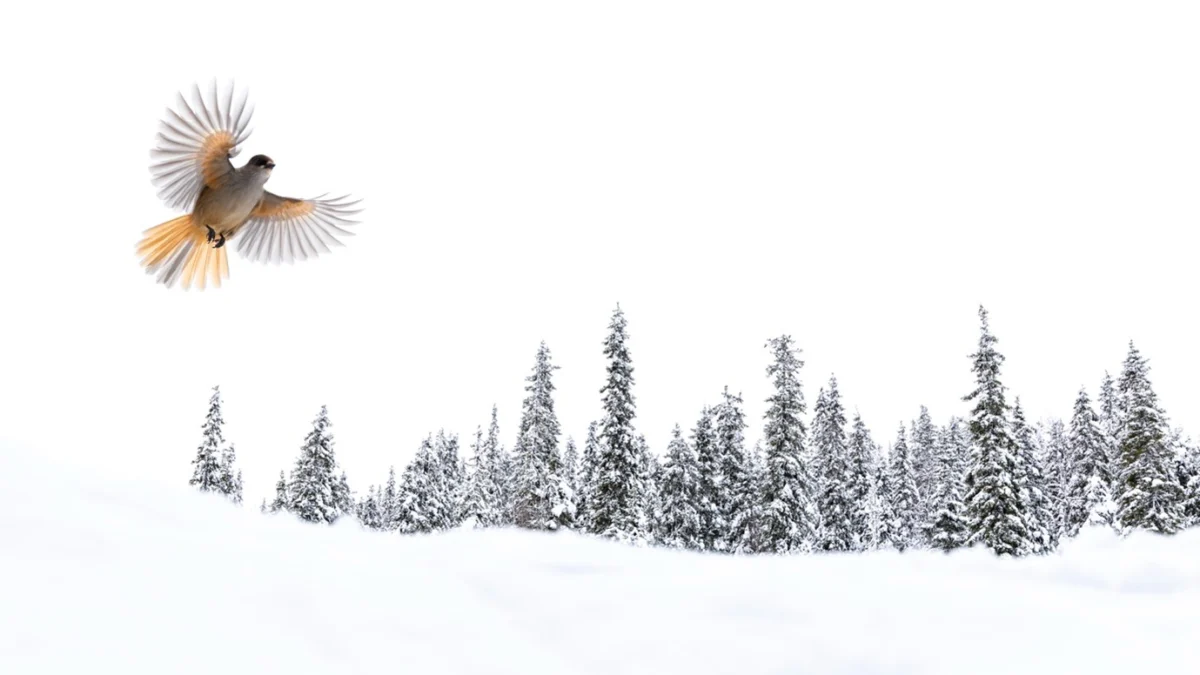
Stefan Gerrits, a renowned nature photographer originally from the Netherlands and now based in Finland, has carved a distinctive niche in the photographic world with his profound minimalist and high-key approach to capturing the natural beauty of the Nordic countries. His work transcends mere documentation, aiming instead to evoke a deeper sense of calm, timelessness, and emotional connection by meticulously stripping away distractions and focusing on the essential. This photographic philosophy, which he describes as "less truly becomes more," transforms vast, often stark Nordic landscapes and their inhabitants into evocative two-dimensional, graphic, and quiet compositions.

The Nordic Canvas: A Landscape of Evocative Simplicity
The Nordic regions of Europe – encompassing countries like Finland, Sweden, Norway, and Denmark – provide an unparalleled backdrop for Gerrits’s artistic vision. Characterized by expansive, often sparsely populated territories, dramatic seasonal shifts, and a unique quality of light, this environment naturally lends itself to a minimalist aesthetic. The long periods of darkness, the pristine, often boundless snowscapes, and the extreme cold compel both nature and observer to simplify. These conditions, far from being deterrents, become integral elements that shape the photographer’s perception and output. Gerrits’s interpretation of the North is not just geographical but experiential, embodying a feeling of spaciousness and emptiness that paradoxically brings peace. This profound connection to the serene, often challenging Nordic environment underpins his commitment to a photographic style that reflects its inherent simplicity and profound silence.

High-Key and Minimalism: A Deliberate Artistic Choice
Gerrits’s methodology hinges on the deliberate application of high-key photography, not merely as a technical setting but as a fundamental creative decision to amplify emotion and draw immediate focus. High-key photography is a style of shooting that uses bright lighting to reduce or eliminate shadows, resulting in an image composed primarily of light tones. This technique often conveys a sense of optimism, purity, and ethereal beauty. When combined with minimalism, it allows the photographer to simplify reality, effectively ignoring superfluous elements and details to reduce the frame to only what is essential. This synergistic approach creates an aesthetic that is both striking and deeply contemplative, forcing the viewer to engage solely with the subject and the vastness surrounding it. By elevating the brightest parts of the image and often employing overexposure, Gerrits imbues his subjects with an almost ethereal quality, enhancing the quietude and imaginative depth he seeks to convey.

The Art of Reduction: Embracing Simpler Compositions
The journey towards photographic minimalism, as articulated by Gerrits, is an incremental process described as "Simple, Simpler, Simplest." It is a skill developed through practice, fostering confidence in the deliberate omission of elements, trusting that what remains is sufficiently powerful and communicative. This process challenges the photographer to continuously ask: "What does this image truly need to be impactful?"

- Initial Simplification: The first step involves aiming for a clean frame, constructing a composition around a singular visual focal point. This might mean isolating a Siberian Jay against a snowy background or capturing Common Cranes as stark silhouettes on a vast white expanse.
- Further Refinement in the Field: During capture, photographers are encouraged to subtly alter their position – moving left or right, tilting the camera, or even lying on the ground – to exclude distracting backgrounds or foregrounds. Framing a subject against a neutral backdrop, such as snow or an expansive sky, is a common tactic. For instance, capturing a Western Capercaillie in a sparse winter environment, as seen in Gerrits’s work, exemplifies this in-field reduction.
- Post-Processing for Purity: When in-field adjustments are insufficient, post-processing becomes a critical tool. Cropping, simplifying tonal ranges, and selectively erasing distracting elements are employed to achieve the desired level of minimalism. This digital refinement ensures that every pixel contributes to the image’s core message, removing anything that does not serve or strengthen the central theme. This rigorous process underscores that minimalism is not about scarcity for its own sake, but about maximizing impact through deliberate reduction.
Beyond Color: The Transformative Power of Monochrome
A significant aspect of Gerrits’s minimalist toolkit is the strategic conversion of images to monochrome or black and white. This is not a default setting but a conscious artistic choice, contingent on whether the subject benefits from the removal of color. While a vibrant butterfly might lose much of its character in black and white, subjects like a mountain hare in its winter coat, with its subtle palette of whites, grays, and faint pinkish tones, are profoundly enhanced.

The absence of color in such images amplifies mood, silence, harmony, and focus, drawing attention to form, texture, and the interplay of light and shadow. Monochrome photography can evoke a sense of timelessness and gravitas that color often cannot. Gerrits frequently utilizes tools like Silver Efex Pro, which offers precise control over contrast, structure, and tonal variations crucial for impactful black-and-white renditions. This deliberate selection underscores that monochrome is a creative decision designed to heighten the emotional resonance of the photograph, rather than merely a technical workaround.
Structural Elegance: Geometric Shapes and Lines as Building Blocks

Geometric forms—angles, triangles, circles, and lines—are foundational to minimalist design and photography, providing clarity, structure, and balance. In Gerrits’s work, these elements offer a strong visual framework for the viewer’s focus. By composing an image around a distinct shape or even a fragment of one, such as a subtle curve suggesting a half-circle, the photographer guides the eye with precision.
For example, a Bearded Reedling clinging to a single reed stem creates a powerful vertical line, isolating the bird against a minimalist background. Similarly, the composition of two Banded Demoiselles waiting for the sun can highlight subtle symmetries and lines within their forms and environment. These geometric elements contribute not only to visual direction but also to a sense of scale, anchoring the subject within its expansive surroundings while maintaining the overall minimalist aesthetic. They transform natural scenes into graphic statements, reinforcing the two-dimensional quality Gerrits often seeks.

Rhythm and Harmony: The Power of Repetition and Symmetry
Repetition and symmetry are potent tools in minimalist photography for establishing rhythm, order, and a playful visual dynamic without introducing clutter. Whether perfectly symmetrical or subtly mirrored, recurring patterns can render an image compelling and even hypnotic. A series of similar subjects, such as the common guillemots "locked in a silent conversation," creates an interesting visual cadence that captures and holds attention.

In Gerrits’s photographs, repetition might manifest in the recurring texture of snow, the pattern of bare branches, or the alignment of multiple subjects. This creates a sense of harmony and balance, guiding the viewer’s eye through the frame while reinforcing the minimalist ethos. The use of repetition in nature photography, particularly in stark Nordic environments, can transform seemingly mundane elements into profound visual statements, emphasizing the underlying order and beauty of the natural world.
The Breath of Space: Negative Space, Isolation, and Visual Balance

Central to minimalist photography is the strategic deployment of negative space, isolation, and visual balance, which together create "breathing space" around the subject. By intentionally incorporating more negative space, Gerrits enhances the aesthetic appeal and amplifies the sense of isolation, imbuing the image with an artistic, contemplative quality. This isolation is not about detachment; rather, it strengthens the connection between the viewer and the sole focal point.
Minimalist images, by their very nature, contain few elements, demanding that the subject carry greater emotional weight. This "wow effect" is often achieved by selecting subjects that inherently convey fragility, vulnerability, rarity, mystery, solitude, or danger. Elusive or endangered species, such as the great gray owl captured against freshly fallen snow, immediately resonate with viewers due to their scarcity and sought-after status. The vast negative space surrounding the owl magnifies its presence and the drama of its hunt.

Furthermore, negative space doesn’t necessarily mean a uniform, monochromatic background. It can be visually interesting while remaining subordinate to the main subject. In the image of a white-throated dipper positioned small within the frame, surrounded by visually engaging yet uniform water, the simplicity of the setting supports the subject without competing. This careful balance ensures that the eye is drawn to the dipper, its solitude emphasized by the tranquil, flowing environment. This deliberate use of space invites viewers to slow down, observe meticulously, and forge a deeper, more mindful connection with the natural world and the subject within it.
Implications and Impact: A Deeper Connection to Nature

Stefan Gerrits’s minimalist and high-key photography offers more than just aesthetically pleasing images; it presents a profound commentary on how we perceive and connect with nature. In an era saturated with information and visual complexity, his work serves as a powerful antidote, inviting viewers to engage in mindful observation. By stripping away extraneous details, he forces a re-evaluation of what is truly essential, both within the frame and in our broader appreciation of the environment.
This deliberate photographic style carries significant implications. Firstly, it fosters a deeper emotional response by presenting subjects in a manner that highlights their inherent beauty, fragility, or resilience. An isolated brown bear, a lone grouse, or a hidden hare, presented within vast, uncluttered space, evokes a more immediate and potent sense of wonder or vulnerability. This, in turn, can cultivate greater empathy and a stronger impulse for conservation, as viewers are encouraged to value the essence of each creature and its environment.

Secondly, Gerrits’s approach subtly challenges the prevailing tendency towards maximalism in visual culture. His philosophy that "what’s not in the frame says just as much as what is" encourages critical thinking about composition and storytelling. It underscores that true power often lies in understatement and suggestion. This artistic discipline reflects not only on the subject and the moment but also on the photographer’s intentionality and unique perspective. Ultimately, Gerrits’s work stands as a testament to the idea that by simplifying our visual language, we can unlock a more profound and lasting engagement with the natural world, fostering stillness, creative thought, and a meaningful connection to nature itself.