
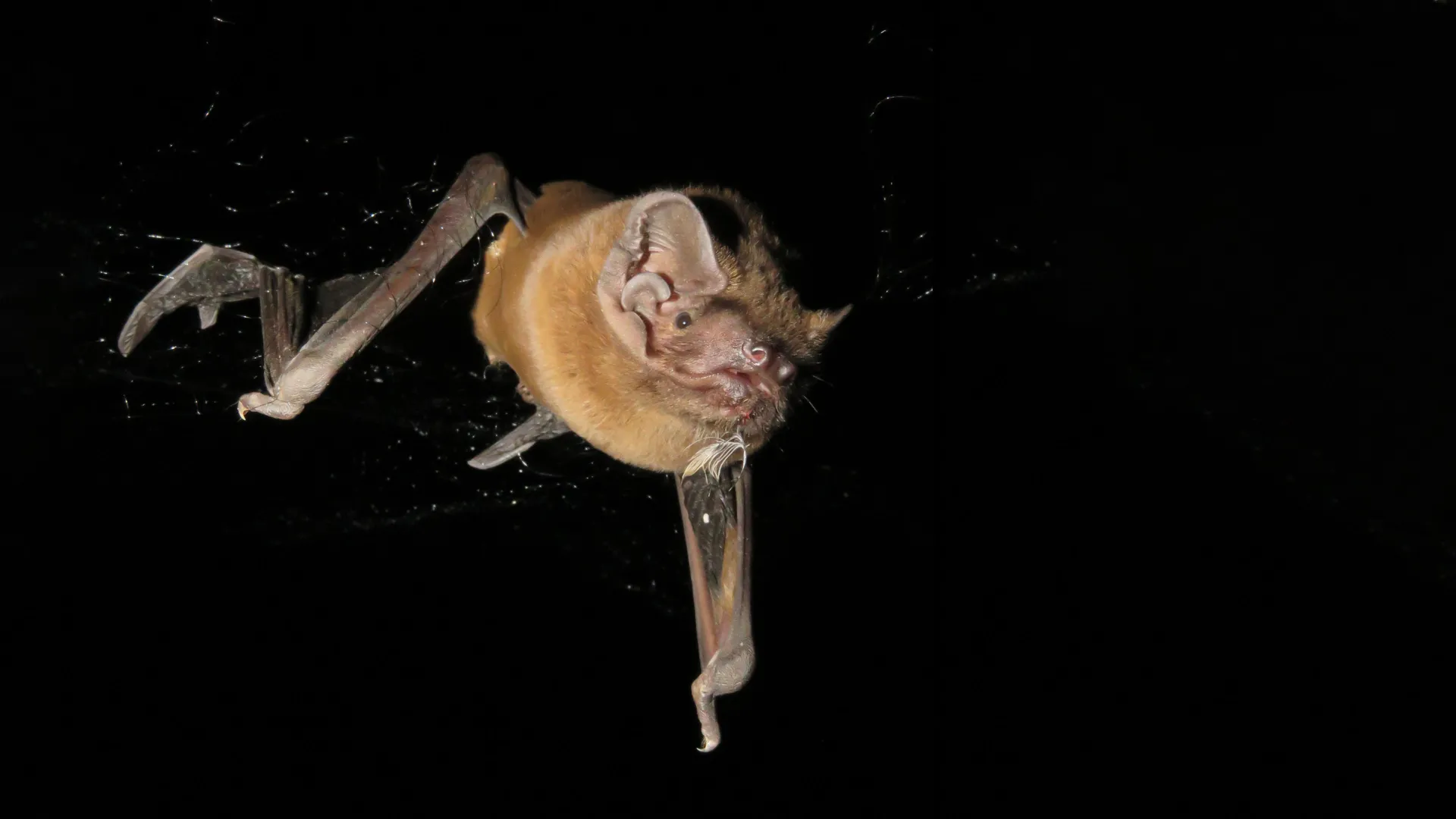
After nearly a quarter century of investigation and persistent scientific inquiry, an international research team has finally solved a remarkable mystery of the nocturnal skies. Europe’s largest bat, the greater noctule (scientific name: Nyctalus lasiopterus), doesn’t merely supplement its diet with small birds; it actively hunts, pursues, captures, and consumes them more than a kilometer above the ground, all while remaining in continuous flight. This astonishing discovery, published in the prestigious journal Science, rewrites our understanding of aerial predation and highlights the sophisticated ecological dynamics unfolding in the darkness above us.
The Unveiling of a Nocturnal Predator
The groundbreaking findings illuminate an intricate ballet of night-time aerial chases, precision attacks, and consumption performed in what to human eyes would be total darkness. For decades, the notion of a bat catching a bird in mid-flight, especially one that could weigh up to half its own body mass, was met with considerable skepticism within the scientific community. However, through a confluence of advanced bio-logging technology and years of dedicated observation, researchers have now provided irrefutable evidence of this extraordinary predatory behavior.
Each year, billions of songbirds undertake perilous migrations between their breeding and wintering grounds. Many species opt for nocturnal travel at high altitudes, a strategy believed to offer refuge from diurnal predators such as hawks and falcons. Yet, as this new research reveals, the cover of darkness introduces its own set of dangers, particularly when navigating territories where bats reign supreme. The greater noctule, a formidable apex predator of the night, demonstrates a mastery of this aerial environment that challenges previous ecological assumptions.
Riding on the Bats’ Backs: A Technological Leap
To unravel the secrets of these elusive hunters, scientists embarked on an ambitious project, effectively "riding along" with individual greater noctules. This was achieved by equipping the bats with minuscule, custom-designed "backpacks" containing biologgers developed by researchers at Aarhus University in Denmark. These state-of-the-art devices, weighing mere grams to minimize impact on the bats’ flight, were engineered to record a wealth of crucial data. They meticulously measured altitude, acceleration, movement patterns, and, critically, the bats’ echolocation calls – the ultrasonic sounds they emit to navigate and hunt. This unprecedented data stream offered an intimate, real-time glimpse into their nocturnal hunting strategies, often occurring at altitudes exceeding a kilometer above the earth’s surface.
The data analysis painted a vivid picture: the greater noctules ascend to impressive heights in the night sky, positioning themselves to detect and ambush unsuspecting birds. A key advantage for the bats lies in the fact that birds, unlike insects, are largely unable to detect the ultrasonic calls used by bats for echolocation. This gives the bats a significant element of surprise, with birds often becoming aware of the danger only moments before capture. The bats’ success hinges on their ability to produce powerful, low-frequency echolocation calls that possess a remarkable range, allowing them to detect birds from considerable distances. As they close in on a target, the bats transition from their long-range detection calls to rapid bursts of shorter, higher-frequency calls, signaling the final, critical stage of their attack sequence.
Daring Dives and Aerial Combat
The information gleaned from the biologgers provided dramatic insights into the physical mechanics of these hunts. The bats were observed executing steep, high-speed dives towards their prey, maneuvers described by researchers as reminiscent of fighter jets engaging in combat. These descents are not merely passive drops; they are active, controlled plunges requiring immense physical exertion.
In two particularly well-documented chase events, the biologgers recorded dives lasting 30 and an astonishing 176 seconds, respectively. During these pursuits, the bats significantly increased their wing-flapping frequency and intensity, tripling their acceleration in a burst of concentrated effort, all while continuously emitting a barrage of attack calls. While the first bat eventually abandoned its pursuit – a testament to the agility of birds as aerialists – the second chase culminated in a successful capture. This pursuit lasted nearly three minutes, concluding with the bat seizing a robin close to the ground.
Perhaps the most compelling evidence came from the integrated microphones within the biologgers. These devices recorded 21 distinct distress calls from the unfortunate robin, followed by a chilling 23 minutes of chewing sounds as the bat flew at a lower altitude, feeding on its prey while still in mid-air. This auditory evidence, combined with post-hunt analysis of bird wings found beneath known hunting areas using X-ray and DNA techniques, provides a comprehensive understanding of the entire predatory sequence. The bat kills the bird with a swift bite, then meticulously removes its wings – a crucial step likely performed to reduce aerodynamic drag and facilitate easier handling of the prey. Subsequently, the bat utilizes the membrane stretched between its hind legs as a makeshift pouch, allowing it to securely hold and consume the bird while maintaining continuous flight.
Wild Maneuvers and Energetic Demands
Assistant Professor Laura Stidsholt from the Department of Biology at Aarhus University, a lead author of the study, vividly describes the complexity of these interactions. "We know that songbirds perform wild evasive maneuvers such as loops and spirals to escape predators like hawks during the day – and they seem to use the same tactics against bats at night. It’s fascinating that bats are not only able to catch them, but also to kill and eat them while flying. A bird like that weighs about half as much as the bat itself – it would be like me catching and eating a 35-kilo animal while jogging," she explained, emphasizing the extraordinary physiological demands of such a feat.
Stidsholt’s expertise in perfecting biologger technology has been instrumental in numerous bat research discoveries. Her work for this project, including data collection and analysis, was conducted during her tenure as a Postdoc at the Leibniz Institute for Zoo and Wildlife Research (Leibniz-IZW) in Berlin, underscoring the collaborative international nature of this research. The successful deployment of these miniature, sophisticated devices represents a significant advancement in wildlife tracking and behavioral ecology.
A 25-Year Hypothesis Confirmed
The confirmation of bird predation by greater noctules is the culmination of decades of dedicated effort and a remarkable scientific journey. For nearly 25 years, scientists had harbored suspicions that certain large bat species engaged in bird predation during flight. Much of this pioneering work originated from the insights and relentless efforts of Spanish bat expert Carlos Ibáñez and his colleagues at the Doñana Biological Station (CSIC) in Seville.
As far back as the late 1990s, Ibáñez made a pivotal discovery: he found bird feathers in the droppings of greater noctules. This seemingly simple observation sparked a quarter-century quest to gather definitive evidence that these bats were indeed avian predators. His team at Doñana Biological Station meticulously monitored this elusive, forest-dwelling species, employing "smart" roosts equipped with antennas designed to detect implanted microchips in the bats. This advanced system allowed them to track movements, store valuable data, and even send real-time alerts to researchers’ phones, providing an unprecedented level of insight into the bats’ daily lives.
Despite the mounting circumstantial evidence, the idea that bats could successfully catch birds midair continued to face considerable skepticism within the scientific community. The sheer challenge of capturing a bird weighing nearly half as much as the bat itself, coupled with the inherent difficulties of observing such events in total darkness, made direct confirmation seem almost insurmountable. Filming these hunts was impossible with existing technology. Over the years, researchers experimented with a diverse array of observational tools, including roost cameras, military radar, hot-air balloons equipped with ultrasound recorders, and various iterations of GPS trackers. The persistent challenge remained creating tools light enough for the bats to carry without impeding their natural behavior or flight capabilities.
Finally, with the advent of the new miniature biologgers from Aarhus University, and just as Carlos Ibáñez approached retirement, the team achieved their long-sought breakthrough. The successful recording of a greater noctule hunting and consuming a bird in flight provided the conclusive proof that had eluded scientists for so long, vindicating Ibáñez’s decades of perseverance.
Voices from the Field: Thrill and Sobering Reality
For co-author Elena Tena, the moment of hearing the recorded evidence was a powerful experience, described as both thrilling and sobering. "While it evokes empathy for the prey, it is part of nature. We knew we had documented something extraordinary. For the team, it confirmed what we had been seeking for so long. I had to listen to it several times to fully grasp what we had recorded," Tena shared, conveying the profound impact of finally witnessing the culmination of years of dedicated work. Carlos Ibáñez, whose hypothesis had been central to the investigation, expressed deep satisfaction at the definitive proof, a testament to the importance of long-term ecological studies.
Ecological Implications and Broader Significance
This discovery significantly enriches our understanding of predator-prey dynamics in nocturnal ecosystems. It places the greater noctule higher on the trophic ladder than previously assumed, establishing it as a top aerial predator of migratory birds. The fact that these hunts occur at such high altitudes adds another layer of complexity to the challenges faced by migratory birds, highlighting a previously unrecognized selective pressure. The research also underscores the incredible adaptability and specialized sensory capabilities of bats, particularly their sophisticated echolocation systems, which are finely tuned to detect and track fast-moving avian prey.
Furthermore, this study serves as a powerful testament to the advancements in bio-logging technology. The ability to deploy such miniature, multi-sensor devices opens new avenues for studying the behavior of elusive species in their natural habitats, offering insights that were once considered impossible. It exemplifies how technological innovation can unlock fundamental ecological secrets, bridging gaps in our knowledge of the natural world.
Essential for Bat Conservation
Despite the dramatic nature of these findings, it is crucial to emphasize that the greater noctule bats pose no threat to overall songbird populations. The greater noctule itself is an extremely rare and endangered species across many regions of Europe. Its populations have suffered significant declines, primarily due to habitat loss, particularly the destruction and fragmentation of the mature forest ecosystems where it roosts and forages.
Therefore, understanding its behavior and ecology, including its unique predatory strategies, is not merely an academic exercise. This research is now vital for developing effective conservation and management strategies that can help protect this magnificent and extraordinary nocturnal predator. By gaining a deeper appreciation for its ecological role and habitat requirements, scientists and conservationists can work towards safeguarding the future of the greater noctule, ensuring that this aerial marvel continues its high-flying hunts for generations to come. The study provides critical data for informing conservation policies, potentially influencing forest management practices and the establishment of protected areas that specifically cater to the needs of this specialized bat species. This groundbreaking research not only solves a long-standing scientific mystery but also serves as a critical call to action for the preservation of one of Europe’s most fascinating and vulnerable nocturnal inhabitants.