
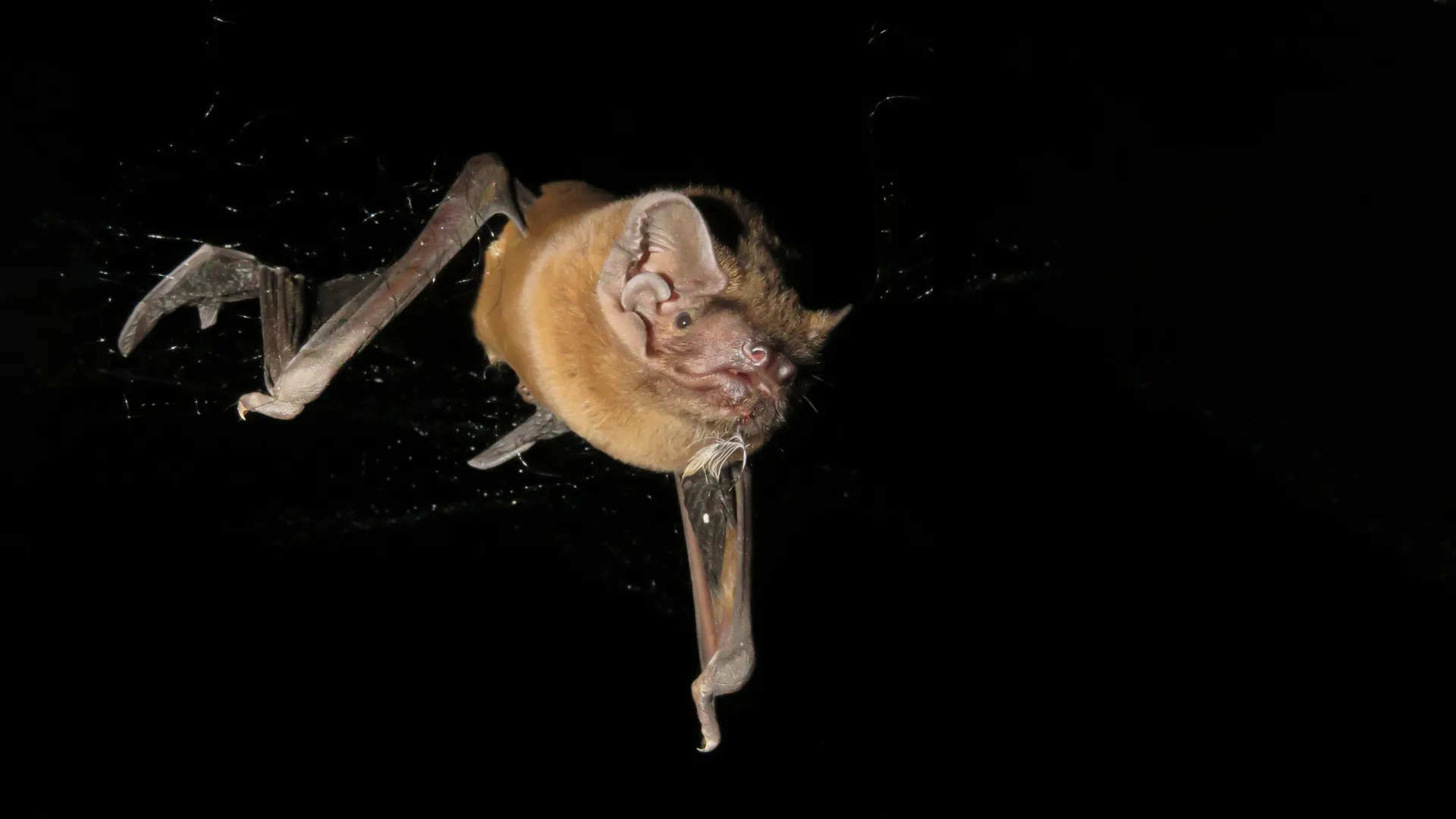
After nearly a quarter-century of intensive investigation, an international consortium of scientists has definitively solved a remarkable ecological mystery, confirming that Europe’s largest bat, the greater noctule (Nyctalus lasiopterus), is not merely an opportunistic feeder but a sophisticated aerial predator capable of hunting, capturing, and consuming small birds more than a kilometer above the ground while still in flight. This groundbreaking discovery, detailed in the prestigious journal Science, offers an unprecedented glimpse into the complex and often brutal predator-prey dynamics of the nocturnal skies, challenging long-held assumptions about the safety of avian migration.
The findings illuminate an astonishing narrative of night-time aerial chases, precision attacks, and consumption in total darkness, fundamentally altering our understanding of the greater noctule’s ecological role and the dangers faced by billions of migratory songbirds. These birds, undertaking vast journeys between breeding and wintering grounds each year, often travel under the cloak of darkness and at high altitudes, primarily to evade the numerous diurnal predators such as raptors. However, this study reveals that the night sky, once considered a sanctuary from certain threats, harbors its own formidable hunters.
Unveiling the Aerial Hunter: The Greater Noctule Bat
The greater noctule, a magnificent mammal with a wingspan that can reach up to 45 centimeters and weighing between 18 and 40 grams, is a species of significant conservation concern, listed as Near Threatened by the IUCN in some parts of its range. Historically, its diet was understood to consist primarily of large insects. However, anecdotal evidence and observations over decades hinted at a more complex dietary profile, including small birds. This research provides irrefutable proof, painting a vivid picture of a highly specialized predator.
To penetrate the veil of night and understand these elusive hunters, scientists employed an innovative approach: they effectively "rode along" with individual greater noctules. This involved fitting the bats with tiny, cutting-edge biologgers, miniature "backpacks" developed at Aarhus University. These lightweight devices, carefully designed to not impede the bats’ flight, were marvels of miniaturization. They contained an array of sensors, including altimeters to measure altitude, accelerometers to track movement and speed, gyroscopes to record orientation, and highly sensitive microphones to capture the bats’ echolocation calls and any other sounds made during their nocturnal expeditions. This unprecedented suite of data offered an intimate, moment-by-moment look at their hunting strategies more than a kilometer above the ground.
The wealth of data transmitted by these biologgers revealed a sophisticated hunting strategy. The bats ascend to impressive heights in the night sky, positioning themselves to intercept unsuspecting birds. Crucially, birds, unlike insects, are largely deaf to the ultrasonic calls bats use for echolocation. This gives the greater noctule a significant advantage, allowing them to close in on their targets, often undetected until the final, critical moments. Their success hinges on the emission of powerful, low-frequency echolocation calls, which, while offering less detailed information than higher frequencies, can travel much further, enabling the detection of birds at considerable distances. As a bat closes in on its target, it switches to rapid bursts of shorter, higher-frequency calls, a precise acoustic "lock-on" signaling the final stage of attack and allowing for highly accurate spatial tracking.
A Quarter-Century Quest: The Chronology of a Scientific Breakthrough
The idea that some large bat species prey on small birds during flight is not new. For nearly 25 years, this hypothesis had been championed by a dedicated group of scientists, most notably Spanish bat expert Carlos Ibáñez and his colleagues at the Doñana Biological Station (CSIC) in Seville. Ibáñez’s pioneering work began in the late 1990s when he first discovered bird feathers in the droppings of greater noctules. This initial clue ignited a long-term quest to gather more definitive evidence that these bats were indeed bird predators.
Despite the tantalizing evidence, the concept was met with considerable skepticism within the scientific community. The sheer agility of songbirds, their relatively substantial weight (often approaching half that of the bat itself), and the inherent difficulty of capturing them in total darkness made the notion seem improbable to many. Proving such an extraordinary behavior required direct observation, a task that proved monumentally challenging.
Over the years, Ibáñez’s team and collaborators experimented with a myriad of technologies. They deployed roost cameras in an attempt to capture bats bringing prey back, utilized military radar to track aerial movements, launched hot-air balloons equipped with ultrasound recorders to listen in on high-altitude activity, and tested early GPS trackers. Each attempt, while contributing incrementally to the understanding of bat ecology, ultimately fell short of providing the conclusive visual or acoustic proof needed. The primary hurdle remained the miniaturization of tracking devices; early GPS units and other sensors were simply too heavy for bats to carry without significantly impairing their flight and natural behavior.
Ibáñez’s team also implemented an ingenious system of "smart" roosts. These specially designed bat boxes were equipped with antennas that could detect implanted microchips in the bats, tracking their movements, storing data, and even sending real-time alerts to researchers’ phones. This provided invaluable data on the bats’ presence and activity patterns but could not directly document the mid-air hunts.
The breakthrough finally arrived with the advent of the new generation of miniature biologgers from Aarhus University. Just as Carlos Ibáñez was nearing retirement, the confluence of persistent scientific inquiry and cutting-edge technological development enabled the team to achieve their long-sought goal: the first-ever direct recording of a greater noctule hunting and consuming a bird in flight. This moment marked the culmination of decades of dedication and a testament to the power of sustained scientific investigation.
The Hunt Unfolds: A Nocturnal Ballet of Predator and Prey
The data retrieved from the biologgers painted a dramatic and detailed picture of the hunts. Information on acceleration, altitude changes, and echolocation patterns vividly described the bats plunging toward their prey in steep, high-speed dives. These maneuvers were reminiscent of fighter jets engaged in aerial combat, demonstrating incredible agility and precision in the dark.
In two particularly well-documented chases, the biologgers recorded dives lasting 30 and an astonishing 176 seconds, respectively. During these pursuits, the bats significantly increased their flapping intensity, tripling their acceleration and continuously emitting a rapid succession of attack calls – the acoustic equivalent of a fighter jet’s targeting system. The first bat, after a strenuous effort, eventually abandoned its pursuit; small birds, despite the darkness, are remarkably agile aerialists and possess their own repertoire of evasive maneuvers.
However, the second bat proved successful. After a nearly three-minute chase, it managed to capture a robin, likely a migratory individual, near the ground. The attached microphones provided the chilling, yet scientifically invaluable, auditory evidence: 21 distinct distress calls from the robin, followed by a prolonged period of 23 minutes of chewing as the bat flew low, feeding on its catch while still airborne.
This auditory evidence, combined with subsequent X-ray and DNA analysis of bird wings discovered beneath known bat hunting areas, provided a comprehensive understanding of the entire predatory sequence. Once captured, the bat swiftly kills the bird with a precise bite. To reduce aerodynamic drag and facilitate in-flight consumption, it then removes the bird’s wings. The bat then ingeniously utilizes the membrane between its hind legs – known as the uropatagium – as a makeshift pouch to hold and consume its prey, all while maintaining flight. This incredible feat of dexterity and aerial multitasking underscores the greater noctule’s remarkable adaptations.
Expert Insights and Reactions
The research team’s reactions to this long-awaited confirmation were a mix of scientific validation and profound awe. Assistant Professor Laura Stidsholt from the Department of Biology at Aarhus University, a lead author of the study, reflected on the sheer athleticism of the bats. "We know that songbirds perform wild evasive maneuvers such as loops and spirals to escape predators like hawks during the day – and they seem to use the same tactics against bats at night. It’s fascinating that bats are not only able to catch them, but also to kill and eat them while flying," Stidsholt explained. She vividly illustrated the challenge: "A bird like that weighs about half as much as the bat itself – it would be like me catching and eating a 35-kilo animal while jogging." Stidsholt’s expertise in perfecting biologger technology has been pivotal in numerous bat research discoveries. At the time of this project’s data collection and analysis, she was a Postdoc at the Leibniz Institute for Zoo and Wildlife Research (Leibniz-IZW) in Berlin, highlighting the international collaborative nature of the research.
For co-author Elena Tena, hearing the actual recording was a moment of profound impact, described as both thrilling and sobering. "While it evokes empathy for the prey, it is part of nature," Tena remarked. "We knew we had documented something extraordinary. For the team, it confirmed what we had been seeking for so long. I had to listen to it several times to fully grasp what we had recorded." Her statement encapsulates the scientific detachment required for objective research, tempered by the emotional weight of witnessing such a raw display of the natural world.
Ecological Ramifications and Broader Context
This discovery has significant implications for our understanding of nocturnal ecology and predator-prey dynamics. The long-held assumption that night offered a relatively safe passage for migratory birds against all but a few specialized owl species must now be re-evaluated. The greater noctule, and potentially other large bat species, represents a previously underestimated selective pressure on avian migrants. While the study emphasizes that these bats pose no threat to overall songbird populations due to their rarity, their presence introduces another layer of complexity to the already perilous journeys of migratory birds.
The finding also enriches the broader understanding of bat dietary diversity. While many bats are insectivores, frugivores, or nectarivores, and some specialized species are known to prey on fish, frogs, or even blood, the confirmation of regular, in-flight avian predation by a European bat adds a crucial dimension to their ecological roles. It demonstrates an evolutionary adaptation to exploit a high-energy food source during periods of abundance, such as during mass bird migrations.
Furthermore, this research underscores the incredible evolutionary ingenuity of bats. Their ability to navigate, hunt, and consume prey in complete darkness using echolocation is a marvel of sensory biology. The specific adaptations of the greater noctule, including its powerful low-frequency calls for long-range detection and its physical prowess for mid-air capture and consumption, highlight a finely tuned predatory specialization.
Conservation Imperative
Despite its formidable hunting prowess, the greater noctule bat is an extremely rare and endangered species in many regions across Europe. Its populations have suffered significant declines due to a variety of anthropogenic factors, primarily the loss and fragmentation of its preferred habitat: mature deciduous forests with abundant large, old trees for roosting in hollows. Other threats include the increased use of pesticides, which reduce its insect prey base, and the impacts of climate change on both its habitat and prey availability.
The detailed understanding of the greater noctule’s behavior and ecology, including its unique predatory strategies, is now more vital than ever for developing effective conservation and management strategies. Knowing that it relies on specific prey items like migratory birds, and the altitudes at which it hunts, can inform forest management practices, habitat restoration efforts, and the designation of protected areas. Conservation efforts must consider the full spectrum of its ecological requirements, from its roosting sites to its foraging grounds and the integrity of migratory flyways. This study serves as a powerful reminder that protecting a species requires a comprehensive understanding of its place within the intricate web of life, ensuring that one of Europe’s most extraordinary nocturnal predators can continue to thrive.
Future Directions
The success of the miniaturized biologgers in this study opens new avenues for ecological research. This technology can now be applied to other elusive species, offering unprecedented insights into their movements, behaviors, and interactions within their environments. Researchers anticipate further studies utilizing these advanced trackers to investigate the precise routes and altitudes of migratory birds, the energetic costs of these daring hunts for the bats, and whether similar predatory behaviors exist in other large bat species globally. The revelation of the greater noctule’s aerial mastery is not just the end of a long scientific quest but a springboard for countless future discoveries in the hidden world of nocturnal wildlife.