
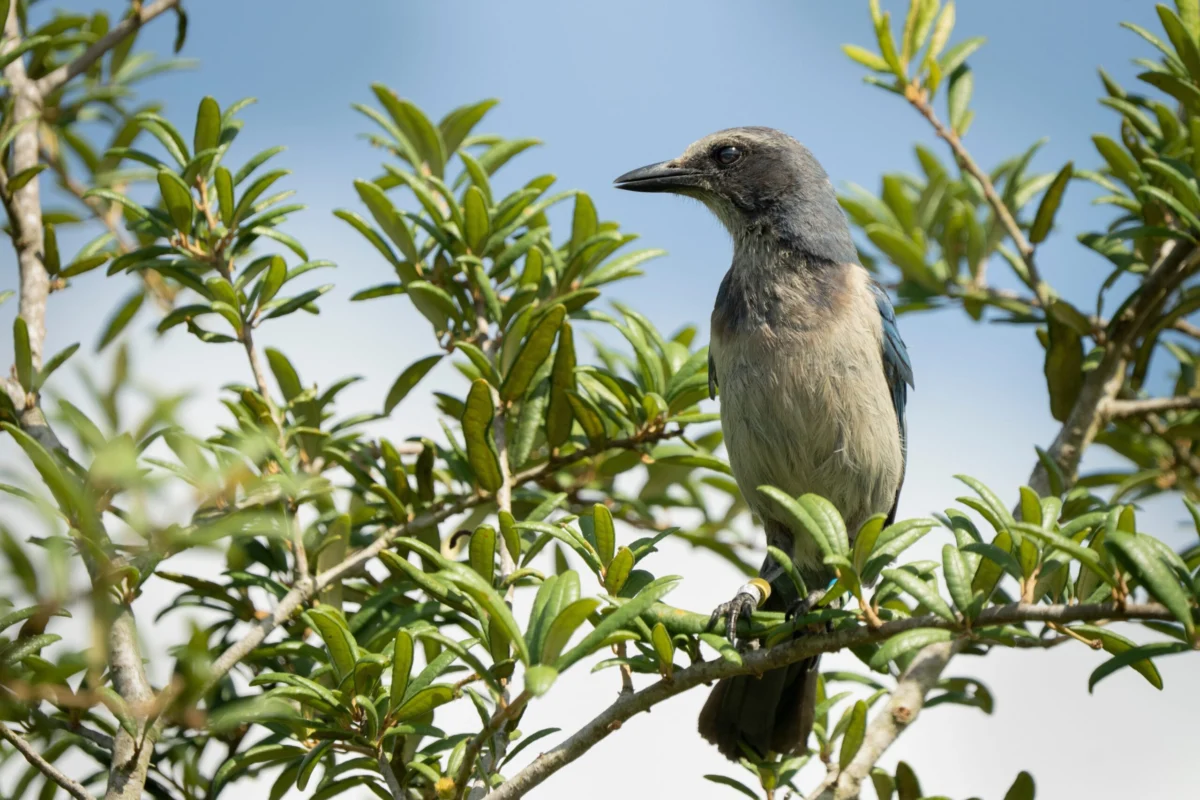
The Florida Scrub-Jay, a bird of unwavering character and singular demands, stands as a poignant emblem of Florida’s imperiled natural heritage. This species, exclusively found within the Sunshine State, embodies an extraordinary adaptation to one of North America’s most unique and overlooked biodiversity hotspots: the Florida scrub habitat. Characterized by its searing sandy soils, dwarfed oak thickets, and a historical rhythm of natural fires, this ecosystem, much like the scrub-jay itself, is an anomaly of life. The very survival of these charismatic birds, known for their dramatic, flashy, and entertaining personalities, is inextricably linked to the health of this specialized environment, which has been drastically altered by human expansion.
A Unique Species in a Unique Landscape
The Florida Scrub-Jay ( Aphelocoma coerulescens ) is not merely a bird; it is an ecological architect and indicator species. Unlike other jays, it is non-migratory and highly territorial, living in cooperative family groups. Their "strong opinions" are not merely anecdotal; they are evolutionary imperatives. They demand specific conditions: open, sandy patches for acorn caching, short scrub oaks for perching and predator avoidance, and a landscape periodically swept by fire to prevent overgrowth. Their evolutionary journey spans over two million years, during which they developed an intimate, co-dependent relationship with fire, a natural force that historically maintained the health of their scrub habitat.
The Florida scrub itself is a relic of ancient coastlines, formed on relict sand dunes when sea levels were higher. Its coarse, nutrient-poor sands drain rapidly, creating arid conditions despite Florida’s abundant rainfall. This seemingly harsh environment, however, teems with specialized life. Beyond the scrub-jay, at least 40 species of plants, eight species of vertebrates, and 40 species of invertebrates are endemic to this habitat. Among these are federally endangered species such as the Florida mouse, sand skink, Florida rosemary, and scrub mint, all intricately woven into the scrub’s ecological tapestry. This unique assemblage of life, adapted to infrequent but intense lightning-ignited fires (and historically, controlled burns by Indigenous peoples), represents a biodiversity hotspot often overshadowed by Florida’s more famous wetlands and beaches. Fire, occurring every 15-20 years, acts as a critical reset button, promoting new growth in scrub oaks for acorn production, maintaining the vital sandy openings for acorn storage, and preventing taller trees that offer perches for predators from dominating the landscape.
The Perilous Decline: Habitat Loss and Fire Suppression
The specialized traits that allowed scrub-jays to thrive for millennia became their greatest vulnerability when human activity began to drastically alter their environment. Beginning in the 19th century and accelerating through the 20th, Florida underwent rapid transformation. Vast swathes of scrub habitat were cleared for agriculture, particularly citrus groves, and later for sprawling residential and commercial development. Simultaneously, the life-sustaining fires, once a natural and Indigenous-managed process, were aggressively suppressed due to concerns for human safety and property.
The consequences for the Florida Scrub-Jay were catastrophic. Without periodic fires, the scrub habitat quickly became overgrown, transitioning into dense woodlands unsuitable for the jays. The open sandy patches vanished, scrub oaks grew too tall, and predator cover increased. The jays, unable to adapt to these rapid changes, disappeared from these altered landscapes. The cumulative impact of habitat loss and fire suppression led to a staggering 90 percent decline in the Florida Scrub-Jay population since the early 1900s. Recognizing this precipitous drop and the ongoing threats, the U.S. Fish and Wildlife Service federally declared the Florida Scrub-Jay a threatened species in 1987 under the Endangered Species Act, a critical step towards acknowledging its dire situation and initiating conservation efforts.
Today, the remaining scrub-jay population is fragmented, existing primarily in isolated pockets of suitable habitat. Approximately 70 percent of the species’ total population is concentrated in four major strongholds: the vast Ocala National Forest, the coastal Merritt Island National Wildlife Refuge, the secure confines of the Cape Canaveral Space Force Station, and the scientifically dedicated Archbold Biological Station. These large, relatively intact areas provide crucial refuge. However, the remaining 30 percent cling to survival in smaller, scattered fragments of scrub habitat, primarily on public lands across central Florida. While these smaller parcels are individually vital, their fragmented nature presents significant management challenges. Many local land managers overseeing these smaller properties often lack the dedicated staff, financial resources, and specialized expertise required for consistent monitoring and effective habitat management, a critical hurdle for species recovery.
Jay Watch: A Community Science Imperative
The pressing need for comprehensive monitoring on these smaller, often overlooked habitat fragments did not go unnoticed. In 2002, The Nature Conservancy recognized this critical gap and launched Jay Watch, an innovative community science program designed to empower and train volunteers to monitor scrub-jays on properties lacking the capacity to do so themselves. This initiative marked a pivotal shift, harnessing the power of citizen engagement to address a complex conservation problem.
Over the years, the program evolved, demonstrating its efficacy and broader appeal. In 2011, Jay Watch was transferred to the Florida Fish and Wildlife Conservation Commission (FWC), a testament to its growing importance in state-level conservation strategies. The following year, in 2012, management of Jay Watch transitioned to Audubon Florida, where it has since flourished under their expert coordination. The core mission of Jay Watch remains steadfast: to furnish land managers with accurate, timely data essential for restoring and maintaining viable scrub-jay populations across these crucial, smaller properties.
Each year, dedicated teams of Jay Watch volunteers embark on comprehensive surveys across 46 to 50 sites. The timing is critical: surveys are conducted during Florida’s sweltering summers, specifically after scrub-jay chicks have fledged and are visible, typically from late May through July. This period allows for accurate family counts and assessment of reproductive success. Over three intensive days at each site, volunteers meticulously inventory the scrub-jay populations. They count the number of family groups, painstakingly map their territories, assess their reproductive success by noting the presence and number of fledglings, and ultimately provide a total population count for the site. This rigorous methodology ensures consistency and reliability in the collected data.
Translating Data into Action: Guiding Habitat Restoration
The raw data collected by Jay Watch volunteers are invaluable, but their true power lies in their transformation into actionable insights for land managers. Audrey DeRose-Wilson, Director of Bird Conservation for Audubon Florida and the dedicated coordinator of Jay Watch, spearheads this crucial translation process. For every property surveyed, DeRose-Wilson meticulously compiles the data, creating detailed maps illustrating scrub-jay territories and the demographic composition of each family, including the ratio of adults to juveniles.
These maps and demographic trends serve as critical diagnostic tools. Because Florida Scrub-Jays are exceptional indicators of habitat health – their presence and reproductive success directly reflecting the suitability of the scrub – areas where jays are absent or declining signal to managers that the habitat is degrading. Specifically, these indicators often point to a need for intervention, typically "knocking back" taller trees and shrubs that have encroached upon the open scrub environment.
Ideally, managers address this overgrowth through prescribed burns, mimicking the natural fire regime to which the scrub has adapted. Prescribed burns are a cost-effective and ecologically beneficial method, stimulating new growth and maintaining the desired open structure. However, in many fragmented parcels surrounded by residential areas, roads, and other infrastructure, conducting prescribed burns is often impractical or poses unacceptable risks. In such scenarios, land managers resort to mechanical alternatives, primarily brush mowers, to simulate the effects of fire by physically removing overgrown vegetation. Jay Watch data provides the scientific basis for these decisions, indicating not only where restoration is needed but also whether current management strategies are yielding positive results, evidenced by increasing scrub-jay populations and improved reproductive success.
Case Studies: Jay Watch’s Tangible Impact
The impact of Jay Watch extends beyond mere data collection; it has directly shaped conservation outcomes, demonstrating the profound influence of sustained community science efforts over time. One particularly notable success story unfolded at the Marjorie Harris Carr Cross Florida Greenway, a significant state park. In 2001, the state acquired a 446-acre property adjacent to the greenway. This parcel, having gone unburned for many years, was severely overgrown and no longer represented suitable scrub-jay habitat. Surprisingly, a state employee discovered a small, isolated population of eight scrub-jays clinging to survival on the property.
Laurie Dolan, an environmental specialist with the Florida Department of Environmental Protection (FDEP) who helps manage the greenway, recognized the urgency of the situation. She initiated an ambitious habitat restoration project, aiming to reclaim the overgrown land and save this dwindling population. To guide these efforts and accurately monitor the jays’ response, Dolan immediately requested assistance from Jay Watch volunteers to inventory the unexpected population.
The partnership proved invaluable. As Dolan’s team systematically restored tracts of scrub habitat – clearing overgrown vegetation and conducting controlled burns where feasible – Jay Watch volunteers meticulously tracked the scrub-jays’ response. "The volunteers have been critical for us. I can’t tell you how important they’ve been from the very beginning," Dolan emphasizes. With the capacity of five volunteer teams, they are able to survey the entire 1,000-acre site, a substantial undertaking, in just three days. Dolan notes, "We wouldn’t be able to do that with just our own staff," highlighting the indispensable role of volunteer labor in achieving comprehensive coverage. Over two decades of dedicated management and consistent monitoring facilitated by Jay Watch, Dolan and her team have witnessed a remarkable recovery: the scrub-jay population at this site has grown from a precarious eight individuals to more than 100, a testament to effective restoration guided by reliable data.
The program’s reach and impact are substantial. In a recent year (2025 data provided), approximately 150 volunteers participated in Jay Watch surveys, collectively contributing over 1,200 hours of invaluable work. This dedicated volunteer force fills a critical void, providing essential monitoring data to land managers who would otherwise lack the resources to gather it. This network of informed management decisions helps maintain the interconnected web of habitat parcels that supports a full third of the species’ remaining population. Audrey DeRose-Wilson reiterates the sentiment of dependence: "They’re depending on the volunteers, and I certainly couldn’t cover this ground in this short amount of time." Beyond direct site management, Jay Watch data is also shared with the state of Florida, where it informs broader species management plans and regional conservation strategies. Cities and counties across central Florida similarly leverage this data for localized management decisions affecting specific scrub-jay sites within their jurisdictions.
Beyond Data: Fostering Community and Conservation Advocacy
While the primary objective of Jay Watch is to generate critical population data, its impact extends far beyond mere numbers. Monitoring endangered wildlife populations through dedicated staff is standard practice, but relying on a robust network of trained volunteers to do so is a unique and powerful approach. This engagement of community members serves a dual purpose: it not only bolsters the operational capacity for conservation efforts but also cultivates invaluable societal support for the Florida Scrub-Jay and its imperiled habitat.
DeRose-Wilson explains this synergistic effect: "They come, they get invested, they learn about conservation, and they take that information back into their communities and share it with all the people they know." This grassroots outreach has translated into tangible, real-world conservation outcomes in several instances, demonstrating the power of an informed and engaged citizenry.
In 2024, a proposal emerged to construct a golf course within Jonathan Dickinson State Park, a site that harbors an important scrub-jay population. Jay Watch volunteers, armed with their firsthand knowledge and deep investment in the species, joined an organized effort to protest the development. They actively lobbied elected officials and rallied public opposition, emphasizing the ecological value of the park’s scrub habitat. Thanks to this significant public pushback and advocacy, the golf course proposal was ultimately withdrawn, safeguarding a vital scrub-jay refuge.
Another compelling example occurred in eastern Florida at the Malabar Scrub Sanctuary. This sanctuary had suffered years of neglect, leading to dense overgrowth and the local extirpation of its scrub-jay population. In 2023, when Brevard County proposed a necessary restoration plan involving tree removal to revert the habitat to its natural scrub state, a group of recreational mountain bikers opposed the plan, fearing the loss of their shaded trails. Again, Jay Watch volunteers stepped forward. They attended community meetings, patiently explaining the ecological imperative of tree removal and the critical role of fire or mechanical clearing in restoring scrub habitat for the jays. Their informed advocacy helped sway public opinion, and the restoration efforts proceeded. As a direct result, scrub-jays have since returned to the sanctuary, a clear victory for science-backed conservation and community engagement.
Global Relevance and Enduring Dedication
The plight of the Florida Scrub-Jay, though geographically localized, mirrors a pervasive global conservation challenge. Like countless species worldwide, these jays exist within an ecosystem drastically altered by human activity. Restoring their populations necessitates decisive, often seemingly drastic, steps – such as cutting down trees or deliberately lighting fires – to rejuvenate the ecosystems upon which they depend. These restoration efforts are frequently constrained not only by a lack of scientific data but also by insufficient social understanding and support. Jay Watch stands as an exemplary model for generating both: providing crucial data while simultaneously building a powerful constituency for conservation.
The commitment of Jay Watch volunteers is particularly striking, given the demanding nature of their work. Surveys require walking for hours under the intense Florida summer sun, often during the hottest parts of the day. While some volunteers understandably opt out after their initial experience, many return year after year, driven by a profound sense of purpose. Ken Larsson, a dedicated Jay Watch volunteer, exemplifies this commitment, rising at 4:30 AM to drive to survey sites. "It’s pretty tiring, but it’s a good type of tired," he reflects. "I feel very satisfied at the end that I’ve done something positive."
The story of the Florida Scrub-Jay and Jay Watch is a powerful narrative of resilience, both natural and human. It underscores the critical importance of a unique species, its specialized habitat, and the innovative ways in which community science can bridge gaps in conservation capacity, foster public understanding, and ultimately secure a future for threatened wildlife. By empowering ordinary citizens to become active participants in scientific monitoring and advocacy, Jay Watch offers a beacon of hope, demonstrating that even the most complex conservation challenges can be met through collective action and unwavering dedication.