
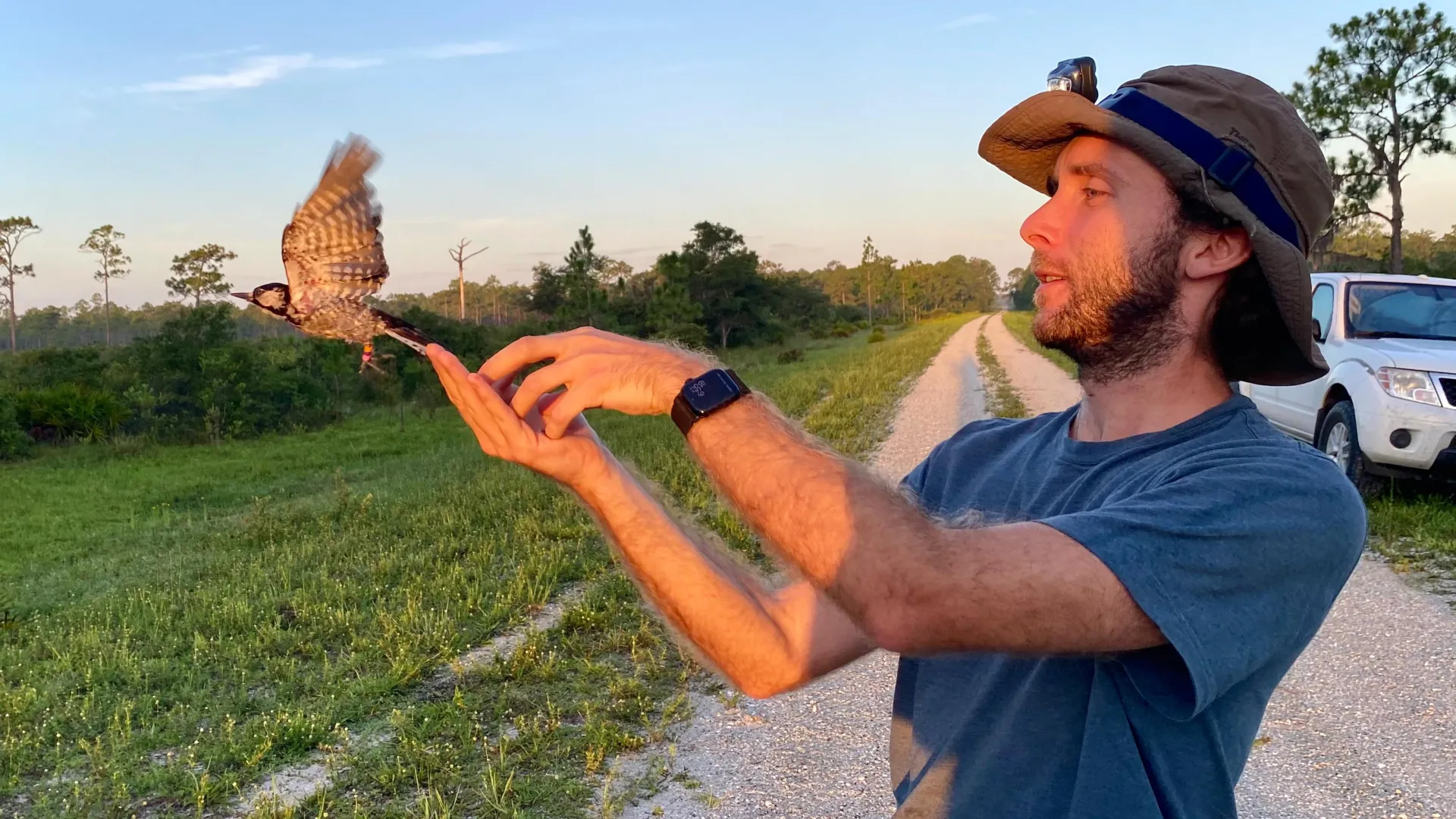
Florida’s Avon Park bombing range, an expansive 106,000-acre tract of land primarily utilized by the U.S. Air Force for vital training exercises, is paradoxically teeming with life, serving as a critical refuge for over 40 at-risk species. This unique juxtaposition of military operations and ecological preservation has become the proving ground for innovative conservation strategies, particularly those aimed at reversing the decline of imperiled species like the red-cockaded woodpecker. Conservation biologists from Michigan State University (MSU), in a landmark study, have leveraged decades of monitoring data from this site to demonstrate the profound success of translocation as a powerful tool in species recovery, offering a promising blueprint for future efforts.
The research, recently published in a special edition of the prestigious Proceedings of the National Academy of Sciences (PNAS), provides compelling evidence that translocations—the deliberate movement of individuals from robust donor populations to bolster isolated, at-risk ones—can effectively halt and reverse long-term population declines in endangered species. This study, the latest from MSU’s Fitzpatrick Lab, meticulously analyzes how such efforts can restore genetic connectivity, enhance population viability, and ultimately pull dwindling species back from the brink of extinction. The findings underscore the remarkable efficacy of carefully managed individual introductions, not just in the short term but over decades, representing a significant boon for threatened and endangered biodiversity. When integrated with broader land protection and management practices, such as the crucial application of controlled burns, these targeted interventions at the individual level can catalyze the recovery of vulnerable ecological communities.
The Plight of the Red-Cockaded Woodpecker: A Sentinel Species
The red-cockaded woodpecker ( Picoides borealis ) is a small, non-migratory bird native to the southeastern United States, easily identifiable by the distinctive black-and-white barred pattern on its back and wings, and the small red "cockade" or patch of feathers found only on adult males. Historically, these woodpeckers were abundant across a vast range stretching from the American South to the Eastern Seaboard. However, their populations have suffered a catastrophic decline, primarily due to the destruction and fragmentation of their highly specialized habitat: mature, open longleaf pine ( Pinus palustris ) savannahs.
Longleaf pine ecosystems, characterized by widely spaced, fire-resistant pines and a diverse herbaceous understory, once covered an estimated 90 million acres across the Southeast. Today, less than 3% of this original habitat remains, a direct consequence of widespread logging practices that favored clear-cutting over selective harvesting, agricultural conversion, and rapid urban and suburban development. The red-cockaded woodpecker is unique among North American woodpeckers for excavating its nesting and roosting cavities exclusively in living pine trees, often those infected with red heart fungus ( Phellinus pini ), which softens the heartwood while leaving the sapwood intact. This specialized requirement means the birds depend on old-growth pines, typically 60 years or older, which were systematically removed across much of their historic range.
Furthermore, the natural fire regime that historically maintained the open structure and health of longleaf pine savannahs was largely suppressed in the 20th century. Fire prevents the encroachment of hardwood midstory vegetation, which can block woodpecker foraging routes, provide predator access to cavity trees, and alter the microclimate of nesting sites. The cumulative impact of habitat loss, fragmentation, and altered fire ecology pushed the red-cockaded woodpecker to the brink, leading to its listing as an endangered species under the U.S. Endangered Species Act (ESA) in 1970. Its survival now relies on small, disconnected pockets of remaining habitat and intensive conservation management.
Avon Park: An Unlikely Haven and Sentinel Landscape
The Avon Park Air Force Range in Florida presents a fascinating paradox: a landscape primarily dedicated to military readiness also functions as an invaluable ecological sanctuary. Spanning 106,000 acres, this facility houses over 35,000 acres of pristine pine savannah, offering a well-protected and extensive band of habitat for a multitude of threatened and endangered species. The presence of such significant natural resources within a military installation is not unique; indeed, many Department of Defense (DoD) lands across the United States have inadvertently become critical refuges for biodiversity due to their large size, restricted public access, and often, the implementation of land management practices like controlled burns that mimic natural ecological processes.
Avon Park is one of 18 designated Sentinel Landscapes, a federal initiative established in 2013 to protect working lands and natural habitats near military installations. This collaborative program brings together the DoD, other federal agencies (such as the U.S. Fish and Wildlife Service and the U.S. Department of Agriculture), state governments, and private stakeholders to achieve mutually beneficial goals. For the military, Sentinel Landscapes help buffer installations from incompatible development, preventing encroachment that could hinder training missions and ensuring long-term mission viability. For conservation, these partnerships facilitate sustainable land management, protect vital ecosystems, and secure funding for critical conservation projects, often on private lands adjacent to military bases. The program exemplifies how national security interests can align with and actively support environmental stewardship.
Within this framework, the Avon Park Air Force Range offers a unique proving ground for complex conservation strategies. Its protected status and managed landscape provide the stable conditions necessary for long-term ecological experiments and interventions that would be challenging to implement in more fragmented or developed areas.
A Detailed Timeline of Translocation and Monitoring
Leveraging this rare opportunity, a collaborative team comprising researchers from Archbold Biological Station, in partnership with the U.S. Fish and Wildlife Service (USFWS) and the U.S. Air Force, embarked on a comprehensive translocation project for the red-cockaded woodpecker. The initiative began in 1998 and continued through 2016, during which a total of fifty-four red-cockaded woodpeckers were carefully introduced into the pine savannahs of the Avon Park range. These birds were sourced from six different donor populations, a strategic decision aimed at maximizing genetic diversity within the recipient population and minimizing the risks associated with inbreeding depression.
The translocation process itself is meticulous. Young, non-breeding birds, often referred to as "juvenile dispersers," are typically chosen as they are naturally seeking new territories. They are captured from donor populations and transported to the recipient site. Upon arrival, they are usually held in temporary "hack boxes" or artificial cavities for a short period to acclimate to their new surroundings before release. This "soft release" method increases the likelihood of site fidelity. Post-release, intensive monitoring is crucial. The Avon Park project distinguished itself through its extraordinary commitment to long-term, high-resolution data collection, spanning several decades. Researchers meticulously tracked the survival, reproductive success, nesting behavior, and genetic contributions of both translocated birds and their locally hatched descendants.
This extensive dataset became the foundation for the Michigan State University research team, led by graduate student Alex Lewanski and senior author Professor Sarah Fitzpatrick. Their role was to rigorously analyze this wealth of historical information, looking back through time to understand the long-term ecological and genetic outcomes of these interventions. The challenge in gauging the effectiveness of translocation efforts often lies in the complex population dynamics that unfold across decades and the sheer difficulty of gathering consistent, high-resolution monitoring data over such extended periods. The detailed and lengthy nature of the Avon Park study provides rare and invaluable insights into the enduring effects of these conservation strategies.
Scientific Validation: A Promising Story of Success
The comprehensive analyses conducted by the MSU researchers revealed a profoundly promising story of success. The findings unequivocally demonstrated that the translocations provided substantial and extended benefits to the red-cockaded woodpecker population at Avon Park. Key metrics of success included:
- Population Growth: The introduced birds contributed directly and significantly to higher overall population counts, reversing a previous trajectory of decline.
- Enhanced Survival and Reproduction: Translocated birds and their descendants exhibited notably higher rates of survival and reproductive success compared to locally hatched individuals. This suggests that the introduction of new genetic material and potentially more vigorous individuals boosted the overall fitness of the population.
- Extended Nesting Longevity: A critical finding was that reproductive success was highly associated with the total number of nesting years. Translocated birds tended to nest for more years than their locally hatched counterparts, indicating a sustained contribution to the population’s reproductive output over their lifespan.
- Genetic Health Boost: The positive effects of translocation persisted along family lines. Approximately 70% of the translocated woodpeckers survived in the population after their release, and crucially, many formed breeding pairs with local individuals. This interbreeding provided a vital boost to the genetic diversity of the Avon Park population, helping to mitigate the risks of inbreeding depression that often plague small, isolated populations. Increased genetic diversity enhances a population’s resilience to environmental changes and disease.
Alex Lewanski, the first author on the study, emphasized the collaborative and sustained nature of these efforts: "The only reason that these populations are still around is because of the continued collaborations and long-term investment in these imperiled species." This sentiment underscores that the success at Avon Park is not merely a scientific achievement but a testament to enduring partnership and commitment.
Broader Implications and Future Trajectories
The success story at Avon Park carries significant implications beyond the red-cockaded woodpecker. The team hopes that these positive results will incentivize land managers and conservation practitioners worldwide to seriously consider the long-term benefits of translocations and the critical importance of sustained monitoring programs. As Lewanski noted, translocation "has the potential to act as an important component of managing many imperiled species."
This study reinforces that translocation is not a standalone solution but a powerful tool when used in concert with broader conservation efforts. The effectiveness at Avon Park was undeniably linked to robust land protection and management strategies, most notably the practice of controlled burns. These prescribed fires are essential for maintaining the open, park-like structure of longleaf pine savannahs, preventing hardwood encroachment, promoting the growth of native grasses and forbs, and creating the ideal habitat for the woodpeckers and countless other species dependent on fire-adapted ecosystems.
Looking to the future, the research team anticipates a growing role for genetic insights in tracking and evaluating conservation programs. While traditional on-site monitoring of bird nesting and reproduction is invaluable, the integration of genetic monitoring tools offers new avenues for precision and efficiency. Analysis of genetic material can help detect and minimize inbreeding, construct highly detailed pedigrees for populations, and potentially reduce some of the logistical burdens associated with solely field-based monitoring programs. Sarah Fitzpatrick, the senior author on the study, highlighted this potential, stating that using genetic monitoring tools allows scientists and land managers to be more precise when deciding how and when to use translocations.
Ultimately, the vision is for a synergistic combination of advanced genomic analysis and traditional on-site monitoring. This integrated approach could provide tailor-made strategies for managers attempting translocations, allowing for more informed decisions about donor selection, release sites, and the timing of interventions, thereby maximizing the chances of success for endangered species.
A Model of Collaborative Conservation
This groundbreaking study is a direct product of a robust and enduring partnership involving Michigan State University, Archbold Biological Research Station, the U.S. Air Force, the Department of Defense, and the U.S. Fish and Wildlife Service. This multi-agency and academic collaboration exemplifies the kind of interdisciplinary effort required to tackle complex conservation challenges on a landscape scale. The funding for managing and monitoring the red-cockaded woodpeckers at Avon Park was generously provided by the DoD, the USAF, and the USFWS, with additional project support from the National Defense Science & Engineering Graduate Fellowship from the Department of Defense and the National Science Foundation. Such sustained financial and institutional backing is vital for the longevity and success of large-scale conservation initiatives.
The Avon Park success story stands as a compelling testament to the power of scientific innovation, dedicated partnerships, and long-term commitment in the face of ecological crisis. It provides a robust scientific foundation for the continued use of translocation as a critical conservation tool and offers a beacon of hope for countless other species teetering on the edge of extinction, proving that with strategic intervention and collaborative effort, species can indeed be brought back from the brink.