
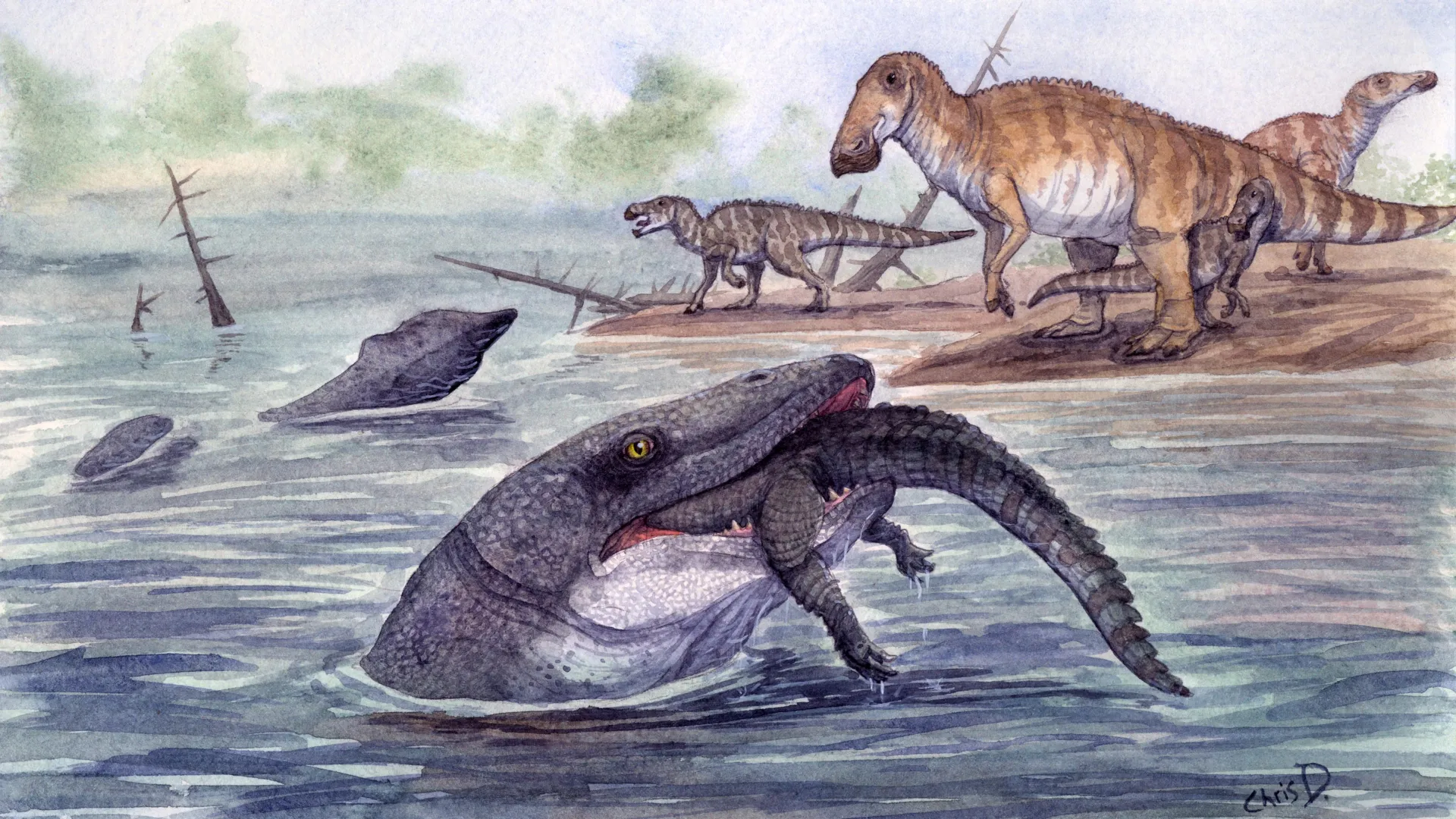
Mosasaurs, the formidable marine reptiles that dominated ancient oceans more than 66 million years ago, have long been understood as creatures exclusively tethered to saline environments. However, groundbreaking new evidence has surfaced, challenging this long-held perception and revealing that some of these apex predators adapted to freshwater river systems during the final million years of their existence. This paradigm-shifting discovery stems from the meticulous analysis of a mosasaur tooth unearthed in North Dakota, providing compelling indications of a significant ecological shift for these colossal animals. The tooth, belonging to an individual estimated to have reached an astonishing 11 meters in length—comparable to the size of a modern city bus—underscores the remarkable adaptability of life on Earth even in the face of impending cataclysm. The international research team, spearheaded by scientists at Uppsala University, has published findings that redefine our understanding of Late Cretaceous ecosystems and the versatility of its inhabitants.
A Serendipitous Discovery in North Dakota’s Ancient Rivers
The pivotal fossil, a mosasaur tooth, was brought to light in 2022 from a river deposit situated in North Dakota, a region historically more associated with terrestrial and freshwater fauna than with giant marine reptiles. What immediately struck paleontologists was not just the presence of a mosasaur tooth in such an unexpected locale, but the extraordinary assemblage of fossils found alongside it. The excavation site yielded a tooth from a Tyrannosaurus rex, the undisputed king of terrestrial predators, and a jawbone from a crocodylian, a clear inhabitant of freshwater environments. This diverse collection was found in an area already renowned for its abundant fossils of the duck-billed dinosaur Edmontosaurus, a large herbivore common in the Late Cretaceous. The unusual juxtaposition of land dinosaurs, river-dwelling crocodiles, and a supposed ocean-dwelling behemoth raised an immediate and profound question: how did the tooth of a giant marine reptile become preserved in a riverine setting, far from the open ocean? This unprecedented mix ignited a scientific investigation aimed at unraveling the mystery behind the mosasaur’s surprising presence.
Unlocking Ancient Secrets Through Isotope Analysis
To solve this perplexing paleontological puzzle, researchers from a collaborative international team spanning the United States, Sweden, and the Netherlands turned to the sophisticated technique of isotope analysis. This method involves examining the chemical composition of the mosasaur tooth enamel, which retains a geochemical signature reflecting the animal’s environment and diet throughout its life. Given that the mosasaur tooth, the T. rex tooth, and the crocodylian jawbone were all dated to approximately 66 million years ago, just prior to the end-Cretaceous extinction event, scientists were able to conduct direct comparative analyses of their chemical signatures.
The detailed work was meticulously carried out at the Vrije Universiteit (VU) in Amsterdam, focusing specifically on stable isotopes of oxygen, strontium, and carbon. Oxygen isotopes (specifically the ratio of heavier oxygen-18 to lighter oxygen-16) are particularly effective environmental proxies, as water bodies have distinct isotopic signatures. Freshwater typically contains higher levels of the lighter oxygen isotope (¹⁶O) compared to marine environments. The mosasaur tooth, to the astonishment of the research team, exhibited unusually high levels of ¹⁶O, a signature unequivocally characteristic of freshwater habitats rather than the salty ocean. This initial finding was further corroborated by the strontium isotope ratios, which similarly pointed towards a freshwater existence.
Adding another layer of insight, carbon isotopes in tooth enamel generally reflect an animal’s diet and its position within the food web. Melanie During, one of the study’s corresponding authors and a key researcher from Uppsala University, elaborated on this aspect. "Carbon isotopes in teeth generally reflect what the animal ate. Many mosasaurs have low ¹³C values because they dive deep into the ocean to hunt," During explained. "The mosasaur tooth found with the T. rex tooth, on the other hand, has a higher ¹³C value than all known mosasaurs, dinosaurs, and crocodiles previously analyzed. This suggests that it did not dive deep and may sometimes have fed on drowned dinosaurs." This intriguing dietary revelation paints a picture of a mosasaur that was not only present in freshwater but actively hunting within it, potentially scavenging on the carcasses of terrestrial dinosaurs that met their end in the river systems.
The robustness of these findings was further strengthened by subsequent analyses. "The isotope signatures indicated that this mosasaur had inhabited this freshwater riverine environment," During confirmed. "When we looked at two additional mosasaur teeth found at nearby, slightly older sites in North Dakota, we saw similar freshwater signatures. These analyses collectively show that mosasaurs lived in riverine environments in the final million years before going extinct." This crucial confirmation from multiple specimens underscores that the North Dakota tooth was not an isolated anomaly, but rather evidence of a broader, established pattern of mosasaur adaptation to freshwater.
When Seas Slowly Transformed into Rivers: The Western Interior Seaway
The groundbreaking findings also offer a compelling explanation for how such a dramatic lifestyle shift for mosasaurs became ecologically possible. The Late Cretaceous period witnessed significant geological and environmental transformations across North America. Central to this narrative is the Western Interior Seaway (WIS), a vast, shallow inland sea that bisected the North American continent, stretching from the Gulf of Mexico north to the Arctic Ocean. For millions of years, this epicontinental sea was a dominant feature of the continent’s geography, teeming with marine life, including various species of mosasaurs, plesiosaurs, and sharks.
However, as the Late Cretaceous progressed, increasing amounts of freshwater runoff from the surrounding landmasses began to flow into the Western Interior Seaway. This influx of freshwater, driven by extensive continental drainage and potentially increased precipitation, gradually altered the seaway’s salinity. The researchers propose that this process led to a progressive transformation of the seaway, evolving from a predominantly salty marine environment to one that was increasingly brackish, and eventually, in certain regions and at certain depths, becoming mostly freshwater. This phenomenon is analogous to modern-day conditions observed in semi-enclosed basins like the Gulf of Bothnia, where significant freshwater input from rivers creates a stratified water column.
The scientists suggest that this process created a pronounced ‘halocline’ within the seaway. A halocline is a strong vertical gradient in salinity within a body of water, meaning that lighter, less dense freshwater formed a distinct surface layer, floating atop denser, more saline saltwater below. The isotope data collected from the mosasaur teeth strongly supports this hypothesis. To validate their theory, the research team also measured isotopic signatures from fossils of other marine animals found in the same geological strata. Per Ahlberg, a co-author of the study and Dr. During’s doctoral supervisor, elaborated on these comparative analyses. "For comparison with the mosasaur teeth, we also measured fossils from other marine animals and found a clear difference," Ahlberg stated. "All gill-breathing animals had isotope signatures linking them to brackish or salty water, while all lung-breathing animals lacked such signatures. This shows that mosasaurs, which needed to come to the surface to breathe, inhabited the upper freshwater layer and not the lower layer where the water was more saline." This crucial distinction reinforces the idea that mosasaurs were exploiting the freshwater surface layer, effectively becoming freshwater inhabitants while still technically within the broader basin of the former seaway. This environmental partitioning allowed them to thrive in a niche previously thought inaccessible to them.
Evolutionary Adaptability: A Tale of Shifting Habitats
The researchers contend that the isotopic signatures from the studied teeth definitively indicate that these mosasaurs were not merely temporary visitors to freshwater environments but had undergone a significant adjustment to these novel conditions. The ability of large predators to shift between different habitats is not unprecedented in the grand tapestry of evolutionary history, though the scale of this particular adaptation for mosasaurs is remarkable.
Melanie During offered insight into the evolutionary mechanics behind such a transition: "Unlike the complex adaptation required to move from freshwater to marine habitats, the reverse adaptation is generally simpler." Moving from freshwater to saltwater often necessitates physiological adaptations to cope with osmoregulation (balancing water and salt levels in the body) in a hypertonic environment, which can be metabolically demanding. Conversely, adapting from a marine environment to a hypotonic freshwater environment, while still requiring adjustments, can be less physiologically challenging for certain large, robust organisms that are already capable of efficient osmoregulation.
Modern animals provide compelling parallels to this ancient mosasaur flexibility. Take, for instance, river dolphins. Species like the Amazon River Dolphin (Inia geoffrensis) and the Ganges River Dolphin (Platanista gangetica) live entirely in freshwater systems, despite their ancestors being unequivocally marine. Their evolutionary journey involved a complete transition from ocean to riverine ecosystems, demonstrating the profound adaptability of cetaceans. Another prime example is the estuarine crocodile (Crocodylus porosus), famously known as the saltwater crocodile in Australia. These formidable reptiles are renowned for their incredible ecological plasticity, regularly moving between freshwater rivers, estuaries, and the open ocean, hunting a wide array of prey wherever it is most abundant. Their capacity to tolerate both fresh and saline water allows them to exploit a vast range of habitats and resources. Other examples include bull sharks (Carcharhinus leucas), which are well-known for their ability to enter and thrive in freshwater rivers far inland, and various species of seals and otters that inhabit both coastal marine and inland freshwater environments. These contemporary examples underscore that the mosasaurs’ adaptation, while surprising, fits within a broader biological pattern of ecological opportunism and evolutionary flexibility in response to changing environmental conditions.
A Bus-Sized Predator in Unexpected Places
Mosasaur fossils are typically abundant in marine deposits across North America, Europe, and Africa, dating from approximately 98 to 66 million years ago. These fossils offer a rich record of their diversity and widespread oceanic distribution. In stark contrast, discoveries of mosasaur fossils in North Dakota have historically been exceedingly rare, making this particular finding exceptionally striking and significant. The sheer size suggested by the tooth—an animal up to 11 meters long—is truly awe-inspiring, roughly equivalent to the length of a standard public transit bus. This estimate is further supported by earlier discoveries of mosasaur bones at a nearby site, which provided corroborating evidence for the existence of such immense individuals in the region.
While the exact genus of the mosasaur cannot be definitively identified from a single tooth, its characteristics strongly suggest it belonged to the prognathodontine group, possibly a close relative of the genus Prognathodon. Members of Prognathodon were known for their massive, robust heads, powerful jaws, and exceptionally strong, conical teeth. These features indicate that they were highly efficient, opportunistic predators, capable of attacking and consuming a wide range of large prey, from ammonites and fish to other marine reptiles and possibly even terrestrial dinosaurs that ventured too close to the water’s edge or drowned.
"The size means that the animal would rival the largest killer whales in terms of predatory prowess and sheer physical presence," Per Ahlberg emphasized. "This makes it an extraordinary predator to encounter in riverine environments not previously associated with such giant marine reptiles." The image of an 11-meter-long mosasaur, a creature typically imagined prowling deep oceans, navigating the murky waters of a Late Cretaceous river system alongside T. rex and crocodiles, fundamentally alters our understanding of the trophic structure and ecological dynamics of that period. It paints a vivid picture of a world where the boundaries between marine and freshwater ecosystems were far more fluid than previously conceived.
Broader Implications for Paleontology and the K-Pg Extinction
This discovery significantly enriches our understanding of mosasaur paleoecology and their behavioral plasticity. It adds a crucial layer to the already complex picture of Late Cretaceous life, particularly in the period immediately preceding the catastrophic K-Pg extinction event. The presence of mosasaurs in freshwater environments during this tumultuous time raises intriguing questions: Was this adaptation a strategic survival mechanism, allowing them to exploit new food sources and escape potentially declining marine habitats? Or was it merely an opportunistic expansion into available niches as the Western Interior Seaway evolved?
The fact that this adaptation occurred in the final million years before the K-Pg extinction event is particularly poignant. It suggests that some mosasaur lineages possessed an incredible capacity for ecological flexibility, even as global environments were undergoing significant stress. This flexibility might have offered a temporary reprieve or a distinct ecological advantage, though ultimately, it was not enough to save them from the mass extinction event triggered by the Chicxulub asteroid impact. The coexistence of freshwater-adapted mosasaurs with terrestrial giants like T. rex and riverine crocodiles also paints a more complete picture of a thriving, albeit complex and interconnected, ecosystem in North America just before the end-Cretaceous asteroid impact. It highlights the dynamic nature of ancient environments and the remarkable ways in which life found ways to persist and even flourish under changing conditions.
The research was a collaborative effort, involving scientists from Uppsala University, in conjunction with Eastern West Virginia Community and Technical College, Moorefield, West Virginia, Vrije Universiteit Amsterdam, and the North Dakota Geological Survey. This multi-institutional collaboration underscores the international nature of cutting-edge paleontological research. The article itself draws heavily on a chapter from Melanie During’s doctoral thesis, which she successfully defended at Uppsala University in November 2024. This seminal work not only expands our knowledge of mosasaur biology but also opens new avenues for future research into the environmental dynamics of the Late Cretaceous and the adaptive strategies of its inhabitants in the face of profound geological and climatic change. Future investigations may delve deeper into the specific physiological adaptations that allowed mosasaurs to thrive in freshwater, potentially through analysis of bone microstructure or further isotopic studies across different growth stages of these ancient river giants.