
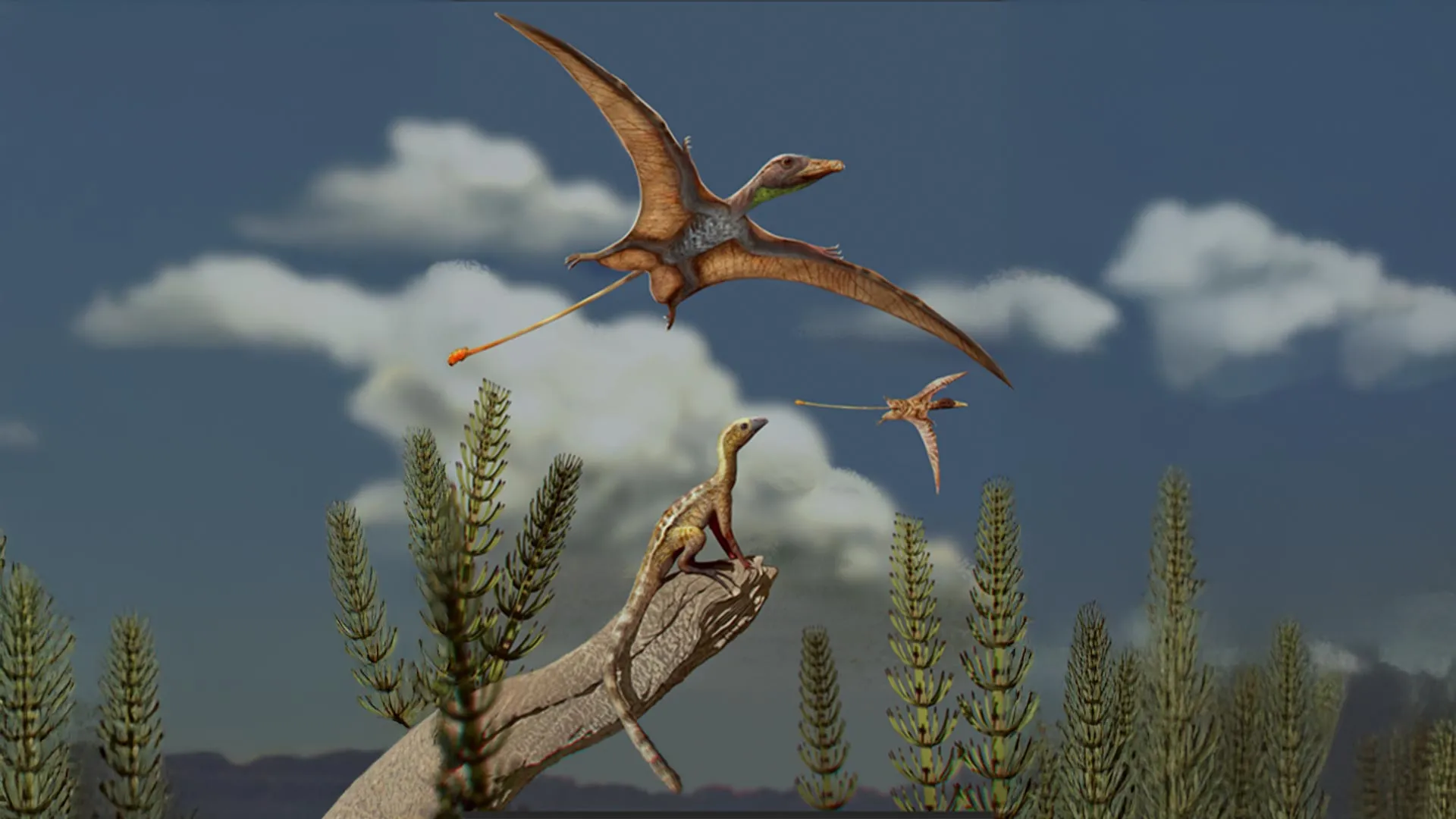
A groundbreaking study led by an evolutionary biologist at Johns Hopkins Medicine has unveiled compelling evidence suggesting that ancient giant reptiles, known as pterosaurs, may have developed the intricate ability to fly remarkably early in their evolutionary timeline, as far back as 220 million years ago. This discovery presents a stark contrast to the widely accepted understanding of avian evolution, where the ancestors of modern birds are believed to have achieved powered flight through a more protracted, gradual process, typically accompanied by the development of larger, more complex brains. The findings, which relied on advanced imaging techniques to meticulously examine the internal brain cavities of pterosaur fossils, received partial support from the National Science Foundation and were formally published on November 26 in the esteemed scientific journal Current Biology.
The investigation’s revelations significantly bolster the hypothesis that the enlarged and highly developed brains characteristic of modern birds, and presumably their ancestral lineage, were not a prerequisite for the independent evolution of powered flight in pterosaurs. Dr. Matteo Fabbri, an assistant professor of functional anatomy and evolution at the Johns Hopkins University School of Medicine and a lead author of the study, articulated the core implication: "Our study shows that pterosaurs evolved flight early on in their existence and that they did so with a smaller brain similar to true non-flying dinosaurs." This statement underscores a potential paradigm shift in how scientists understand the neurological demands and evolutionary pathways associated with the conquest of the skies.
Pterosaurs: Ancient Aerial Dominators with Surprising Neurological Traits
Pterosaurs, a diverse group of winged reptiles that reigned supreme during the Mesozoic Era, are renowned as the earliest of the three major vertebrate lineages—alongside birds and bats—to achieve powered flight independently. These formidable airborne predators commanded the ancient skies, with some species reaching colossal sizes, boasting wingspans of up to 30 feet and weighing an estimated 500 pounds. Their evolutionary success story, spanning over 150 million years, is a testament to their remarkable adaptations. To meticulously unravel the mysteries surrounding how pterosaurs acquired this extraordinary ability and whether their evolutionary trajectory diverged significantly from that of birds and bats, the research team embarked on an in-depth examination of the reptile’s evolutionary history. Their investigation meticulously focused on analyzing shifts in the morphology and dimensions of the brain over vast stretches of geological time, with particular emphasis on the optic lobe—a crucial brain region intrinsically linked to visual processing and, by extension, flight capabilities.
The conventional wisdom has long posited that the development of complex cognitive functions, housed within a proportionally larger brain, would be a prerequisite for the sophisticated motor control and sensory integration demanded by powered flight. However, the Johns Hopkins team’s research challenges this notion, suggesting that pterosaurs might have circumvented this evolutionary constraint, achieving aerial mastery through a different neurological blueprint. This finding opens new avenues for exploring convergent evolution and the diverse strategies life employs to adapt to challenging environments.
Unlocking Ancient Secrets Through Advanced CT Imaging
The success of this investigation was largely predicated on the application of cutting-edge computed tomography (CT) imaging technology and sophisticated specialized software. These tools enabled the researchers to construct precise digital models of fossilized nervous system structures, providing an unprecedented glimpse into the internal anatomy of these extinct creatures. The team’s primary focus was directed towards the closest known relative of the pterosaur: the lagerpetid. This enigmatic, flightless, and arboreal (tree-climbing) animal was first identified by paleontologists in 2016 and thrived during the Triassic period, approximately 242 to 212 million years ago. Its critical evolutionary connection to pterosaurs was further solidified and confirmed by another research team in 2020, establishing lagerpetids as a vital sister group for understanding pterosaur origins.
The analysis of lagerpetid fossils yielded particularly illuminating insights. Dr. Mario Bronzati, a corresponding author of the study and a researcher at the University of Tübingen, Germany, highlighted the significance of these findings: "The lagerpetid’s brain already showed features linked to improved vision, including an enlarged optic lobe, an adaptation that may have later helped their pterosaur relatives take to the skies." This suggests a pre-adaptation, a foundational visual acuity, present in the non-flying ancestors that could have been leveraged by pterosaurs as they embarked on their aerial journey.
Dr. Fabbri further elaborated on the striking comparisons: while pterosaurs also exhibited enlarged optic lobes, their overall brain shape and size diverged considerably from those of the lagerpetid. This distinction is crucial. "The few similarities suggest that flying pterosaurs, which appeared very soon after the lagerpetid, likely acquired flight in a burst at their origin," Fabbri explained. "Essentially, pterosaur brains quickly transformed acquiring all they needed to take flight from the beginning." This concept of a rapid, almost instantaneous evolutionary acquisition of flight stands in stark contrast to the more protracted, stepwise model typically associated with avian evolution. It implies a swift, targeted neurological reorganization rather than a long, gradual accumulation of adaptations.
A Tale of Two Flights: Pterosaur vs. Bird Evolution
The evolutionary journey of modern birds towards powered flight is widely understood as a more gradual and incremental process. Avian ancestors are thought to have progressively inherited and refined several key neuroanatomical traits from earlier relatives, including the expansion of the cerebrum (associated with higher cognitive functions), the cerebellum (critical for motor control and coordination), and the optic lobes. These regions were then further adapted and specialized over millions of years to meet the rigorous demands of sustained flight.
Supporting this gradualist model for bird flight, recent research from 2024, emanating from the laboratory of Dr. Amy Balanoff, an assistant professor of functional anatomy and evolution at Johns Hopkins Medicine, specifically underscores the pivotal role of cerebellum expansion in the origins of bird flight. The cerebellum, located at the posterior aspect of the brain, is fundamentally involved in regulating muscle coordination, balance, and fine motor skills—all indispensable for the intricate maneuvers of aerial locomotion. Dr. Balanoff emphasized the broader scientific value of such comparative studies: "Any information that can fill in the gaps of what we don’t know about dinosaur and bird brains is important in understanding flight and neurosensory evolution within pterosaur and bird lineages." Her statement highlights the interconnectedness of these research avenues, each contributing vital pieces to the complex puzzle of vertebrate flight evolution.
The contrast between the "burst" model for pterosaurs and the "gradual" model for birds offers profound insights into the plasticity of evolution. It suggests that there isn’t a single, monolithic pathway to complex adaptations like powered flight. Instead, different lineages, facing distinct ecological pressures and possessing varying ancestral predispositions, can arrive at similar outcomes through divergent evolutionary strategies. This highlights the concept of convergent evolution, where unrelated species independently evolve similar traits to adapt to similar environments or ecological niches.
Insights from Fossilized Brains Across Diverse Species
To further contextualize their findings and broaden the comparative scope, the research team extended their analysis to include the brain cavities of other prehistoric species. This comparative neuroanatomy included crocodilians (ancient ancestors of modern crocodiles), early extinct birds, and other dinosaur groups, all meticulously compared with the pterosaur data.
Their comprehensive analysis revealed that pterosaurs possessed moderately enlarged brain hemispheres, a characteristic feature comparable to those observed in other dinosaur groups. This includes two-legged, bird-like troodontids, which thrived between the Late Jurassic and Late Cretaceous periods (approximately 163 to 66 million years ago), as well as Archaeopteryx lithographica, famously recognized as the oldest-known bird, which existed between 150.8 and 125.45 million years ago. Critically, these prehistoric species—pterosaurs, troodontids, and Archaeopteryx—differ markedly from modern birds, which exhibit significantly larger and more complex brain cavities relative to their body size. This distinction reinforces the idea that while some degree of brain development was necessary for flight, the extent and specific architectural layout differed substantially between these ancient fliers and their modern avian counterparts.
The study’s chronological framework is essential for understanding these evolutionary distinctions. The lagerpetids, emerging in the Triassic (242-212 million years ago), provided a baseline for pterosaur origins, with pterosaurs themselves quickly developing flight thereafter. This places pterosaur flight firmly in the early Mesozoic. In contrast, the earliest birds like Archaeopteryx appeared much later, in the Late Jurassic, with the full suite of modern avian brain features developing even later through the Cretaceous and Cenozoic. This timeline underscores the significant temporal and evolutionary separation between the two lineages’ acquisition of flight.
Broader Implications and Future Research Trajectories
The implications of this research extend far beyond merely understanding pterosaur flight. It challenges fundamental assumptions about the relationship between brain size, complexity, and the emergence of highly sophisticated behaviors. The finding that pterosaurs achieved powered flight with a relatively simpler brain structure compared to birds suggests that different neural strategies can lead to convergent evolutionary outcomes. This could have profound implications for understanding other complex behaviors in extinct animals and even for informing biomimetic design in engineering.
Looking ahead, Dr. Fabbri emphasizes that future progress in this field will necessitate a deeper understanding of the brain’s internal structure, moving beyond just its external size and shape. He posits that delving into the intricate neural circuitry and organization within the brain will be indispensable for uncovering the broader biological principles that universally govern the evolution of flight across diverse taxa. This next frontier of research will likely involve even more advanced imaging techniques, potentially combined with computational neuroscience models, to reconstruct and simulate the functional capacities of these ancient brains.
This monumental research was made possible through the generous funding and support from a consortium of international bodies, including the Alexander von Humboldt Foundation, the Brazilian Federal Government, The Paleontological Society, Agencia Nacional de Promoción Científica y Técnica, Conselho Nacional de Desenvolvimento Científico e Tecnológico, the European Union NextGeneration EU/PRTR, the National Science Foundation (NSF DEB 1754596, NSF IOB-0517257, IOS-1050154, IOS-1456503), and the Swedish Research Council.
The collaborative spirit of scientific inquiry was evident in the extensive list of contributors to this study. In addition to Dr. Fabbri and Dr. Bronzati, other distinguished scientists who played crucial roles in this research include Akinobu Watanabe from New York Institute of Technology; Roger Benson from the American Museum of Natural History; Rodrigo Müller from Federal University of Santa Maria, Brazil; Lawrence Witmer from the University of Ohio; Martín Ezcurra and M. Belén von Baczko from Bernardino Rivadavia Museum of Natural Science; Felipe Montefeltro from São Paulo State University; Bhart-Anjan Bhullar from Yale University; Julia Desojo from Universidad Nacional de La Plata, Argentina; Fabien Knoll from Museo Nacional de Ciencias Naturales, Spain; Max Langer from Universidade de São Paulo, Brazil; Stephan Lautenschlager from University of Birmingham; Michelle Stocker and Sterling Nesbitt from Virginia Tech; Alan Turner from Stony Brook University; and Ingmar Werneburg from Eberhard Karls University of Tübingen. Their collective expertise and dedication were instrumental in shedding new light on one of the most fascinating chapters in the history of life on Earth: the independent evolution of flight.