
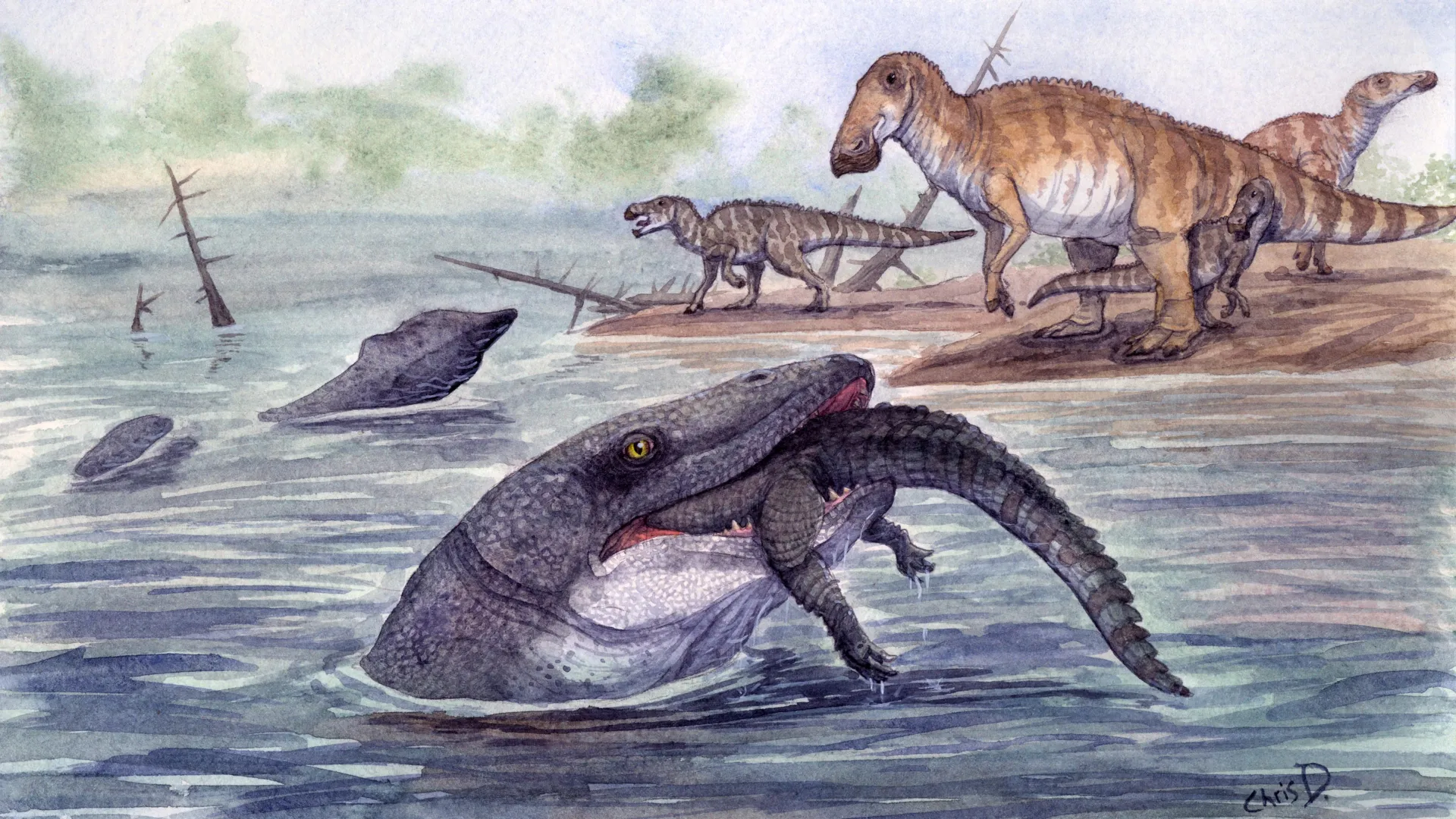
The extraordinary discovery of the mosasaur tooth occurred in 2022, found preserved within a river deposit in North Dakota. Its context was immediately striking to paleontologists: it lay alongside a tooth from a Tyrannosaurus rex and a jawbone fragment from a crocodylian. This fossil assemblage was recovered from a region already renowned for its wealth of duck-billed dinosaur fossils, particularly those of Edmontosaurus, a common inhabitant of the Late Cretaceous landscape. The unusual juxtaposition of terrestrial dinosaurs, known river-dwelling crocodilians, and a creature previously considered an exclusively giant marine reptile instantly raised profound questions. The primary puzzle was apparent: if mosasaurs were truly creatures of the open ocean, how could one of their teeth possibly end up so meticulously preserved within a freshwater riverine environment, hundreds of kilometers from any marine influence?
Unlocking Ancient Habitats Through Isotope Analysis
To unravel this paleontological enigma, an international consortium of researchers from the United States, Sweden, and the Netherlands embarked on a detailed examination of the mosasaur tooth’s chemical composition. Their primary tool was isotope analysis, a sophisticated geochemical technique that allows scientists to reconstruct the environmental conditions an animal lived in and even its dietary preferences by studying the ratios of stable isotopes within its biological tissues, such as tooth enamel.
The timing of the fossils proved fortuitous. The mosasaur tooth, the T. rex tooth, and the crocodylian jawbone all date to approximately 66 million years ago, placing them squarely in the final throes of the Cretaceous period, just before the cataclysmic K-Pg extinction event. This temporal synchronicity enabled the scientists to perform direct comparative chemical analyses, providing a robust baseline. The analytical work, primarily conducted at the Vrije Universiteit (VU) in Amsterdam, focused specifically on the stable isotopes of oxygen, strontium, and carbon.
The results from the mosasaur tooth were unequivocally compelling. It exhibited unusually high levels of the lighter oxygen isotope (¹⁶O), a signature characteristic of freshwater environments, starkly contrasting with the heavier oxygen isotope (¹⁸O) ratios typically found in marine organisms. Further corroboration came from the strontium isotope ratios, which also pointed decisively towards a freshwater habitat, as strontium isotopes reflect the geological composition of the water source, distinguishing between marine and terrestrial runoff.
Melanie During, one of the study’s corresponding authors, elaborated on the significance of the carbon isotope data. "Carbon isotopes in teeth generally reflect what the animal ate," During explained. "Many mosasaurs have low ¹³C values because they dive deep into the ocean, where the carbon cycle is different. The mosasaur tooth found with the T. rex tooth, on the other hand, has a higher ¹³C value than all known mosasaurs, dinosaurs, and crocodiles we have analyzed. This suggests that it did not dive deep, living instead in shallower waters, and intriguingly, may sometimes have fed on drowned dinosaurs that had fallen into the river." This particular finding offers a tantalizing glimpse into the mosasaur’s adapted diet in its new riverine domain, potentially scavenging on carcasses washed downstream.
During further emphasized the broader pattern observed: "The isotope signatures indicated that this mosasaur had indeed inhabited this freshwater riverine environment. When we looked at two additional mosasaur teeth found at nearby, slightly older sites in North Dakota, we saw similar freshwater signatures. These analyses collectively show that mosasaurs were not just occasional visitors but genuinely lived in riverine environments during the final million years before their extinction." This replication across multiple specimens significantly strengthens the study’s conclusions, indicating a widespread adaptation rather than an isolated incident.
A Shifting World: The Decline of the Western Interior Seaway
The findings also provide critical context for how this remarkable lifestyle shift became ecologically viable. The Late Cretaceous period witnessed dramatic environmental transformations across North America. For millions of years, the continent had been bisected by the Western Interior Seaway, a vast, shallow epicontinental sea stretching from the Gulf of Mexico to the Arctic Ocean. This seaway was a thriving marine ecosystem, but as the Cretaceous drew to a close, geological and climatic forces began to alter its character.
Increasing amounts of freshwater, derived from continental runoff and fluvial systems, flowed into the seaway. This continuous influx gradually diluted the marine waters, initiating a process of desalinization. The seaway slowly transitioned from a fully marine, salty environment to brackish conditions, and in its northern reaches, particularly in areas like what is now North Dakota, it likely became predominantly freshwater. This ecological shift created conditions analogous to modern-day environments such as the Gulf of Bothnia, a large arm of the Baltic Sea that is significantly less saline than the open ocean due to substantial freshwater input from rivers.
Researchers propose that this process led to the formation of a ‘halocline’ within the seaway. A halocline is a distinct vertical stratification of water layers, where lighter, less dense freshwater forms a surface layer above denser, more saline water. This phenomenon would have created a freshwater ‘cap’ over deeper, saltier water. The isotope data strongly supports this hypothesis.
Per Ahlberg, a co-author of the study and Dr. During’s promoter, elucidated this point further: "For comparison with the mosasaur teeth, we also measured fossils from other marine animals found in the region and found a clear difference. All gill-breathing animals, such as fish, had isotope signatures linking them to brackish or salty water, indicating they lived in the lower, more saline layers. In contrast, all lung-breathing animals, including the mosasaurs, lacked such signatures, instead showing freshwater markers. This unequivocally demonstrates that mosasaurs, which, like modern whales and dolphins, needed to come to the surface to breathe, inhabited the upper freshwater layer and not the lower layer where the water was more saline." This adaptation would have allowed them to exploit a newly formed ecological niche while still technically within the bounds of a former seaway that was undergoing profound environmental change.
Evolutionary Flexibility: Adapting to a Changing Planet
The researchers contend that the teeth analyzed unequivocally belonged to mosasaurs that had made a significant physiological and ecological adjustment to these novel freshwater conditions. The ability of large predators to shift between different habitats is not an unheard-of phenomenon in the grand tapestry of evolutionary history, although it is often complex.
During highlighted a crucial distinction in evolutionary adaptation: "Unlike the complex physiological and anatomical adaptations required to move from freshwater to marine habitats, such as developing salt glands or specific kidney functions to excrete excess salt, the reverse adaptation – from marine to freshwater – is generally simpler. Marine animals often possess systems to cope with high salinity, which can be ‘dialed down’ or repurposed in freshwater, whereas freshwater animals lack the basic mechanisms to handle high salt concentrations." This inherent physiological flexibility likely facilitated the mosasaurs’ transition.
Modern animal examples abound, illustrating similar flexibility and adaptive prowess. River dolphins, such as the Amazon River dolphin (Inia geoffrensis) and the Ganges River dolphin (Platanista gangetica), are prime examples. Their ancestors were marine dolphins, but they have adapted entirely to freshwater river systems, developing specialized echolocation and morphological features suited to turbid river environments. Another striking example is the estuarine crocodile (Crocodylus porosus), famously known in Australia as the saltwater crocodile. While capable of thriving in highly saline coastal waters and even open ocean, these formidable reptiles regularly venture far up rivers, moving between freshwater and marine habitats, exploiting available prey resources across both domains. Even certain species of sharks, like the bull shark (Carcharhinus leucas), demonstrate remarkable osmoregulatory capabilities, allowing them to traverse between fresh and saltwater environments with ease, hunting in rivers and estuaries. These contemporary parallels underscore the biological plausibility of the mosasaur’s freshwater adaptation.
A Bus-Sized Predator in Unexpected Places
Mosasaur fossils are typically abundant in marine sedimentary deposits across vast geographical ranges, including North America, Europe, and Africa, dating from approximately 98 to 66 million years ago. Their discovery in North Dakota, particularly in a freshwater context, is therefore exceptionally striking and rare. The sheer size suggested by the tooth further amplifies the significance of the find. With an estimated length of up to 11 meters, this mosasaur would have rivaled the largest killer whales (Orcinus orca) in size, making it an extraordinary apex predator to encounter in a riverine environment. Earlier discoveries of mosasaur bones at a nearby site in North Dakota, though not directly linked to this tooth, support this impressive size estimate.
While the exact genus of the mosasaur cannot be definitively identified from a single tooth, its morphology strongly suggests it belonged to the prognathodontine mosasaur group. Close relatives within the genus Prognathodon were characterized by massive, robust heads, powerful jaws, and exceptionally strong, conical teeth. These features indicate they were opportunistic and formidable predators, capable of crushing shells and attacking large prey. The thought of such a colossal, powerful hunter navigating ancient North American rivers, alongside T. rexes and crocodilians, paints a vivid and previously unimagined picture of the Late Cretaceous ecosystem.
"The size means that the animal would rival the largest killer whales, making it an extraordinary predator to encounter in riverine environments not previously associated with such giant marine reptiles," Ahlberg remarked, highlighting the profound ecological implications. This discovery necessitates a re-evaluation of food webs and predatory dynamics within Late Cretaceous freshwater systems, suggesting that these rivers were far more complex and dangerous than previously understood.
Implications for the End-Cretaceous World
This revelation of freshwater mosasaurs provides a crucial piece of the puzzle regarding the final million years of the Late Cretaceous, a period of immense environmental upheaval leading up to the K-Pg extinction event. The Hell Creek Formation, where these fossils were found, is one of the most important geological windows into this critical juncture in Earth’s history. The adaptation of mosasaurs to freshwater environments could be interpreted in several ways: perhaps it was a strategic move to exploit new, abundant food resources in a changing seaway, or it might have been a desperate measure to escape increasing competition or environmental pressures in the dwindling marine realm.
While this adaptation demonstrates incredible evolutionary flexibility, it ultimately did not save the mosasaurs from the cataclysm that ended the Mesozoic Era. Like the vast majority of other large marine reptiles and non-avian dinosaurs, they vanished from the fossil record following the asteroid impact. However, their foray into freshwater ecosystems adds a fascinating layer to their ecological story, showcasing their remarkable capacity to adapt to radically different environments even in their final chapter. It underscores the dynamic nature of ancient ecosystems and the constant interplay between climate change, geological processes, and evolutionary responses.
This groundbreaking research was meticulously carried out by a collaborative team of scientists from Uppsala University, in conjunction with experts from Eastern West Virginia Community and Technical College, Moorefield, West Virginia, Vrije Universiteit Amsterdam, and the North Dakota Geological Survey. The findings presented in the article are derived from a significant chapter of Melanie During’s doctoral thesis, which she successfully defended at Uppsala University in November 2024, marking a pivotal moment in our understanding of these magnificent, ancient marine predators. The study not only reshapes our perception of mosasaur ecology but also highlights the enduring power of interdisciplinary scientific inquiry to uncover the hidden complexities of life on Earth millions of years ago.