
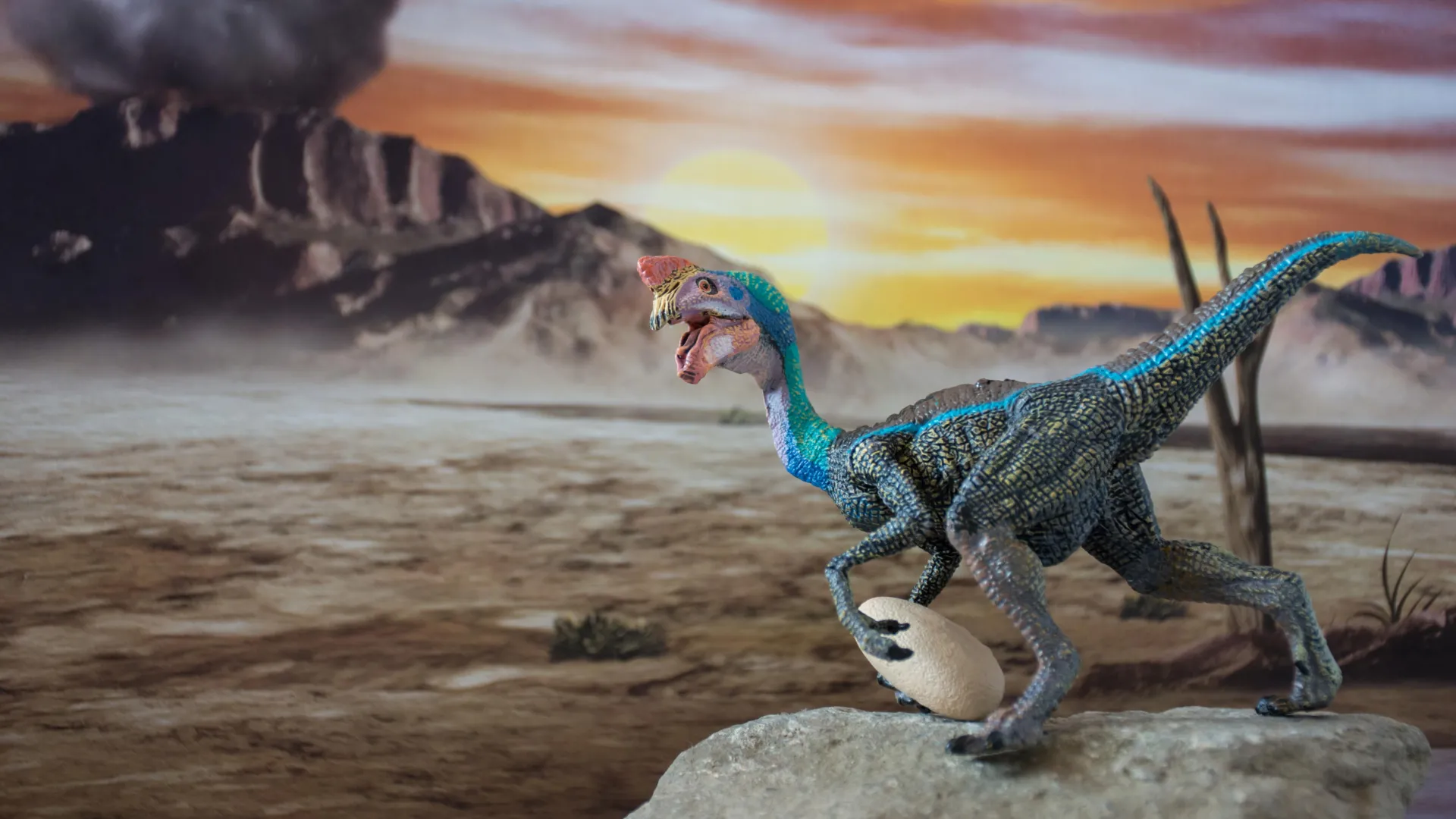
For decades, the question of how oviraptors—bird-like, flightless dinosaurs—nurtured their offspring from egg to hatchling remained a captivating mystery within paleontology. Did these intriguing creatures, whose name famously (and incorrectly) means "egg thief," rely on ambient environmental heat like modern crocodiles and turtles, or did they provide direct warmth to their clutches, mirroring the dedicated brooding of contemporary birds? A groundbreaking new study, published in Frontiers in Ecology and Evolution, has brought unprecedented clarity to this evolutionary puzzle, proposing a nuanced "co-incubation" strategy that leveraged both parental care and solar radiation.
The research, spearheaded by a team from Taiwan, including senior author Dr. Tzu-Ruei Yang, an associate curator of vertebrate paleontology at Taiwan’s National Museum of Natural Science, and first author Chun-Yu Su, who contributed significantly as a high school student from Washington High School in Taichung, represents a sophisticated fusion of heat transfer simulations and meticulous physical experiments. Their findings not only illuminate the unique nesting behaviors of oviraptors but also offer a vital evolutionary link in the development of avian incubation strategies, suggesting a path distinct from purely reptilian or fully avian methods.
The Long-Standing Debate: Dinosaur Parenting Strategies
The reproductive behaviors of dinosaurs have long been a subject of intense scientific debate. Early paleontological interpretations often depicted dinosaurs as primitive, reptilian creatures, implying a hands-off approach to parenting where eggs were buried and left to incubate solely by geothermal or solar heat. This view was challenged by the discovery of fossilized dinosaur nests, particularly those attributed to oviraptors, showing adults positioned directly over clutches in a brooding posture remarkably similar to modern birds. Such finds hinted at a more complex and active form of parental care, pushing the scientific community to reconsider the evolutionary trajectory of incubation.
Oviraptors, known from the Late Cretaceous period (approximately 70 to 66 million years ago), are theropod dinosaurs closely related to birds. Their anatomy—lightweight skeletons, feathered bodies (inferred from close relatives), and distinctive beaked skulls—has made them central to discussions about the dinosaur-bird transition. Understanding their incubation methods is crucial for mapping the evolutionary path from ancestral reptilian egg-laying to the highly efficient, endothermic brooding characteristic of modern birds. The challenge, however, lies in reconstructing processes that occurred millions of years ago, using only fossilized remnants and inferential comparisons with living species.
Innovative Methodology: Reconstructing a Prehistoric Nursery
To overcome these inherent challenges, the Taiwanese research team embarked on an ambitious experimental journey. Their methodology involved constructing a life-size physical model of an oviraptor and its nest, integrated with sophisticated heat transfer simulations. The chosen species for this reconstruction was Heyuannia huangi, a specific oviraptor known from fossil discoveries in what is now China. This dinosaur, measuring approximately 1.5 meters in length and weighing around 20 kilograms, was selected due to the availability of detailed fossil evidence pertaining to its nesting architecture, characterized by semi-open nests arranged in multiple rings of eggs.
The physical model of the Heyuannia huangi torso was meticulously crafted using a polystyrene foam core, reinforced by a wooden frame. To simulate the dinosaur’s soft tissues and provide realistic thermal insulation properties, layers of cotton, bubble paper, and fabric were applied. This careful construction aimed to replicate the thermal interaction an actual brooding oviraptor would have had with its clutch. Crucially, the eggs themselves were not real fossilized specimens, but rather invented resin eggs designed to approximate the thermal properties, size, and unique shape of actual oviraptor eggs, which differ significantly from those of any living species. These resin eggs were then arranged in two double-ring clutches, faithfully reproducing fossilized nesting patterns.
"Part of the difficulty lies in reconstructing oviraptor incubation realistically," stated Chun-Yu Su, highlighting the ingenious solution to a paleontological dilemma. "For example, their eggs are unlike those of any living species, so we invented the resin eggs to approximate real oviraptor eggs as best as we could." This innovative approach allowed the researchers to conduct controlled experiments on heat distribution within the nest, under varying simulated environmental conditions.
Key Findings: Asynchronous Hatching and Environmental Synergy
The experiments revealed fascinating insights into how oviraptor presence and ambient conditions influenced egg temperatures and, consequently, potential hatching patterns. One of the most significant discoveries concerned temperature variations within the nest, directly linked to the position of the incubating adult.
In simulated colder environmental conditions, the presence of the brooding oviraptor model resulted in substantial temperature differences, with the outer ring of eggs experiencing variations of up to 6°C. Such a significant thermal gradient within a single clutch would likely lead to asynchronous hatching—where eggs within the same nest hatch at different times. This staggered hatching pattern, observed in some modern reptiles and birds, can have various ecological implications, such as spreading the demand for parental resources over time or increasing the survival chances of at least some offspring in unpredictable environments.
However, the scenario shifted dramatically in warmer simulated environments. Under these conditions, the temperature variation across the outer ring of eggs plummeted to a mere 0.6°C. This stark contrast suggests that in warmer climates, solar radiation played a crucial role in evening out the temperatures across the entire clutch. As Dr. Yang explained, "It’s unlikely that large dinosaurs sat atop their clutches. Supposedly, they used the heat of the sun or soil to hatch their eggs, like turtles. Since oviraptor clutches are open to the air, heat from the sun likely mattered much more than heat from the soil." This observation underscores the hypothesis that oviraptors were not solely responsible for heating their eggs but rather acted as "co-incubators," leveraging ambient warmth, particularly solar energy, in conjunction with their own body heat.
Dinosaur vs. Bird Incubation: A Matter of Efficiency, Not Superiority
The study also critically compared oviraptor incubation efficiency with that of modern birds. Most avian species employ thermoregulatory contact incubation (TCI), a highly evolved strategy where the adult sits directly on its eggs, acting as the primary, consistent heat source, and ensuring uniform temperatures across the entire clutch. For TCI to be effective, the adult must maintain continuous contact with all eggs and efficiently transfer body heat.
The research suggests that oviraptors, despite their brooding posture, likely could not achieve the same level of TCI as modern birds. Their unique ring-shaped egg arrangement, as evidenced by fossil finds, meant that the adult could not simultaneously maintain direct contact with every egg in the clutch. This physical constraint, combined with their likely lower metabolic rates compared to endothermic birds, would naturally lead to a lower incubation efficiency. "Oviraptors may not have been able to conduct TCI as modern birds do," noted Su. Instead, their method was a synergistic blend of parental heat and environmental warmth.
While this "co-incubation" strategy was demonstrably less efficient in terms of achieving uniform egg temperatures and potentially faster incubation times compared to modern birds, Dr. Yang cautioned against labeling it as "inferior." "Modern birds aren’t ‘better’ at hatching eggs. Instead, birds living today and oviraptors have a very different way of incubation or, more specifically, brooding," he clarified. "Nothing is better or worse. It just depends on the environment." This perspective emphasizes the adaptive nature of reproductive strategies, perfectly suited to the specific ecological niches and climatic conditions of their respective eras. The oviraptor’s semi-open nest design, potentially an evolutionary shift from fully buried nests, represents an intermediate step, balancing direct parental care with reliance on external heat sources.
Broader Implications for Dinosaur Parental Care and Avian Evolution
This study offers profound implications for our understanding of dinosaur parental care and the evolutionary trajectory of avian reproduction. It paints a picture of dinosaur parenting that is far more sophisticated and adaptive than previously assumed, moving beyond simplistic categorizations. Oviraptors were not mere reptilian egg-layers nor were they fully avian brooders; they occupied a fascinating middle ground, demonstrating a unique strategy that maximized reproductive success within their biological and environmental constraints.
The findings also provide critical context for the evolution of bird-like traits. The transition from buried nests to semi-open ones, and subsequently to full contact incubation, highlights a gradual, step-wise evolution of parental investment. This nuanced understanding supports the growing consensus that many "avian" behaviors, including complex parental care, had deep roots within their non-avian dinosaur ancestors.
Limitations and Future Directions
The researchers acknowledge certain limitations to their study, primarily that the experiments were conducted using a reconstructed nest and under modern environmental conditions. The Late Cretaceous period, when Heyuannia huangi thrived, presented a significantly different global climate—characterized by higher atmospheric CO2 levels, potentially warmer average temperatures, and distinct atmospheric compositions. These historical differences could have influenced incubation dynamics, and future research could incorporate paleoclimatic modeling to refine the findings. Additionally, oviraptors likely had considerably longer incubation periods than modern birds, a factor that could also influence overall efficiency and the impact of temperature variations.
Despite these limitations, the study’s innovative combination of physical models and computational simulations sets a new standard for investigating complex biological questions in paleontology. This interdisciplinary approach opens new avenues for exploring various aspects of dinosaur biology, from thermoregulation to biomechanics.
An Encouragement for Global Scientific Collaboration
Beyond its scientific merits, the study carries a poignant message of inspiration, particularly for the scientific community in Taiwan. As Dr. Yang eloquently concluded, "It also truly is an encouragement for all students, especially in Taiwan. There are no dinosaur fossils in Taiwan, but that does not mean that we cannot do dinosaur studies." This emphasizes that groundbreaking scientific research transcends geographical boundaries and the immediate availability of local resources. Through ingenuity, collaboration, and a dedication to scientific inquiry, researchers can contribute significantly to global understanding, even when working with subjects that are millions of years and thousands of miles away. The work of Dr. Yang, Chun-Yu Su, and their team stands as a testament to the power of scientific curiosity and methodological innovation in unraveling the deep past.