
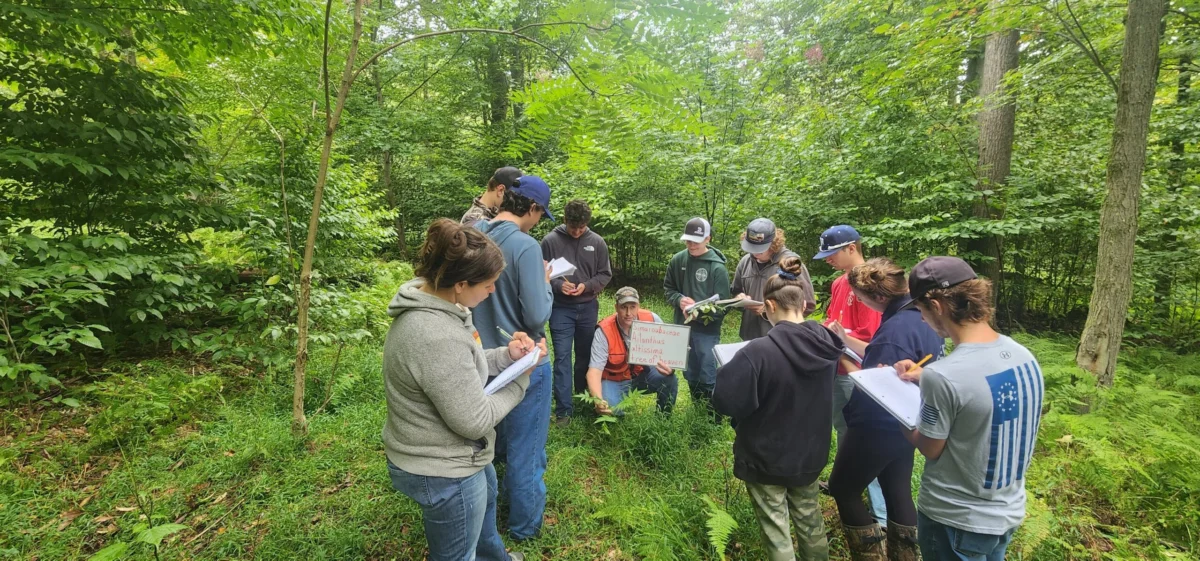
Mike Eckley’s profound connection to the natural world, initially nurtured by the trout streams of Pennsylvania, has blossomed into a distinguished career in forestry and land stewardship, now significantly enhanced by Audubon Mid-Atlantic’s Forester Training and Endorsement Program. This initiative has not only sharpened his professional skills but also deepened his ecological insight, particularly concerning avian conservation, enabling him to forge stronger, trust-based relationships with private forest landowners across central Pennsylvania. Eckley’s work exemplifies a modern approach to forestry that meticulously balances ecological health, wildlife habitat, and long-term stewardship goals, offering a compelling model for sustainable land management in a critical ecological region.
From Trout Streams to Timber Stands: A Forester’s Evolving Path
Eckley’s journey into forestry was an organic evolution, rooted in the formative experiences of his youth. Weekends spent fishing with his father in the "Big Woods" of Central Pennsylvania instilled a foundational curiosity about the outdoors. What began as an interest in aquatic ecosystems gradually broadened to encompass the surrounding terrestrial environment, particularly the intricate world of forests. This transition from water to woods laid the groundwork for a career dedicated to understanding and managing these vital landscapes.
In 2008, Eckley returned to his home state, embarking on a new chapter with The Nature Conservancy as their first Outreach Forester for the Pennsylvania chapter. This role proved pivotal, exposing him to a vibrant community of passionate birders—among staff, donors, and volunteers alike. It was here that he recognized the profound potential of bird conservation as a powerful vehicle for engagement. He observed that bird-friendly forestry served as a universal "love language," capable of uniting diverse individuals around a shared appreciation for nature and conservation, thereby broadening the scope of traditional forestry beyond mere timber production.
The Genesis of Bird-Friendly Forestry: A Strategic Approach to Engagement
The concept of "bird-friendly forestry" emerged for Eckley not just as an ecological imperative but also as a strategic tool for communication and relationship-building. For many landowners, wildlife, especially birds, often serves as the primary motivator for making management decisions regarding their property. By aligning forestry practices with avian habitat needs, Eckley found a compelling narrative that resonated deeply with his clients, allowing him to discuss complex ecological principles through an accessible and emotionally resonant lens. This approach has proven instrumental in fostering crucial, trust-based relationships, a cornerstone of effective private land conservation.
The importance of this specialization is underscored by the broader context of avian population declines. According to a 2019 study published in Science, North America has lost nearly 3 billion birds since 1970, a staggering 29% reduction across all biomes. Habitat loss and degradation are identified as primary drivers of these declines. Therefore, forest management practices that actively promote and enhance bird habitats are not merely beneficial but critical for reversing these trends. Bird-friendly forestry, as championed by Eckley, moves beyond general sustainability to implement targeted interventions that address the specific ecological requirements of various bird species, especially those in decline.
Audubon Mid-Atlantic’s Forester Training and Endorsement Program: Elevating Expertise
Recognizing the need for specialized knowledge in this evolving field, Eckley participated in Audubon Mid-Atlantic’s Forester Training and Endorsement Program. This program is designed to equip foresters with advanced ecological insights and practical strategies for integrating bird conservation into forest management plans. The rigorous curriculum covers topics such as identifying priority bird species, understanding their habitat needs, and implementing best management practices that support diverse avian populations.
The endorsement process provided Eckley with tangible benefits, significantly enhancing his professional profile. In his private practice, working with a diverse array of forest landowners, the Audubon endorsement has become a powerful differentiator. It signals a specialized expertise that resonates strongly with clients who are particularly passionate about birds, improving his visibility and credibility within this crucial demographic. Furthermore, Eckley’s commitment to continuous learning extends to his role as a lecturer within the Penn State DuBois Wildlife Technology Program, where he shares his practical experience and the principles of bird-friendly forestry with the next generation of wildlife professionals. This academic connection further reinforces the scientific underpinnings of his work and the program’s relevance.
"The Audubon Forester Training and Endorsement Program is vital for creating a network of skilled professionals who can translate conservation science into on-the-ground action," states an Audubon Mid-Atlantic representative, who prefers to remain anonymous due to internal policy but is familiar with the program’s impact. "Foresters like Mike Eckley are at the forefront of this effort, demonstrating how sustainable forestry can go hand-in-hand with robust biodiversity protection, especially for our most vulnerable bird species."
Implementing Advanced Wildlife Management: A Comprehensive Toolkit
The training program has fundamentally transformed Eckley’s approach to wildlife management, providing him with a "complete toolkit" of practices. He emphasizes how the program helped him "connect-the-dots," strengthening his understanding of specific bird species’ habitat requirements and offering a "playbook of best management practices" to aid declining populations. When consulting with landowners interested in managing their forests for birds, Eckley can now offer concrete, scientifically backed strategies.
For instance, if a client owns overgrown fields adjacent to a forest, Eckley is equipped to advise on how strategic cutting and clearing can maintain critical scrubby habitat. This specific type of early successional habitat is vital for species such as the Prairie Warbler (Setophaga discolor) and the Golden-winged Warbler (Vermivora chrysoptera), both of which have experienced significant population declines across their range. The Golden-winged Warbler, in particular, is listed as a species of high conservation concern, with its populations having plummeted by over 60% since the 1960s. Managing for these specific habitat niches directly contributes to the recovery efforts for these vulnerable species.
Distinguishing Bird-Friendly Practices from Traditional Forestry
Bird-friendly forestry, as practiced by Eckley, distinguishes itself from more traditional approaches by deepening the focus on maintaining structural complexity within forests with greater intention. While conventional sustainable forestry aims for healthy timber stands, bird-friendly practices integrate "finesse factors"—targeted interventions designed to retain and support species that provide essential food and shelter for birds.
A prime example involves the identification and prioritization of vigorously growing oak trees, particularly white oaks (Quercus alba). These "champion trees" develop broad crowns and produce abundant acorns, a critical food source for numerous wildlife species, including deer, turkeys, and a wide array of birds. To support these keystone trees, Eckley might recommend selectively thinning mid-story vegetation. This allows more sunlight to reach the forest floor, strengthening the growth of the oaks and enhancing their ability to support caterpillars and other insect populations—a vital protein source for breeding birds and their young. White oaks are also known for their long lifespans, contributing to structural diversity over centuries, and their rough, flaky bark provides excellent microhabitats for insects and nesting sites for certain bird species. This emphasis on enhancing specific ecological functions, rather than solely focusing on timber yield, defines the bird-friendly approach.
Engaging Landowners: The "Engine Additive" of Avian Conservation
Mike Eckley views much of his career as a continuous dialogue with people about forest management. He observes that for many private landowners, wildlife has historically been, and continues to be, the primary driver behind their management decisions. In this context, bird-friendly forestry has served as a powerful "engine additive," further captivating clients and strengthening the trust-based relationships essential for successful, long-term conservation outcomes.
Pennsylvania boasts a significant amount of privately owned forestland, with individual landowners managing millions of acres. Their decisions collectively hold immense sway over the ecological health of the region. Engaging these landowners effectively requires understanding their motivations and demonstrating tangible benefits. By framing management through the lens of bird conservation, Eckley taps into a widespread appreciation for nature, translating complex ecological needs into relatable goals. Landowners often express satisfaction not only in the improved health of their forests but also in the increased presence and diversity of birdlife they observe.
"Working with Mike Eckley has opened my eyes to how much more we can do with our land," shared a hypothetical private landowner, reflecting a common sentiment. "We always wanted to protect the wildlife, but Mike showed us exactly how to manage our trees to help specific birds. It feels good to know our forest is contributing to something bigger."
Pennsylvania’s Critical Role in Avian Conservation: The PA Wilds Region
Eckley finds particular satisfaction in knowing his work is concentrated within the PA Wilds region, an area scientifically identified as a priority for a multitude of conservation values, including the protection of birds. This vast, largely forested expanse in north-central Pennsylvania is recognized as a critical migratory pathway and breeding ground for numerous avian species. Pennsylvania, as a whole, is designated a "high-responsibility state" due to its importance for the viability of both game and non-game species, underscoring the continental significance of local conservation efforts.
The state lies within the Atlantic Flyway, one of North America’s major migratory routes, making its forests crucial stopover and breeding sites for millions of birds annually. Efforts channeled into focal areas like the PA Wilds, which boast extensive contiguous forest blocks, provide essential habitat connectivity that is increasingly threatened elsewhere. The fragmented nature of many landscapes across the eastern U.S. makes these large, intact forest systems irreplaceable for species requiring interior forest habitat. Consequently, the work Eckley performs with individual landowners contributes directly to the resilience of broader regional and continental bird populations.
A Personal Connection: Bridging Generations Through Nature
Beyond his professional endeavors, Eckley’s commitment to birds permeates his personal life, offering a unique avenue for connection with his teenage son. He recounts a recent outing where he abruptly stopped, asking his son if he heard a particular bird. Initially met with the typical teenage skepticism—a scoff, an eye-roll, and a dismissive "No"—Eckley used a modern tool to bridge the gap. Pulling out his iPhone, he activated the Merlin Bird ID app, which captured the bird’s audio. The app identified the species as a Rose-breasted Grosbeak (Pheucticus ludovicianus), which soon revealed its location, perched on a nearby sapling. The son’s expression transformed from annoyance to genuine curiosity, a small but significant victory in fostering a love for nature in the next generation. This anecdote highlights the power of combining traditional field skills with contemporary technology to make nature more accessible and engaging, especially for younger audiences.
Favorite Species and Ecological Significance
Though he humbly describes himself as a "birder in training," Eckley cherishes a memorable encounter with a pair of Pine Warblers (Setophaga pinus), a species closely associated with pine forests. His favorite tree species is the white oak, a choice deeply rooted in both personal connection and ecological appreciation. He owns several white oaks on his personal property and is drawn to their aesthetic beauty—characterized by their large, sweeping, quarter-acre sized crowns and distinctive ashy gray, flaky bark. Beyond their visual appeal, Eckley recognizes the white oak’s immense ecological importance, particularly for warblers and a vast array of other wildlife, reinforcing the interconnectedness of his professional and personal passions. White oaks are known for their high mast production, providing abundant acorns that are a critical food source, and their robust structure supports diverse insect communities, which in turn feed birds.
A Model for Sustainable Stewardship and Biodiversity
Mike Eckley’s journey stands as a powerful testament to the efficacy of integrating ecologically-responsible forestry practices with dedicated avian conservation. His work demonstrates that effective land management is as much about attentive listening—to the land, its wildlife, and the people who care deeply about both—as it is about implementing expert interventions. Programs like Audubon Mid-Atlantic’s Forester Training and Endorsement are instrumental in empowering professionals like Eckley to translate this nuanced understanding into tangible action on the ground. Through his efforts, thriving bird populations and healthy, resilient forests are shown to be not just compatible, but mutually reinforcing goals. As conservation challenges continue to mount, models of integrated stewardship, like Eckley’s, offer a vital pathway towards securing a sustainable future for both our natural landscapes and the diverse life they support. Further information about Audubon’s Forester Training and Endorsement Program can be found on their official website.