
The late February landscape of Manitoba served as the backdrop for a comprehensive ornithological expedition that concluded on February 27, 2026, marking a successful period of observation despite volatile winter weather conditions. The five-day tour, which traversed a variety of habitats from the open prairies of Oak Bluff to the boreal transition zones of Lac du Bonnet, resulted in the documentation of several key owl species, including Snowy Owls, Northern Hawk Owls, and Barred Owls. This expedition not only provided participants with rare sightings of North America’s most elusive raptors but also underscored the shifting ecological dynamics of the region, characterized by the increasing presence of species like the Red-bellied Woodpecker and the continued importance of Manitoba as a critical wintering ground for boreal birds.

Expedition Commencement and Early Meteorological Challenges
The expedition began on February 23, 2026, with an initial briefing and orientation. The primary objective of the tour was to locate and document the diverse array of owls that inhabit or migrate through the Red River Valley and the surrounding boreal forests during the winter months. However, as the group set out on the morning of February 24, they were met with the harsh realities of a Manitoba winter.
Heading southwest toward the town of Oak Bluff, the team encountered "blustery" conditions that significantly hampered visibility. The initial search for Snowy Owls (Bubo scandiacus) along hydro poles and snowdrifts proved difficult. While the owls remained elusive during the early hours, the group successfully documented Grey Partridge (Perdix perdix) foraging along the roadside—a hardy species that relies on cleared patches of ground to find seeds during heavy snow cover.

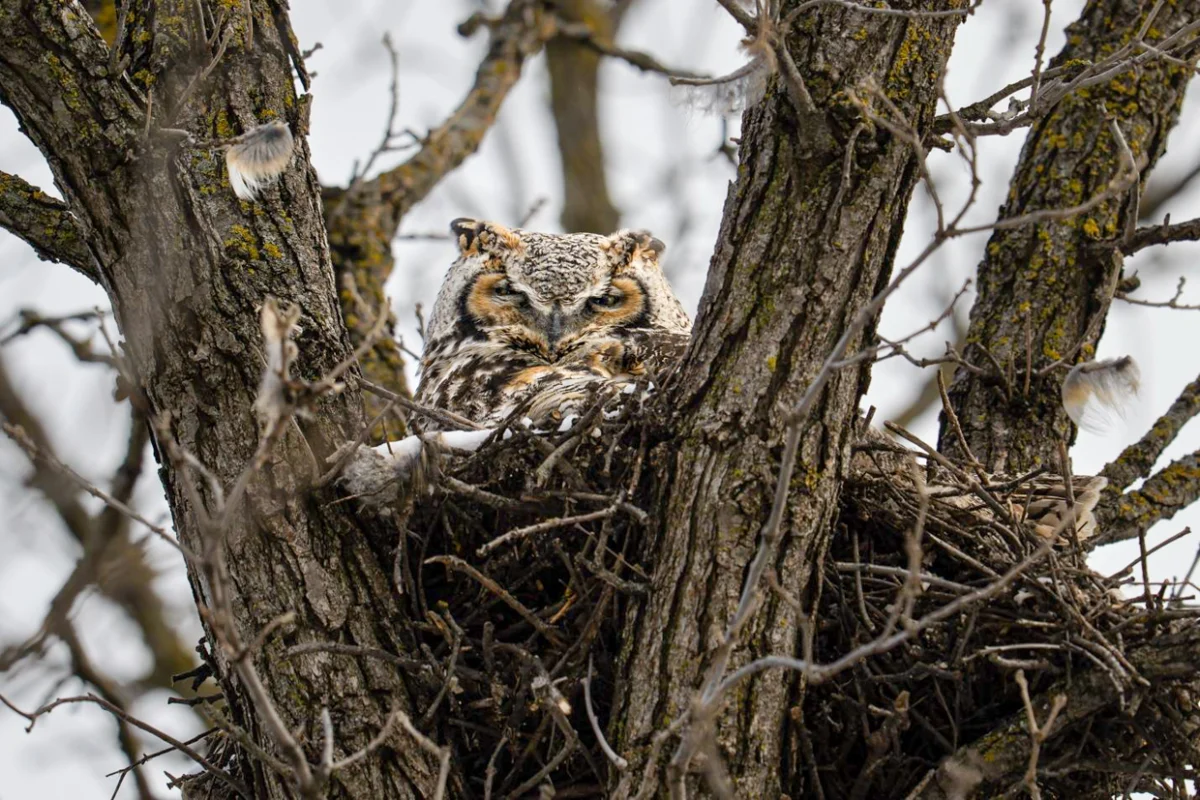
Due to deteriorating visibility caused by blowing snow, the expedition’s leadership made the strategic decision to pivot toward more sheltered environments. This led the group to Bunn’s Creek Centennial Park. The shift in strategy yielded immediate results. In a heated picnic area, the group observed a nesting pair of Great Horned Owls (Bubo virginianus). Journalistic observations noted the resilience of the female, who remained "tight on the nest" despite the swaying of the trees in the high winds, while the male maintained a vigilant watch nearby. This site also featured a Pileated Woodpecker (Dryocopus pileatus), the largest woodpecker in North America, which was observed excavating a roosting or nesting hole, seemingly indifferent to the presence of the apex predators nearby.
Ornithological Insights and Expert Engagement
The evening of the second day was marked by a significant educational component, featuring a presentation by Dr. Jim Duncan, a renowned expert on Great Grey Owls. Dr. Duncan, who has spent decades studying the "Phantom of the North," shared insights into the population dynamics and conservation needs of Manitoba’s provincial bird. A highlight of the session was the presence of Oska, an education bird that allowed participants to observe the specialized physiological adaptations of owls at close range.

Dr. Duncan’s research is particularly relevant as climate change begins to impact the snowpack density in the boreal forest, which in turn affects the ability of Great Grey Owls to hunt voles beneath the surface. Presentations such as these provide a vital link between recreational birding and scientific conservation, framing the expedition within a broader context of environmental stewardship.
The Boreal Transition: Success in Lac du Bonnet
On February 25, the third day of the tour, the expedition moved toward the Libau area and Lac du Bonnet, seeking species more typical of the boreal forest. The day began with a sighting of 17 Sharp-tailed Grouse (Tympanuchus phasianellus) and approximately 30 Snow Buntings (Plectrophenax nivalis), the latter often referred to as "snowflakes" due to their white plumage and erratic flight patterns.

The highlight of the day was the discovery of five Northern Hawk Owls (Surnia ulula). Unlike most owl species, the Northern Hawk Owl is diurnal, hunting during the day and often perching on the highest available vantage points. The first was observed hunting near smoldering brush piles—a behavior that suggests the bird was capitalizing on rodents flushed out by the heat or human activity. Later, on Maple Creek Road, another Hawk Owl was observed on a hydro pole, demonstrating the species’ characteristic lack of fear toward humans as it attempted a hunt within close proximity to the group.
The presence of three additional Hawk Owls in a recently burned coniferous forest near Lac du Bonnet provided a clear example of how wildlife utilizes disturbed habitats. Burned areas often see a surge in small mammal populations, which in turn attracts raptors. The day concluded with observations of Pine Grosbeaks, Redpolls, and Blue Jays at local feeders, as well as an encounter with White-tailed Deer in Pinawa, highlighting the rich mammalian and avian biodiversity of the region.

The Snowy Owl Return and Urban Raptors
On February 26, the fourth day, the expedition returned to the open country south of Winnipeg to reattempt the search for Snowy Owls. With improved weather conditions, the group was rewarded with five sightings in quick succession. These included four juvenile birds and one adult female. The high concentration of juveniles is often an indicator of a successful breeding season in the Arctic, leading to an "irruption" where younger birds move further south in search of territory and food.
In the southern reaches of Winnipeg, the group also located a dark morph Rough-legged Hawk (Buteo lagopus). This Arctic-breeding raptor is a common winter visitor to the prairies, but the dark morph—characterized by nearly all-black plumage—is a particularly prized sighting for birders. The group observed the hawk successfully consuming prey, offering a rare look at the life-and-death struggle of winter survival.

The afternoon focused on urban parks, specifically Harris Park and St. Vital Park. In Harris Park, the group utilized the behavior of American Crows to locate a Barred Owl (Strix varia). Crows frequently "mob" owls to drive them out of their territory, and their vocalizations led the expedition directly to the owl’s daytime roost. In addition to the Barred Owl, the group documented three Red-bellied Woodpeckers (Melanerpes carolinus). Historically considered a vagrant species in Manitoba, the Red-bellied Woodpecker has been steadily expanding its range northward, a phenomenon often cited by ornithologists as evidence of warming winter trends and the proliferation of bird feeders in suburban areas.
Conclusion at FortWhyte Alive: A Study in Scavenging and Symbiosis
The final major stop of the expedition was FortWhyte Alive, a reclaimed industrial site that now serves as a premier nature center. Here, the group observed a pair of Bald Eagles (Haliaeetus leucocephalus) at a large nest. The observation provided a fascinating look at pair-bonding and scavenging behavior, as the male returned to the nest with what appeared to be salvaged roadkill to share with the female.

As the eagles fed in the "golden light" of the late afternoon, they were flanked by Black-billed Magpies and a Northern Shrike—species that often follow larger predators to scavenge remains. This final sighting served as a microcosm of the entire trip, illustrating the complex interdependencies within the Manitoban ecosystem.
Broader Implications and Environmental Context
The 2026 Manitoba Owls expedition serves as more than a simple birding tour; it is a data-gathering exercise that contributes to our understanding of avian distribution. The results of the trip were uploaded to eBird, a global citizen-science database managed by the Cornell Lab of Ornithology. By documenting species like the Northern Hawk Owl and the expanding Red-bellied Woodpecker, such expeditions provide longitudinal data that scientists use to track the impacts of climate change and habitat loss.

Furthermore, the success of the tour highlights the economic and conservation value of ecotourism in Manitoba. The province’s unique geography—where the prairie meets the boreal forest—makes it one of the few places in North America where such a high density of owl species can be observed in a single week. This "owl tourism" brings vital revenue to rural communities like Lac du Bonnet and Pinawa while fostering a public interest in the preservation of the habitats these birds require.
As the participants departed on February 27, the collective data from the five-day period confirmed that despite the challenges of winter weather, the region remains a robust and vital sanctuary for North American raptors. The expedition concluded with a final dinner where the group reflected on the sightings of five owl species, multiple raptors, and the enduring beauty of the Manitoban wilderness. For the scientific community and birding enthusiasts alike, the 2026 tour stands as a testament to the resilience of nature and the importance of continued monitoring of our avian populations.