
The vast, windswept landscapes of Manitoba recently served as the backdrop for a comprehensive five-day ornithological expedition, during which a specialized birding group documented a wide array of owl species and winter-hardy boreal birds. From March 10 to March 14, 2026, the tour navigated a variety of ecosystems, including southern prairie gravel roads, urban parklands, and the dense boreal forests of the Lac du Bonnet region. The expedition, which combined citizen science with high-level ecotourism, highlighted the unique biodiversity of the Canadian Prairies during the late winter transition and underscored the region’s status as a premier destination for raptor observation.

A Foundation of Conservation and Expertise
The expedition commenced on the evening of March 10 in Winnipeg, where participants gathered for an introductory briefing at the Oak and Grain restaurant. The centerpiece of the evening was a presentation by Dr. James Duncan, a renowned biologist and leading authority on Manitoba’s owl populations. Accompanying Dr. Duncan was Oska, a captive-bred Great Grey Owl used for educational purposes.
Dr. Duncan’s work, which spans several decades, has been instrumental in understanding the population dynamics and nesting habits of the Great Grey Owl (Strix nebulosa), Manitoba’s provincial bird. His presentation provided the group with essential context regarding the "Phantom of the North," detailing how these owls utilize their exceptional hearing to hunt prey beneath deep snow. This academic foundation set the stage for the field observations that followed, emphasizing the importance of habitat preservation in the face of shifting climatic patterns in the subarctic and boreal zones.

The Search for the Arctic Ghost: Southern Prairie Expeditions
On March 11, the second day of the tour, the focus shifted to the open agricultural lands south of Winnipeg. The town of Oak Bluff and the surrounding Highway 330 corridor are known for providing the flat, tundra-like vistas preferred by Snowy Owls (Bubo scandiacus) during their winter irruptions. The morning began with the sighting of a pair of Grey Partridges, a species introduced to North America that has become a staple of the prairie landscape.
As the group traversed gravel roads, they encountered numerous Horned Larks, which often congregate along roadsides where the wind clears snow from the ground, revealing seeds and grit. The first major raptor sighting of the day was a "ghost-like" adult Snowy Owl. These birds, which migrate south from their Arctic breeding grounds, are highly sought after by birders for their striking white plumage. Shortly after, near the town of La Salle, the group located a second Snowy Owl—an immature individual characterized by more prominent dark barring. Observations of immature birds are particularly significant to researchers as they provide data on the previous year’s breeding success in the Arctic.

The day’s itinerary also included a transition into urban and suburban environments. A visit to Fort Whyte Alive allowed the group to observe a Bald Eagle nest, a testament to the recovery of the species in Southern Manitoba. While the nest was currently unoccupied, a nearby perched adult confirmed the territory’s continued use.
Urban Raptors and the Complexity of Nesting Biology
Winnipeg’s extensive park system provides a unique opportunity to observe raptors within city limits. However, the expedition also highlighted the challenges of winter birding. At St. Vital Park, a known roost for Western Screech-Owls was found empty, illustrating the nomadic and elusive nature of small owls during fluctuating March temperatures. Similarly, an attempt to locate a Barred Owl at Harris Park was unsuccessful, though the group did engage in an auditory encounter with a Red-bellied Woodpecker, a species that has been gradually expanding its range northward into Manitoba.

A significant highlight of the urban survey occurred at Bunn’s Creek in North Winnipeg. The group observed a pair of nesting Great Horned Owls (Bubo virginianus). The female was seen on the nest, with the downy feathers of at least one chick visible beneath her—a clear indication of the early nesting cycle typical of this hardy species. The male was perched nearby, providing a sentinel presence. This sighting was complemented by a pair of Pileated Woodpeckers, the largest woodpeckers in North America, whose presence indicates a healthy forest canopy with sufficient decaying wood for foraging.
Venturing into the Boreal: The Northern Hawk Owl
On March 12, the expedition traveled northeast toward the boreal forest transition zone along Highway 317. The primary objective was the Northern Hawk Owl (Surnia ulula), a diurnal hunter that behaves more like a hawk than a typical owl. The group successfully located a specimen perched on an exposed log, a behavior typical of the species as it scans for voles across open muskeg and clearings.

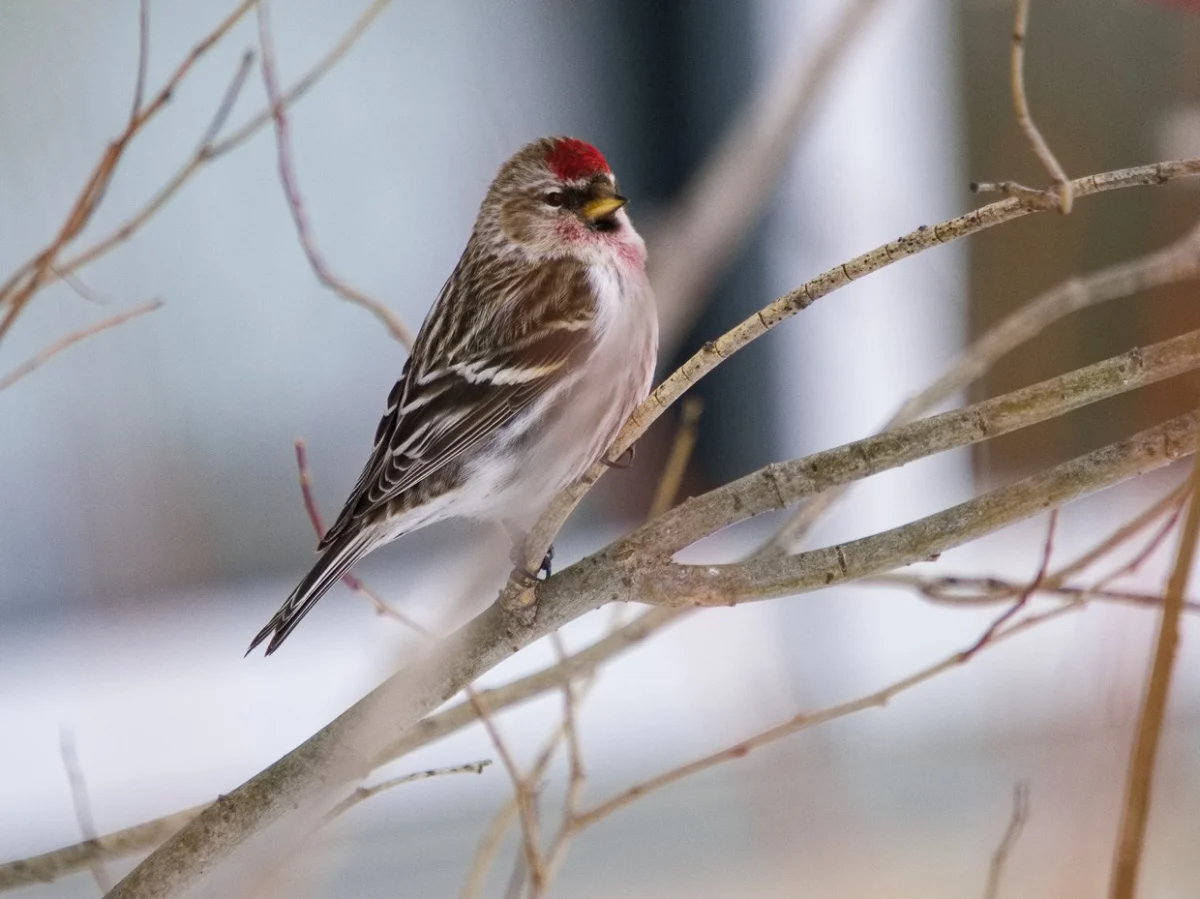
The tour then proceeded to the Lac du Bonnet area, specifically visiting feeders on Henry Bellin Road. Winter feeders in this region are critical for the survival of many "irruptive" species. The group recorded high numbers of Evening Grosbeaks and Pine Grosbeaks, both of which are celebrated for their vibrant plumage against the winter snow. Other sightings included both Common and Hoary Redpolls, Black-capped Chickadees, and Blue Jays. A notable addition was the Sharp-tailed Grouse, a native prairie-forest edge species known for its elaborate spring lekking displays.
The afternoon continued with further sightings of the Northern Hawk Owl and a visit to Silver Falls, where a Red-breasted Nuthatch and Evening Grosbeaks were documented. Near Powerview, the presence of open water—a rarity in a Manitoba March—attracted Common Goldeneyes and a pair of Bald Eagles, highlighting the importance of ice-free river sections for wintering waterfowl and their predators.

Wetland Conservation and the Final Discovery
The final full day of the tour, March 13, saw a strategic shift in the itinerary based on local reports and weather conditions. After a return to the Oak Bluff area for a secondary, though unsuccessful, search for additional Snowy Owls, the group moved to the Oak Hammock Marsh Interpretive Centre.
Oak Hammock Marsh is a Ramsar-recognized wetland of international importance. While much of the marsh remains frozen in early March, it serves as a vital staging ground for the first arrivals of spring. The group observed 16 Canada Geese in a small patch of open water, signaling the very beginning of the spring migration. At the marsh’s feeders, participants were able to study female Red-winged Blackbirds and a large flock of Redpolls. The visit also provided an opportunity to learn about the marsh’s role in North American waterfowl conservation and its management by Ducks Unlimited Canada.

The expedition concluded with a successful "tip-off" regarding a Northern Saw-whet Owl (Aegolius acadicus) at Assiniboine Park. This tiny, strictly nocturnal owl is notoriously difficult to find due to its preferred dense roosting habitat. The sighting allowed the group to end the tour on a high note, having documented a diverse cross-section of Manitoba’s owl species, ranging from the massive Great Horned Owl to the diminutive Saw-whet.
Scientific and Economic Implications of Winter Birding
The results of the March 2026 Manitoba Owls tour have been uploaded to eBird, a global citizen science database managed by the Cornell Lab of Ornithology. Such data is vital for researchers tracking the timing of migrations and the health of wintering raptor populations. The observation of nesting Great Horned Owls and the presence of Northern Hawk Owls in traditional territories suggest a stable ecosystem for these apex predators, despite the broader challenges posed by habitat loss and climate variability.

Furthermore, the tour underscores the growing economic importance of "niche" ecotourism in Manitoba. Winter birding attracts enthusiasts from across North America and beyond, providing significant revenue for local hospitality and guiding services during the traditional "off-season." The success of such tours relies heavily on the preservation of diverse habitats—from the prairie potholes and agricultural fringes to the deep boreal forests and managed wetlands.
As the participants departed on March 14, the expedition stood as a successful model of how organized birding can foster environmental appreciation while contributing to the body of knowledge required to protect these iconic avian species. The sightings of five different owl species—Snowy, Great Horned, Northern Hawk, Northern Saw-whet, and the educational Great Grey—provide a snapshot of a region that remains a critical stronghold for North American raptors.