
In a significant departure from the prevailing pursuit of hyper-sharpness and technical exactitude, Kuwaiti wildlife photographer Mohammad Murad has forged a distinctive path, embracing motion, light, and raw emotion as the cornerstone of his artistic vision. His work, which frequently employs techniques such as slow shutter speeds and intentional camera movement (ICM), transcends mere documentation, offering an interpretative lens into the natural world. As a recognized Canon EMEA Ambassador and an award-winning artist, Murad’s photographs invite viewers to engage with wildlife on a profoundly emotional level, challenging traditional perceptions of nature photography and highlighting the dynamic pulse of life itself.

Embracing the Unseen: A Paradigm Shift in Wildlife Photography
Murad’s artistic philosophy stands in stark contrast to the conventional tenets of wildlife photography, which often prioritize crisp detail, precise focus, and scientific accuracy. He consciously chooses to de-emphasize these technical benchmarks in favor of conveying the essence of movement, the ephemeral quality of light, and the underlying emotional narratives within wild landscapes. This approach is not a rejection of technical skill but rather a re-channeling of it towards a more expressive outcome. His images are less about capturing a frozen moment in time and more about illustrating the continuous flow of life, the fleeting beauty of a gesture, or the atmospheric mood of a scene. This artistic stance resonates with a growing segment of the photography community that seeks to imbue imagery with personal interpretation and artistic depth, pushing the boundaries beyond purely illustrative representations. Such works often draw parallels to impressionistic painting, where the artist’s subjective experience and emotional response to a subject are paramount.

The Genesis of Motion: From Cormorants to Intentional Art
The genesis of Murad’s distinctive style can be traced to a pivotal moment involving a flock of cormorants. What began as an experimental lowering of shutter speed unexpectedly transformed the scene into a fluid, almost painterly depiction of movement—wings blurring, water rippling. This epiphany revealed photography’s potential beyond static record-keeping, inspiring Murad to actively infuse his work with energy and dynamism. Since that turning point, he has systematically explored and mastered techniques like slow shutter speeds, panning, and Intentional Camera Movement (ICM). These methods deliberately introduce blur, not as a technical flaw, but as a compositional tool to convey speed, grace, and the sheer vitality of wildlife.

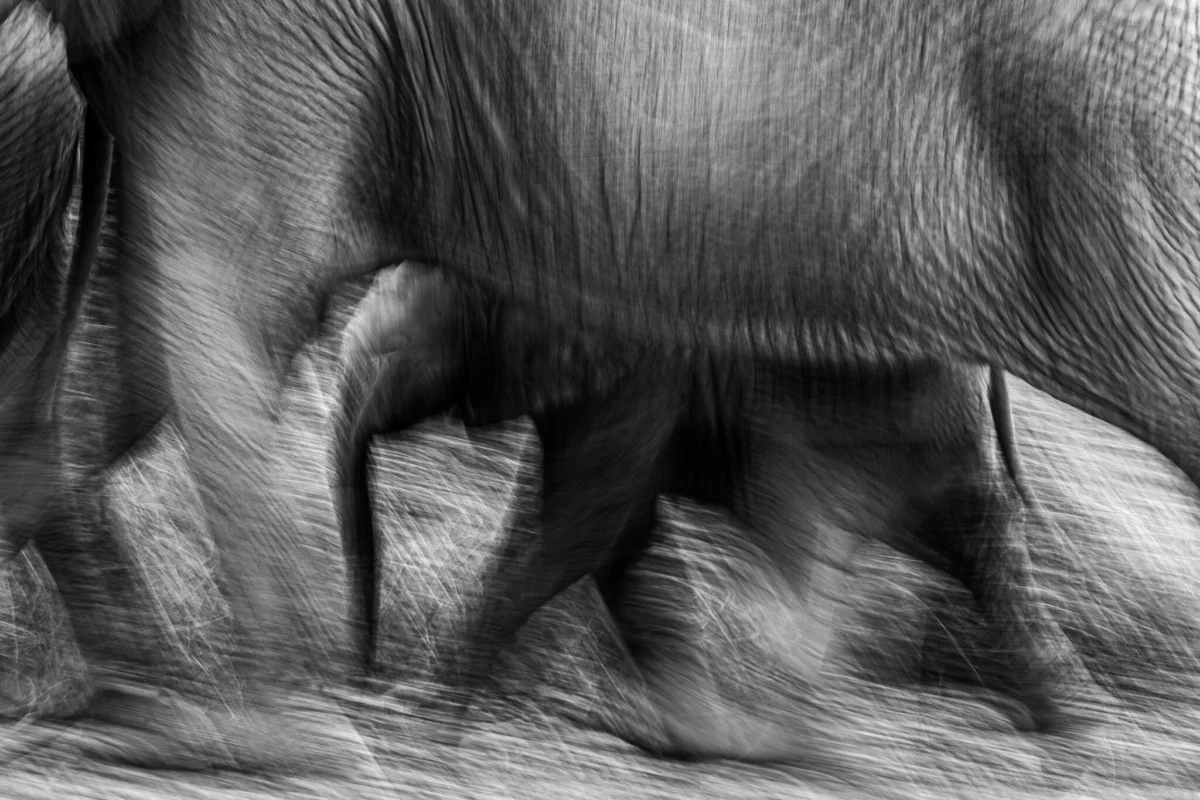
For instance, capturing a group of zebras fleeing a cheetah hunt, Murad employed a slow shutter speed to render the surrounding environment in a dramatic blur, emphasizing the urgency and raw power of their escape. Similarly, a herd of gazelles racing across the Maasai Mara plains under varying light and shadow became a testament to speed and survival, with the blurred background intensifying the gazelles’ focused motion. Even a lone Grant’s gazelle, walking gracefully, was immortalized not in a sharp, static pose, but with a soft, motion-filled backdrop and a delicate rim light at f/5, allowing the viewer to feel its elegant movement. His photograph of an elephant’s powerful, pillar-like legs, blurred to highlight their strength and rhythmic stride, rather than capturing a fixed posture, further exemplifies this dedication to depicting the essence of motion. This deliberate use of blur requires a profound understanding of light, composition, and the subject’s movement, transforming ordinary scenes into captivating visual poems.
Light as a Narrative Force: Crafting Emotion in the Wild

Beyond motion, light serves as a primary narrative element in Murad’s photography, acting as a crucial storyteller that sculpts mood and emotion. He meticulously observes how the quality and direction of light can dramatically alter a scene, turning a harsh landscape into a soft, inviting vista or imbuing shadows with tension and mystery. Backlighting, in particular, is frequently employed to transform subjects into poetic silhouettes or to create ethereal glows, highlighting their contours against a vibrant backdrop.
Murad’s dedication to capturing the perfect light often entails hours of patient waiting, not for a technically flawless shot, but for the moment when the light authentically conveys the scene’s emotional truth. This commitment is evident in images such as a White (Pied) Wagtail enveloped by a swarm of mosquitoes at sunset in a Kuwaiti nature reserve, where placing the sun directly behind the subject created a beautiful, glowing aura. A full-bellied hyena wandering at sunset embodies solitude at day’s end, its form silhouetted against the fading light, while a herd of blue wildebeest kicking up dust after fleeing predators is bathed in a warm, dramatic yellow glow from the setting sun, enhancing the sense of both urgency and momentary relief. For Murad, light is not merely illumination; it is a brushstroke, an emotional modulator that shapes the viewer’s experience of the wild.

Urban Wilderness: The Arabian Red Foxes of Kuwait City
One of Murad’s most compelling projects involved documenting Arabian red foxes in an unexpected urban setting: Kuwait City’s Doha shore, framed by the vibrant glow of streetlights. This series vividly illustrates his unique approach to both subject matter and technique. To achieve the captivating rim light that defines these images, Murad ingeniously utilized two small handheld flashlights, patiently waiting for a mother fox to unearth food she had cleverly hidden for her cubs. The reflected street and car lights off the sea provided a unique, colorful bokeh, blending the natural world with the urban environment in a visually striking manner.

This project was a testament to his patience and ethical engagement with wildlife. Over two months, Murad dedicated four evenings a week to observing the fox family. Maintaining a respectful distance initially, he gradually earned their trust to such an extent that the curious kits began to approach his gear, even licking his camera and feet. This deeply personal connection, stemming partly from his own experience as a father of five, fostered a profound sense of responsibility for these urban foxes. The photographs depict intimate moments: a cub gazing into the camera with streetlights forming a luminous bokeh, a kitten exploring its den’s periphery, and cubs digging for hidden treasures, all bathed in the magical glow of the urban night. The series culminates with an image of the mother fox surveying her territory against the city’s vibrant lights, a powerful reminder of nature’s resilience and adaptability in human-dominated landscapes. This work not only highlights the presence of wildlife in unexpected places but also underscores the photographer’s role as a silent advocate for their protection and coexistence.
Journeys into the Extreme: Lessons in Adaptability and Serendipity

Murad’s pursuit of evocative wildlife imagery has taken him far beyond the urban edges of Kuwait, leading him to the icy expanses of Iceland and the rugged mountains of Mongolia. These challenging environments have served as profound teachers, imparting invaluable lessons in patience, adaptability, and the embrace of serendipity. Navigating lost luggage, enduring arctic winds, and contending with extreme temperatures—sometimes as low as -34°C—have all been integrated into his creative process. Nature, as he observes, rarely conforms to human expectations, and the most profound images often emerge when one relinquishes control and allows the scene to unfold naturally.
In the remote Hornstrandir Nature Reserve in Iceland, a wild land untouched by infrastructure since the 1950s, Murad captured an Arctic fox peacefully napping behind snow-covered plants, its nose curled under its tail, gazing directly into his lens. This moment, achieved without disturbance, speaks to the deep connection forged through respectful observation. Another image shows an Arctic fox walking alone in the vast tranquility of Hornstrandir, emphasizing the untouched beauty of the reserve. His arduous expedition to the Altai Mountains in Mongolia yielded a rare glimpse of the elusive snow leopard, perfectly camouflaged amidst fiery orange lichens and jagged rocks. This awe-inspiring encounter, achieved after enduring severe conditions, served as a stark reminder of nature’s resilience and the urgent need to protect this endangered predator, whose dwindling populations face significant threats from habitat loss and poaching across Central Asia. These journeys underscore a fundamental principle in his work: moving with nature, rather than against it, allows for authentic and deeply resonant captures.

Beyond Documentation: Inspiring a Deeper Connection to Nature
At the core of Mohammad Murad’s photography is a fervent desire to communicate beyond the purely visible; he seeks to evoke a visceral, emotional response from his audience. His images are crafted to be felt, to resonate with the viewer’s inner self. This aspiration drives his experimentation with techniques that transcend conventional photographic norms, aiming to translate the fragility of a bird in flight, the collective resilience of a herd, or the silent, intricate dynamics between predator and prey. His work is not merely about showcasing wildlife; it is about sharing a personal, artistic interpretation of life itself.

This emotional approach has significant implications for conservation advocacy. While scientifically precise images serve vital educational purposes, Murad’s evocative, art-driven photographs can cultivate a deeper empathy and foster a more personal connection with the subjects, potentially inspiring greater conservation efforts. The emotional weight of an abstract image, such as seagulls rendered with "fiery wings" through slow shutter speed along Kuwait’s coast, or the mysterious depiction of a baby elephant and its mother in Tanzania, can bypass intellectual barriers and tap directly into human emotions. As he states, like a violinist playing a personal melody, photography allows him to share his story, leaving interpretation to the viewer. This artistic freedom, seen also in his capture of a lion roaming the African wilderness—a scene with which he personally identifies—and the "mystical oneness" conveyed in his slow shutter speed shots of Greater Crested Tern colonies on Kubbar Island, encourages a broader appreciation for nature’s intrinsic value. By moving away from the relentless pursuit of technical perfection, Murad encourages aspiring photographers to trust their instincts and embrace their unique creative voices, fostering a more diverse and impactful landscape within nature photography.
The Evolving Landscape of Wildlife Photography

Mohammad Murad’s work is not an isolated phenomenon but rather a prominent example of a broader evolution within wildlife photography. The genre, traditionally rooted in scientific illustration and documentary realism, is increasingly recognizing the value of artistic interpretation. This shift is partly driven by advancements in camera technology, which have democratized access to high-quality images, pushing photographers to find new ways to differentiate their work. More importantly, there’s a growing understanding that emotional engagement is a powerful tool for advocacy and connection, especially in an era of unprecedented environmental challenges.
His status as a Canon EMEA Ambassador further solidifies the legitimacy of this artistic approach within the industry. Canon, a leader in photographic equipment, endorsing a photographer whose signature style emphasizes artistic blur and emotional narrative, sends a clear message about the expanding definition of photographic excellence. This recognition provides a platform for Murad to influence a new generation of photographers, encouraging them to explore their personal artistic expressions rather than solely adhering to established technical paradigms. The implications are profound: artistic wildlife photography can broaden the appeal of nature imagery, attracting audiences who might not be drawn to purely factual representations, thereby expanding the reach of conservation messages. It challenges the notion that objective truth is the sole valuable outcome of photography, affirming that subjective, emotional truth holds equal power in fostering appreciation and protection of the natural world.

Conclusion: An Ongoing Dialogue with the Wild
For Mohammad Murad, photography is an perpetual journey, a dynamic interplay between light and shadow, motion and stillness, meticulous precision and fortunate chance. Through his distinctive images, he endeavors to draw viewers into this intricate dance, inviting them to feel the profound heartbeat of the world. Every frame he captures is imbued with a fragment of his personal narrative—his challenges overcome, his boundless wonder, and his deep, abiding reverence for the natural world.

His artistic odyssey serves as an inspiring testament to the power of a unique creative vision. He hopes his work encourages others to look beyond the immediate surface, to discover their individual rhythm within the vast wild, and to perceive photography not merely as a technical craft, but as an ever-evolving, deeply personal conversation with nature. In a world saturated with imagery, Murad’s art carves out a vital space for emotional resonance, reminding us that the truest portrayal of the wild often lies not in what is sharply seen, but in what is deeply felt. His legacy will undoubtedly be one of pushing boundaries, inspiring introspection, and fostering a more profound, empathetic connection between humanity and the magnificent, dynamic world of wildlife.