
Ten miles offshore from Santa Rosa, Ecuador, a vital port on the Pacific coast, the small motorboat Minervita 2 cuts its engine, momentarily silencing the rhythmic thrum against the backdrop of ocean swells. Victor Balón, known to all as Flaco, begins the meticulous process of preparing his longline. Bits of fish are carefully sliced by Flaco, then handed to his crewman, Viejo, who deftly baits hundreds of hooks. These baited hooks are then slotted into long PVC tubes, a crucial innovation designed to protect the very creatures that share these rich fishing grounds. Every two dozen hooks, a smaller line descends, secured by a cement weight, destined to pull the entire apparatus quickly into the deep. This painstaking procedure, taking roughly 20 minutes to arm all 247 hooks, promises significant rewards, not just in terms of catch, but in the preservation of endangered seabirds.
With the hooks meticulously set, Flaco engages the Minervita 2’s engine, leaving a trail of shimmering jellyfish in the Pacific’s wake. Viejo casts the first weight overboard, and a cascade of hooks rapidly plunges beneath the surface. He maintains a steady rhythm, deploying additional weights at precise intervals. In a mere two minutes and thirty-eight seconds, the entire 1,300-foot line vanishes from sight. On this warm, mercifully overcast April morning, Flaco navigates slowly, allowing for observation. At full speed, this seasoned crew can deploy the entire line in under a minute, a testament to their efficiency and the design of the system. The speed is paramount: the faster the hooks sink, the less opportunity critically endangered Waved Albatrosses and other seabirds have to snatch the bait, drastically reducing their risk of accidental entanglement and drowning—a pervasive threat in longline fisheries globally.
“This system is designed to improve our fishing methods,” explains biologist Giovanny Suárez Espín, who has joined the crew for this demonstration of the bird-friendly device. “Our dual goal is to prevent seabird deaths and simultaneously make fishing more efficient for the artisanal fisher.” While no albatrosses are visible on this particular excursion, these majestic seabirds typically forage further offshore during this season, precisely where Flaco would normally seek out valuable species like tuna, sea bass, rockfish, and swordfish. For safety reasons during this demonstration, however, Flaco has chosen to remain closer to the coast, a decision that underscores the increasing dangers faced by fishermen themselves on the open sea.
The Artisanal Fishery and Mounting Challenges
Santa Rosa is one of Ecuador’s largest artisanal fishing ports, situated in one of the world’s most biologically productive coastal areas. Hundreds of small boats, mirroring the Minervita 2, depart daily from this hub. Unlike large-scale commercial or industrial operations, these artisanal fishers typically employ modest vessels and lower-technology gear, yielding smaller but consistent catches. Across Ecuador and neighboring Peru, tens of thousands of these small-scale fishers sustain their families through this traditional livelihood.
Historically, artisanal fishing has been a demanding and often precarious profession. Many young Ecuadorians forgo higher education to enter the fishing trade early, driven by the immediate need to support their families. The signs of this economic strain are evident in the port itself, where boats rely on aging motors and rusty gear is often held together by little more than tape, string, and ingenuity. Compounding these existing difficulties, fishermen now confront an array of new and escalating threats. Overfishing and the effects of climate change are compelling them to venture ever farther offshore, undertaking grueling multi-day trips that increase their exposure to danger.
Perhaps the most significant and rapidly escalating threat is the surge in organized crime along Ecuador’s coast. Powerful gangs, vying for control of lucrative drug trafficking routes, have transformed these once-familiar waters into perilous territories. Fishermen, often operating in isolation, find themselves caught in the violent crosshairs of these criminal enterprises. The statistics are stark: in 2024 alone, the Federation of Artisanal Fishing Organizations of Ecuador reported 230 disappearances and 60 murders of fishermen at sea. Despite these profound and personal risks, many in the fishing communities of Santa Rosa continue to prioritize the well-being of vulnerable marine life, including the albatrosses.
The Plight of the Waved Albatross
The albatross, a symbol of both grace and superstition in maritime lore, as famously depicted in Samuel Taylor Coleridge’s 18th-century poem “The Rime of the Ancient Mariner,” now bears the weight of human impact. These magnificent seabirds face a litany of threats, from invasive predators, avian flu, and other diseases on their remote nesting grounds to the accumulating burden of plastic pollution, warming oceans, and intensifying storms at sea, where they spend the vast majority of their long lives soaring over vast expanses.
However, fishing activities remain arguably the most immediate and significant challenge. Global estimates suggest that up to 100,000 albatrosses are killed annually as bycatch, primarily in longline fisheries. Attracted by the bait, birds dive for an easy meal, only to become hooked or entangled in the lines, ultimately drowning. The loss of a single adult albatross can have disproportionate impacts on future generations. As Don Lyons, conservation science director of Audubon’s Seabird Institute, explains, albatrosses typically form monogamous pairs for life, lay only one egg per year, and share parental duties. “You can drive that population to extinction pretty rapidly because it cannot bounce back very fast at all if adults are being lost,” he cautions.
Concern over declining albatross populations and related seabirds, such as petrels and shearwaters, prompted international action over two decades ago. In response, governments and conservation organizations united to establish the Agreement on the Conservation of Albatrosses and Petrels (ACAP), a legally binding treaty aimed at protecting these birds both on land and at sea. Today, 13 nations are signatories, and while some progress has been made, a sobering 15 out of 22 albatross species remain classified as threatened or endangered.
The Waved Albatross ( Phoebastria irrorata ), also known as the Galápagos Albatross, exemplifies the complexities facing conservation efforts. As the largest bird of the Galápagos Islands, it plays a vital role in the marine ecosystem, linking land and sea by fertilizing soil and coral reefs with its guano. Its primary nesting ground is the uninhabited Española Island, a popular tourist destination and a conservation sanctuary encircled by one of the world’s largest marine protected areas. Despite millions of dollars invested in protecting the archipelago’s rare and endemic species, the Waved Albatross remains in a critical state. Research in 2008 revealed a alarming 42 percent population decline over 13 years, reducing the estimated adult population to between 15,000 and 16,000 individuals.
Innovation and Early Successes
The greatest threats to the Waved Albatross persist at sea, a vast and challenging domain for researchers to monitor, according to Sebastian Cruz, a Galápagos-based seabird ecologist who has tracked these birds for years. GPS tag data reveal that the species primarily forages directly around the Galápagos in June and July, a critical period when recently hatched chicks require frequent feeding. At other times, their journeys extend up to 3,000 miles to various points along the coasts of southern Ecuador and Peru. Upon their return to Española, Cruz notes that researchers occasionally observe birds with fishing gear lodged in their wings or beaks, direct evidence of their encounters with fishing lines.
Mitigating seabird bycatch in such expansive marine environments is inherently complex. Thanks in part to ACAP’s sustained efforts over the past two decades, Cruz acknowledges a growing trend among international and national fishery regulators to mandate simple bycatch mitigation practices. These include weighting fishing lines to accelerate hook sink rates, deploying colorful streamer lines to deter birds, or shifting fishing operations to nighttime when most seabirds are not actively foraging. The effectiveness of these measures is well-documented. Hawaii, for instance, experienced a 67 percent reduction in seabird bycatch following rules implemented in 2001, which required its longline tuna industry to use heavier weighted lines and encouraged night fishing. Similarly, Namibia’s bottom trawl and longline fisheries saw a remarkable reduction of over 98 percent in seabird bycatch after bird-scaring lines became mandatory in 2015.
However, proactive seabird bycatch mitigation remains largely unregulated in many fisheries globally, even in signatory nations to ACAP like Ecuador. Where regulations do exist, they are often difficult to enforce and frequently apply only to industrial or commercial vessels, which typically utilize automated gear and operate at higher volumes, thus posing the greatest cumulative risk. Yet, in the Waved Albatross’s crucial foraging grounds, scientists began to suspect that the combined impact of approximately 80,000 artisanal fishers in Ecuador and over 50,000 in Peru might constitute an even more significant threat. The precise scale of this impact has been historically difficult to ascertain, as while both countries technically require artisanal vessels to broadcast their locations, the vast majority lack the necessary equipment. “No one is accurately and comprehensively monitoring these populations of fishermen,” states Nancy De Lemos, Latin American communications officer for Global Fishing Watch.
For more than a decade, Giovanny Suárez has been dedicated to bridging this information gap and fostering collaboration with artisanal fishermen to protect the Waved Albatross, alongside other migratory species like Pink-footed and Sooty Shearwaters that traverse these waters. In 2012, the American Bird Conservancy (ABC) enlisted Suárez to help design a system that would enable local fishermen to reduce bycatch. Collaborating with local biologist Andrés Rivera and visiting Australian biologist Nigel Brothers, Suárez embarked on an experimental journey, testing various materials and weights to devise a practical and affordable solution for accelerating hook sink rates. Their combined efforts culminated in a design they christened NISURI, an acronym formed from the first letters of their names. The greater challenge, however, lay not in the invention, but in convincing a deeply traditional fishing community to adopt it.
Building Bridges and Confronting Distrust
On a shaded cement platform overlooking the bustling Santa Rosa pier, Suárez conducts one of his regular workshops. A video projected onto a screen shows dozens of albatrosses circling a small fishing boat, illustrating the peril these birds face. He addresses an audience of about 20 fishermen, casually seated on plastic chairs. Another slide depicts a fisherman attempting to unhook a bird by grasping its wingtip and yanking it aboard. “This is not how you do it,” Suárez states, eliciting a burst of laughter from the assembly.
Using plush seabird toys—two albatrosses, a petrel, and a booby—Suárez demonstrates a safer, more gentle rescue method. A skeptical fisherman from the audience interjects, noting the birds’ aggressive defensive behaviors with their powerful beaks. The group leans forward intently as Suárez illustrates how one person can secure the bird’s body and head from behind, allowing another to carefully free the creature.
Suárez has been leading these crucial workshops in the province of Santa Elena, home to Santa Rosa, for years. His overarching objective is to educate fishermen on the rationale and methods for avoiding seabirds, and to provide effective protocols for managing unavoidable interactions. More fundamentally, he aims to transform their long-standing relationship with these animals. In the past, the albatross was often dismissed as el pato grande— “the big duck”—and many fishermen regarded it as a mere nuisance, pecking at their bait and tangling their lines. Reports from other ports even suggest instances of albatrosses being intentionally killed for their meat, although Santa Rosa fishermen vehemently deny this practice in their community.
Convincing fishermen, many of whom have spent their entire lives at sea, to alter ingrained practices has been an uphill battle, Suárez admits. Their experience with conservation initiatives has often been limited, or, worse, associated with resentment. Historically, government agencies and non-governmental organizations have sometimes approached fishing communities with conservation mandates without offering reciprocal benefits or fulfilling promised support.
However, years of dedicated outreach have gradually shifted perspectives in Santa Rosa. Flaco, a 57-year-old veteran who began fishing as a teenager, recalls a time when it was common to return from an excursion having inadvertently hooked up to ten albatrosses. He always felt a degree of remorse but lacked knowledge of alternative methods. Now, having used the NISURI system for over five years, he reports catching no seabirds when it is deployed. Beyond the device itself, he possesses a significantly enhanced understanding of seabird protection.
Suárez himself grew up fishing along these very docks. At 15, he chose to study animals rather than catch them, pursuing biology at university. Upon becoming ABC’s seabird bycatch coordinator in Ecuador, he understood that systemic change in fishing habits would require community support. In 2016, he forged a pivotal partnership with José González Caiche, then president of the local fishing association. González had a long history of advocating for fishermen’s rights, promoting training, and securing loan programs to improve their livelihoods. González advised Suárez that offering tangible incentives would make fishermen far more receptive to conservation messages.
Working collaboratively, they provided essential gear such as extra fishing lines, rubber boots, and rain gear, cultivating long-term relationships based on mutual benefit. Fishermen began actively attending workshops and contributing invaluable data by sending videos and photos of albatross sightings. Over several years, approximately 25 boat owners committed to using the NISURI system. Observers accompanied them on their vessels, providing hands-on training on operating the setup, minimizing seabird interactions, and monitoring albatross populations. Crucially, many fishers also began voluntarily self-reporting interactions with seabirds—even, Suárez notes, when these incidents occurred during illegally fished off-seasons, demonstrating a significant shift in trust and responsibility.
Sebastian Cruz was profoundly impressed by this collaborative spirit when he first visited Santa Rosa in 2024, after assuming his role as ABC’s South American coordinator. As he and Suárez walked the pier, fishermen approached them freely, sharing recent albatross sightings, and in one instance, even joking about past incidents. Cruz remarked that he had never achieved such a candid dynamic with fishers in the Galápagos. “They know what an albatross is. They know the albatross is important,” he observed. “Giovanny has done that.” Despite these significant successes, the escalating violence gripping the country has begun to exact a heavy toll.
Security Crisis and Setbacks
Around 2017, the momentum behind the NISURI adoption program began to wane. One identifiable reason was a design limitation: the original device allowed for the deployment of only 500 hooks, compared to the 1,200 hooks fishermen could manually set, making it less efficient in terms of potential catch volume. However, Suárez and González faced a far more intractable problem: a dramatic surge in pirate activity, thefts, and kidnappings. NISURI systems were stolen directly from boats, along with motors and any valuable parts that could be sold. Due to the escalating safety risks, they were forced to suspend sending observers out to sea with the fishermen. The arrival of the COVID-19 pandemic in 2020 brought an almost complete halt to all activities, including conservation workshops and much of the fishing itself.
Since the pandemic’s peak, Ecuador has undergone a disturbing transformation, shifting from one of Latin America’s safest countries in 2018 to one of its most violent. Organized crime has fundamentally altered the dynamics of fishing communities. Renato Rivera, a senior analyst with the independent organization Global Initiative Against Transnational Organized Crime, notes that these criminal networks have long been present, but their operations have become far more dangerous since 2020. This period saw the fragmentation of top gangs, intensifying internal conflicts over leadership and territory, and leading to a significant increase in forced recruitment and extortion.
As gangs aggressively seek to control strategic ports and drug shipping routes, artisanal fishermen represent one of the most vulnerable groups. Rivera explains that fishers are compelled to pay monthly vacunas, or extortion fees. Those whose production falls short and cannot meet these demands become susceptible to kidnapping, violent attacks, or forced participation in illegal activities, such as delivering drugs or gasoline into international waters. Their inherent isolation at sea tragically amplifies their risk.
There are no facile solutions to this pervasive violence. Ecuador’s president, Daniel Noboa, has largely adopted a military-centric response, declaring an “internal armed conflict” against 22 gangs in 2024 and deploying increased armed forces onto the streets. In March, the United States joined Ecuador in military operations targeting “narco-terrorists.” However, Rivera suggests that these tactics have, thus far, had limited success in ensuring citizen safety and well-being on the ground. Fishermen express deep skepticism regarding government intervention. Flaco, for instance, states that marine patrols have themselves become a source of threat, frequently treating fishermen as criminals and accusing them of fuel trafficking due to the substantial quantities of gasoline they must carry for multi-day trips.
Resilience and Future Horizons
Despite these profound tensions and escalating dangers, Suárez understood that his mission to protect seabirds remained unfinished. In 2022, he modified the NISURI system, incorporating a second tube that allowed fishermen to deploy up to 800 hooks, addressing the previous efficiency concerns. However, campaigning for its adoption this time around has proven far more arduous, with only 14 individuals signing up so far. Nevertheless, Suárez observes that attendance at workshops across Santa Elena remains robust. “There is still curiosity,” he affirms, a spark of optimism in challenging times.
This enduring optimism has prompted Suárez and González to cautiously expand their workshops to fishing cooperatives in other provinces, a task fraught with difficulty. Many fishermen are wary of outsiders asking questions, fearing that such inquiries could make them targets for retribution. There is also a deep-seated distrust of authority figures perceived as attempting to control their traditional practices.
González himself has stepped back from his direct lobbying efforts with the federal government for fishermen’s rights, a decision made after a colleague was tragically shot and killed on the Santa Rosa pier in 2024, with no justice yet served. When engaging with fishing groups, the team now meticulously confines discussions strictly to bird conservation, a deliberate strategy to navigate the dangerous political and criminal landscape.
González acknowledges the imperfections of this strategy. A workshop in the province of Manabí last year, for instance, saw participants remain silent throughout. “For me, that’s a failure,” he reflects. Conversely, an event further north in Esmeraldas, considered one of Ecuador’s most violent provinces, was more successful, with 30 attendees actively participating. However, the perilous conditions in Esmeraldas make recurrent workshops exceptionally challenging. “We took a risk,” González concedes. “It’s exhausting, but it’s super rewarding when things turn out well.” What is increasingly evident is that the future of the Waved Albatross is inextricably linked to their unwavering efforts—and now, they possess compelling data to substantiate their claims.
Data, Decoys, and a Bridge to the Future
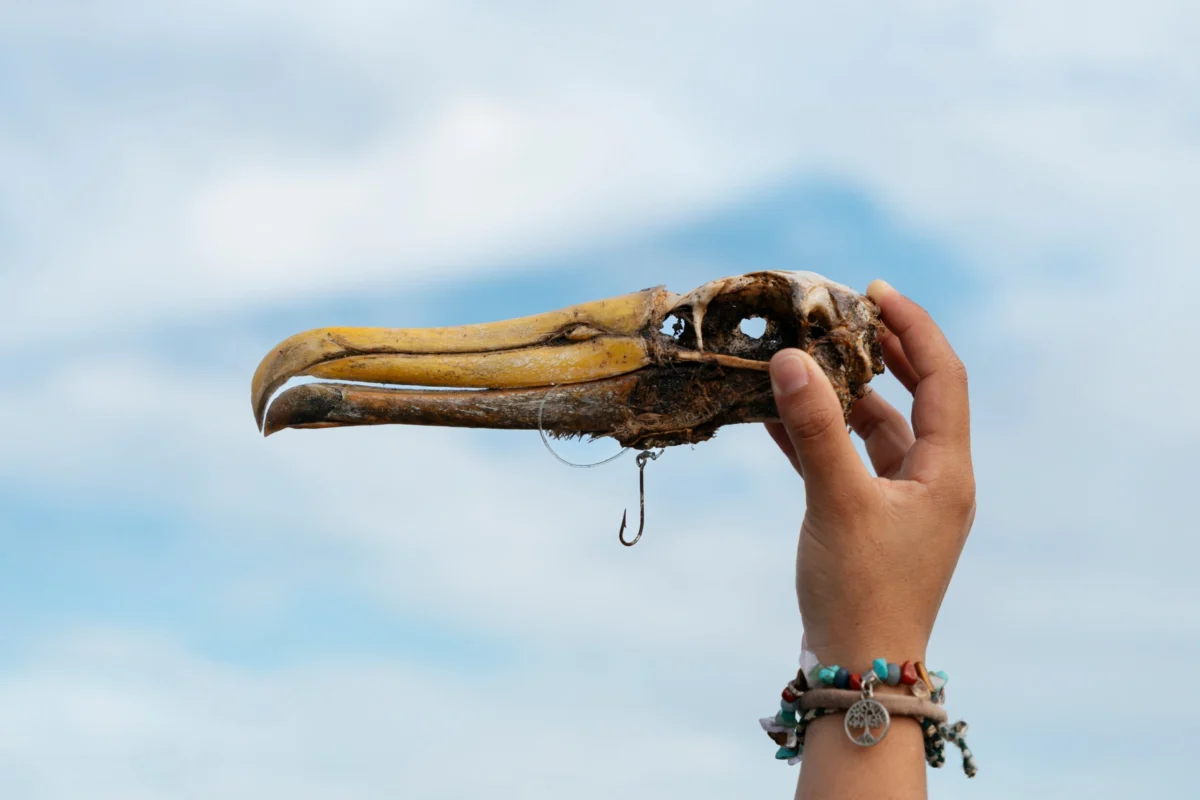
On a piercing morning sun, we walk along Mar Bravo, a ten-mile stretch of beach at the tip of the Santa Elena peninsula. Suárez, González, and their colleague Ivonne Becilla Cedeño meticulously scan the shoreline for signs of bird carcasses. As we approach piles of seaweed or discarded plastic, González employs a metal detector, searching for any birds with embedded hooks that might lie hidden beneath. Today, no new carcasses are found, but Suárez shows me the remains of a Waved Albatross discovered just last month. In life, it possessed an impressive 8-foot wingspan, piercing jet-black eyes, and distinctive fluffy eyebrows that evoked the image of a wise old man. Now, it is mostly bone and scattered feathers, a stark reminder of the ocean’s silent toll.
Suárez initiated these monthly beach surveys three years ago, observing a disturbing increase in refuse washing ashore. He diligently maintains a tally of seabird carcasses bearing embedded hooks—a critical indicator of the hidden bycatch occurring out at sea. This data also serves as a powerful tool to convince fishermen that even attempts to release birds from lines often result in delayed mortality.
In 2024, Cruz and Suárez embarked on a more high-tech approach to quantify the impact of artisanal vessels. They recruited willing fishermen to carry discreetly boxed GPS devices, designed to avoid raising suspicion from armed groups. The objective was to ascertain whether their fishing routes overlapped with the critical foraging areas of Waved Albatrosses. The results have been striking: the overlap is almost perfect, Cruz reports. To date, they have tracked 55 fishing expeditions, ranging from 20 to 90 miles offshore, unequivocally demonstrating a strong intersection with the species’ known migratory and foraging paths.
Cruz hopes this compelling data will persuade lawmakers and international organizations to intensify efforts to address the bycatch problem. Through collaborations with the international Albatross Task Force, they aim to expand the use of NISURI and broaden outreach to artisanal fishermen in Peru. Lacking immediate funding for this expansion, they are developing a series of online instructional videos to empower anyone to construct these vital devices. Suárez also envisions developing specific bycatch mitigation practices for fishermen targeting surface-feeding fish like mahi-mahi, whose methods do not involve sinking lines. He suggests that incentivizing fishermen to adhere to closed seasons for mahi-mahi, which often coincide with the Waved Albatross’s chick-feeding period, could be highly beneficial.
Concurrently, scientists are exploring other avenues to bolster the Waved Albatross population. While the birds breed almost exclusively on Española Island in the Galápagos, Enzo M.R. Reyes, an Ecuadorian conservationist at New Zealand’s Southern Institute of Technology, is working to expand a tiny secondary colony on Isla de la Plata. Located approximately 15 miles off Ecuador’s mainland, this island once hosted dozens of nesting Waved Albatrosses. Last year, however, only four adults were observed. Reyes believes that buttressing this smaller population would provide a crucial “insurance policy” for the species, safeguarding against potential disasters like avian flu outbreaks or other environmental catastrophes on Española Island.
With support from Machalilla National Park, the Ecuadorian nonprofit Equilibrio Azul, and ABC, Reyes installed 20 albatross decoys on Isla de la Plata last year and began broadcasting the birds’ distinctive calls from solar-powered speakers. His ambitious goal is to attract at least two breeding adults to this nesting site within the next three years. While similar tactics have proven successful globally, their long-term effectiveness is often enhanced when other pervasive threats have been addressed, Lyons notes. Although officials have successfully eradicated feral goats and invasive rodents from the birds’ Galápagos nesting grounds and implemented stringent biosecurity protocols to prevent the reintroduction of nonnative species, Isla de la Plata itself remains home to dangerous rat populations.
To protect vulnerable eggs and chicks from these rodents, Reyes ultimately hopes to construct a protective fence around potential nest areas. However, tracking data from 2014 indicates that any albatross hatched on Isla de la Plata would still forage within what Cruz terms the “danger zone,” precisely where artisanal fishers operate.
As long as fishermen continue to endure unsafe and precarious conditions, their activities are likely to remain an inherent risk to Waved Albatrosses on both islands. Yet, Suárez confronts these multifaceted challenges with an unwavering resolve. He understands that his pivotal role is to focus on practical solutions—meticulously building a bridge of understanding and cooperation between the fishing communities and the endangered seabirds, with the profound hope that both may once again find security and sustainability on the vast, often turbulent, open ocean.