
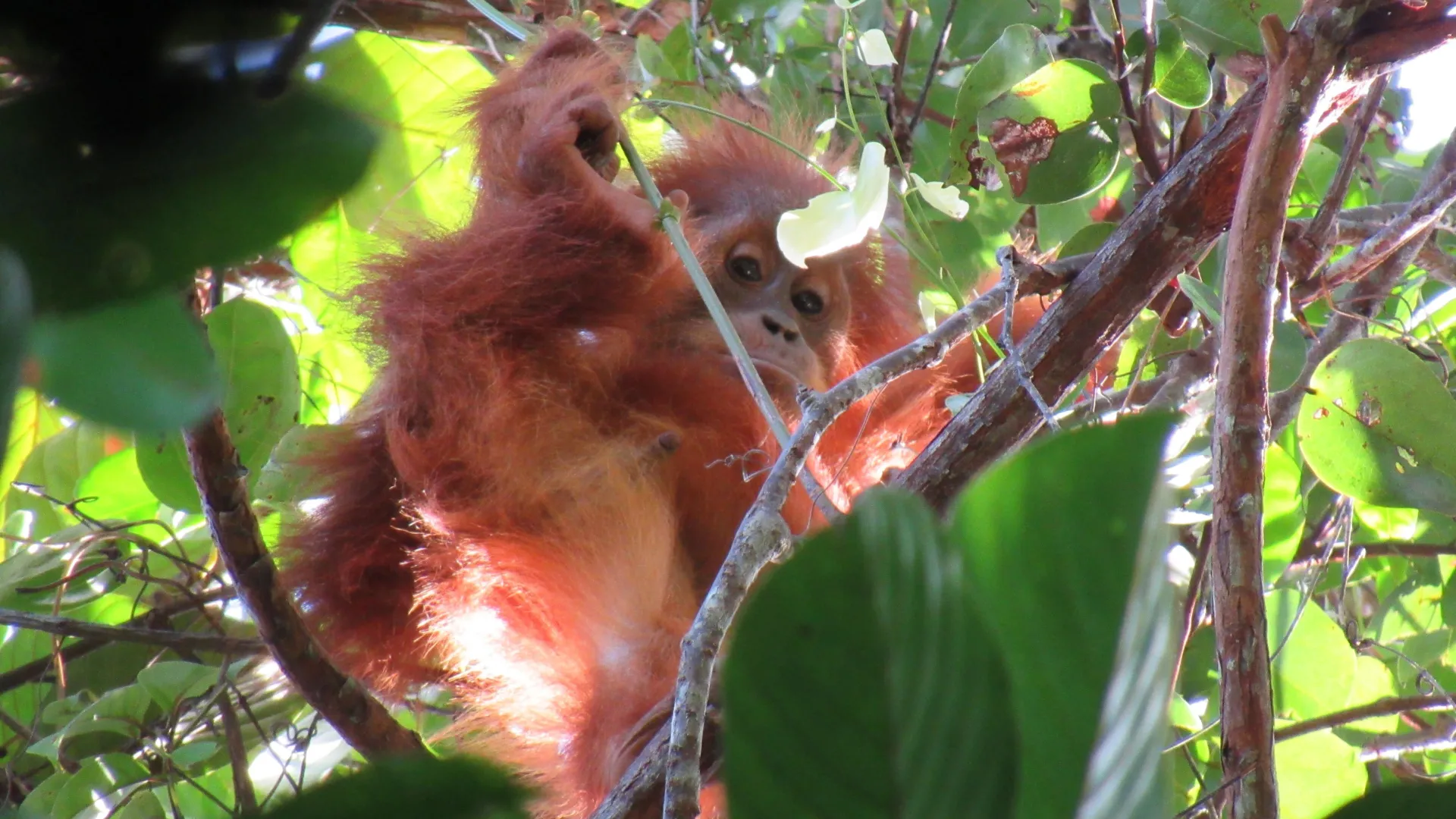
Warwick primatologists, in collaboration with the Max Planck Institute, have definitively shown that young orangutans develop their nighttime nest building skills via observational social learning — by closely watching others and then practicing these complex constructions. This groundbreaking research, published in Nature Communications Biology, sheds new light on the sophisticated cognitive abilities of these critically endangered great apes and has significant implications for their conservation. The study, drawing on an extensive 17-year observational dataset, provides unprecedented detail into how one of the most vital survival skills for arboreal species is acquired, moving beyond previous assumptions of innate tendencies to highlight the critical role of social transmission.
Nest-building is an often-overlooked behavior in great apes, yet for species that spend the majority of their lives in the trees, like orangutans, a well-constructed nest is not merely a convenience but an absolute prerequisite for survival. These elevated platforms serve multiple essential functions: they provide crucial protection from ground predators suchas clouded leopards and sun bears, and even arboreal threats; they offer thermal regulation, helping apes stay warm during chilly nights or sheltered from adverse weather conditions; they create a secure, stable platform for sleep and rest high above the forest floor; and surprisingly, research has even indicated that certain nest materials can possess anti-mosquito properties, contributing to overall health and well-being. Despite the undeniable importance of this complex ability, the precise mechanisms through which orangutans acquire and perfect their nest-building prowess have, until now, remained largely enigmatic.
Unveiling the Learning Process: A Seventeen-Year Endeavor
The meticulous research conducted by University of Warwick primatologists, in close partnership with scientists from the Max Planck Institute, now clarifies this mystery. Their extensive investigation focused on immature Sumatran orangutans (Pongo abelii) in their natural habitat, revealing that these young apes learn the intricate art of constructing these arboreal feats of engineering through a process of careful observation—or "peering"—at the workmanship of their mothers and other experienced individuals, followed by dedicated practice of the steps they have meticulously paid attention to.
Dr. Ani Permana, from the Department of Psychology at the University of Warwick and lead author of the paper, emphasized the often-underappreciated significance of this behavior. "Nest-building is absolutely critical to survival in orangutans but has been surprisingly neglected in much of the existing research," Dr. Permana stated. "We had previously established that it takes multiple years for immature orangutans to fully master nest construction. However, based on our remarkable 17 years of continuous observational data, this latest paper definitively demonstrates that this prolonged learning process is profoundly dependent on young animals actively and carefully watching the nest-building activities of others."
The findings suggest that while an inherent predisposition or "innate basis" for nest-building might exist in orangutans, the nuanced details, sophisticated techniques, and specific methods involved are unequivocally learned socially. This learning journey commences from a very young age, involving a continuous cycle of observation, practice, and iterative refinement as they learn from their inevitable mistakes. Dr. Permana highlighted the novelty of this discovery, asserting, "This paper represents the first instance where such detailed observational social learning in nest-building has been explicitly demonstrated in wild apes."
The Architecture of Survival: Day vs. Night Nests
In the dense rainforests of Sumatra, orangutans construct two distinct types of nests, each serving a specific purpose. Day nests are typically more rudimentary and functional, often basic frames used for short rests or midday siestas. In stark contrast, the night nests are elaborate and structurally complex sleeping platforms. These intricate constructions are frequently built at impressive heights, often soaring as high as 20 meters (approximately 65 feet) within the tree canopy, offering both security and an expansive view of their surroundings. Beyond mere structural integrity, these night nests incorporate "comfort elements" that speak to the apes’ ingenuity and foresight. These can include carefully woven "pillows," "blankets," "mattresses" (soft linings made from leaves and twigs), and even "roofs" fashioned from broad leaves to provide protection from the unpredictable tropical weather, such as torrential rain or strong winds. The ability to construct such multi-faceted structures requires not only physical dexterity and strength but also significant cognitive planning and problem-solving skills.
Chronology of Learning: From Peering to Proficiency
The research group’s methodology involved observing individual orangutans for exceptionally long durations over many years, meticulously documenting their interactions and behaviors. This sustained effort allowed them to pinpoint the precise mechanism of learning. They discovered that young orangutans deliberately "peered at" – a term specifically used to denote active, focused watching – their mothers constructing nests. This focused observation was not a passive act. Crucially, when such "peering" was observed, the immature orangutan was significantly more likely to subsequently engage in practicing nest-building themselves. Conversely, if an immature orangutan was physically near its mother while she built a nest but was distracted and did not actively watch, they generally did not proceed to practice the skill themselves. This strong correlation between active observation and subsequent practice provides compelling evidence that deliberate watching is a crucial, perhaps indispensable, component in developing this complex skill, thereby strongly supporting the hypothesis of observational social learning.
Furthermore, the study revealed that immature orangutans exhibited a heightened level of attention to the more intricate and challenging aspects of nest construction. This included observing the addition of comfort elements, such as padding or roofing, or the sophisticated technique of building a nest spanning across multiple trees to create a larger, more stable platform. Following their observation of these complex actions, the young orangutans were shown to practice these specific, more advanced techniques with greater frequency. This indicates a selective learning process, where the most challenging aspects of the skill are prioritized for observation and practice.
Beyond Maternal Influence: Expanding the Learning Circle
As the orangutans progressed through their developmental stages and grew older, their learning patterns diversified. They began to extend their observations beyond their mothers, increasingly watching and learning from other individuals within their social sphere. This expansion of their "role models" suggests a deliberate strategy to diversify their knowledge base. By observing different adults, young orangutans could potentially acquire varied techniques, discover alternative tree species suitable for nesting, and learn about different approaches to nest construction, indicating that both how to build and what materials to build with are learned through social interaction.
Dr. Caroline Schuppli, a senior author of the study from the Max Planck Institute of Animal Behavior, elaborated on this fascinating aspect of their findings. "Aside from learning ‘how to’ physically construct a nest, immature orangutans also appear to learn the ‘know-what’ – specifically, which materials to use," Dr. Schuppli explained. "Infants, who primarily focus their peering on their mothers, are naturally more inclined to select and utilize the same tree species that their mothers employ for nest construction."
However, this pattern evolves with maturity. "Just like human teenagers finding their own path and experimenting, maturing orangutans increasingly diversify their observations, peering at the nest-building of other individuals and subsequently beginning to experiment with the different tree species those individuals use," Dr. Schuppli added, drawing a compelling parallel to human adolescent development. This phase of experimentation is crucial for broadening their understanding of available resources and optimal choices in their specific environment.
Interestingly, the study observed a return to familiar wisdom as orangutans reached full adulthood. "Ultimately, adult orangutans tend to revert to utilizing the nest materials and construction methods primarily used by their mothers," Dr. Schuppli noted. "This could suggest an implicit recognition that the most effective and efficient methods for their particular environment had already been established and proven by their initial primary mentor. This consistent variation in nest materials and techniques, transmitted across generations and within a population, strongly indicates that wild orangutan populations possess genuine cultural elements that are vital to their survival. Such cultural knowledge could be irrevocably lost without dedicated conservation efforts focused on protecting both the species and their rapidly diminishing habitats."
Broader Impact and Implications: Culture, Cognition, and Conservation
This discovery of observational social learning in nest-building carries profound implications across several scientific domains, extending far beyond the immediate understanding of orangutan behavior. While social learning has been previously documented in great apes for behaviors such as tool use (e.g., chimpanzees using frayed sticks for termite fishing), this study represents a significant advancement due to the sheer complexity and constructive nature of nest-building.
Advancing Primate Cognition Research:
The findings significantly enrich our understanding of great ape cognition. Nest-building is a multi-faceted skill requiring spatial reasoning, material selection, structural engineering principles (even if intuitive), and foresight. Demonstrating that this complex constructive behavior is primarily learned through observation and practice underscores the sophisticated cognitive capacities of orangutans. It suggests an ability to not only mimic but also to understand and replicate complex sequences of actions, adapt them to different contexts (e.g., varying tree structures), and refine them through iterative trial and error. This challenges simpler explanations of instinctual behavior and highlights the role of higher-order cognitive processes in their daily survival. The sequential nature of learning, from basic observation to focused practice on complex elements, mirrors developmental learning pathways observed in humans and other highly intelligent species.
Defining and Preserving Animal Culture:
The concept of "culture" in non-human animals has been a topic of extensive debate. This research provides compelling evidence for cultural transmission in wild orangutans. The observed variations in nest materials and construction techniques across different individuals and generations, combined with the social learning mechanism, strongly suggest that these are not merely individual preferences but culturally transmitted knowledge. The "know-what" (which trees to use) and "how-to" (specific techniques) elements are passed down, creating localized traditions. This adds a crucial layer to our understanding of animal culture, moving beyond just tool use or foraging techniques to encompass complex constructive behaviors that are fundamental to survival. The implication is that losing orangutan populations means losing not just individuals, but entire repositories of cultural knowledge accumulated over generations, a unique heritage that contributes to the biodiversity of the planet.
Critical Conservation Implications:
Perhaps the most urgent implications of this study lie in the realm of conservation. Sumatran orangutans are classified as Critically Endangered by the IUCN Red List, facing immense pressure from habitat destruction, primarily due to the expansion of palm oil plantations, logging, and other agricultural encroachments. Poaching and illegal wildlife trade also pose significant threats.
The finding that nest-building is a socially learned skill has direct and severe consequences for conservation efforts:
- Orphaned Orangutans: When adult female orangutans are killed or displaced, their dependent offspring often become orphans. While rehabilitation centers do incredible work in caring for these orphans, teaching them essential survival skills like complex nest-building poses an enormous challenge. Without a mother or other experienced adults to observe and learn from in a natural setting, orphaned orangutans may struggle to develop the proficiency needed to build safe, effective night nests, significantly reducing their chances of successful reintroduction into the wild. They may learn rudimentary nest construction, but the finer details and comfort elements, crucial for long-term well-being, might be missing.
- Impact of Habitat Fragmentation: As orangutan habitats become increasingly fragmented, it can disrupt social networks and reduce opportunities for young orangutans to observe diverse building techniques from a variety of adults. This could lead to a loss of specific cultural knowledge related to nest construction, potentially impacting the adaptability and resilience of isolated populations.
- Importance of Intact Social Structures: The study underscores that conservation efforts must extend beyond merely preserving forest tracts. It is equally vital to protect the integrity of orangutan social structures and allow for natural learning processes to occur. Saving an orangutan population means ensuring the survival of its collective knowledge and cultural traditions.
- Rehabilitation Strategies: For rehabilitation programs, this research provides invaluable guidance. It suggests that simply providing materials or basic instruction might not be enough. Instead, strategies that facilitate observational learning from experienced adults (if possible) or meticulously designed "apprenticeship" programs that mimic natural social learning environments could be more effective in preparing orphaned orangutans for independence.
The long-term survival of Sumatran orangutans is inextricably linked to their ability to thrive in their arboreal environment, and central to this is their capacity to build effective nests. This study from the University of Warwick and the Max Planck Institute serves as a powerful reminder of the intricate web of behavioral, cognitive, and social factors that underpin species survival. It emphasizes that conservation must not only protect physical habitats but also safeguard the complex cultural transmission of knowledge that allows these magnificent apes to navigate their world. The potential loss of this culturally transmitted knowledge, alongside the physical loss of individuals, would represent an immeasurable blow to biodiversity and to our understanding of the sophisticated intelligence that thrives within the natural world.