
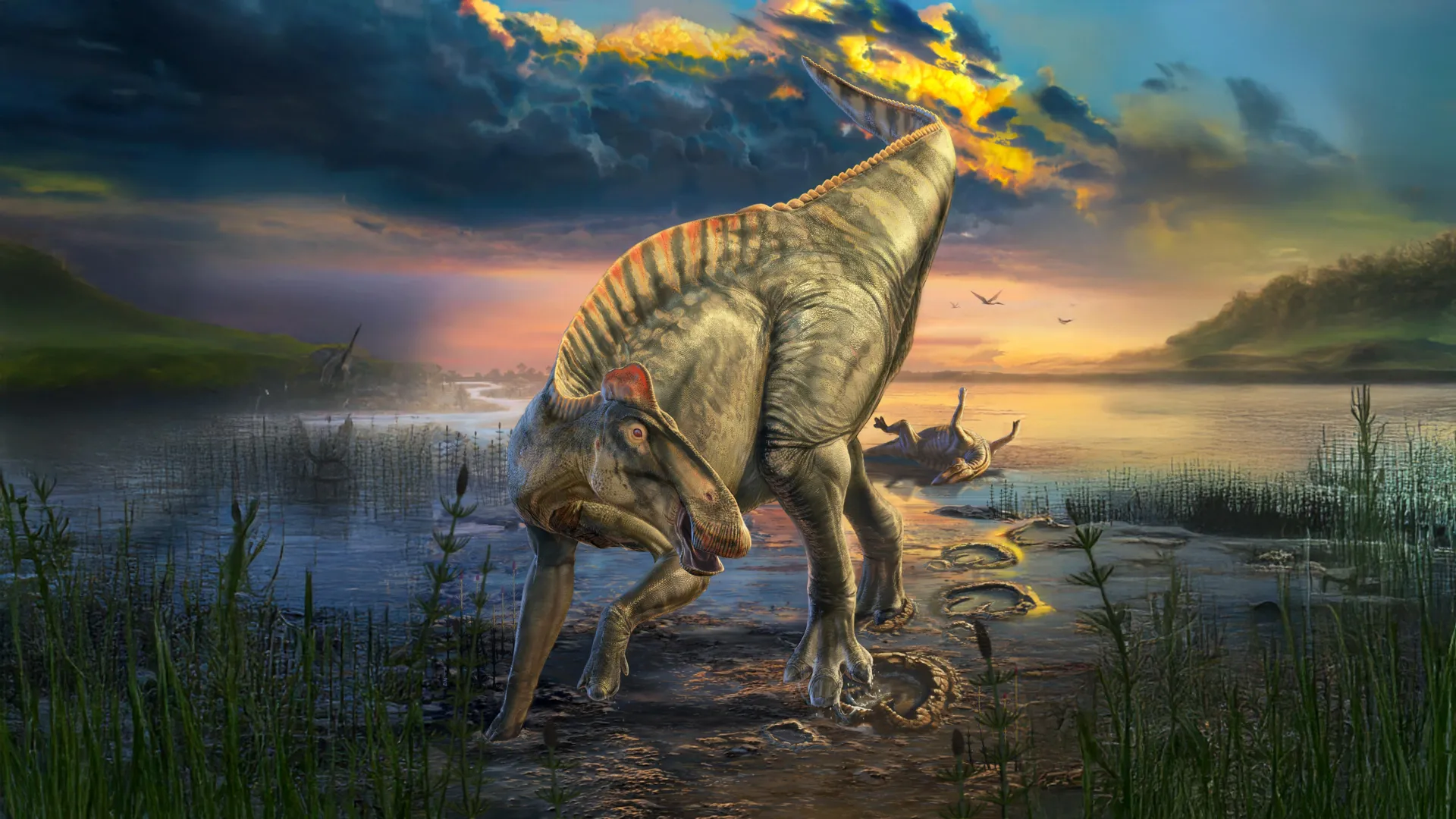
In a groundbreaking paper published in the prestigious journal Science, researchers from the University of Chicago have unveiled extraordinary insights into the life and appearance of Edmontosaurus annectens, a duck-billed dinosaur that roamed the Earth approximately 66 million years ago. The study meticulously details how the bodies of these colossal herbivores were transformed into remarkably preserved dinosaur "mummies," retaining intricate features of skin, scales, and even hooves. This unparalleled level of preservation, which the team has aptly named "clay templating," involved the outer soft tissues of the animal being encased in a delicate clay coating that settled over the skeleton after burial, forming a mask less than 1/100th of an inch thick. This discovery not only provides the most complete picture to date of a large dinosaur’s external anatomy but also introduces a novel understanding of fossilization processes.
A Late Cretaceous Giant Revealed: The Edmontosaurus annectens
The Edmontosaurus annectens was a prominent figure in the Late Cretaceous period, specifically during the Maastrichtian stage, just before the cataclysmic K-Pg extinction event that ended the reign of non-avian dinosaurs. As one of the largest hadrosaurids, or duck-billed dinosaurs, Edmontosaurus could reach lengths exceeding 40 feet (12 meters) and weigh several tons, making it a significant herbivore in the ancient ecosystems of North America. Its name, meaning "lizard from Edmonton," reflects early fossil discoveries near Edmonton, Alberta, Canada, though its remains are widespread across western North America, including states like Wyoming, Montana, and the Dakotas.
Prior to this study, paleontologists relied primarily on skeletal remains and occasional skin impressions to reconstruct the appearance of Edmontosaurus. While these provided a general understanding of its size and duck-like snout, the finer details of its soft tissues, such as crests, specific scale patterns, and foot structure, remained largely speculative. This new research dramatically alters that landscape, offering an unprecedented, "fleshed-out" view that challenges previous assumptions and confirms long-held hypotheses about the external morphology of these magnificent creatures. The ability to visualize the dinosaur with such precision allows scientists to move beyond mere skeletal frameworks and truly comprehend the animal as a living, breathing entity.
Unveiling the "Clay Templating" Phenomenon: A Novel Preservation Mechanism
The core of this revolutionary discovery lies in the unique preservation process identified by the University of Chicago team: "clay templating." Unlike typical fossilization, which often involves permineralization where minerals replace organic material, or carbonization that leaves a carbon film, clay templating offers a distinct pathway for soft tissue preservation. In this process, the outer soft tissues of the animal, including skin, muscle, and even internal organs, are not directly preserved as organic material, but rather their external morphology is recorded as an incredibly thin, yet durable, clay mold.
The researchers propose a specific sequence of events for this rare phenomenon. Following the death of the Edmontosaurus, their bodies likely experienced a period of desiccation in the sun, leading to a degree of mummification similar to that seen in some modern carcasses. This initial drying phase would have helped to maintain the integrity of the external soft tissues before burial. Subsequently, these carcasses were rapidly interred, most likely during sudden flash floods that swept through riverine environments. Crucially, a microbial film, which naturally forms on decaying organic matter, then played a pivotal role. Through electrostatic forces, this microbial layer attracted microscopic clay particles from the surrounding wet sediment, causing them to adhere tightly to the outer surface of the carcass. This created an extraordinarily thin, wafer-like clay template that faithfully captured the animal’s three-dimensional outer shape. Over geological timescales, the original soft tissues completely decayed away, leaving behind the clay film, which then acted as a mold, and the underlying skeleton, which also underwent fossilization. This "mask" of clay, as senior author Paul Sereno describes it, is so delicate—less than 1/100th of an inch thick—that its survival over 66 million years is nothing short of miraculous, representing a "fluke event of preservation."
A Century of Discovery: The Wyoming "Mummy Zone" Revisited
The story of these extraordinary fossils stretches back over a century, highlighting the enduring value of historical paleontological sites. The study’s authors, led by Paul Sereno, undertook meticulous detective work, using old field photographs and archival records to retrace the locations in east-central Wyoming where several classic dinosaur mummies were first uncovered in the early 1900s. These early finds, including the famous "Trachodon mummy" (AMNH 5060) discovered by Charles H. Sternberg in 1908, were groundbreaking at the time, providing some of the first glimpses of dinosaur skin. However, the exact mechanisms of their preservation were not fully understood.
The University of Chicago team successfully mapped a compact "mummy zone" within these specific rock layers, which represent stacked river sands deposited by ancient waterways. This geological context is crucial, as the riverine environment provided the necessary conditions for rapid burial and the presence of fine clay sediments. Within this re-identified zone, the team excavated two new Edmontosaurus mummies: a younger individual and a somewhat older one. These new specimens were instrumental, as they preserved large, continuous patches of the external skin surface, offering vital, complementary pieces of the puzzle needed to construct a complete, fleshy profile of the animal. The ability to combine information from multiple, exceptionally preserved individuals allowed for a more comprehensive and robust reconstruction than any single fossil could provide.
Advanced Paleontological Toolkit: Imaging and Digital Reconstruction
Revealing a boundary as fragile as this paper-thin clay layer demanded an arsenal of cutting-edge scientific techniques and painstaking effort. The research team employed a sophisticated suite of imaging and analytical approaches to unlock the secrets held within these delicate fossils. These included hospital-grade and micro-CT (computed tomography) scans, which allowed scientists to peer inside the rock without damaging the specimens, creating detailed 3D models of both the skeletal structure and the overlying clay impressions. Thin sections were prepared for microscopic examination, revealing the layered structure of the clay and its interaction with the original organic material. X-ray spectroscopy and clay mineral analyses provided crucial data on the chemical composition of the preserving clay, helping to confirm its nature and origin. A close study of the surrounding rock layers further illuminated the environmental conditions present during the mummification process.
The meticulous preparation of the fossils was a heroic undertaking in itself. Fossil Lab manager Tyler Keillor, a co-author on the study, led countless hours of careful work to uncover the crucial surfaces without destroying them. This delicate task required immense patience and precision, as the clay layer was incredibly thin and easily damaged.
Once the physical data was acquired, a separate group, spearheaded by postdoctoral scholar Evan Saitta, took charge of the digital reconstruction. They utilized 3D surface imaging, combining it with the CT scan data and, significantly, integrating comparisons with fossil footprints from the same time period and geological formation. This multi-modal approach allowed them to accurately trace the preserved soft anatomy, meticulously examine the sediments both inside and outside the mummy, and even match the dinosaur’s hooves back into an existing footprint. Digital artists then collaborated closely with the scientists, transforming the complex data into stunning, lifelike reconstructions that vividly illustrate how the Edmontosaurus would have looked and moved as it traversed the soft, muddy floodplains near the very end of the dinosaur age. This interdisciplinary approach, combining paleontology, geology, imaging technology, and artistic interpretation, was essential to bringing these ancient giants back to life with unprecedented fidelity.
Anatomy Reimagined: Crests, Spikes, Scales, and Revolutionary Hooves
Working from the two newly described mummies, the researchers were able to assemble a complete, fleshy outline of Edmontosaurus annectens, revealing a host of previously unknown anatomical features. "The two specimens complemented each other beautifully," Sereno remarked, emphasizing how the combined data provided a holistic view. "For the first time, we could see the whole profile rather than scattered patches."
One of the most striking discoveries was a continuous feature running along the center of the dinosaur’s back. This structure began as a fleshy, ridge-like crest over the neck and torso, likely serving as a display feature, possibly for species recognition or mating rituals. Over the hips, this crest seamlessly transitioned into a single row of prominent spikes along the tail, with each spike precisely aligned above a vertebra and fitting neatly with its neighbors. Such integumentary structures add another layer of complexity to our understanding of dinosaur communication and defense.
The team also meticulously documented the dinosaur’s scale patterns. They found that the largest polygonal scales were concentrated along the lower body and tail, likely providing greater protection in these areas. However, surprisingly, the vast majority of the animal’s body was covered in very small, pebble-like scales, measuring only 1-4 millimeters across. This is remarkably tiny for a dinosaur that could exceed 40 feet in length, suggesting a fine, textured skin. Furthermore, fine wrinkles preserved over the ribcage indicated that the skin of this duckbill was relatively thin, challenging previous assumptions of uniformly thick, leathery hides for large dinosaurs. This thin skin might have played a role in thermoregulation or provided greater flexibility.
Perhaps the most revolutionary discovery came from the larger mummy’s hind feet: this Edmontosaurus had hooves. The tips of each of its three hind toes were enclosed in a distinct, wedge-shaped hoof with a flat underside, remarkably similar in structure to those of modern horses. This finding is profoundly significant, as it represents the earliest documented hooves in a land vertebrate, the first confirmed hooved reptile, and the first hooved four-legged animal exhibiting different forelimb and hindlimb posture. To confirm the exact appearance of these feet in life, the researchers meticulously combined CT scans of the mummified feet with 3D images of the best-preserved duckbill footprint from the same geological period. This allowed them to carefully align the bones and soft-tissue impressions, producing a detailed and accurate reconstruction of the hind foot. Unlike the forefoot, which appears to have made contact with the ground primarily through its hooves, the hind feet also included a fleshy heel pad behind the hooves, likely providing additional cushioning and support for the dinosaur’s immense weight. This convergent evolution with mammalian ungulates highlights how similar environmental pressures can lead to analogous anatomical solutions across vastly different evolutionary lineages.
Reactions and Broader Implications for Paleontology
The announcement of these findings has been met with significant excitement within the paleontological community. Paul Sereno, reflecting on the collaborative nature of the research, stated, "I believe it’s worth taking the time to assemble a dream team in order to generate science that can be appreciated by the general public." His enthusiasm is palpable, underscoring the profound impact of this study. "We’ve never been able to look at the appearance of a large prehistoric reptile like this," he added, emphasizing the unprecedented clarity these mummies provide.
This research represents a landmark study, not merely for its spectacular discoveries, but also for its methodological advancements. The authors have effectively provided a "new toolkit" for future studies of dinosaur soft tissue. This includes outlining novel preparation techniques specifically tailored for such delicate clay impressions, proposing a clear set of terms for describing soft anatomical structures and scale types, and establishing a step-by-step imaging pathway from fossil specimen to a fully fleshed-out digital model. Crucially, they have also formulated a comprehensive "recipe" detailing how a dinosaur mummy can form under natural conditions through clay templating.
The broader implications for paleontology are substantial. This work offers more than a series of isolated findings; it proposes a general model for dinosaur mummification based on clay templating, a model that can now be rigorously tested on other fossils suspected of having formed in similar ways. This shift in understanding could lead to the re-evaluation of previously discovered fossils and a more targeted approach to finding new ones. The insights gained into Edmontosaurus anatomy will undoubtedly influence biomechanical studies, which can now rely on accurate external body outlines to model locomotion, feeding, and other behaviors with greater precision. Furthermore, the detailed taphonomic analysis (the study of fossilization processes) provides a robust framework for understanding when and where clay templating is most likely to occur, guiding future fieldwork.
Future Directions and Unanswered Questions
The University of Chicago team has already outlined the critical next steps following this foundational research. Focused searches for additional specimens exhibiting this rare kind of preservation are now underway, not only within the identified Wyoming "mummy zone" but also in other regions and geological formations where similar environmental conditions might have existed during the Late Cretaceous. Such discoveries could further validate the clay templating model and reveal the soft tissue anatomy of other dinosaur species.
Beyond fieldwork, the scientific community can anticipate a surge in biomechanical studies that will leverage these newly accurate external body outlines. Researchers can now develop more realistic models to investigate how the Edmontosaurus‘s crest and tail spikes might have functioned in display or defense, how its unique hooves facilitated movement across varied terrains, and how its body shape influenced its overall physiology and behavior. Complementary analyses will also be designed to refine our understanding of the precise geochemical and environmental conditions that promote clay templating, potentially identifying specific clay compositions or microbial communities that are conducive to this extraordinary preservation.
Ultimately, this research profoundly enriches our understanding of dinosaur biology, behavior, and ecology during a pivotal moment in Earth’s history, just before the K-Pg extinction event. By revealing the nuanced external features of Edmontosaurus annectens, scientists gain a clearer picture of dinosaur diversity and adaptation. Paul Sereno succinctly summarized the monumental achievement: "This may be the single best paper I’ve released. From field to lab to 3D reconstructions along with a suite of useful terms defined, it’s a tour de force, and it tells a coherent story about how these remarkable fossils come to be and what we can learn from them." The discovery of these "clay templated" dinosaur mummies stands as a testament to the ongoing revelations hidden within the fossil record, offering an unparalleled window into the ancient world.