
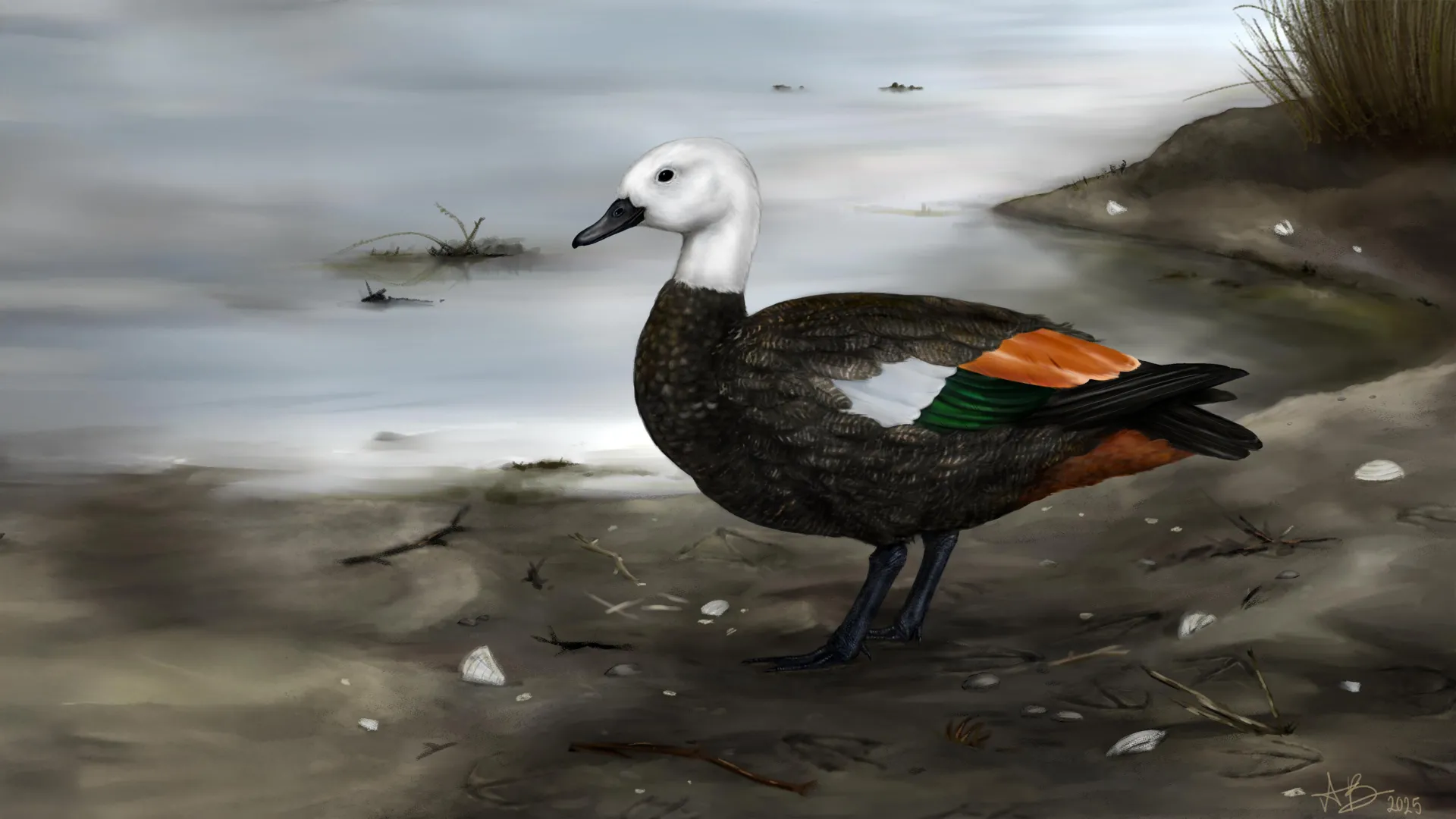
New research, spearheaded by the University of Otago – Ōtākou Whakaihu Waka, has unveiled the existence of a previously unknown, extinct shelduck species, Tadorna rekohu, whose ancestors arrived on the remote islands approximately 390,000 years ago. This remarkable discovery not only adds a new chapter to the natural history of the Rēkohu Chatham Islands but also provides compelling evidence of the rapid evolutionary adaptations that can occur in isolated island ecosystems, particularly the tendency towards flightlessness in the absence of terrestrial predators.
Unveiling Tadorna rekohu: A Testament to Island Evolution
The research, detailed in the prestigious Zoological Journal of the Linnean Society, describes Tadorna rekohu, or the Rēkohu shelduck, as a prime example of convergent evolution. While 390,000 years might appear a relatively short span in geological terms, co-lead author Associate Professor Nic Rawlence, Director of the Otago Palaeogenetics Laboratory, asserts that it was more than sufficient time for significant evolutionary changes to manifest within the species. "In that time the Rēkohu shelduck evolved shorter, more robust wings and longer leg bones indicating it was going down the pathway towards flightlessness," Professor Rawlence explains, highlighting the bird’s gradual transition from an aerial existence to a more terrestrial one.
The physiological alterations observed in Tadorna rekohu were a direct response to a unique set of environmental pressures prevalent on Rēkohu. Factors such as an abundant food supply, the conspicuous absence of ground-dwelling predators prior to human arrival, and the persistently windy conditions characteristic of the islands collectively diminished the adaptive advantage of flight. Co-lead author Dr Pascale Lubbe, also from the Otago Palaeogenetics Laboratory, succinctly encapsulates this evolutionary principle, describing it as a classic case of "use it or lose it, the wings start to reduce." Flight, an energetically demanding activity, becomes an unnecessary expenditure of resources when its benefits are outweighed by environmental conditions. "Flight is energetically expensive, so if you don’t have to fly, why bother," Dr Lubbe posits, underscoring the efficiency-driven nature of natural selection. The compensatory development of "longer leg bones [that] are more robust to support more muscle and create increased force for take-off" further illustrates the species’ adaptation to a life primarily spent on the ground, even with reduced flight capabilities. This robust leg structure would have been crucial for rapid terrestrial movement and for generating enough thrust for short, powerful bursts of flight, if any, with smaller wings.
The Scientific Journey: Ancient DNA and Morphometric Analysis
The identification and characterisation of Tadorna rekohu involved a meticulous combination of cutting-edge scientific techniques. Researchers employed ancient DNA analysis to establish the genetic lineage of the extinct shelduck, comparing its genetic material to extant species. This palaeogenetic approach revealed that the Rēkohu shelduck’s closest living relative is the pūtakitaki paradise shelduck (Tadorna variegata) from Aotearoa New Zealand. This genetic link strongly suggests a common ancestor that colonised Rēkohu, likely via accidental dispersal across the Tasman Sea.
Complementing the genetic insights, the team conducted detailed morphometric analyses of the shelduck’s fossilised bones. By examining the shape, size, and robustness of skeletal elements, particularly the wing and leg bones, scientists were able to reconstruct the bird’s likely gait, flight capabilities, and overall lifestyle. The comparative analysis with the pūtakitaki paradise shelduck highlighted the significant divergence in skeletal morphology, providing tangible evidence of Tadorna rekohu‘s evolutionary trajectory towards reduced flight and increased terrestrial locomotion. The study’s rigour is a testament to the interdisciplinary nature of modern palaeontology, blending molecular biology with traditional osteological examination.
This international collaboration brought together expertise from several leading institutions, including the University of Otago, the Museum of New Zealand Te Papa Tongarewa, The University of Adelaide, and Manaaki Whenua Landcare Research. Such partnerships are vital for undertaking complex research projects that span geographical boundaries and scientific disciplines, pooling resources and knowledge to unravel the mysteries of past life.
Rēkohu Chatham Islands: A Sanctuary of Endemism
The Rēkohu Chatham Islands, an archipelago located approximately 800 kilometres east of New Zealand’s South Island, are a globally recognised hotspot for endemism and a living laboratory for evolutionary studies. Formed by volcanic activity millions of years ago, their extreme isolation has fostered the evolution of a unique array of flora and fauna, many of which are found nowhere else on Earth. Prior to human settlement, the islands harboured no terrestrial mammalian predators, creating an ecological niche where ground-dwelling birds could thrive without the constant threat of predation. This ecological vacuum is a recurring theme in island biogeography, often leading to the evolution of flightlessness in birds.
The islands’ rich palaeontological record has already yielded numerous discoveries of extinct species, particularly waterfowl and rails, which also exhibited tendencies towards flightlessness or reduced flight capabilities. These include the Chatham Island rail (Cabalus modestus), the Chatham Island snipe (Coenocorypha chathamica), and various species of ducks and geese. The addition of Tadorna rekohu to this list further solidifies Rēkohu’s reputation as a critical site for understanding the processes of insular evolution. The windy, often harsh, climate also plays a role, making sustained flight energetically challenging and favouring ground-based foraging and movement. The abundant coastal and terrestrial food resources further reduced the need for extensive flight to find sustenance, allowing species to adapt to a more sedentary, ground-based existence.
Cultural Guardianship: The Moriori Connection
A distinctive and deeply significant aspect of this discovery is the collaboration with the Hokotehi Moriori Trust, the indigenous people of Rēkohu Chatham Islands. In a profound gesture of cultural recognition and partnership, the Trust gifted both the scientific name (Tadorna rekohu) and the common name (Rēkohu shelduck) to the researchers. This act underscores the Moriori people’s enduring connection to their ancestral lands and its unique biodiversity.
Levi Lanauze, CEO of the Hokotehi Moriori Trust, expressed the profound importance of this discovery for his people: "this discovery is great for Rēkohu as a whole and helps connect imi (tribe) Moriori with miheke (treasure) of the past." The Moriori worldview, encapsulated by the concept of hokopapa (genealogy), emphasises an intrinsic interconnectedness with all living things and the land. As tchieki (guardians) of the plants and animals on Rēkohu, the Trust plays a vital role in protecting and preserving the island’s natural heritage. This collaborative approach between Western science and indigenous knowledge systems sets a powerful precedent for future research and conservation efforts, acknowledging the invaluable insights and perspectives that traditional ecological knowledge can offer. The naming of the species by the Moriori ensures that the scientific endeavour is culturally grounded and respectful of the islands’ original inhabitants and their history.
A Timeline of Extinction: The Anthropogenic Impact
While Tadorna rekohu flourished for hundreds of millennia, adapting perfectly to its island home, its ultimate demise highlights the profound and often devastating impact of human arrival on fragile island ecosystems. The Rēkohu shelduck became extinct prior to the 19th century, a period coinciding with the arrival of human settlers – first the Moriori, and later Māori and European colonists.
The primary drivers of its extinction were over-hunting and predation. Moriori, and later settlers, hunted large, easily accessible ground-dwelling birds as a significant food source. The shelduck, having evolved in an environment free from terrestrial predators, would have been fearless and easy prey for humans. Furthermore, the introduction of non-native species by human settlers, such as rats, cats, pigs, and dogs, would have wreaked havoc on the shelduck population. These introduced predators, against which the native fauna had no evolved defences, would have preyed on adults, eggs, and chicks, pushing the species rapidly towards extinction. This tragic narrative is not unique to Rēkohu; countless island species globally have faced similar fates following human colonisation and the introduction of invasive species. The Chatham Islands themselves lost many other endemic species, including the Chatham Island Bellbird and several endemic invertebrates, due to these pressures.
The study of Tadorna rekohu‘s extinction offers a stark reminder of the vulnerability of island biodiversity and the irreversible consequences of human activity. It underscores the urgency of current conservation efforts to protect remaining endemic species on islands worldwide from similar threats.
Broader Implications for Conservation and Evolutionary Biology
The discovery of Tadorna rekohu carries significant implications for both evolutionary biology and modern conservation strategies. From an evolutionary perspective, it provides another compelling case study of insular gigantism and flightlessness, demonstrating the remarkable speed and direction of adaptive evolution in isolated environments. The genetic and morphological data from Tadorna rekohu contribute to a broader understanding of the mechanisms driving these evolutionary changes, offering insights into the plasticity of avian morphology and physiology.
For conservation, the lessons learned from Tadorna rekohu are invaluable. The vulnerability of flightless or near-flightless birds to introduced predators is a critical factor in current conservation planning. Understanding the past ecological dynamics of islands, illuminated by discoveries like this, can inform efforts to restore ecosystems, manage invasive species, and protect extant endemic populations. The study reinforces the importance of meticulous palaeontological research, particularly ancient DNA analysis, in reconstructing past biodiversity and identifying the factors that led to extinction. This knowledge is crucial for predicting future threats and developing proactive strategies to prevent further biodiversity loss.
The publication of this research in the Zoological Journal of the Linnean Society ensures its dissemination within the global scientific community, contributing to the ever-growing body of knowledge on evolutionary processes and the critical need for conservation. It highlights the Rēkohu Chatham Islands not just as a repository of unique natural history, but as a living laboratory offering vital lessons for the planet’s ecological future. The collaborative, culturally sensitive approach taken in this research serves as a model for future scientific endeavors, demonstrating how integrating diverse perspectives can enrich both scientific understanding and cultural heritage. The Rēkohu shelduck, though extinct, continues to teach us profound lessons about life, adaptation, and our collective responsibility towards the natural world.