
A groundbreaking new study, spearheaded by a researcher from the University of Hawaiʻi at Mānoa, has unveiled a stark reality: virtually every forest bird species across the Hawaiian Islands possesses the capacity to transmit avian malaria. This pervasive ability to spread the deadly infection provides a crucial explanation for the disease’s ubiquitous presence in nearly every habitat where its mosquito vectors thrive, significantly escalating the urgency for robust, integrated conservation strategies. The findings, meticulously detailed and published on February 10 in the prestigious journal Nature Communications, represent a pivotal moment in understanding the enduring crisis faced by Hawaiʻi’s unique and highly endangered avian fauna.
The comprehensive research detected avian malaria in an alarming 63 out of 64 locations sampled statewide, encompassing forests characterized by remarkably diverse avian communities. This near-universal prevalence underscores the insidious nature of the illness, caused by the generalist parasite Plasmodium relictum, which has historically been a primary driver behind the precipitous declines and outright extinctions of many native Hawaiian honeycreeper species. The implications of these findings are profound, challenging previous assumptions about disease dynamics and highlighting the immense difficulty in containing its spread across the archipelago.
Christa M. Seidl, the mosquito research and control coordinator for the Maui Forest Bird Recovery Project, who conducted this critical research as part of her PhD at the University of California, Santa Cruz, articulated the gravity of the situation. "Avian malaria has taken a devastating toll on Hawaiʻi’s native forest birds, and this study shows why the disease has been so difficult to contain," Seidl stated. "When so many bird species can quietly sustain transmission, it narrows the options for protecting native birds and makes mosquito control not just helpful, but essential." Her words resonate with a sense of urgency that has been building within the conservation community for decades, now bolstered by definitive scientific evidence.
Hawai’i’s Unique Avian Heritage Under Siege
To fully grasp the magnitude of this threat, it is essential to understand the unparalleled evolutionary history and ecological significance of Hawaiʻi’s native birds. The Hawaiian Islands, Earth’s most isolated archipelago, served as a crucible for spectacular adaptive radiation, particularly among the honeycreepers (family Fringillidae, subfamily Carduelinae). Descended from a single ancestral finch species that arrived millions of years ago, these birds diversified into more than 50 distinct species, each uniquely adapted to specific ecological niches, developing an astonishing array of beak shapes, plumages, and behaviors. From the insectivorous ‘Akikiki and ‘Akeke’e of Kaua’i to the nectar-feeding ‘I’iwi and the seed-crushing Palila, these birds are not merely components of the ecosystem; they are its architects, playing vital roles in pollination, seed dispersal, and insect control. Their vibrant colors and melodious songs are integral to the cultural heritage of Native Hawaiians, embedded in chants, legends, and traditional practices.
However, this unique evolutionary trajectory also rendered them exceptionally vulnerable to external threats. Having evolved in an environment largely free from introduced diseases and predators, native Hawaiian birds lacked the natural immunities and defensive behaviors common in mainland species. This "naïve host" phenomenon is central to their current plight.
A Century of Silent Devastation: The Arrival of Malaria and its Vector
The timeline of avian malaria’s devastating impact on Hawaiʻi traces back to the early 19th century. The vector responsible for transmitting the disease, the Southern House Mosquito (Culex quinquefasciatus), is believed to have arrived on the islands around 1826, likely on whaling ships or other vessels from the Americas. Initially confined to lower elevations, these mosquitoes began to establish populations, breeding in stagnant water sources and expanding their range.
The parasite itself, Plasmodium relictum, likely arrived later, in the early 20th century, carried by non-native, introduced bird species. These introduced birds, often from continents where avian malaria is endemic, had co-evolved with the parasite and often exhibited greater resistance or tolerance, serving as chronic, asymptomatic carriers. As these introduced birds spread across the islands, they brought the parasite into contact with the burgeoning mosquito populations and, critically, with the highly susceptible native Hawaiian birds.
The consequences were swift and catastrophic. Native bird populations, particularly those in lowland forests where mosquitoes were most prevalent, plummeted. Species that once thrived in the rich, biodiverse forests of all elevations began to disappear from their historical ranges, retreating to higher, cooler altitudes where the mosquitoes could not survive or reproduce effectively. These high-elevation "refugia" became the last strongholds for many iconic species.
How Avian Malaria Exacts Its Toll
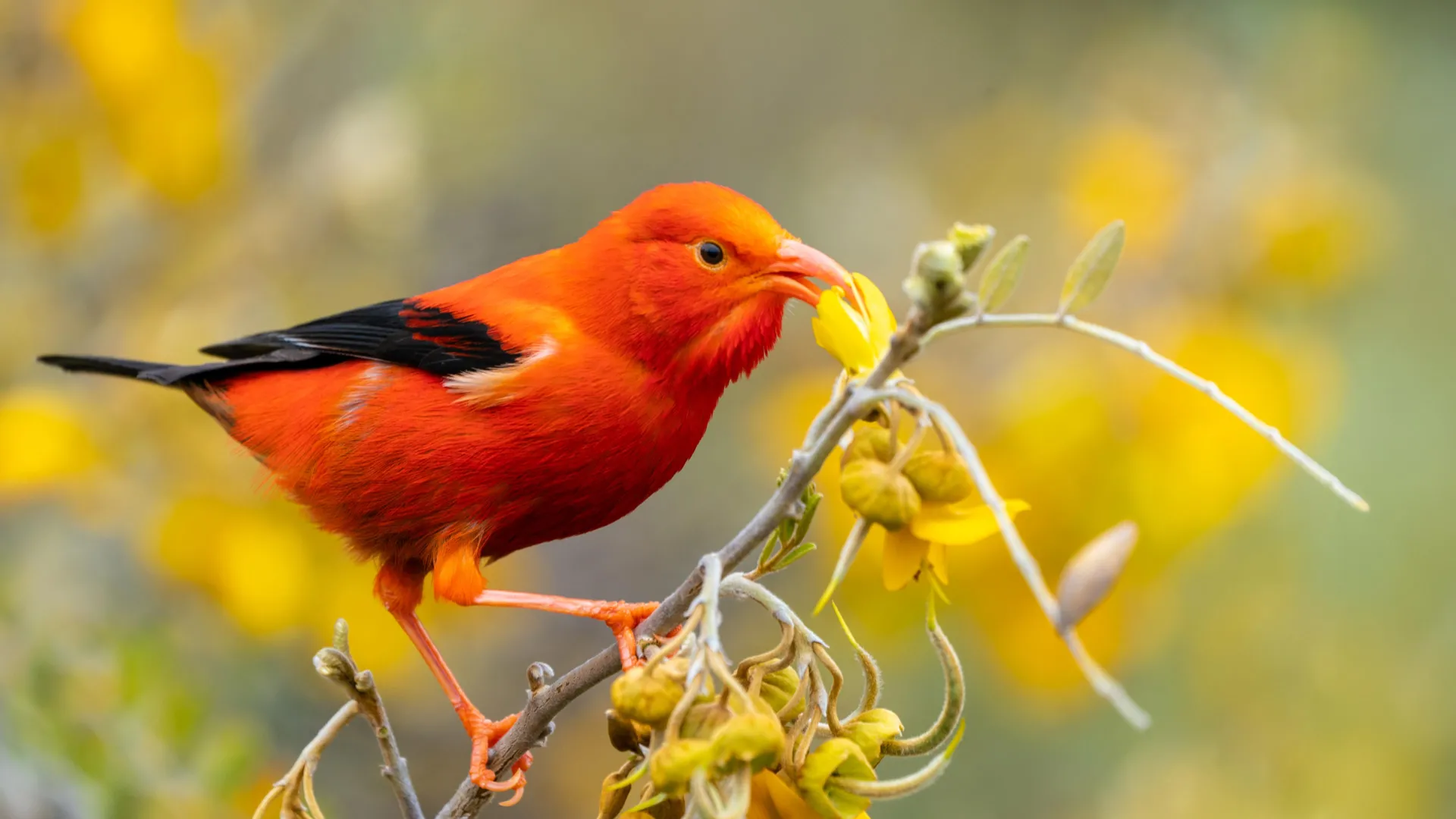
Avian malaria attacks the red blood cells of infected birds, leading to a cascade of debilitating physiological effects. These can include severe anemia, organ failure, significant reductions in survival rates, and, in many highly susceptible species, rapid death. The study highlights specific examples of this devastating impact. The ‘I’iwi (Drepanis coccinea), also known as the scarlet honeycreeper, an iconic symbol of Hawaiʻi’s forests with its brilliant red plumage and sickle-shaped bill, faces an estimated mortality rate of approximately 90 percent if infected. The ‘Akikiki (Oreomystis bairdi), a small, critically endangered honeycreeper endemic to Kauaʻi, is now considered extinct in the wild, with avian malaria being a primary factor in its demise, pushing its last remaining individuals into captive breeding programs in a desperate attempt to save the species.
Crucially, the new research illuminates why this disease has been so uniquely challenging to combat in Hawaiʻi. Unlike many infectious diseases that rely on a limited number of specific "reservoir" species to maintain transmission, avian malaria in Hawaiʻi operates differently. The study found that most forest birds—whether native or introduced—are at least moderately capable of infecting Southern House Mosquitoes, the disease’s primary vector. Even birds carrying extremely low, almost undetectable, amounts of the parasite were demonstrated to be capable of infecting mosquitoes. This revelation means that a vast and diverse array of bird communities can sustain ongoing transmission, making the task of breaking the disease cycle exponentially more complex.
Seidl emphasized this point, noting, "We often understandably think first of the birds when we think of avian malaria, but the parasite needs mosquitoes to reproduce and our work highlights just how good it has gotten at infecting them through many different birds." This shift in focus from solely bird susceptibility to the broader host-parasite-vector interaction is critical for developing effective intervention strategies.
Unraveling the Dynamics of Chronic Infections
The study’s methodology involved an extensive examination of blood samples from over 4,000 birds captured across the four main islands: Kauaʻi, Oʻahu, Maui, and Hawaiʻi Island. These comprehensive field data were then meticulously paired with controlled laboratory experiments designed to quantify how readily mosquitoes became infected after feeding on birds with varying parasite loads. The results yielded a critical insight: native and introduced bird species often exhibited similar levels of infectiousness, unequivocally demonstrating that both groups contribute significantly to the widespread dissemination of the parasite across the landscape. This finding challenges any simplistic notion that removing or managing only introduced birds would solve the problem, instead pointing to a systemic ecological issue.
A particularly alarming discovery was the prevalence of chronic infections. The researchers found that birds can harbor Plasmodium relictum infections for months, and in some cases, even years. During this protracted period, birds may appear outwardly healthy or only mildly infected, yet they remain fully capable of transmitting the parasite to mosquitoes. The study’s models estimate that this long-lasting, low-to-moderate infectious stage is responsible for the vast majority of avian malaria transmission observed statewide. This chronic carrier state creates a persistent reservoir of infection, making eradication efforts incredibly difficult, as seemingly healthy birds can continuously fuel the disease cycle.
Climate Change: Shrinking Safe Havens and Amplifying Risk
The parasite’s remarkable ability to infect a multitude of bird species inherently explains its widespread distribution across Hawaiʻi. The study’s findings suggest that very few mosquito-infested habitats remain truly free of transmission risk. This already dire situation is being exacerbated by another formidable force: climate change.
Warming global temperatures are having a profound and devastating effect on Hawaiʻi’s delicate ecosystems. As temperatures rise, the thermal limits for mosquito survival and Plasmodium relictum development are expanding into higher elevation areas. Historically, these cooler, high-altitude forests served as vital refugia for vulnerable native bird species, places where the climate was too cold for mosquitoes to thrive and complete their life cycle, thus providing a natural barrier against avian malaria. Species like the Maui Parrotbill (Pseudonestor xanthophrys), the ‘Akepa (Loxops coccineus), and the ‘I’iwi have retreated to these remaining montane forests, their last bastions against the disease.
However, as the mercury climbs, these vital safe havens are shrinking rapidly. Mosquitoes are now being detected at elevations previously thought to be impenetrable, bringing avian malaria directly into contact with the last, most concentrated populations of critically endangered native birds. This expansion of the disease vector’s range creates an "extinction vortex," where declining bird populations are further stressed by habitat loss and increased disease pressure, accelerating their descent towards extinction. For example, on Maui, where the last populations of several honeycreeper species cling to existence in the remote high-elevation forests of Haleakalā, the upward creep of mosquitoes poses an existential threat. Similarly, on Kauaʻi, where ‘Akikiki and ‘Akeke’e once roamed, the disease has already pushed them to the brink.
This climate-driven expansion of the disease zone underscores the urgency of proactive and innovative conservation interventions. Without immediate and effective action, the combined forces of widespread transmission capability and climate change will likely lead to the loss of many more of Hawaiʻi’s irreplaceable avian treasures within our lifetime.
A United Front: The "Birds, Not Mosquitoes" Initiative and Innovative Solutions
Recognizing the escalating crisis, a formidable collaborative effort known as "Birds, Not Mosquitoes" has emerged. This alliance brings together a diverse coalition of academic institutions, state and federal agencies, non-profit organizations, and industry partners, all united by the common goal of advancing mosquito control to save Hawaiian birds. The Maui Forest Bird Recovery Project, where Christa Seidl serves as coordinator, is a key member of this critical collaboration, operating under the Pacific Cooperative Studies Unit in the College of Natural Sciences.
The initiative is primarily focused on deploying groundbreaking mosquito control technologies, most notably the Incompatible Insect Technique (IIT), utilizing the naturally occurring Wolbachia bacteria. This innovative approach involves releasing male mosquitoes that carry a specific strain of Wolbachia into the wild. When these Wolbachia-infected males mate with wild female mosquitoes that do not carry the same strain, the eggs produced are incompatible and do not hatch, effectively preventing offspring. This method is species-specific, environmentally benign, and does not involve genetic modification of the mosquito itself. It offers a promising path to significantly reduce Culex quinquefasciatus populations in targeted areas, thereby breaking the transmission cycle of avian malaria.
While the concept of Wolbachia-based mosquito control holds immense promise, its implementation is complex, involving rigorous scientific trials, regulatory approvals, logistical challenges in mass-rearing and releasing mosquitoes, and, crucially, public engagement and acceptance. Conservationists and state officials, including those within the Hawaiʻi Department of Land and Natural Resources (DLNR), emphasize the careful planning and transparent communication required to roll out such a large-scale intervention. The ‘Akikiki on Kauaʻi and the ‘Akepa on Maui are considered top priority species for these interventions due to their critically low numbers and the imminent threat of extinction.
The new study’s findings provide further scientific validation for the urgent need to implement such technologies. With nearly every bird species capable of transmitting the parasite, the problem cannot be solved by simply isolating a few infected individuals or focusing on a limited set of reservoir hosts. A broad-scale reduction of the mosquito vector population is now seen as the most viable, if not the only, path forward to prevent further extinctions.
Broader Implications and the Path Forward
The implications of this comprehensive study extend far beyond the Hawaiian Islands, offering valuable insights into disease ecology in fragmented ecosystems and the devastating impact of introduced pathogens on naïve host populations globally. For Hawaiʻi, the research reinforces the fact that the crisis of avian malaria is not a static problem but an escalating emergency, driven by complex biological interactions and exacerbated by global climate change.
The cultural significance of Hawaiʻi’s birds to Native Hawaiians cannot be overstated. Their loss represents not just an ecological void but a profound cultural impoverishment. The economic impact is also considerable, as these unique species are a draw for ecotourism and contribute to the overall health and resilience of the islands’ natural resources.
The study serves as a powerful call to action for increased funding, accelerated research, and streamlined regulatory processes to enable the rapid deployment of effective mosquito control measures. It underscores the necessity of a sustained, collaborative effort across all levels of government, scientific institutions, and local communities. The researchers involved, including those at the Maui Forest Bird Recovery Project, operated under strict state and federal permits, with all birds captured and handled by highly trained ornithologists, adhering to the highest ethical standards of wildlife research.
In conclusion, the University of Hawaiʻi at Mānoa-led study on avian malaria transmission in Hawaiʻi represents a watershed moment in conservation science. By definitively demonstrating the widespread capacity for transmission among forest birds, it clarifies the pervasive nature of the threat and intensifies the urgency for innovative, large-scale mosquito control. The battle to save Hawaiʻi’s iconic honeycreepers is a race against time, with the future of these irreplaceable avian treasures hanging precariously in the balance. The findings provide the critical scientific foundation needed to inform and galvanize the concerted efforts required to ensure that these unique species can once again thrive in the forests of their ancestral home.