
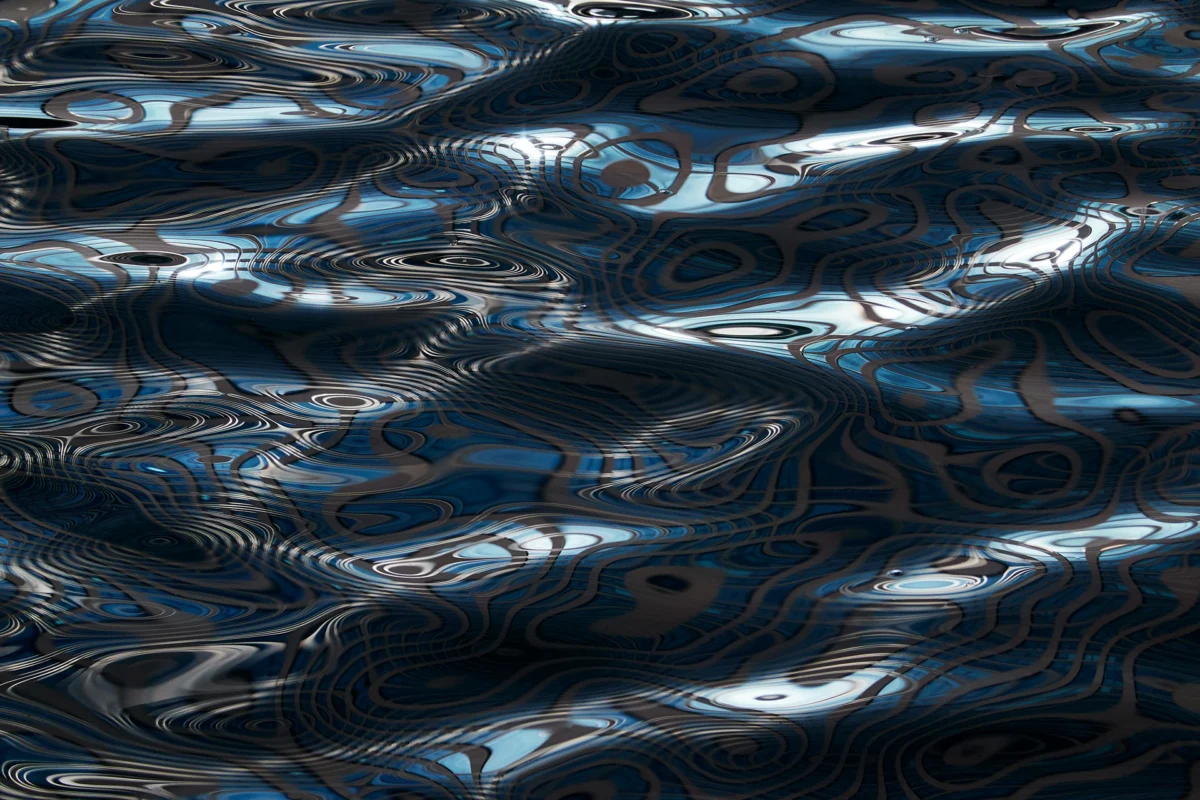
The acclaimed Fleeting Reflections photographic series, a captivating exploration of light, glass, steel, and water, challenges conventional notions of abstract and nature photography. Far from being digital manipulations, these mesmerizing images are meticulously captured in-camera, often as single frames or carefully layered multiple exposures, by an artist who champions attention, repetition, and a profound investment of time. The body of work, spanning over a decade, is centered exclusively on the dynamic waterways surrounding London’s Canary Wharf, transforming the financial district’s reflections into an ethereal canvas of color, rhythm, and form.
Unveiling the Authenticity Behind the Abstraction
When viewers encounter an image from Fleeting Reflections for the first time, a common assumption is that it is a product of sophisticated digital manipulation, specifically Photoshop. However, the artist behind the series takes pleasure in clarifying that the ethereal patterns and vibrant hues are a direct result of physical phenomena: light reflecting off the towering glass and steel structures, scattering and breaking on the surface of the water, and then precisely recorded by the camera’s lens. This commitment to in-camera capture underscores a purist approach, distinguishing the series in an era often defined by post-processing. Each image is a testament to the raw interaction of environment and optics, a candid observation rather than a synthetic creation. This method not only reinforces the authenticity of the artwork but also deepens the viewer’s appreciation for the subtle complexities of the urban landscape. The deliberate choice to eschew digital manipulation aligns with a growing movement in fine art photography that values the integrity of the captured moment and the photographer’s skill in harnessing natural elements.

Canary Wharf: An Unconventional Muse
Canary Wharf, internationally recognized as a bustling financial hub characterized by its imposing skyscrapers and intricate docklands, might seem an unlikely setting for a profound abstract photography project. Yet, for the artist, this concentrated urban environment has proven to be an inexhaustible source of inspiration. The architectural marvels, designed by leading global firms, function less as static buildings and more as colossal light sources, their reflective surfaces continuously projecting shifting patterns of color and line onto the water below. The docks themselves, remnants of London’s rich maritime history, provide the liquid canvas upon which these transient light shows unfold. Wind, currents, and passing vessels continuously sculpt the reflected light, transforming it into an ever-changing spectacle of waves, ripples, and fractured geometries. This dynamic interplay between man-made structures and natural forces is the essence of the Fleeting Reflections series, offering a fresh perspective on a familiar cityscape.
The Three Pillars of Artistic Creation
At the core of the Fleeting Reflections series, and indeed, the artist’s philosophy on meaningful creative work in both nature and abstract photography, lie three fundamental principles: accessibility, repeatability, and patience. These pillars, honed over more than ten years of dedicated practice in Canary Wharf, represent a departure from common photographic wisdom and offer a powerful framework for artistic development.

Pillar 1: Accessibility – The Power of Proximity
A pervasive myth within nature photography dictates that artists must journey to remote, dramatic locales to capture truly worthwhile images. The Fleeting Reflections series unequivocally refutes this notion. The entirety of the project has blossomed from a singular, highly accessible location: approximately one square mile of water nestled amidst the office towers of Canary Wharf.
The artist views this steel-and-glass financial district not merely as a commercial center but as a vibrant array of light sources. These towers, with their varied facades and orientations, cast a dynamic palette of colors and lines onto the water’s surface. The wind, an invisible sculptor, then transforms this reflected light into an infinite array of waves, ribbons, and intricate fractures. The artist’s role, as described, is to "listen to it," implying a deep, almost meditative engagement with the environment.
The profound ability to "listen so closely" stems directly from the location’s inherent accessibility. The artist can reach Canary Wharf with ease, walk its perimeters, and, crucially, return frequently. This eliminates the need for expensive flights, complex permits, extended time off, or arduous pre-dawn hikes. The flexibility allows for photographic excursions even with limited time—a mere 40 minutes—or under conventionally "bad" lighting conditions, such as rain, which can transform the water’s surface into a mesmerizing tapestry of hammered metal.

This seemingly mundane aspect of accessibility is, in fact, absolutely foundational to the work’s depth. Without the practical ability to engage with a subject frequently, the photographer cannot cultivate the profound familiarity required to move beyond superficial observations. The more readily an artist can stand before their subject, the more intimately and honestly they can study its nuances, leading to a richer, more authentic artistic output. This approach offers a sustainable and democratic model for artistic practice, demonstrating that profound beauty and creative depth can be unearthed in one’s immediate surroundings, challenging the often-costly and environmentally impactful pursuit of exotic landscapes.
Pillar 2: Repeatability – Discovering Infinite Change in the Familiar
The second cornerstone of the Fleeting Reflections series is repeatability—the deliberate choice of a subject that consistently evolves, surprises, and presents new possibilities with each encounter. The docks of Canary Wharf exemplify this principle in abundance. The environment is never static; its character transforms continuously, ensuring that no two moments are ever precisely alike.
A calm morning might yield long, smooth ribbons of reflected color, stretching elegantly across the water’s surface. In stark contrast, a gusty afternoon can shatter those same reflections into sharp, serrated lines, reminiscent of the iconic waveform from Joy Division’s Unknown Pleasures album cover, evoking a sense of raw energy and fragmentation. The passage of a boat introduces another layer of dynamism, smearing and distorting the reflections into painterly, hand-drawn effects. Even fleeting elements like diesel on the water’s surface can create iridescent interference patterns that appear for mere minutes before vanishing forever.

Because the environment is inherently repeatable, the artist can legitimately photograph the "same" scene hundreds or even thousands of times, yet always feel engaged in new creative work. This dedication often involves remaining in a single spot for hours, observing a specific patch of water as it cycles through a myriad of personalities. At such moments, the focus shifts from merely documenting architecture to capturing the behavior of light and water—a dynamic, living subject.
This is where specific in-camera techniques become critical enablers. Fast burst rates are employed to freeze micro-moments of intricate detail on the water’s surface before they collapse and dissipate. Multiple exposure modes are utilized to layer gestures and extend the inherent abstraction, creating complex visual tapestries directly within the camera. These techniques, however, are not ends in themselves; they serve to amplify the rich, raw material that the repeatable subject continually offers. The palette of colors shifts with the changing weather, the geometry of reflections bends with the wind’s caprice, and the overall mood changes with the tidal ebb and flow. Without this foundational repeatability, the resulting images would be mere "postcards"—superficial snapshots. With it, the artist cultivates a cohesive and deeply explored "body of work."
Pillar 3: Patience – The Unseen Engine of Artistic Mastery
The final and arguably most underestimated pillar of the Fleeting Reflections series is patience. This quality permeates every stage of the artistic process, from conceptualization to exhibition.

Patience begins long before the shutter button is pressed. It involves a meticulous waiting game for the precise confluence of suitable weather conditions and the artist’s available time. Bright, hard sun on still water produces one kind of reflection, while flat light under a drizzle yields something entirely different. Not every combination is creatively useful. Consequently, the artist might walk for miles, scrutinizing various angles and patches of water, only to conclude that the conditions on a given day are not conducive to the desired aesthetic, returning empty-handed.
Even when conditions appear promising, patience transforms into a physical endurance test. The artist may stand at a single location for up to four hours, capturing as many as 3,000 frames of what an casual observer might perceive as "the same scene." The objective during these extended periods is to identify that singular, fleeting instant where all elements—color, rhythm, structure, and tension—harmoniously lock into place. This process cannot be rushed; it demands unwavering presence and acute observational skill to recognize the ephemeral perfection.
The rigorous application of patience continues long after the field work. Upon returning home, thousands of nearly identical-looking images are downloaded. This initiates a slow, deliberate sifting process on an iMac. This stage is where discipline becomes paramount. The artist purposefully navigates through the vast collection, searching for the exact frame where every element aligns perfectly, rejecting the overwhelming majority. The "keep rate" is described as "brutally low," a testament to an uncompromising artistic vision.
The post-production process, too, reflects this disciplined patience and commitment to authenticity. The artist works in Capture One, employing only global adjustments such as levels, clarity, sharpness, and contrast. Crucially, there is no manipulation of shapes or forms in Photoshop. The intent is not to "create" new forms but to "reveal what was already there in the water." This choice is as much philosophical as it is aesthetic, emphasizing the honesty and integrity of the work. The artist desires to state, "hand on heart, this happened," upholding a deep commitment to truth in depiction.

The deepest manifestation of patience, however, is the long-term commitment to allow the work to mature. The Fleeting Reflections project was not shown publicly in any significant capacity for years. The artist consistently returned to Canary Wharf, shooting, refining, and discerning what was truly essential from mere visual noise. It took approximately seven years before a coherent enough body of work emerged to present to a publisher. This culminated in the publication of the first book, Fleeting Reflections, by Triplekite in 2017. This milestone was followed by exhibitions at the Greenwich Gallery in 2017 and the Anise Gallery in London in 2019, leading to a second volume, Fleeting Reflections II, in 2023.
These public milestones, while significant, might give the impression of a swift or smooth progression. The reality was a slow, deliberate, and often obsessive journey. The photographs themselves, as striking as they are, represent only the visible tip of an immense artistic iceberg. Beneath them lie thousands upon thousands of hours dedicated to walking, watching, waiting, shooting, editing, rejecting, and, most importantly, returning—a testament to profound perseverance.
Broader Impact and Implications for the Photographic Community
The Fleeting Reflections series offers profound lessons for photographers across all genres. Its central message is clear: the creation of personal, distinctive, and deeply meaningful photographic work does not necessitate dramatic landscapes or exotic locales. What is truly essential is a combination of access, repeatability, and patience.

The artist encourages fellow photographers to find subjects that are easily and frequently reachable, whether it be a local canal, a harbor wall, a marsh on the outskirts of town, or even rainwater collecting in a car park. The key is to return to this chosen subject repeatedly, observing it under all moods and weather conditions, until its responses and transformations become predictable. This intimate familiarity then paves the way for the "slow work": the patient process of walking, waiting, refining compositions, and rigorously editing with self-honesty.
Patience, in this context, is far from a passive trait. It is a highly active decision—a conscious commitment to invest oneself fully in a subject for as long as it takes to achieve a comprehensive understanding. Over time, this sustained patience becomes inherently visible within the photographs themselves. While viewers might initially be drawn to the captivating colors and intriguing shapes, what they are ultimately experiencing is the palpable presence of the artist’s unwavering attention.
This methodology has significant implications for the wider photographic community. It democratizes artistic pursuit, making profound work accessible to those without extensive travel budgets or access to remote wildernesses. It promotes a sustainable practice that minimizes environmental impact by focusing locally. Furthermore, it champions a "slow art" movement within photography, emphasizing depth, process, and genuine connection over superficial spectacle or instant gratification. The legacy of Fleeting Reflections is not just a collection of beautiful images, but a powerful manifesto for how artists can find infinite inspiration and create enduring bodies of work by looking closely at the world directly in front of them, armed with nothing more than their camera, keen observation, and an abundance of time and patience.