
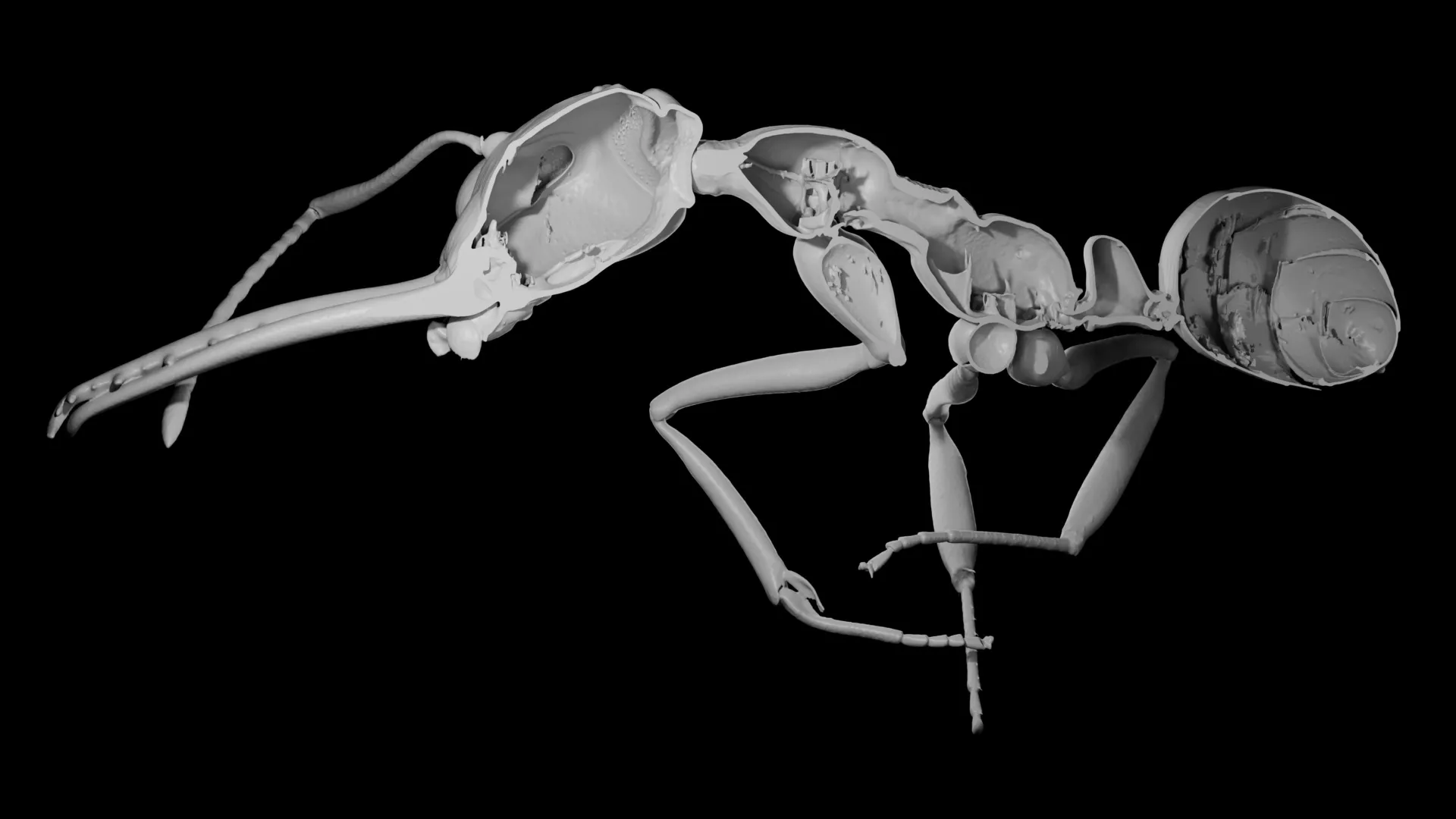
New research, published on December 19, 2025, in the esteemed journal Science Advances, has illuminated a profound evolutionary strategy employed by ants: the prioritization of quantity over individual quality in the development of complex animal societies. This groundbreaking study suggests that certain ant species achieve remarkable societal scale and evolutionary success by investing less in the physical robustness of individual workers, thereby freeing up resources to produce a greater number of individuals. This strategy, wherein "cheaper," less-protected ants proliferate to form vast, intricate colonies, offers critical insights into the fundamental trade-offs that have shaped evolution, including the development of human societies.
The Core Discovery: A Trade-off Between Individual Strength and Collective Power
At the heart of the discovery lies the finding that many ant species organize their colonies by choosing numerical superiority over the individual strength of their members. Instead of building heavily armored workers, these ants allocate fewer vital nutrients and resources to the development of each worker’s cuticle—the hard, protective outer layer of their exoskeleton. This strategic reduction in individual "armor" allows for the production of a significantly larger workforce. The research team, led by senior author Evan Economo, chair of the Department of Entomology at the University of Maryland, and lead author Arthur Matte, a Ph.D. student in zoology at the University of Cambridge, found that this approach of producing numerous, less-protected ants proved to be an evolutionarily advantageous path.
"There’s this fundamental question in biology of what happens to individuals as the societies they are in become more complex," explained Economo. "For example, the individuals themselves may become simpler because tasks that a solitary organism would need to complete can be handled by a collective." This concept of individuals becoming "cheaper"—requiring fewer resources to build and thus being producible in larger numbers, even if less physically robust—had long been a theoretical postulate. "That idea hasn’t been explicitly tested with large-scale analyses of social insects until now," Economo emphasized, highlighting the significance of their extensive empirical work.
Ants as a Premier Model for Social Evolution Studies
Ants present an unparalleled biological system for unraveling the mysteries of complex societal evolution. Their colonies exhibit an astonishing range in size, from a mere few dozen individuals to colossal supercolonies numbering in the millions. This immense variation, coupled with their ubiquitous presence across nearly every terrestrial ecosystem, makes them ideal subjects for studying how social structures adapt and thrive.
"Ants are everywhere, and yet the fundamental biological strategies which enabled their massive colonies and extraordinary diversification remain unclear," noted Arthur Matte. The research team hypothesized that a crucial, yet overlooked, factor linking colony size to evolutionary success might be the degree to which ants invest in their cuticle. The cuticle, a marvel of biological engineering, is not merely a protective shell; it serves multiple vital functions, shielding ants from predators, preventing desiccation, guarding against disease, and providing essential structural support for their musculature.
However, this sophisticated biological armor comes at a significant cost. Its production demands a substantial investment of limited nutrients, particularly nitrogen and various essential minerals. Crafting a thicker, more robust cuticle consumes a greater proportion of these valuable resources, directly impacting the colony’s capacity to produce more individuals. This inherent trade-off forms the crux of the evolutionary dilemma: enhance individual survival at the expense of numbers, or boost numbers by compromising individual resilience?
Methodological Rigor: Unpacking the Costs of Body Armor
To rigorously investigate this hypothesis, the researchers embarked on an ambitious data collection and analysis effort. They amassed a vast dataset comprising 3D X-ray scans from more than 500 distinct ant species. This extensive collection allowed for meticulous measurements of both total body volume and cuticle volume for each specimen. The findings revealed a remarkable variability in cuticle investment across species, ranging from a mere 6% to a substantial 35% of an ant’s total body volume. This wide spectrum underscored the diverse evolutionary strategies adopted by different ant lineages.
When these precise measurements were fed into sophisticated evolutionary models, a clear and compelling trend emerged: species that allocated a smaller proportion of their body mass to cuticle development consistently tended to form larger colonies. This statistical correlation provided strong evidence for the proposed trade-off, demonstrating that a reduction in individual armor was indeed linked to an increase in overall colony size. The methodology’s reliance on large-scale anatomical data, combined with robust evolutionary modeling, provided a powerful framework for drawing these significant conclusions.
The Power of the Collective: Bigger Colonies Through Shared Strength
While the notion of thinner cuticles rendering individual ants more vulnerable might initially seem like an evolutionary disadvantage, the authors contend that this trade-off is, in fact, a powerful driver for the growth of large, complex societies. They propose that reduced individual armor goes hand-in-hand with the intensification of other crucial social traits, which collectively compensate for any individual weakness. These traits include highly cooperative foraging strategies, where multiple ants work together to secure resources; shared nest defense, where the sheer numbers of defenders overwhelm threats; and an advanced division of labor, where specialized tasks are distributed among a large workforce. All these collective behaviors become more pronounced and effective as colony sizes expand.
"Ants reduce per-worker investment in one of the most nutritionally expensive tissues for the good of the collective," Matte elucidated. "They’re shifting from self-investment toward a distributed workforce, resulting in more complex societies. It’s a pattern that echoes the evolution of multicellularity, where cooperative units can be individually simpler than a solitary cell, yet collectively capable of far greater complexity." This analogy is particularly insightful, drawing a parallel between individual ants in a colony and individual cells within a multicellular organism, both sacrificing some autonomy or robustness for the greater good and complexity of the whole.
The research also uncovered another striking correlation: lower investment in the cuticle was consistently linked to higher diversification rates. In biology, diversification, which measures the frequency at which new species form, is a widely accepted marker of evolutionary success. Economo highlighted the unusual nature of this finding, noting that very few specific traits have been definitively connected to diversification rates in ants, making this result particularly significant for understanding ant evolutionary history.
"The Evolution of Squishability": How Less Armor Leads to More Species
The exact mechanisms by which reduced cuticle investment promotes speciation are still being explored, but the researchers have put forth compelling hypotheses. One leading idea posits that ants with lower nutritional demands for individual construction can more readily expand into new environments, particularly those where resources, especially nitrogen, are limited. "Requiring less nitrogen could make them more versatile and able to conquer new environments," Matte suggested, linking resource efficiency directly to ecological adaptability and range expansion. This ability to colonize diverse and often challenging habitats would naturally lead to geographical isolation and, over time, the formation of new species.
Furthermore, the authors propose a fascinating reinforcing cycle. As ant societies become increasingly complex and large, group-level defenses—such as the collective protection of the nest from invaders, or advanced social mechanisms for disease control—effectively reduce the necessity for individual ants to possess heavy, expensive armor. This, in turn, allows for even lower cuticle investment, freeing up more resources to produce more workers, which then enables the colony to grow even larger and develop even more sophisticated collective defenses. This feedback loop creates a powerful engine for both colony growth and, ultimately, diversification.
Economo playfully, yet insightfully, dubbed this phenomenon "the evolution of squishability." He remarked, "Many kids have discovered that insects aren’t all equally robust." This lighthearted observation underscores a profound biological truth: an individual ant’s perceived vulnerability can be a strategic asset for the collective. While this study focused on ants, the researchers suggest that other highly social organisms, such as termites, may have followed similar evolutionary trajectories, a possibility that warrants further investigation.
A Chronology of Discovery and Collaboration
The journey to this discovery began with Arthur Matte’s master’s program, during which he interned in Evan Economo’s lab at the Okinawa Institute of Science and Technology (OIST) in Japan. It was there that the foundational ideas and initial data collection for this ambitious project took root. The collaborative spirit of scientific inquiry saw the project grow, incorporating expertise and resources from multiple institutions, including the University of Maryland, the University of Cambridge, and support from the Japan Society for the Promotion of Science and the Research Grant Council of Hong Kong. The publication of the findings in Science Advances on December 19, 2025, marks the culmination of years of dedicated research, cross-continental collaboration, and rigorous analysis. This timeline highlights the extended effort required for such significant scientific breakthroughs, often beginning with an initial spark of an idea in a master’s student’s mind and evolving through successive stages of experimentation, analysis, and peer review.
Broader Implications: Lessons from Ants for Human Societies
The implications of these findings extend far beyond the realm of entomology, offering profound insights into fundamental principles of evolution and even drawing intriguing parallels to human societies. The researchers explicitly connect their discoveries to human military history, pointing out how heavily armored, individually formidable knights were eventually superseded by larger numbers of specialized, less-armored soldiers such as archers and crossbowmen. This shift reflects a similar strategic trade-off: individual resilience giving way to collective power and specialized roles.
Economo further invoked Lanchester’s Laws, mathematical equations developed during World War I that analyze the dynamics of military engagements. These laws demonstrate how, under certain conditions, a larger force of individually weaker fighters can decisively overpower a smaller force of stronger, more robust adversaries. This historical and mathematical context underscores the universality of the "quantity vs. quality" dilemma observed in ant evolution.
"The tradeoff between quantity and quality is all around," Matte reflected. "It’s in the food you eat, the books you read, the offspring you want to raise. It was fascinating to retrace how ants handled it through their long evolution. We could see lineages taking different directions, being shaped by different constraints and environments, and ultimately giving rise to the extraordinary diversity we observe today." His statement eloquently captures the pervasive nature of this evolutionary principle, extending its relevance to everyday human decisions and broader societal structures.
This research enriches our understanding of major evolutionary transitions, from the emergence of multicellularity to the development of complex social systems. It suggests that the drive towards societal complexity might inherently favor a reduction in individual "cost" or robustness, enabling a numerical expansion that, in turn, unlocks new levels of collective capability and adaptive flexibility. For humanity, the lessons are clear: specialization and collective action, while potentially making individuals seem "simpler" in isolation, can lead to unparalleled societal achievements and a profound capacity for adaptation and innovation.
The study, titled "The evolution of cheaper workers facilitated larger societies and accelerated diversification in ants," represents a significant leap forward in understanding the intricate dance between individual traits and societal dynamics that drives evolutionary success. It underscores the profound wisdom embedded in the natural world, offering timeless insights into the strategies that enable life to thrive and diversify across the planet.
This research was made possible through the generous support of the Okinawa Institute of Science and Technology, the Japan Society for the Promotion of Science KAKENHI (24K01785), the University of Cambridge, and the General Research Fund 2022/2023 (17121922) from the Research Grant Council of Hong Kong. The views expressed in this article are those of the researchers and do not necessarily reflect the official positions of the funding organizations.