
The culinary world has long grappled with a persistent frustration that affects both amateur home cooks and professional chefs: the difficulty of peeling hard-boiled eggs. This challenge is significantly magnified when dealing with farm-fresh eggs, which are prized for their superior flavor and nutritional profile but are notoriously resistant to clean peeling. While traditional wisdom has suggested everything from aging the eggs for several weeks to adding chemical agents to the water, a growing consensus among culinary experts and poultry enthusiasts suggests that the most effective solution lies not in the water, but in the vapor. Steaming eggs, rather than boiling them, has emerged as the definitive method for ensuring that even eggs laid just hours prior can be peeled with ease and precision.

The Biological Mechanics of the Fresh Egg Dilemma
To understand why steaming is superior, one must first examine the biological and chemical composition of a fresh egg. A farm-fresh egg possesses a unique internal environment that changes as the egg ages. The primary culprit behind the "difficult peel" is the pH level of the egg white, or albumen. In a newly laid egg, the albumen has a relatively low pH, typically ranging between 7.6 and 7.9. This acidity causes the proteins in the albumen to bond strongly to the inner shell membrane during the cooking process.

As an egg ages, carbon dioxide escapes through the thousands of microscopic pores in the calcium carbonate shell. This loss of CO2 causes the pH of the egg white to rise, eventually reaching levels around 9.2. At this higher, more alkaline pH, the protein bond between the white and the membrane weakens, which is why older, store-bought eggs—which may be several weeks old by the time they reach the consumer—are generally easier to peel. However, relying on age comes at a cost; older eggs lose their structural integrity, the yolk becomes off-center, and the flavor profile diminishes. Furthermore, the air cell at the blunt end of the egg expands significantly over time, resulting in a flattened or "dipped" appearance in the finished hard-boiled egg, which is undesirable for aesthetic presentations such as deviled eggs.

A Chronology of Culinary "Hacks" and Their Limitations
For decades, the search for the perfect peeling method has led to a variety of folk remedies and scientific experiments. A timeline of these attempts reveals a consistent pattern of mixed results and marginal improvements.

In the mid-20th century, the addition of salt to boiling water was a common recommendation, based on the theory that it would increase the water’s boiling point and help seal any cracks in the shell. While salt can help coagulate escaping egg whites, it does little to assist in the peeling process. Later, the use of white vinegar became popular. The acetic acid in vinegar was thought to soften the calcium carbonate shell, but in practice, the concentrations used in a standard kitchen pot are far too low to have a meaningful impact on the structural bond between the membrane and the white.

By the early 2000s, the "baking soda method" gained traction on social media and in cooking forums. By adding an alkaline substance like sodium bicarbonate to the water, cooks hoped to artificially raise the pH of the egg white through the shell. While scientifically sound in theory, the effectiveness of this method is hampered by the fact that the shell is a remarkably effective barrier, and the results remained inconsistent, often leaving the eggs with a slight chemical aftertaste. Other methods, such as pricking the blunt end of the egg with a pin to release pressure or "shocking" the eggs by moving them directly from a refrigerator to boiling water, provided some relief but did not solve the problem of farm-fresh adhesion.

The Steaming Breakthrough: Precision and Thermodynamics
The shift toward steaming represents a fundamental change in the thermodynamic approach to egg preparation. Unlike boiling, where eggs are submerged in turbulent, bubbling water, steaming involves suspending the eggs above a concentrated cloud of water vapor.

The primary advantage of steam is its temperature and consistency. At sea level, steam is at least 212 degrees Fahrenheit (100 degrees Celsius), the same as boiling water, but it carries more latent heat. When an egg is introduced into a pre-heated steamer, the intense heat penetrates the shell almost instantly. This "thermal shock" causes the proteins in the outer layer of the albumen to contract rapidly, pulling away from the inner membrane before they have a chance to form a permanent bond.

Furthermore, steaming is a much gentler physical process. In a boiling pot, eggs often bounce against the bottom or each other, leading to hairline fractures that can cause the whites to leak out (the "feathering" effect). Steaming keeps the eggs stationary, preserving the integrity of the shell and ensuring a more symmetrical, aesthetically pleasing final product.

Technical Protocol for Flawless Steamed Eggs
To achieve professional-grade results with farm-fresh eggs, a specific protocol involving equipment and timing must be followed. This method has been validated by culinary experts and long-term poultry keepers who prioritize both efficiency and presentation.

Required Equipment
- A Steaming Apparatus: This can include a stainless steel steamer basket, a bamboo steamer, or even a simple metal colander that fits inside a large pot.
- A Tight-Fitting Lid: Essential for maintaining a constant vapor pressure and temperature.
- Tongs or a Slotted Spoon: For the safe transfer of hot eggs.
- An Ice Bath: A large bowl filled with a 50/50 ratio of cold water and ice cubes.
The Procedure
- Vapor Preparation: Bring approximately two to three inches of water to a boil in the bottom of the pot. It is crucial that the water level remains below the bottom of the steamer basket to ensure the eggs are cooked by vapor, not immersion.
- Egg Introduction: Once a steady flow of steam is achieved, place the farm-fresh eggs into the steamer basket in a single layer. For best results, the eggs should be rinsed in warm water beforehand to prevent the cold shell from cracking when it hits the hot steam.
- Timed Cooking: Cover the pot tightly. The cooking time varies based on the desired consistency:
- Soft-boiled (runny yolk): 6–7 minutes.
- Medium-boiled (jammy yolk): 8–9 minutes.
- Hard-boiled (fully set yolk): 12–13 minutes.
- The Thermal Shock (Ice Bath): Immediately upon the timer’s expiration, transfer the eggs into the prepared ice bath. This rapid cooling serves two purposes: it stops the cooking process instantly to prevent overcooking and causes the egg to shrink slightly within the shell, further loosening the membrane.
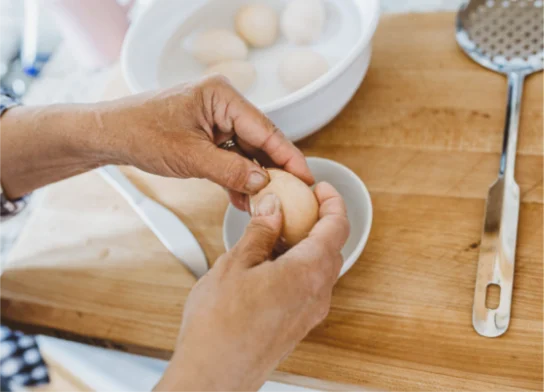
- The Peeling Technique: After the eggs have cooled for at least 5–10 minutes, they are ready to peel. The most effective technique involves gently rolling the egg on a hard surface to create a network of small cracks across the entire shell. Start peeling from the blunt end, where the air sac is located. Under these conditions, the shell and membrane typically slide off in large, clean pieces.
Chemical Analysis: Avoiding the Ferrous Ring
A common complaint with hard-cooked eggs is the appearance of a thin, greenish-gray ring around the yolk. While safe to eat, it is an indicator of overcooking and is considered a culinary flaw. This ring is the result of a chemical reaction between the sulfur in the egg white and the iron in the egg yolk.

As the egg is heated, the sulfur-containing proteins in the albumen begin to break down, releasing hydrogen sulfide gas. This gas migrates toward the center of the egg. When it encounters the iron naturally present in the yolk, it reacts to form iron sulfide (ferrous sulfide), which creates the characteristic dark ring. Because steaming provides a more controlled and even heat distribution than boiling, and because the ice bath method ensures an immediate cessation of the cooking process, steamed eggs are significantly less likely to develop this discoloration.

Broader Implications and the Backyard Poultry Movement
The adoption of steaming as a standard for egg preparation coincides with a significant rise in the backyard poultry movement across North America and Europe. According to data from the United States Department of Agriculture (USDA), interest in urban and suburban chicken keeping has surged by over 400% in the last decade, driven by a desire for food security, organic nutrition, and a connection to the source of one’s food.

With more households having access to eggs laid the same day, the "fresh egg peeling problem" transitioned from a minor nuisance to a widespread culinary challenge. The validation of the steaming method has had a tangible impact on reducing food waste. Previously, many fresh eggs were mangled during the peeling process, leading to significant portions of the egg white being discarded with the shell. By perfecting the peel, consumers are able to fully utilize the high-quality protein provided by their flocks.

Furthermore, the rise of modern kitchen technology, specifically the electric pressure cooker or "Instant Pot," has popularized a version of the steaming method. These devices use a "5-5-5" rule (five minutes of pressure, five minutes of natural release, five minutes in an ice bath) which essentially functions as a high-pressure steam environment. This has further solidified the transition away from traditional boiling in the modern kitchen.

Conclusion
The evolution of the hard-cooked egg from a frustrating kitchen chore to a predictable science marks a victory for culinary pragmatism. By understanding the underlying pH chemistry of the albumen and the thermodynamics of water vapor, cooks can now enjoy the superior taste of farm-fresh eggs without sacrificing the ease of preparation. Steaming represents a more humane treatment of the delicate egg, respecting its structural integrity while utilizing heat more efficiently than boiling water. As the "farm-to-table" movement continues to grow, such techniques ensure that the highest quality ingredients are met with the highest quality preparation methods, resulting in perfect results every time.