
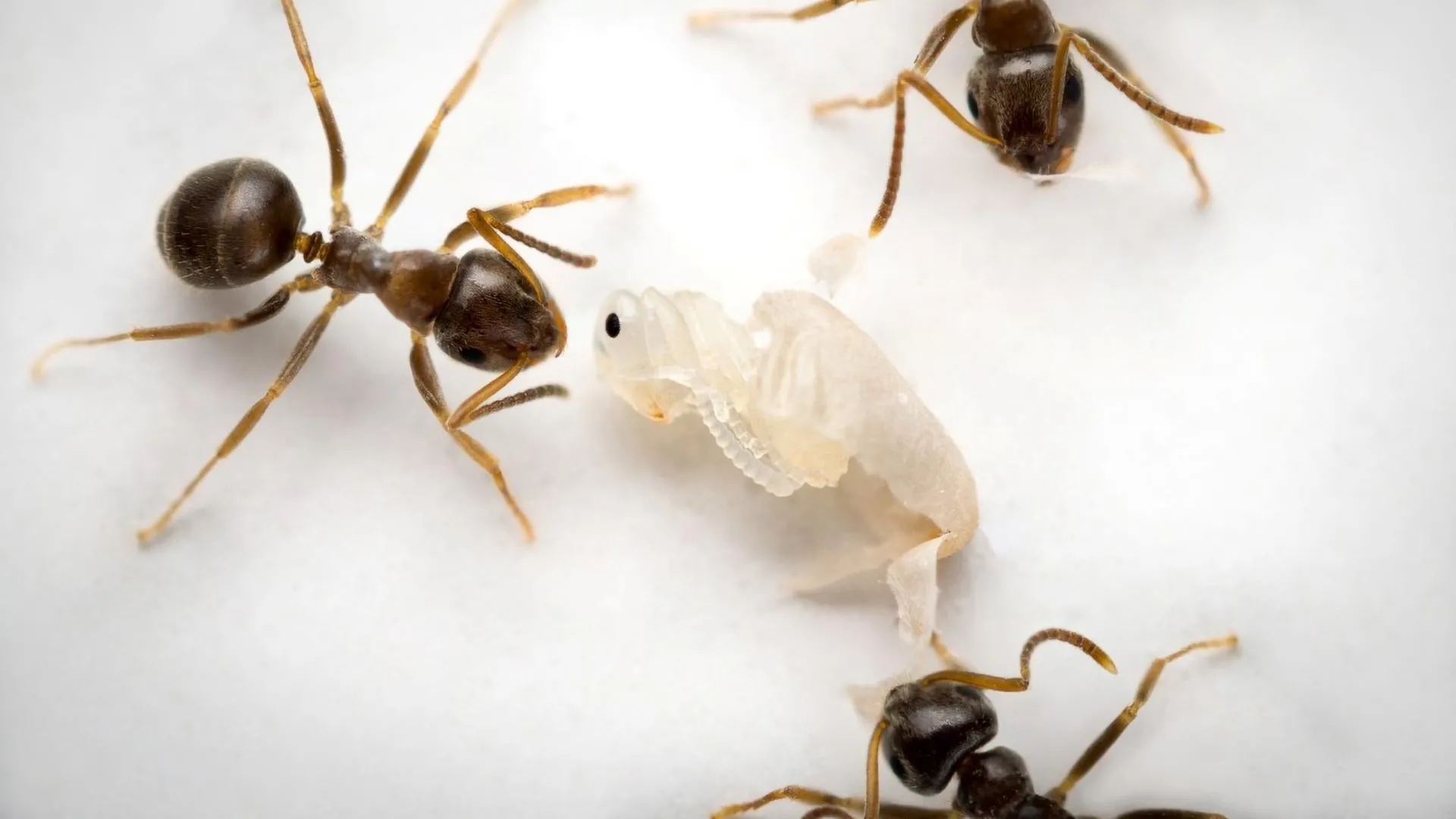
Ant societies operate as highly integrated "superorganisms," where the collective actions of thousands of individuals mirror the coordinated functions of cells within a single biological body. A groundbreaking study by researchers at the Institute of Science and Technology Austria (ISTA) has unveiled a sophisticated mechanism by which terminally ill ant brood emit a distinctive chemical odor, akin to the distress signals sent by infected cells in a multicellular organism. This unique scent serves as an early warning system, enabling the colony to swiftly detect and neutralize infections before they can proliferate and jeopardize the entire social structure. These pivotal findings, which shed new light on the intricate communication and immune strategies within social insects, were recently published in the esteemed journal Nature Communications.
The Superorganism Concept: A Blueprint for Collective Survival
The concept of an "ant superorganism" is not merely a metaphor but a scientific framework to understand the remarkable integration and division of labor within an ant colony. First popularized by entomologist William Morton Wheeler in the early 20th century, and later refined by E.O. Wilson, this idea posits that a colony functions as a single biological entity, transcending the individual actions of its members. Just as cells in a body specialize for different tasks – nerve cells for communication, muscle cells for movement, reproductive cells for perpetuation – ants within a colony adopt specialized roles. Queens are the reproductive core, analogous to the germline cells, dedicating their lives to producing offspring. Worker ants, on the other hand, are the somatic cells of the superorganism, performing all other vital functions: foraging, nest construction and maintenance, defense, and, critically, healthcare.
This extreme level of cooperation and interdependence is foundational to the survival and reproductive success of the colony. The individual ant’s survival is secondary to the superorganism’s health. This mirrors biological systems where individual cells might undergo programmed death (apoptosis) for the greater good of the organism, preventing the spread of disease or malignancy. The new research from ISTA provides compelling evidence of this principle in action, demonstrating a level of altruistic self-sacrifice within the ant superorganism’s immune system previously undocumented in such detail.
A Counter-Intuitive Alarm: Brood Sacrifice for Colony Health
In the animal kingdom, particularly among social species, a common survival strategy for individuals facing illness is to conceal their symptoms. This minimizes the risk of ostracization, cannibalism, or being abandoned by the group, which could otherwise compromise their chances of recovery or reproduction. Ant pupae, however, defy this norm. When confronted with an infection that is beyond their capacity to overcome, these developing ants do not hide their affliction. Instead, they actively generate a specific chemical alarm, a potent warning signal that alerts their nestmates to the grave danger they represent to the collective. This behavior represents a profound evolutionary divergence, prioritizing colony integrity over individual survival.
This remarkable discovery challenges long-held assumptions about individual survival instincts and highlights the unique evolutionary pressures shaping highly eusocial species like ants. It underscores how, in a superorganism, the individual unit’s role is often redefined by the imperative of collective fitness, especially when the genetic relatedness among colony members is high, a concept known as kin selection.
Worker Ants Mobilize: A Coordinated Emergency Response
The detection of this chemical distress signal triggers an immediate and highly coordinated response from the worker ants. As soon as the subtle, yet potent, odor shift is perceived, workers move with remarkable speed and precision. Their first action is to carefully open the cocoon encasing the infected pupa. Following this, they create minute, deliberate cuts in the pupa’s outer surface. The final, critical step involves the application of formic acid, a potent natural antimicrobial compound that the worker ants produce themselves within their venom glands.
This multi-step intervention serves a dual purpose. On one hand, the formic acid effectively kills the pathogens actively multiplying within the infected pupa, thereby preventing their escape and subsequent spread throughout the nest. On the other hand, this treatment invariably leads to the death of the pupa itself. While seemingly a harsh measure, this act of "social euthanasia" is a calculated sacrifice, a testament to the colony’s robust social immunity system designed to safeguard its overall health.
Erika Dawson, the study’s first author and a former postdoc in Sylvia Cremer’s Social Immunity research group at ISTA, articulates the underlying evolutionary logic: "What appears to be self-sacrifice at first glance is, in fact, also beneficial to the signaler: it safeguards its nestmates, with whom it shares many genes. By warning the colony of their deadly infection, terminally ill ants help the colony remain healthy and produce daughter colonies, which indirectly pass on the signaler’s genes to the next generation." This statement elegantly encapsulates the principle of inclusive fitness, where an individual’s genes can be passed on not only through its own offspring but also through the survival and reproduction of genetically related individuals. The genetic commonality within an ant colony, where most individuals are siblings or highly related, provides the evolutionary bedrock for such extreme altruism.
This research, conducted in collaboration with chemical ecologist Thomas Schmitt from the University of Würzburg in Germany, represents the first documented instance of such altruistic disease signaling in social insects. Without such an sophisticated early warning system, a single fatally infected ant could transform into a highly contagious vector, potentially unleashing an epidemic that could decimate the entire colony. By signaling their dire condition proactively, the incurably ill pupae empower the colony to neutralize the threat before it escalates into a catastrophic outbreak.
The Urgent Need for an Early Warning: Brood’s Immobility
A pertinent question arises regarding the necessity of such an elaborate alarm system if sick individuals could simply remove themselves from the colony. Sylvia Cremer, the head of the Social Immunity research group, clarifies this distinction. "Adult ants that approach death leave the nest to die outside the colony. Similarly, workers that have been exposed to fungal spores practice social distancing." These behaviors represent established forms of behavioral immunity, reducing pathogen transmission. However, this option is entirely unavailable to the brood—the eggs, larvae, and pupae—which are utterly immobile and dependent on adult workers for their care and protection. Like infected cells within a larger organism, they cannot self-isolate or remove themselves. They require external intervention.
This immobility draws a compelling parallel between developing ant pupae and infected body cells in multicellular organisms. Both face similar challenges in containing and eliminating pathogens and, remarkably, employ analogous strategies. Infected body cells release specific chemical cues that attract immune cells, prompting their removal. Similarly, ant pupae release chemical cues that summon worker ants, enabling these "helpers" to eliminate potential sources of infection. Immunologists refer to the cellular version of this cue as the "find-me and eat-me signal," a term that perfectly encapsulates the function of the ant pupa’s distress call.
The effectiveness of such a signal hinges on its precision. As Cremer emphasizes, "The signal must be both sensitive and specific. It should help to identify all terminally-sick ant pupae but be precise enough to avoid triggering the unpacking of healthy pupae or those capable of overcoming the infection with their own immune system." This requirement for high fidelity prevents the unnecessary sacrifice of healthy or recoverable brood, optimizing the colony’s resource allocation and ensuring only genuinely fatal threats are addressed with extreme measures.
Unraveling the Chemical Language of Distress
Thomas Schmitt, whose expertise lies in the intricate realm of chemical communication in social insects, provided crucial insights into the nature of this unique alarm. He observed that worker ants possess an extraordinary ability to pinpoint a single sick pupa amidst a multitude of healthy ones. This precision implies that the distress scent cannot simply be a volatile compound that diffuses indiscriminately throughout the nest chamber. Instead, the signal must be directly and specifically associated with the diseased pupa. "Accordingly," Schmitt explains, "the signal does not consist of volatile compounds but instead is made up of non-volatile compounds on the pupal body surface." These non-volatile compounds adhere to the pupa’s cuticle, allowing workers to identify the precise source of the infection through direct contact or close proximity.
The research team meticulously analyzed the chemical profiles of infected and healthy pupae. They discovered that two specific components of the ants’ natural cuticular hydrocarbon (CHC) scent profile become significantly more pronounced and altered when a pupa is fatally infected. These CHCs are complex mixtures of hydrocarbons that serve as a primary means of chemical communication in insects, conveying information about species, colony, caste, and even physiological state. The shift in these two specific components acts as the chemical flag for terminal illness.
To rigorously test whether this altered odor profile alone was sufficient to trigger the disinfection response, researchers devised an elegant experiment. They extracted the distinctive scent from signaling pupae and carefully applied it to the surface of healthy pupae. Subsequently, they observed the behavior of worker ants towards these "scent-transferred" healthy pupae. Cremer recounts the compelling results: "We extracted the smell from the signaling pupae and applied it to healthy brood. The results showed that the scent alone was enough to make workers unpack the treated pupae, demonstrating that the altered odor of terminally infected brood functions in the same way as the ‘find-me and eat-me’ signal seen in infected body cells." This experiment conclusively proved that the chemical signal itself is the primary driver of the worker ants’ extreme intervention.
Specificity in Signaling: Conserving Colony Resources
Further investigations revealed that this alarm signal is not indiscriminately emitted by all infected brood. Erika Dawson highlighted a crucial nuance: "Queen pupae, which have stronger immune defenses than worker pupae and can limit the infection on their own, were not observed to emit this warning signal to the colony." This finding is highly significant. Queen pupae represent the future reproductive potential of the colony; their survival is paramount. Their superior immune capabilities allow them to combat infections independently, negating the need for the colony to intervene and sacrifice them. Worker pupae, on the other hand, possess comparatively weaker immune defenses against the specific pathogens studied and, therefore, are the ones observed to emit the distress signal, indicating their inability to recover.
This selectivity in signaling underscores the sophisticated resource management within the ant superorganism. By signaling only when an infection is genuinely uncontrollable and poses an existential threat, the brood ensures that the colony’s drastic response is reserved for critical situations. This prevents the unnecessary loss of individuals who might otherwise recover, thereby conserving valuable colony resources and maximizing overall fitness. Cremer concludes, "This precise coordination between the individual and colony level is what makes this altruistic disease signaling so effective." It is a testament to the finely tuned evolutionary mechanisms that optimize survival strategies at both the individual and collective levels within these complex societies.
Broader Implications and Future Avenues
The discovery of this sophisticated chemical alarm system in ant superorganisms has profound implications for our understanding of social immunity, evolutionary biology, and even the dynamics of disease transmission in complex systems. Social immunity, a concept referring to collective behaviors and physiological adaptations that reduce disease risk for the group, is a critical component of colony health in social insects. This study adds a powerful new dimension to this field, demonstrating a highly evolved form of "altruistic immunity" where the individual actively facilitates its own elimination to protect the collective.
This research reinforces the strength of kin selection theory, which explains how altruistic behaviors can evolve when they benefit genetically related individuals, ensuring the propagation of shared genes. In the context of a superorganism where genetic relatedness is extremely high, such extreme acts of self-sacrifice become evolutionarily viable and advantageous.
The findings also open new avenues for bio-inspired research. Understanding the specific chemical compounds involved in this distress signal could potentially lead to the development of novel biosensors for early disease detection, or even innovative strategies for pest control that leverage insects’ own communication systems. By dissecting the precise molecular mechanisms behind the "find-me and eat-me" signal in ants, scientists might gain insights applicable to understanding similar processes in other biological systems, including human immunology.
Future research could focus on identifying the exact molecular structure of the non-volatile compounds that constitute the distress signal. Investigating the genetic basis for both the production of this signal by the pupae and the recognition and response by the worker ants would also be crucial. Furthermore, comparative studies across different ant species and other social insects could reveal the evolutionary history and diversity of such sophisticated social immune strategies. The robustness of this system, which discriminates between recoverable and terminal infections, also warrants deeper investigation into the physiological cues that trigger the pupa’s signaling cascade.
Information on Animal Studies
To advance our fundamental understanding of biological processes, particularly in fields such as behavioral biology, immunology, and genetics, research involving animals remains an indispensable tool. No alternative methods, including in silico modeling or in vitro studies, can fully replicate the complexities of live organism interactions and behaviors observed in these experiments. All animals utilized in the described research were collected, reared, and handled in strict adherence to all applicable legal regulations and ethical guidelines, ensuring their welfare throughout the study.