
In 1982, cartoonist Gary Larson introduced a famous Far Side comic called Cow Tools, an illustration that quickly became an iconic piece of pop culture humor. It depicted a cow proudly standing next to a strange collection of crudely fashioned, seemingly useless objects labeled as tools. The enduring humor of the comic relied on a widely accepted, almost axiomatic idea: that cows, as a species, inherently lack the intelligence, dexterity, or cognitive capacity to create or effectively utilize tools. This perception, deeply ingrained in common understanding and often reflected in scientific assumptions, has historically placed cattle far down the ladder of animal cognition.
That long-held assumption is now being fundamentally questioned, thanks to a remarkable real-life bovine named Veronika. A groundbreaking study recently published in the esteemed journal Current Biology has reported the first scientifically documented case of flexible, multi-purpose tool use in a pet cow, profoundly suggesting that cattle may possess far greater cognitive capabilities than previously believed. This discovery not only adds a new species to the exclusive list of known tool-users but also compels a significant re-evaluation of how we perceive and interact with livestock.
"The findings highlight how assumptions about livestock intelligence may reflect gaps in observation rather than genuine cognitive limits," says Alice Auersperg, a cognitive biologist at the University of Veterinary Medicine, Vienna, and a lead author of the study. Her statement underscores a critical point: the absence of observed complex behaviors does not necessarily equate to the absence of the capacity for such behaviors, particularly in environments where opportunities for their expression are severely limited.
The Enduring Legacy of ‘Cow Tools’ and Bovine Perception
Gary Larson’s Cow Tools comic resonated so strongly because it tapped into a universal understanding of animal capabilities, or rather, perceived inabilities. Cows, typically associated with grazing, milk production, and a seemingly placid demeanor, were never seen as candidates for complex problem-solving or innovative behavior. This caricature cemented a perception of bovine simplicity, contrasting sharply with species like chimpanzees, crows, or even sea otters, which are widely recognized for their tool-using prowess.
For decades, the study of animal cognition largely focused on primates, certain birds, and marine mammals, with agricultural animals often relegated to behavioral studies primarily concerning production efficiency or welfare in a farmed context. The very idea of a cow demonstrating sophisticated cognitive skills, such as tool use, was largely dismissed as fanciful, a subject for comedy rather than serious scientific inquiry. Veronika’s case directly challenges this entrenched view, forcing scientists and the public alike to reconsider the rich inner lives and cognitive potential of animals we have long underestimated.
Meet Veronika: The Tool-Using Bovine Pioneer
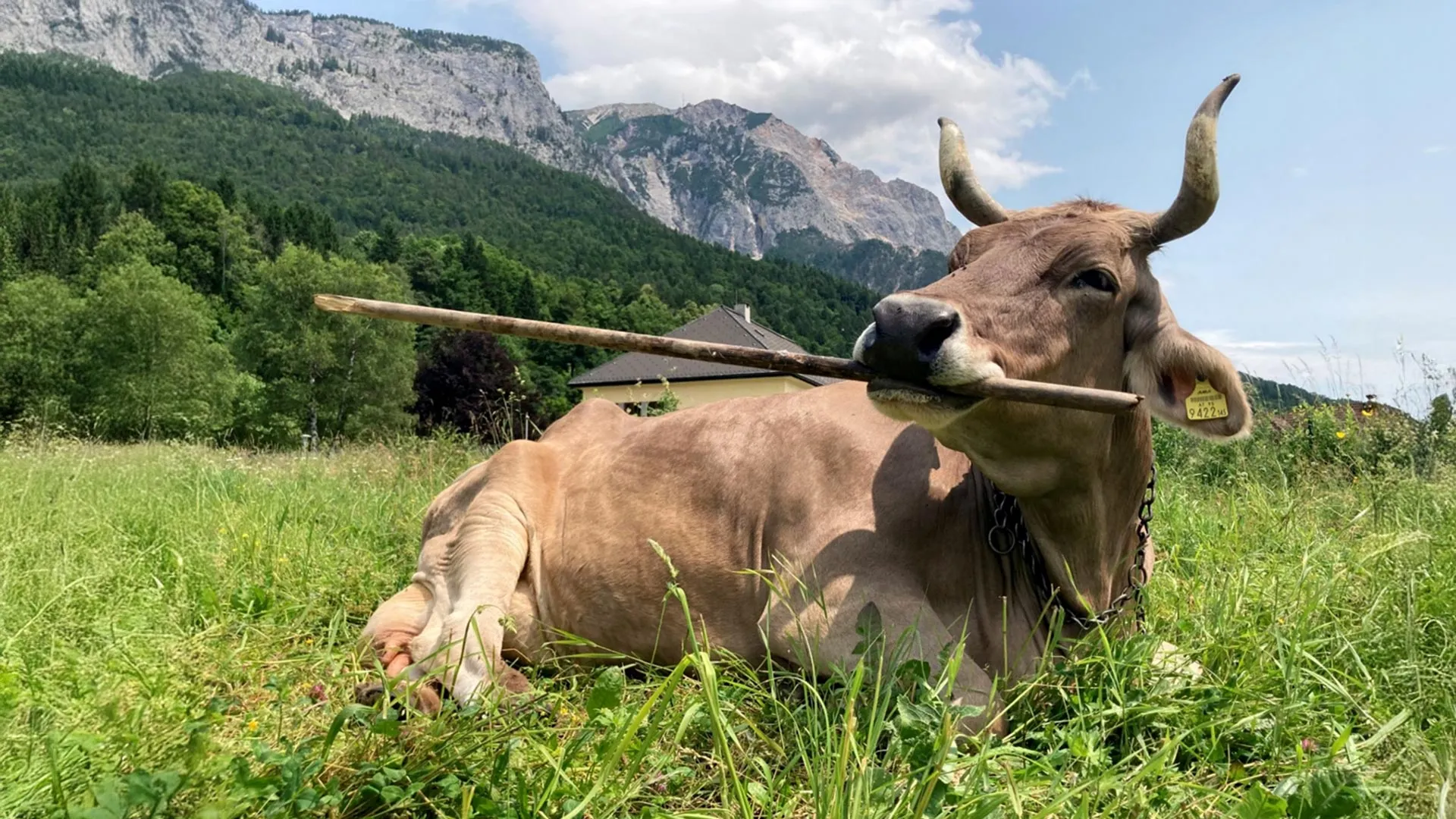
Veronika is a Swiss Brown cow, a breed originating from the Alps, known for its robust build, docile temperament, and high milk yield. However, Veronika’s life diverges significantly from that of most of her kin. She lives not as an animal raised for food production, but as a cherished companion animal on an organic farm in Austria. Her guardian, Witgar Wiegele, an organic farmer and baker, considers her an integral part of his family, fostering an environment rich in interaction, stimulation, and individual attention – conditions rarely afforded to typical farm animals.
It was more than a decade ago that Wiegele first began noticing an unusual and persistent behavior from Veronika. She would routinely pick up sticks, branches, or other suitable objects found around her enclosure and purposefully use them to scratch parts of her body that she couldn’t reach directly. This was not a fleeting or accidental action; it was a consistent, deliberate pattern of behavior. Wiegele, attuned to his animal’s individuality, recognized the significance of these actions, eventually capturing them on video and sharing the footage with researchers.
"When I saw the footage, it was immediately clear that this was not accidental," Auersperg confirms, recalling her initial reaction. "This was a meaningful example of tool use in a species that is rarely considered from a cognitive perspective. It instantly raised the question: how widespread could this be if we only looked?"
Designing the Scientific Investigation: Controlled Experiments
To move beyond anecdotal observation and scientifically validate Veronika’s behavior, researchers from the University of Veterinary Medicine, Vienna, in collaboration with the University of Cambridge, designed a series of structured tests. The objective was to determine if Veronika’s actions were truly deliberate, flexible tool use, or merely a habitual motor pattern.
The research team provided Veronika with a standard deck brush – an everyday object with distinct features (bristles and a smooth handle) that could serve different scratching purposes. They strategically placed the brush on the ground in various positions within her enclosure, then meticulously observed and recorded her interactions. The experiments were conducted over multiple trials, ensuring robust data collection and minimizing the chance of spurious results.
Across these diverse trials, Veronika demonstrated remarkable consistency and adaptability. She consistently chose specific parts of the brush depending on the particular body region she intended to scratch. Her selections were far from random. Instead, they precisely matched the needs of different areas of her body, indicating a clear understanding of the tool’s properties and how to best apply them.
Antonio Osuna-Mascaró, another key researcher on the project, elaborated on the findings: "We show that a cow can engage in genuinely flexible tool use. Veronika is not just using an object to scratch herself. She uses different parts of the same tool for different purposes, and she applies different techniques depending on the function of the tool and the body region." This distinction is crucial in the field of ethology, as it elevates her actions beyond simple object manipulation to a more sophisticated form of problem-solving.
Flexible and Multi-Purpose Tool Use: A Rare Cognitive Feat
The researchers’ detailed observations revealed clear, systematic patterns in how Veronika employed the brush. For larger, firmer, and less sensitive areas of her body, such as her back or flanks, she consistently preferred to use the bristled side of the brush, applying greater force and broader motions. Conversely, for more sensitive regions, particularly on her lower body or around her udder, she switched to the smoother, less abrasive handle, employing slower, more precise movements. This nuanced application of a single tool, adapting its use based on specific bodily needs, is a hallmark of advanced cognitive processing.
In the realm of animal behavior, tool use is scientifically defined as the use of an external object to achieve a goal through physical interaction. Veronika’s actions unequivocally meet this definition. However, her behavior transcends this basic criterion, qualifying as flexible, multi-purpose tool use. This means she effectively utilizes different features of the same object to achieve distinct outcomes, demonstrating a complex understanding of cause-and-effect and an ability to adapt her strategy.
This level of sophisticated tool use is exceedingly rare in the animal kingdom. Among non-human species, such flexible, multi-purpose application of tools has previously been clearly and consistently documented primarily in chimpanzees, and a handful of other highly intelligent animals like New Caledonian crows. To find this capability in a cow is a significant expansion of the known cognitive landscape of species.
Overcoming Physical Limitations: The Challenge of Egocentric Tool Use
Veronika’s tool use is directed at her own body, a category known as egocentric tool use. While this form is typically considered less complex than using tools on external objects (such as a chimpanzee using a stick to extract termites from a mound), it still presents its own unique set of challenges. One of the primary hurdles for Veronika, and indeed for any bovine, is the lack of manipulative forelimbs or hands. Unlike primates, cows must manipulate tools using their mouths and tongues, which requires immense control and coordination.
Despite this inherent physical limitation, Veronika demonstrated remarkable dexterity. The study noted her careful control of the brush, her ability to adjust her grip, and her precise movements, all of which suggest an anticipation of the effects of her actions. She appeared to understand how to angle the tool, how much pressure to apply, and which part of the brush would yield the desired result for a specific itch. This level of intentionality and adaptability, even for egocentric tool use, underscores a higher order of cognitive function than previously attributed to cattle.
Why This Behavior May Be Rare: The Role of Environment and Opportunity
The researchers hypothesize that Veronika’s unique living conditions have played a crucial role in the development and manifestation of her tool-using behavior. Most cattle, even those in humane agricultural settings, live relatively constrained lives focused on herd dynamics and production cycles. They typically do not experience the kind of prolonged individual attention, complex environment, or access to diverse manipulable objects that Veronika enjoys.
Unlike the vast majority of cattle, Veronika has lived a long life (she is over 10 years old, a considerable age for a cow) in a stimulating, enriched environment. Her daily interactions with humans, her status as a companion animal, and her access to a variety of natural and man-made objects have likely fostered an environment ripe for exploration, learning, and innovation. These factors, uncommon for most cows, may have created the necessary opportunities for her innate cognitive potential to express itself.
"[Veronika] did not fashion tools like the cow in Gary Larson’s cartoon, but she selected, adjusted, and used one with notable dexterity and flexibility," the researchers conclude in their paper. "Perhaps the real absurdity lies not in imagining a tool-using cow, but in assuming such a thing could never exist." This poignant reflection serves as a powerful commentary on anthropocentric biases in scientific observation.
Rethinking Animal Intelligence: Broader Implications and Future Directions
This discovery represents the first scientifically confirmed case of tool use in cattle, significantly expanding the known range of species capable of demonstrating this complex ability. Its implications extend far beyond a single cow; it raises profound questions about the cognitive abilities of a species central to human agriculture and, by extension, about other species we often categorize as "less intelligent."
The research team is now actively exploring which environmental and social conditions are conducive to the development and expression of such complex behaviors. Their work could pave the way for a deeper understanding of animal learning, problem-solving, and the impact of environmental enrichment on cognitive development. This study also opens the possibility that similar behaviors may exist, not only in other cows but in various livestock species, and have simply gone unnoticed due to a lack of focused observation or an environment that inhibits their expression.
"Because we suspect this ability may be more widespread than currently documented," Osuna-Mascaró urges, "we invite readers who have observed cows or bulls using sticks or other handheld objects for purposeful actions to contact us." This call to action highlights a crucial aspect of scientific discovery: the importance of citizen science and the collective accumulation of observational data, particularly for behaviors that may be subtle or context-dependent.
The implications for animal welfare are also significant. If cows possess greater cognitive capacities, including flexible tool use, then current livestock management practices may need to be re-evaluated to ensure they meet the complex needs of these intelligent animals. Providing enriched environments, opportunities for exploration, and avenues for expressing natural behaviors could become a more central component of ethical animal husbandry.
Ultimately, Veronika’s story serves as a powerful reminder of the vast, unexplored depths of animal cognition. It challenges us to shed preconceived notions, to observe with an open mind, and to recognize that intelligence manifests in myriad forms across the diverse tapestry of life on Earth. The humor of Cow Tools may endure, but the scientific reality of Veronika has added a new, profound layer to our understanding of the animal kingdom.