
The Manitoba winter landscape served as the backdrop for a comprehensive five-day ornithological expedition from March 10 to March 14, 2026, where researchers and avian enthusiasts documented a diverse array of owl species and boreal birds across the province’s varied ecosystems. This expedition, focusing on the unique intersection of the northern boreal forest and the eastern prairies, underscored the critical importance of Manitoba as a wintering ground for several high-latitude species. Led by expert guides and featuring insights from prominent conservationists, the tour provided significant data on species distribution, nesting behaviors, and the health of local populations during the late winter transition.

Strategic Overview of the Manitoba Avian Survey
The expedition was designed to maximize sightings of Manitoba’s iconic "winter ghosts," specifically the Great Grey Owl, the Snowy Owl, and the elusive Northern Hawk Owl. Manitoba is globally recognized for its owl density; the Great Grey Owl (Strix nebulosa) is the official provincial bird, making the region a focal point for both tourism and scientific observation. The 2026 survey took place during a period of shifting weather patterns, providing an opportunity to observe how these raptors and their prey species utilize both urban parks and rural agricultural lands.
The itinerary was strategically divided between the open agricultural plains south of Winnipeg, the dense boreal transition zones to the northeast, and the vital wetland corridors of Oak Hammock Marsh. By covering these distinct habitats, the group aimed to record a representative sample of the province’s late-winter biodiversity, contributing to long-term citizen science databases such as eBird.

Chronology of Observations: From Urban Centers to the Boreal Edge
Initial Briefing and Conservation Insights
The expedition commenced on March 10 with a technical briefing and a specialized presentation by Jim Duncan, a renowned expert in owl biology. Duncan was accompanied by Oska, a Great Grey Owl used for educational purposes. The session focused on the Great Grey Owl’s unique hunting adaptations—such as its ability to hear prey beneath two feet of snow—and the ongoing conservation challenges facing the species, including habitat loss and the impacts of climate change on small mammal populations. This academic foundation set the stage for the field observations that followed.
The Prairie Circuit: Snowy Owls and Open-Country Specialists
On March 11, the team pivoted to the agricultural landscapes surrounding Oak Bluff and La Salle. These open fields mimic the Arctic tundra, attracting Snowy Owls (Bubo scandiacus) that migrate south for the winter. The group successfully documented two distinct Snowy Owls: a mature, nearly pure-white male and an immature bird characterized by heavy barred plumage. These sightings are indicative of the irruptive nature of the species, where the availability of lemmings in the Arctic during the summer dictates the number of young birds that move south in the winter.

In addition to raptors, the prairie circuit yielded sightings of Grey Partridges (Perdix perdix) and large flocks of Horned Larks (Eremophila alpestris). The presence of these ground-foraging birds is a vital indicator of the health of the agricultural ecosystem, as they rely on exposed waste grain and weed seeds during the harsh winter months.
Urban Biodiversity and Nesting Success
The latter half of the second day focused on Winnipeg’s urban green spaces. At Bunn’s Creek, the expedition observed a nesting pair of Great Horned Owls (Bubo virginianus). Notably, the female was already brooding, with downy chicks visible—a testament to the species’ early nesting cycle, which often begins in the heart of winter. The presence of Pileated Woodpeckers (Dryocopus pileatus) in the same vicinity highlighted the importance of mature urban forests in supporting large cavity-nesting birds.

The Boreal Transition: Northern Hawk Owls and Finches
On March 12, the survey moved toward the boreal transition zone near Lac du Bonnet and Highway 317. The primary objective was the Northern Hawk Owl (Surnia ulula), a diurnal hunter that perches on high, exposed snags. The team located a specimen that had been seen consistently in the area, providing an opportunity for detailed observation of its hawk-like hunting posture.
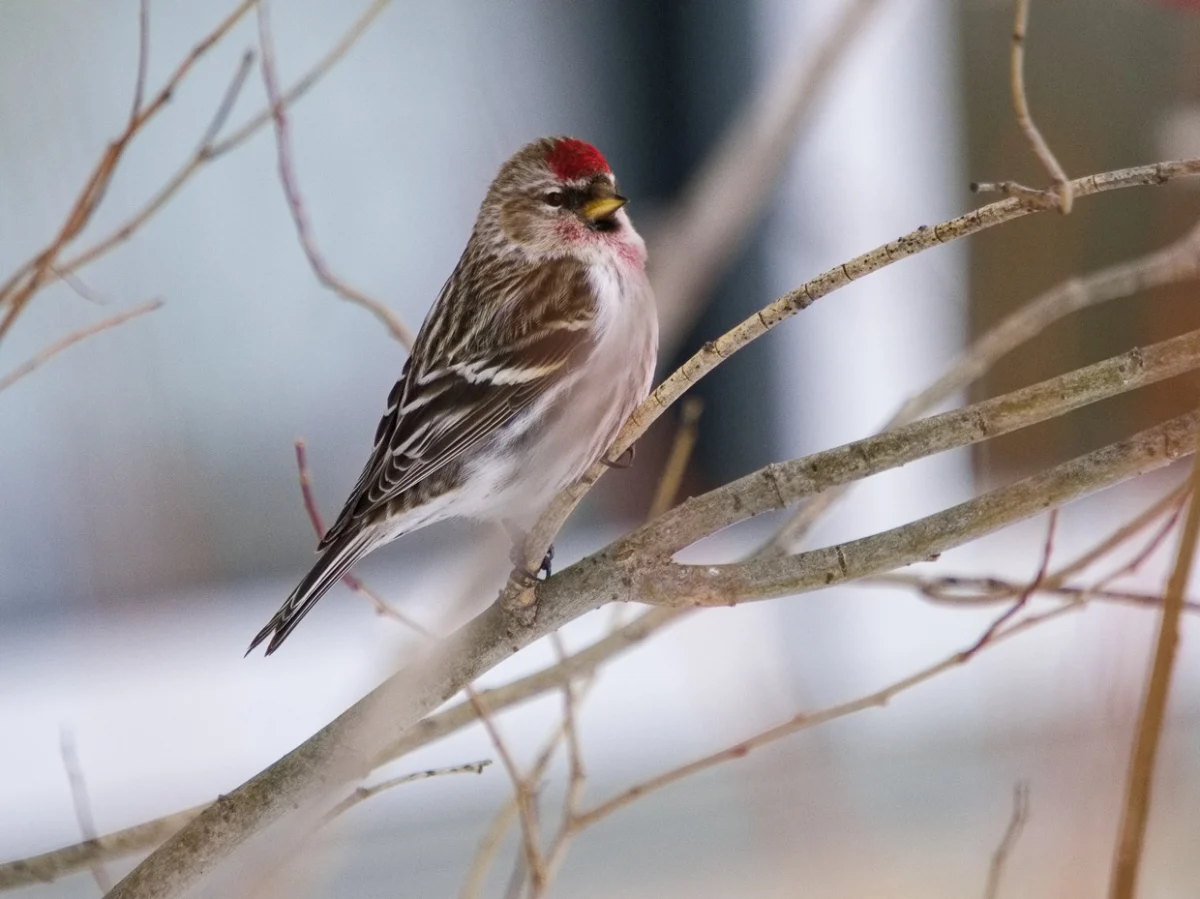
The expedition also visited several feeder stations in Silver Falls and along Henry Bellin Road. These locations are critical for monitoring winter finch populations. The group recorded significant numbers of Evening Grosbeaks and Pine Grosbeaks, alongside both Common and Hoary Redpolls. These sightings are particularly valuable for researchers tracking "irruption years," when boreal birds move south in massive numbers due to cone crop failures in the far north.

Wetland Resilience at Oak Hammock Marsh
The final full day of the expedition, March 13, included a visit to Oak Hammock Marsh, a world-renowned RAMSAR wetland site. While the marsh was largely frozen, the interpretive center and surrounding trails provided data on winter-hardy species. The group documented a high count of Canada Geese in open water leads and observed Snow Buntings (Plectrophenax nivalis) along the roadside—a species that utilizes the marsh’s perimeter for foraging before returning to the high Arctic to breed.
The expedition concluded with a successful search for the Northern Saw-whet Owl (Aegolius acadicus) in Assiniboine Park. Finding this diminutive, strictly nocturnal owl requires immense patience and sharp eyes, as they roost in dense conifers to avoid predation by larger owls.

Supporting Data and Species Analysis
The data collected during the five-day period reflects a stable winter population for several key species in the 2025-2026 season. According to the eBird trip report (485364), the expedition recorded a wide variety of species that serve as ecological indicators.
| Species Category | Key Species Observed | Ecological Significance |
|---|---|---|
| Raptors (Owls) | Snowy, Great Horned, Northern Hawk, Northern Saw-whet | Indicators of small mammal (vole/lemming) density. |
| Boreal Finches | Pine Grosbeak, Evening Grosbeak, Redpolls | Indicators of coniferous seed crop health in the Boreal forest. |
| Upland Birds | Grey Partridge, Sharp-tailed Grouse | Indicators of grassland and agricultural habitat quality. |
| Waterfowl | Canada Geese, Common Goldeneye | Indicators of open-water availability during winter thaws. |
The observation of the Hoary Redpoll (Acanthis hornemanni) alongside the Common Redpoll is of particular interest to taxonomists and climate scientists. The Hoary Redpoll is a "tundra specialist," and its presence in southern Manitoba suggests a standard winter range extension, though its frequency is being closely monitored as the Arctic warms.

Conservation Implications and Expert Commentary
The findings of the March 2026 expedition contribute to a broader understanding of how avian species navigate the human-dominated landscapes of southern Manitoba. The success of the Great Horned Owl nest in a suburban park like Bunn’s Creek suggests that certain raptors have successfully adapted to urban fragmentation, provided that mature trees and adequate prey bases are maintained.
However, the "miss" of the Western Screech-Owl and Barred Owl at certain known roosts highlights the volatility of winter survival. Dr. Jim Duncan’s earlier presentation emphasized that while some owls are thriving, others face increasing pressure from habitat encroachment and the unpredictable nature of winter weather events, such as ice storms that prevent owls from reaching prey beneath the snow.

"The consistency of the Northern Hawk Owl on Highway 317 is a positive sign for the species’ site fidelity in Manitoba," noted one of the expedition’s lead observers. "However, the lack of Snowy Owl sightings on the final day, despite intensive searching, reminds us that these birds are highly mobile and their presence is never guaranteed. They follow the food, and in a changing climate, those food sources are moving."
Economic and Educational Impact of Avitourism
Beyond the biological data, the expedition underscores the economic value of avitourism to the Manitoba economy. Birdwatching is one of the fastest-growing outdoor recreational activities in North America. Events like the Manitoba Owls tour attract international visitors, supporting local hospitality businesses in rural areas like Lac du Bonnet and Silver Falls.

Furthermore, the educational aspect of the trip—incorporating expert lectures and interpretive center visits—plays a vital role in public advocacy. By connecting enthusiasts with the physical reality of these birds in their natural habitats, conservation organizations can better mobilize support for protecting the boreal forest and wetland ecosystems.
Conclusion: A Successful Survey of Manitoba’s Winter Biodiversity
The March 2026 Manitoba Owls expedition concluded on March 14, having successfully documented a significant portion of the province’s winter avian residents. From the majestic "ghost" of the snowy prairies to the tiny, hidden Saw-whet Owl in an urban park, the diversity of species recorded provides a snapshot of an ecosystem in transition.

As the participants returned home, the data they collected remained behind in the form of eBird records and photographic evidence, serving as a baseline for future surveys. The expedition confirmed that despite the challenges of a changing environment, Manitoba remains a premier destination for avian research and a critical sanctuary for the specialized birds of the north. The combination of expert guidance, citizen science, and professional conservation insight ensures that the "winter ghosts" of the province will continue to be monitored and protected for generations to come.