
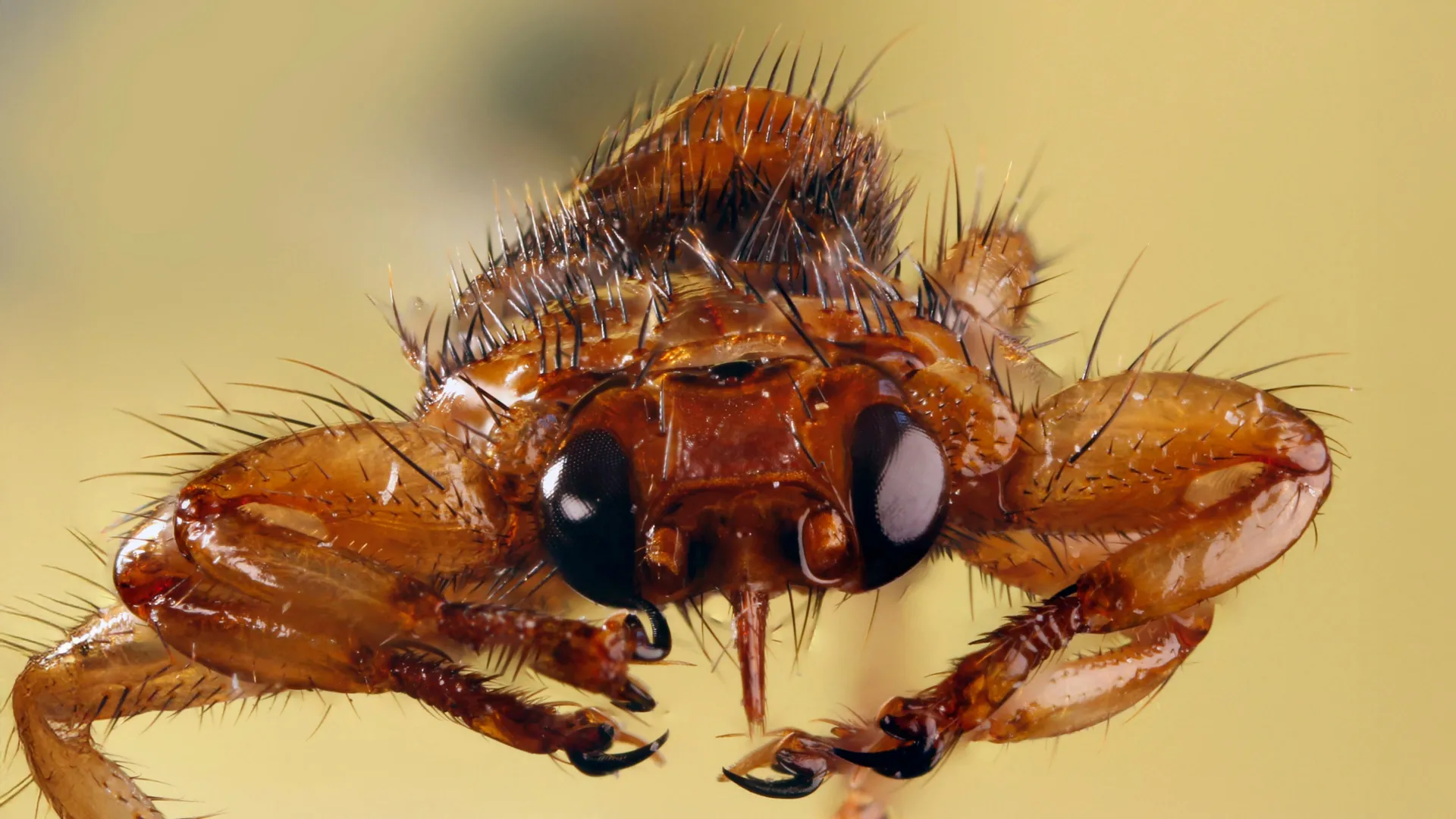
New research reveals a remarkable sensory adaptation in blood-feeding deer keds, demonstrating that these insects significantly reduce their visual sensitivity after successfully locating a host and permanently ceasing flight. This profound shift, observed by scientists from Aberystwyth University and the University of Florence, highlights an evolutionary strategy where energy is redirected from an energetically expensive sensory system, vision, towards functions more critical for a permanent parasitic lifestyle. The findings, published in the Journal of Experimental Biology, offer fresh insights into the intricate mechanisms by which parasites adapt their sensory biology to dramatic changes in their environment and behavior.
The Enigmatic Deer Ked: A Dual Lifestyle
Deer keds, scientifically known primarily as Lipoptena cervi (though other species like Melophagus ovinus, the sheep ked, exhibit similar traits), are fascinating ectoparasites found across vast swathes of Europe, Asia, Africa, and the Americas. Their life cycle presents a stark dichotomy, transitioning from an active, free-flying hunter to a sedentary, blood-feeding parasite. As adults, these biting flies are initially winged, relying heavily on both flight and vision to actively search for a suitable mammalian host. While deer, elk, and moose are their primary targets, they are opportunistic feeders and have been known to infest humans, domestic animals, and other mammals, causing irritation and discomfort.
The initial, winged phase is characterized by a relentless pursuit of a host. Keds are attracted by warmth, carbon dioxide, and visual cues, such as the size and dark coloration of a moving animal. This phase is metabolically demanding, requiring sustained flight and precise visual processing to navigate environments and identify potential blood sources. However, upon successfully landing on a host, the deer ked undergoes a dramatic and irreversible transformation. It permanently sheds its wings, discarding them as an unnecessary appendage for its new existence. From this point forward, the insect dedicates the remainder of its life to moving through the host’s fur, feeding on blood, reproducing, and laying pupae. This commitment to a parasitic existence within the protective environment of the host’s fur eliminates the need for flight and, as the research now shows, significantly reduces the demands on its visual system.
The Energetic Imperative of Vision
Vision, particularly the complex kind required for active hunting and navigation, is one of the most energetically demanding sensory modalities in the animal kingdom. The process of light detection, signal transduction, and subsequent neural processing in the brain requires a continuous supply of ATP (adenosine triphosphate), the primary energy currency of cells. Maintaining photoreceptor cells, synthesizing visual pigments (like opsins), and supporting the vast network of neurons involved in interpreting visual information all come at a significant metabolic cost. Evolution, ever the efficiency expert, consistently favors adaptations that optimize resource allocation. Animals in environments where vision is less critical or entirely absent, such as cave dwellers or deep-sea creatures, often exhibit reduced or vestigial eyes, demonstrating this principle. For an organism like the deer ked, which transitions from a visually demanding aerial life to a largely light-deprived existence within fur, the selective pressure to reallocate energy away from vision would be substantial.
Dr. Roger Santer from the Department of Life Sciences at Aberystwyth University, who led the study, emphasized this point: "Vision plays a vital role in animal behavior, but it is also energetically expensive. Evolution favors sensory systems that are efficiently matched to an animal’s way of life. Some blood-feeding flies rely heavily on vision, while others live permanently on hosts and have little need for it. Deer keds are especially interesting because they switch between these two lifestyles." This unique lifecycle offers a rare opportunity to study sensory plasticity and resource allocation in real-time, or rather, across distinct life stages.
Unveiling Sensory Adaptation: The Research Journey
The collaborative research team from Aberystwyth University and the University of Florence embarked on a detailed investigation to understand how deer keds adapt their sensory systems to this profound behavioral and ecological transition. Their hypothesis centered on the idea that the major behavioral shift – from flight and active host-seeking to permanent parasitism – would be accompanied by measurable changes in the fly’s sensory biology, particularly its visual system.
To test this, the researchers meticulously collected deer keds at different points in their adult life cycle. They examined winged adults that were actively engaged in host-seeking, representing the visually demanding phase. These were then compared with wingless adults collected directly from deer after they had successfully settled and adopted their permanent parasitic lifestyle. This direct comparison of the same species at different life stages, exhibiting vastly different behavioral repertoires, was crucial for isolating the adaptive changes.
The team focused their molecular investigations on genes associated with visual sensitivity, specifically a class of genes known as opsins. Opsins are light-sensitive proteins found in the photoreceptor cells of the eye. They are fundamental to vision, undergoing conformational changes upon light absorption that trigger a cascade of biochemical events, ultimately leading to a nerve impulse that the brain interprets as light. The level of activity, or expression, of opsin genes is a direct indicator of the visual system’s investment and potential sensitivity. By comparing the gene activity of opsins in the winged, host-seeking keds versus the wingless, parasitic keds, the researchers were able to quantify how the insects’ visual systems responded to their sudden and permanent change in lifestyle. Techniques like quantitative polymerase chain reaction (qPCR) or RNA sequencing, though not explicitly detailed in the summary, would have been employed to precisely measure the mRNA levels of these opsin genes, providing a robust proxy for gene activity.
Opsins: The Windows to Visual Acuity
The findings were clear and compelling. The study revealed a significant reduction in the activity of opsin genes in the parasitic, wingless deer keds compared to their free-flying counterparts. Dr. Santer elaborated on this discovery: "We found that a flying deer ked’s visual system is much like that of a tsetse fly, which famously hunt out mammal hosts in Africa. However, after a deer ked loses its wings and becomes an ectoparasite, activity of its opsin genes reduces to around half the previous level. This suggests that the flies do not lose vision entirely, but that their visual sensitivity is reduced."
This reduction of approximately 50% in opsin gene activity is a powerful indicator of a scaled-back visual capacity. It suggests that while the keds may not become entirely blind, their ability to detect light, resolve images, and process visual information is significantly diminished. This is a crucial distinction; complete blindness would imply a complete cessation of opsin production, whereas a reduction indicates a down-regulation, an economy of resources rather than an outright abandonment. The metabolic savings from producing fewer opsin proteins and maintaining a less active visual system are likely substantial, providing a clear evolutionary advantage.
A Striking Parallel and Divergence: Tsetse Flies and Deer Keds
The comparison drawn with tsetse flies (genus Glossina) by Dr. Santer is particularly insightful. Tsetse flies are notorious vectors of African trypanosomiasis (sleeping sickness in humans and nagana in animals), and their host-seeking behavior is heavily reliant on a sophisticated visual system, alongside olfaction and thermal cues. They are active, persistent hunters, navigating complex landscapes to find hosts. Their visual acuity and investment in opsin production are optimized for this visually demanding hunting strategy.
The deer ked’s initial visual system mirroring that of a tsetse fly underscores the importance of vision during its host-seeking phase. Both insects share the common goal of locating a mammalian host, and both employ robust visual systems to achieve this. However, their paths diverge dramatically post-host-contact. Tsetse flies remain winged and continue their active host-seeking throughout their adult lives, requiring a sustained investment in vision. Deer keds, conversely, undergo their transformative wing-shedding and commitment to a single host. This difference highlights the deer ked’s unique "switch" strategy, a testament to evolutionary flexibility where an organism can drastically re-engineer its physiology to suit a new ecological niche within its own lifespan. It is not merely an adaptation over generations, but a remarkable example of phenotypic plasticity within an individual’s adult stage.
The Evolutionary Rationale: Conserving Energy for Survival
The underlying evolutionary rationale for this sensory downscaling is unequivocally tied to energy conservation. Life as a permanent ectoparasite, while seemingly secure once a host is found, still carries significant metabolic demands. The insect must continuously feed on blood, digest complex proteins, maintain its body temperature, ward off host immune responses, and, critically, reproduce. Reproduction, especially the production of numerous offspring, is an incredibly energy-intensive process. By reducing the metabolic load of maintaining a complex visual system that is no longer needed, the deer ked can redirect those precious energy resources to these other vital functions.
Specifically, conserved energy can be channeled towards:
- Digestion and nutrient assimilation: Efficiently processing blood meals.
- Reproduction: Producing viable eggs or pupae, ensuring the continuation of the species.
- Immune response: Counteracting host defenses and potential pathogens.
- Movement within fur: Navigating the dense environment of the host’s coat to find optimal feeding or mating sites, which might rely more on tactile or olfactory senses than vision.
This energy trade-off is a classic example of natural selection optimizing an organism’s biology for maximum fitness within its specific ecological context. For the deer ked, once nestled in the fur, the advantages of sharp vision are outweighed by the costs, making a reduced visual capacity a highly adaptive trait.
Broader Implications for Parasitology and Pest Control
The study, published in a leading scientific journal like the Journal of Experimental Biology, holds significant implications beyond just understanding the curious biology of deer keds. It contributes fundamentally to our broader understanding of phenotypic plasticity – the ability of an organism to change its phenotype (observable characteristics) in response to environmental changes – and the evolutionary drivers behind parasitic adaptation.
For parasitologists, this research provides a clear molecular mechanism for how parasites can fine-tune their sensory systems to match their environment. It opens avenues for investigating similar sensory adaptations in other parasites that undergo dramatic lifestyle shifts, potentially revealing common evolutionary patterns. Understanding such detailed adaptive strategies helps to build a more complete picture of host-parasite co-evolution and the ecological pressures that shape these interactions.
Furthermore, the practical implications extend to pest control strategies. Biting flies, including deer keds, can transmit pathogens, cause economic losses in livestock, and significantly impact human comfort and health. A better understanding of how deer keds and other biting flies utilize and adapt their senses could pave the way for more effective monitoring and control methods. If researchers can pinpoint the exact sensory cues that attract free-flying keds, or identify vulnerabilities in their sensory systems during different life stages, it could lead to:
- Improved traps: Designing traps that specifically exploit the visual (or other) cues used by host-seeking keds.
- Targeted repellents: Developing repellents that disrupt the keds’ ability to perceive hosts during their crucial host-seeking phase.
- Novel control agents: Exploring interventions that might interfere with the sensory adaptation process itself, though this is a more speculative long-term goal.
By delving into the intricate molecular changes underlying these behavioral shifts, scientists gain powerful tools to combat these often-nuisance, and sometimes disease-carrying, insects. The study underscores that a deep understanding of basic insect biology can often lead to innovative solutions for real-world problems.
Future Directions and Unanswered Questions
While this study provides compelling evidence for visual system down-regulation, it also opens doors to numerous further investigations. Researchers may now explore:
- Other sensory modalities: Do other senses, such as olfaction (smell) or mechanoreception (touch), become more important or undergo adaptive changes once the ked is on a host? It’s plausible that senses suited for navigating dense fur would be enhanced.
- Timing and speed of change: How quickly does opsin gene activity decrease after host attachment? Is it an immediate response or a gradual process?
- Environmental factors: Are there variations in visual reduction based on the type of host, the density of its fur, or ambient light levels within the fur?
- Genetic basis: What are the specific regulatory mechanisms (e.g., transcription factors, epigenetic modifications) that control the down-regulation of opsin genes?
- Behavioral consequences: How does reduced visual sensitivity manifest behaviorally for the parasitic ked? Does it become less responsive to light cues, or are its movements within the fur primarily guided by other senses?
The research on deer keds stands as a powerful testament to the intricate and energy-efficient adaptations forged by evolution. It illuminates how even seemingly small insects can exhibit remarkable physiological plasticity, shedding not just their wings, but also a significant portion of their visual investment, all in the service of survival and successful reproduction in their specialized parasitic niche.
