
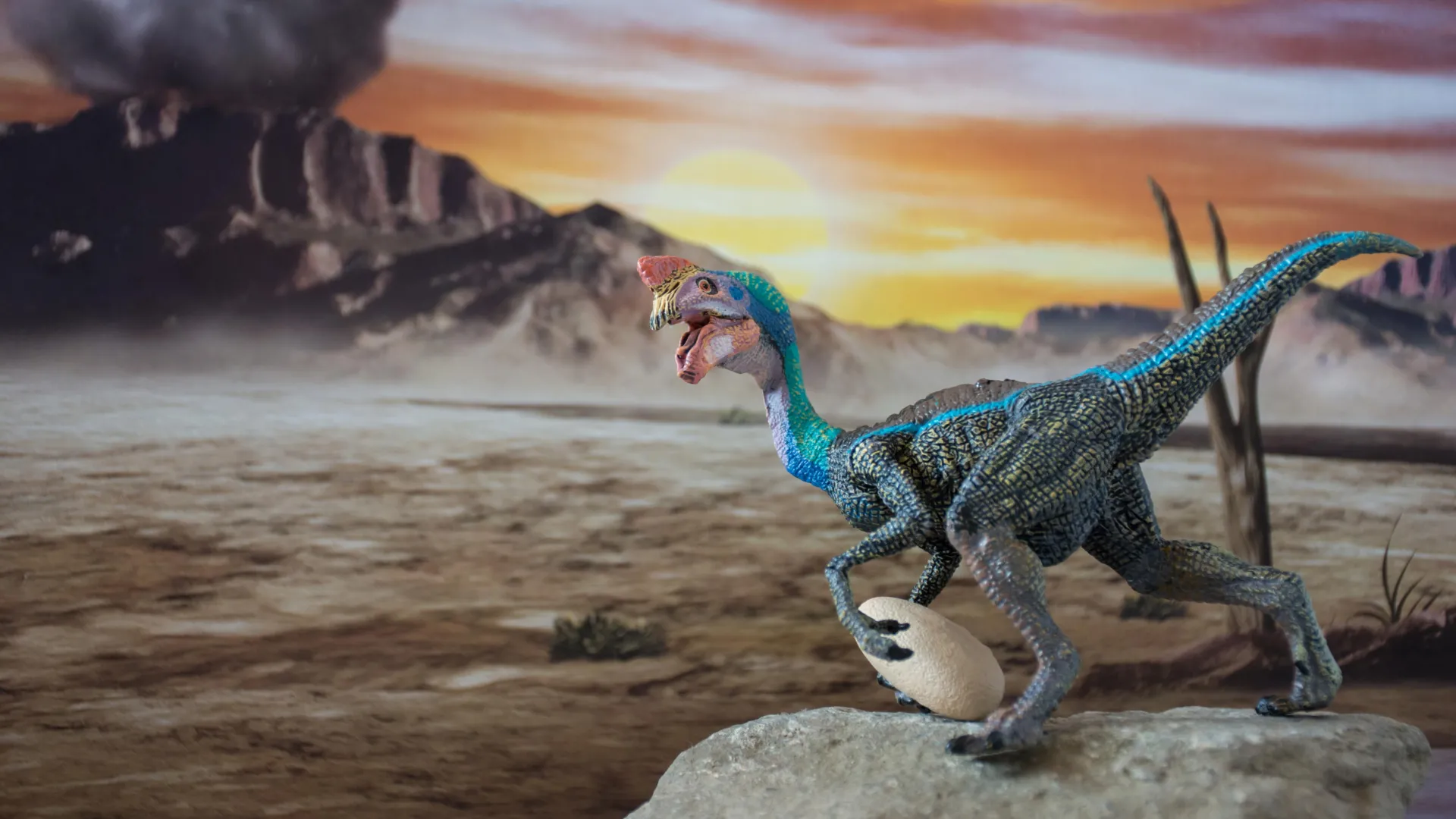
The mystery surrounding how oviraptors, the enigmatic bird-like yet flightless dinosaurs, incubated their eggs has long puzzled paleontologists. While some ancient reptiles relied solely on ambient environmental heat, and modern birds exhibit direct thermal contact, the specific strategy of oviraptors remained elusive. A groundbreaking new study published in Frontiers in Ecology and Evolution offers significant insights, suggesting these Cretaceous dinosaurs employed a sophisticated form of "co-incubation," combining their own body heat with warmth from their surroundings to ensure their offspring’s development. This research not only clarifies a long-standing paleontological question but also sheds light on the evolutionary continuum of parental care from dinosaurs to birds.
Unraveling Ancient Incubation Strategies
Researchers based in Taiwan embarked on an ambitious project, integrating advanced heat transfer simulations with meticulously designed physical experiments to decipher the complex process of oviraptor egg incubation. Their methodology involved creating a life-sized model of an oviraptor and its nest, allowing for unprecedented real-world testing of heat dynamics within the clutch. The findings were then rigorously compared against known patterns of modern avian incubation, providing a crucial comparative framework.
Dr. Tzu-Ruei Yang, a senior author of the study and an associate curator of vertebrate paleontology at Taiwan’s National Museum of Natural Science, highlighted a pivotal discovery: "We show the difference in oviraptor hatching patterns was induced by the relative position of the incubating adult to the eggs." This suggests that the dinosaur’s physical interaction with the nest was a key determinant in how evenly heat was distributed among the developing embryos. Adding to this revelation, Chun-Yu Su, the first author who was a high school student at Washington High School in Taichung during the research, noted, "Moreover, we obtained an estimate of the incubation efficiency of oviraptors, which is much lower than that of modern birds." These initial findings paint a picture of a nuanced, albeit less efficient, incubation strategy that deviates significantly from the singular focus of modern avian parents.
The Enigmatic Oviraptor: A Brief History
Oviraptors belong to a group of theropod dinosaurs known for their distinctive bird-like skulls, beaks (often toothless), and feathered bodies. First discovered in the 1920s in Mongolia, the initial specimen, Oviraptor philoceratops, was controversially named "egg seizer" or "egg thief" because it was found atop a nest believed to belong to Protoceratops. For decades, oviraptors were unfairly portrayed as nest predators. However, subsequent discoveries in the 1990s, particularly well-preserved specimens like Citipati osmolskae found fossilized directly on their own clutches in a brooding posture similar to modern birds, definitively overturned this misconception. These discoveries revealed that oviraptors were, in fact, dedicated parents, guarding and incubating their own eggs, thereby repositioning them as critical examples of dinosaur parental care and a significant link in the dinosaur-bird evolutionary chain.
Oviraptors thrived during the Late Cretaceous period, approximately 70 to 66 million years ago, across regions that now encompass Mongolia, China, and parts of North America. They varied in size, from small, turkey-sized species to larger forms, typically characterized by bipedal locomotion and omnivorous or herbivorous diets. Their nests, often found in fossilized form, consistently exhibit a distinctive ring-shaped or circular arrangement of eggs, a feature that proved central to the Taiwanese team’s research.
Reconstructing a Prehistoric Nursery: The Heyuannia huangi Model
To faithfully replicate the conditions of an oviraptor nest, the research team focused on Heyuannia huangi, a species that roamed what is now China during the Late Cretaceous. This particular oviraptor was approximately 1.5 meters (about 5 feet) long and weighed around 20 kilograms (about 44 pounds), making it a manageable size for physical modeling. Fossil evidence indicates that Heyuannia huangi constructed semi-open nests with eggs arranged in multiple, concentric rings – a key behavioral trait that profoundly influenced the study’s design.
The creation of the oviraptor model was a feat of interdisciplinary engineering and paleontology. Researchers meticulously constructed the dinosaur’s torso using lightweight polystyrene foam and a sturdy wooden frame, then layered it with cotton, bubble paper, and fabric to simulate the soft tissues and insulating properties of a living animal. The eggs themselves posed a unique challenge, as their structure and thermal properties differ significantly from those of any extant species. "Their eggs are unlike those of any living species, so we invented the resin eggs to approximate real oviraptor eggs as best as we could," explained Chun-Yu Su. These custom-made resin eggs were arranged in two double-ring clutches, precisely mirroring fossilized nest layouts. This detailed reconstruction allowed the team to simulate the complex interplay of dinosaur body heat, egg placement, and environmental factors with unprecedented accuracy.
Heat Dynamics, Nest Design, and Asynchronous Hatching
The core of the experimental phase involved testing how both the presence of a brooding adult and varying environmental conditions impacted egg temperatures and, by extension, potential hatching outcomes. The results provided compelling evidence for oviraptor’s co-incubation strategy.
In simulated colder conditions, with the model oviraptor brooding over its eggs, temperatures within the outer ring of eggs exhibited significant variation, fluctuating by as much as 6 degrees Celsius (approximately 10.8 degrees Fahrenheit). Such substantial temperature differentials across a clutch would almost certainly lead to asynchronous hatching, where eggs within the same nest hatch at different times, potentially over several days or even weeks. This phenomenon is observed in some modern reptiles and birds, often as an adaptive strategy to spread the risk of predation or resource scarcity among offspring.
Conversely, in simulated warmer environments, the temperature variation within the outer ring of eggs drastically reduced to approximately 0.6 degrees Celsius (about 1.1 degrees Fahrenheit). This striking difference suggests that in warmer climates, the ambient sunlight played a crucial role in buffering temperature fluctuations and helping to even out the heat distribution across the nest. Dr. Yang elaborated on this point, stating, "It’s unlikely that large dinosaurs sat atop their clutches. Supposedly, they used the heat of the sun or soil to hatch their eggs, like turtles. Since oviraptor clutches are open to the air, heat from the sun likely mattered much more than heat from the soil." This insight underscores the importance of the semi-open nest design, which would have allowed direct solar radiation to penetrate the clutch, supplementing the heat provided by the parent.
Dinosaur vs. Bird Incubation Efficiency: An Evolutionary Perspective
A significant aspect of the study involved a comparative analysis of oviraptor incubation with that of modern birds. Most avian species rely on a highly specialized method known as thermoregulatory contact incubation (TCI). In TCI, the adult bird actively sits directly on its eggs, acting as the primary and often sole heat source. For TCI to be effective, the parent must maintain continuous physical contact with all eggs in the clutch, provide a consistent and optimal temperature, and possess the physiological capacity to regulate its own body heat precisely.
The research unequivocally demonstrated that oviraptors, given their anatomical structure and nest design, likely could not meet these stringent conditions for efficient TCI. Their characteristic ring-shaped egg arrangement meant that even a dedicated brooding parent could not maintain consistent physical contact with every egg simultaneously, particularly those in the outer rings or the very center. Furthermore, the sheer size of many oviraptor species compared to their clutches would have made complete thermal coverage challenging.
"Oviraptors may not have been able to conduct TCI as modern birds do," noted Su. Instead, the study posits that these dinosaurs engaged in a form of "co-incubation," where their parental body heat worked in tandem with environmental heat sources like sunlight. While this combined approach was effective enough to facilitate hatching, the study’s models indicated that it resulted in an "incubation efficiency" significantly lower than that of modern birds. This lower efficiency could imply longer incubation periods, greater vulnerability of eggs to environmental fluctuations, or a higher energy expenditure for the parent.
However, Dr. Yang cautioned against viewing this as an evolutionary shortcoming. "Modern birds aren’t ‘better’ at hatching eggs. Instead, birds living today and oviraptors have a very different way of incubation or, more specifically, brooding," he pointed out. "Nothing is better or worse. It just depends on the environment." This perspective emphasizes that the incubation strategy employed by oviraptors was likely a highly adapted and successful method for their specific ecological niche and the prevailing environmental conditions of the Late Cretaceous. It represents a distinct evolutionary pathway in parental care, bridging the gap between purely environmentally driven reptilian incubation and the highly efficient, parent-centric incubation of modern birds.
Broader Implications for Dinosaur Parenting and Evolution
This study provides invaluable new insights into the complex world of dinosaur parental care, a field that has seen dramatic shifts in understanding over the past few decades. Evidence from dinosaurs like Maiasaura ("good mother lizard") in Montana, which showed communal nesting sites and care for hatchlings, already challenged the long-held view of dinosaurs as purely instinct-driven, non-caring parents. The oviraptor research further enriches this narrative by detailing the mechanics of their reproductive strategy.
The findings also contribute significantly to understanding the evolutionary transition from dinosaurs to birds. The semi-open, ring-shaped nests of oviraptors suggest a fascinating shift in nesting styles from earlier, more deeply buried nests (common in many reptiles) towards more exposed, avian-like clutches. This progression in nest design likely went hand-in-hand with evolving incubation strategies, gradually increasing the role of direct parental brooding while still leveraging environmental heat. The asynchronous hatching suggested by the oviraptor data could also have implications for hatchling survival strategies, potentially ensuring that at least some offspring would emerge even under adverse conditions. Furthermore, if oviraptors indeed had longer incubation periods than modern birds, as hypothesized, this would have had profound ecological consequences, tying up parental resources for extended durations and influencing population dynamics.
Limitations and Future Directions
While groundbreaking, the researchers acknowledge certain limitations inherent in reconstructing prehistoric biological processes. Their results are based on a meticulously crafted model and current environmental conditions, which inevitably differ from the Late Cretaceous period’s paleo-environment. Factors such as atmospheric composition, solar intensity, and average temperatures during the Late Cretaceous could have influenced incubation dynamics. These differences, while accounted for in the simulations, represent areas for future refinement through more sophisticated paleoclimate modeling.
Despite these caveats, the study’s innovative methodology—combining physical models with advanced simulations—opens exciting new avenues for exploring dinosaur reproduction and behavior. It provides a robust framework for investigating how other extinct species might have cared for their eggs, pushing the boundaries of paleontological research beyond fossil morphology.
The research also carries a powerful message of encouragement, particularly for the scientific community in Taiwan. "It also truly is an encouragement for all students, especially in Taiwan," concluded Dr. Yang. "There are no dinosaur fossils in Taiwan, but that does not mean that we cannot do dinosaur studies." This sentiment underscores the global, collaborative nature of modern science, demonstrating that impactful contributions to fields like paleontology can originate from any corner of the world, irrespective of local fossil records, through ingenuity and interdisciplinary collaboration. The Taiwanese team’s work stands as a testament to the power of scientific inquiry to illuminate the distant past and enrich our understanding of life’s intricate evolutionary journey.
