
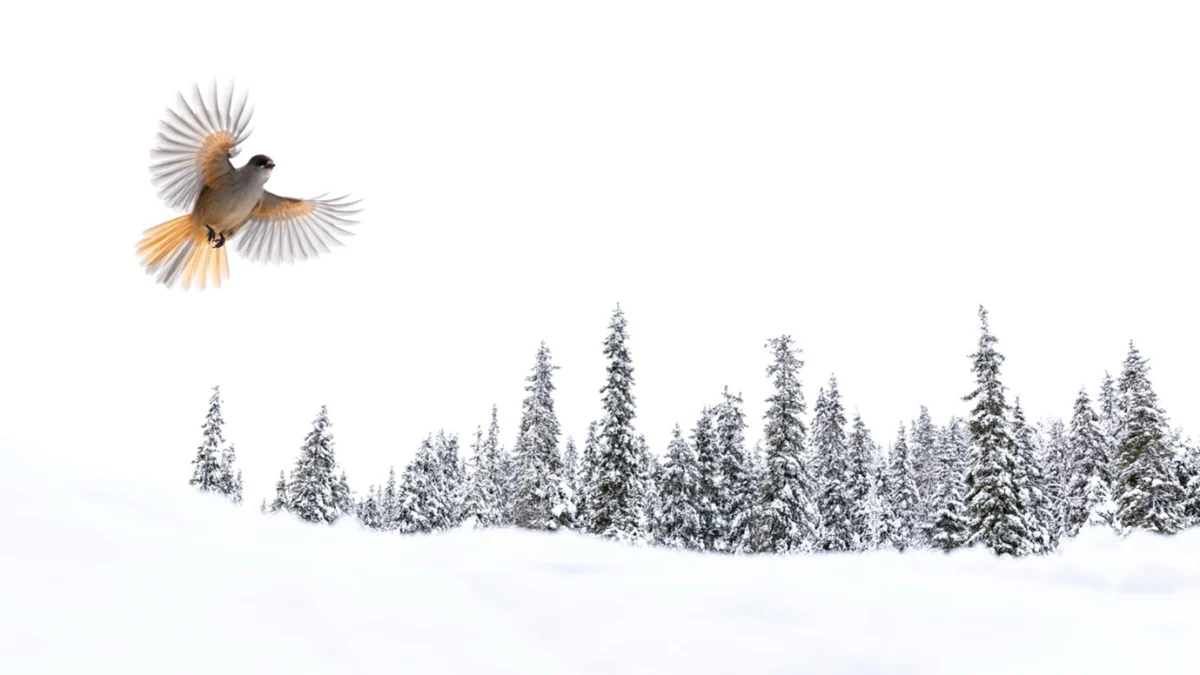
In the stark, captivating landscapes of the Nordic countries, photographer Stefan Gerrits has cultivated a distinctive artistic vision, transforming geographical North into a profound sensory experience. His work, characterized by high-key photography and a minimalist aesthetic, seeks to distill the essence of these regions into images that evoke calmness, silence, and a profound sense of space. Gerrits’s approach transcends mere documentation, aiming instead for an imaginative, two-dimensional, and graphic interpretation that reflects his deep connection to the tranquil yet powerful environment. This article delves into Gerrits’s methodologies, exploring how he leverages technical choices and compositional strategies to achieve a photographic style that is both simple and emotionally resonant.

The Nordic Muse: More Than Just Geography
For many, the Nordic region conjures images of snow-laden forests, vast icy expanses, and the ethereal dance of the aurora borealis. Gerrits, however, perceives the North as more than just a geographic location; it is a "way of seeing, feeling, and experiencing." This perspective is crucial to understanding his photographic philosophy. The region’s inherent characteristics—its often muted light, prolonged periods of darkness, extreme cold, and expansive, seemingly empty vistas—paradoxically offer a rich canvas for minimalist expression. In a world increasingly saturated with visual information, Gerrits finds solace and inspiration in the North’s "calmness, light, or no light, and silence," an "emptiness that brings peace." This environment naturally lends itself to a photographic style where "less truly becomes more," allowing the photographer to strip away non-essentials and focus on the profound simplicity that defines these landscapes. His imagery often presents a sense of timelessness, a quality he endeavors to reflect through flat, graphic compositions that emphasize quietude.

High-Key and Minimalism: A Philosophy of Vision
Gerrits champions high-key photography not merely as a technical setting but as a fundamental choice to evoke emotion and simplify reality. High-key images, typically characterized by an abundance of bright tones and minimal shadows, naturally convey a sense of lightness, airiness, and purity. When applied to nature photography, particularly in snow-covered or misty environments, this technique can elevate the subject, isolating it against a luminous backdrop. The interplay between high-key lighting and minimalism forms the bedrock of Gerrits’s style. Minimalism in photography, as he defines it, is not about arbitrary reduction but about "revealing more by removing what are, in my opinion, distractions." It’s a deliberate act of creating "space for the subject to breathe, and space for the viewer to pause and feel." This aligns with broader art historical movements, where minimalism, originating in the mid-20th century, sought to expose the essence of a medium by eliminating elaborate ornamentation, forcing a direct engagement between the viewer and the artwork. In photography, this translates to a conscious effort to reduce the frame to only what is essential, drawing immediate and unwavering focus to the subject.

Mastering Simplicity: A Step-by-Step Approach
Gerrits outlines a progressive path to achieving photographic simplicity, encapsulated in the mantra "Simple, simpler, simplest." This three-step evolution underscores that minimalism is a skill honed through practice and confidence. The more a photographer practices, the more assured they become in "daring to leave things out, trusting that what remains is enough and powerful." This process, far from yielding boring results, often imbues an image with greater strength, emotional depth, and memorability.

The initial step involves aiming for a "clean frame," building a composition around a singular visual focal point. This might involve careful consideration of the Rule of Thirds or other compositional guidelines, but with an emphasis on clarity over complexity. Subsequently, the photographer is encouraged to pause and critically assess: "Is there anything else I can leave out from the frame?" This introspection can lead to crucial adjustments in the field—a slight change in position, a subtle tilt of the camera, or even adopting a lower perspective to exclude a distracting background or foreground. Framing a subject against a neutral backdrop, such as pristine snow or an expansive sky, is a common and effective technique. The evolution of photographic technology, particularly advanced cropping tools and selective editing capabilities in post-processing software, has further empowered photographers to refine their compositions. If on-site adjustments are not feasible, modern digital darkroom techniques allow for the simplification of tones, the selective erasure of distracting elements, or precise cropping to reinforce the minimalist intent. Gerrits emphasizes that the goal is not reduction for its own sake, but rather the removal of anything that does not serve or strengthen the image’s core message.

Beyond Color: The Power of Monochrome and Black & White
The decision to convert an image to monochrome or black and white is another cornerstone of Gerrits’s artistic practice, though he stresses it must be a "creative choice," not a fallback. Not every subject benefits from the removal of color; a vibrant butterfly, for instance, might lose much of its inherent character. However, for subjects like a mountain hare in its winter coat, where visible color is minimal save for subtle pinkish ears or yellow paw pads, a monochrome approach can profoundly amplify mood, silence, harmony, and focus.

Removing color forces the viewer to concentrate on form, texture, light, and shadow, often revealing a deeper emotional landscape within the image. This technique is particularly potent in nature photography where the subtle nuances of light and shadow on snow, the intricate patterns of tree bark, or the texture of a bird’s feathers can become more pronounced and evocative without the distraction of a color palette. Gerrits frequently utilizes specialized tools like Silver Efex Pro, a well-regarded software, to achieve "precise control over contrast, structure, and black-and-white tonality." Such tools are vital for manipulating the monochromatic spectrum to extract maximum impact, ensuring that the absence of color enhances, rather than diminishes, the photograph’s power. This deliberate choice underscores the idea that black and white photography, when applied thoughtfully, can transcend reality to create a more abstract and contemplative visual experience.

Architectural Elements in Nature: Geometric Shapes and Lines
Minimalist design and photography often draw power from basic geometric forms: angles, triangles, circles, and lines. These elements provide clarity, structure, and balance, offering strong visual anchors within the frame. Gerrits integrates this principle by consciously framing images with, or around, distinct shapes, or even mere parts of them—a suggestive curve, a half-circle, or a quarter-circle.

In nature, these geometric forms are abundant yet often overlooked. A tree branch might form a strong diagonal line, a distant mountain peak might suggest a triangle, or a bird’s flight path could trace an elegant arc. By identifying and emphasizing these inherent geometries, photographers can guide the viewer’s eye through the composition, creating a sense of order and intentionality. Furthermore, these shapes and lines contribute to a sense of scale, providing context for the subject without introducing clutter. A lone bird perched on a slender reed, for example, transforms the reed into a powerful vertical line, isolating the bird and emphasizing its delicate balance. This conscious utilization of natural geometry reinforces the minimalist ideal by creating a robust visual framework that supports the subject’s prominence.

Rhythm and Order: The Art of Repetition and Symmetry
Repetition and symmetry are powerful tools in minimalist photography, capable of generating rhythm, order, and a playful sense of engagement without adding complexity. Whether perfect symmetry or a more subtle mirroring, recurring patterns can be visually compelling, sometimes even hypnotic. Gerrits exemplifies this with images like the common guillemots, where a series of similar subjects, lines, or shapes creates a harmonious, almost meditative visual experience.

In nature, repetition manifests in various forms: a flock of birds flying in formation, a row of trees, the ripples on water, or the scales of a fish. Symmetrical compositions, often found in reflections or balanced natural structures, inherently convey a sense of stability and aesthetic pleasure. By deliberately incorporating these elements, photographers can establish a visual cadence that draws the viewer deeper into the image. This technique is particularly effective in minimalistic compositions where the repetition of a simple form against an expansive, undifferentiated background amplifies its impact. It allows for a narrative to unfold through consistent visual cues, fostering a sense of cohesion and often highlighting the inherent beauty of patterns found in the natural world.

The Canvas of Emptiness: Negative Space and Isolation
Perhaps the most iconic aspect of minimalist photography is the judicious use of negative space, isolation, and visual balance, which Gerrits refers to as "breathing space" around a subject. By consciously including more negative space—the empty or relatively featureless area surrounding the main subject—photographers not only enhance the aesthetic appeal but also amplify the sense of isolation, lending the image an artistic and contemplative quality.

This technique is not merely about leaving empty areas but about making those areas active participants in the composition. The vastness of snow, an open sky, or calm water can become a "canvas of emptiness" that highlights the subject’s presence. Gerrits argues that isolation, in this context, strengthens the connection with the subject alone, guiding "both the eye and the mind towards what is often a single focal point." Because minimalist images contain so few elements, the chosen subject must carry significant emotional weight and create a "wow effect." This is often achieved by selecting subjects that inherently express fragility, vulnerability, rarity, mystery, solitude, or danger. Examples include elusive or endangered species like the great gray owl, whose presence against a pristine snowy backdrop immediately evokes an emotional response due to its rarity and sought-after status.

Crucially, negative space doesn’t necessitate a monolithic expanse of white or black. It can still contain visually attractive elements that capture attention without competing with the main subject. In Gerrits’s image of a white-throated dipper, the bird is intentionally small within the frame, surrounded by a calm, visually interesting, yet uniform environment. The simplicity of the setting supports the subject, allowing it to dominate without overwhelming the viewer. This nuanced approach ensures that the negative space complements the subject, rather than merely acting as an inert backdrop.

Implications and Broader Context
The minimalist approach to nature photography, as championed by Stefan Gerrits, carries significant implications beyond aesthetic preference. In an age of digital abundance and visual noise, it offers a refreshing counter-narrative, inviting viewers to "slow down, to really look." This deliberate act of selectivity and intentionality challenges both the photographer and the audience to consider "what’s not in the frame says just as much as what is: about the subject, the moment, the feeling, and about the one behind the camera."

From a conservation perspective, highlighting individual species or delicate natural patterns through minimalism can foster a deeper appreciation for nature’s subtle beauty, potentially inspiring greater environmental stewardship. By isolating a subject, its uniqueness and vulnerability become more apparent, creating a powerful emotional connection that might be lost in a busy, detail-rich scene. Artistically, this style contributes to the ongoing dialogue about representation in nature photography, pushing boundaries beyond purely documentary work towards a more interpretive and evocative form. The emphasis on feeling and subjective experience aligns with contemporary art trends that prioritize emotional impact and personal vision.

Stefan Gerrits, born in Sambeek, Netherlands, and now residing in Kirkkonummi, Finland, embodies this evolution. His decade-long journey in nature and wildlife photography has culminated in a style recognized for its imaginative, minimalistic, and two-dimensional qualities. Leading photo tours across the Nordics and exhibiting his work, such as the "imaginature" solo exhibition in Helsinki, Gerrits has become a significant voice advocating for an approach that respects nature by presenting both subject and surroundings in their "simplest, most honest form—function over form." This philosophy is not just about capturing an image; it is about conveying an experience, a vision, and a profound respect for the natural world. His work serves as a testament to the enduring power of simplicity, inviting us all to seek the extraordinary in the seemingly ordinary, and to find peace in the quiet spaces of our visual world.
