
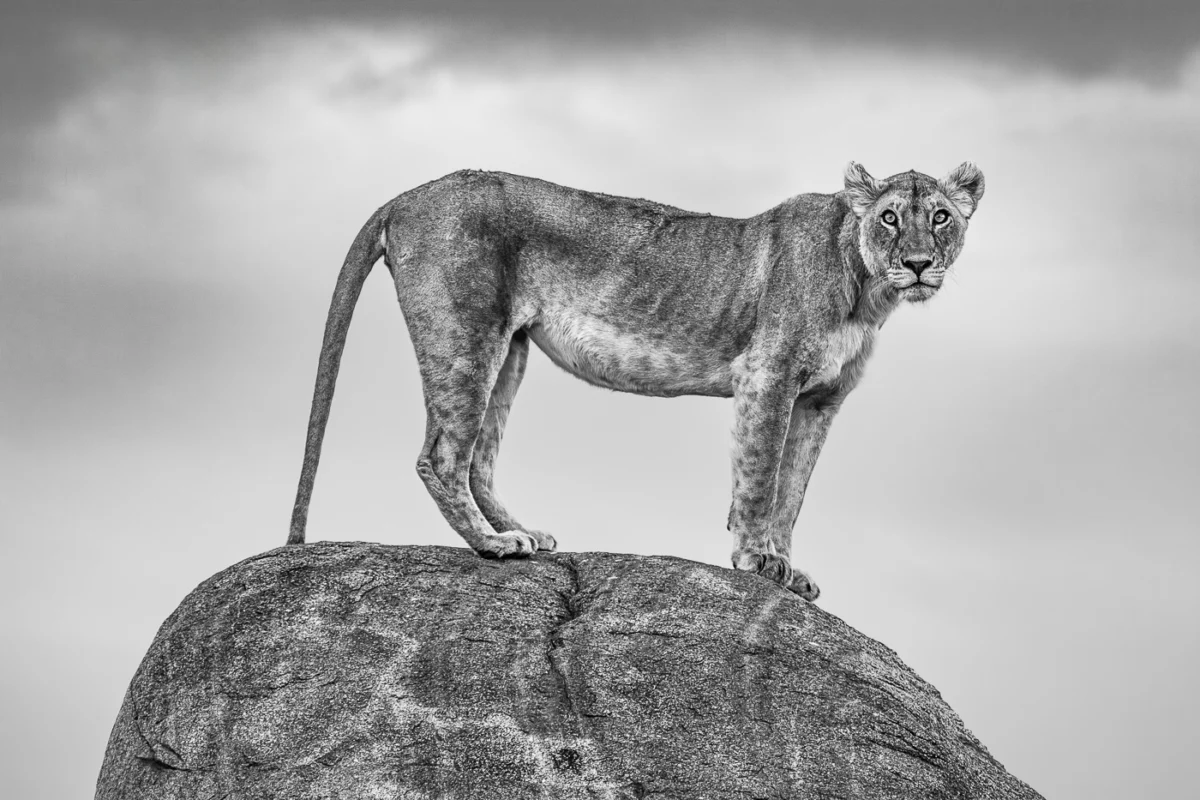
Gabi Guiard, a distinguished figure in contemporary wildlife photography, has carved a unique niche by eschewing the vibrant hues often associated with nature imagery in favor of the profound depth and timeless quality of black and white. Her work transcends mere documentation, transforming observations of the natural world into evocative narratives that speak to the core of existence. Guiard’s artistic journey, deeply rooted in a lifelong affinity for wildlife, represents a compelling evolution from the structured world of graphic design and advertising to the untamed landscapes she now masterfully captures. Her photographic philosophy is not simply a stylistic choice but a deliberate methodology aimed at stripping away superficiality to reveal the raw essence, intrinsic emotion, and enduring spirit of her wild subjects. This commitment to monochrome allows her to harness light, shadow, texture, and form as primary tools, creating images that resonate with a powerful, almost meditative silence, inviting viewers into an intimate dialogue with the wild.

From Advertising Art Director to Wildlife Visionary: A Career Evolution
Guiard’s profound connection with wildlife began in her formative years, a natural attraction that quickly blossomed into an insatiable curiosity about animal behavior and an abiding fascination with their presence. This early passion shaped her perception of the world, fostering a deep reverence for nature. Despite this innate calling, her initial professional path diverged significantly, leading her into the dynamic and visually driven realm of graphic design and art direction within the advertising industry. For years, she honed her creative skills, developing a keen eye for composition, visual storytelling, and impactful imagery. It was within this commercial landscape that her interest in photography began to solidify. Drawing inspiration from the iconic black and white fashion and advertising photographers whose work she admired, Guiard recognized the unparalleled power of monochrome to convey sophistication, drama, and a timeless aesthetic. This period served as an unexpected crucible, refining her visual literacy and preparing her for a eventual synthesis of her two enduring passions: the wild and the lens. The transition was not abrupt but a gradual unfolding, a realization that the technical and artistic principles she mastered in advertising could be profoundly applied to communicate the majesty and vulnerability of wildlife, free from the commercial constraints of her previous profession. This evolution underscores a broader trend in photography where artists often leverage diverse professional backgrounds to forge distinctive styles, bringing fresh perspectives to established genres.

The Language of Luminance: Why Black and White?
For Guiard, black and white is far more than an aesthetic preference; it is a fundamental artistic language, a deliberate choice to amplify her expressive capabilities. In an era dominated by high-definition color photography, where every spectrum of light is meticulously reproduced, Guiard’s commitment to monochrome stands as a powerful counter-narrative. She posits that color, while beautiful, can often serve as a distraction, drawing the viewer’s eye to superficial details rather than the core message. By eliminating color, she intentionally removes a layer of reality, compelling the observer to engage with the image on a deeper, more elemental level. This approach forces a focus on the interplay of light and shadow, the intricate textures of fur or rock, the elegant lines of a creature’s form, and the stark contrasts that define space and depth. Her work echoes the sentiment of many photographic purists who believe that black and white photography, in its inherent abstraction, can often reveal more truth than a literal depiction. It’s a method of speaking directly to the soul of the subject and the viewer, unburdened by the specificities of hue. This philosophical stance aligns with historical photographic traditions, where pioneers like Ansel Adams demonstrated the profound emotional and narrative power of monochrome landscapes, proving that the absence of color can heighten dramatic impact and foster a more enduring connection with the subject.

Stripping Away Distraction: The Power of Essentialism
A cornerstone of Guiard’s methodology is the principle of essentialism, manifested through her unwavering belief that "less is more." This philosophy guides her photographic process from conception to execution. She consciously seeks to simplify reality, to distil complex scenes into their most potent components, ensuring that the inherent wild character of nature and its inhabitants takes undisputed center stage. This means meticulously eliminating any visual "noise" or superfluous elements that might dilute the narrative impact. In her compositions, a singular gaze, the elegant arc of a silhouette, or a poignant gesture is often deemed sufficient to tell an entire story. This minimalist approach serves to intensify the viewer’s connection with the moment, creating an immersive experience akin to hearing the profound silence of a frozen instant. The absence of clutter directs the eye with precision, ensuring that the emotional weight of the subject is felt directly, without interruption. This deliberate reduction of visual information empowers the viewer to engage actively, rather than passively observing. The "apparent emptiness" or negative space within her frames becomes a canvas for individual interpretation, allowing each person to imbue the photograph with their own emotions, memories, and understanding, thereby forging a unique and personal dialogue with the artwork. This emphasis on brevity and impact is a hallmark of compelling visual communication, regardless of the medium, ensuring that the message is clear, direct, and emotionally resonant.

Architecting the Gaze: Composition as the Unseen Framework
In Guiard’s black and white realm, composition assumes an even more paramount role, serving as the invisible backbone that dictates the visual flow and narrative structure of each photograph. Without the guiding cues of color, the arrangement of elements within the frame becomes critical for directing the viewer’s eye and conveying the intended story. Lines, shapes, patterns, and spaces are elevated to primary instruments of expression, taking on a new weight and significance. Guiard meticulously considers the placement of an animal within its natural environment, the delicate balance between areas of intense light and deep shadow, and the deliberate inclusion of empty space to create a sense of vastness or intimacy. These elements work in concert to establish both harmony and a subtle tension, drawing the viewer into the scene with controlled intent. Her pursuit of simplicity extends to her compositional choices; she actively avoids unnecessary elements that could weaken the photographic message. For instance, a strong diagonal line might be employed to lead the eye directly to the intense gaze of a lion, or the graceful curve of a tree branch might frame a solitary silhouette, enhancing its presence. Similarly, the strategic use of negative space around a subject can amplify its power and emotional resonance. Guiard emphasizes that effective composition is not merely about adhering to rigid rules but about understanding when and how to artfully transgress them to elicit a more profound emotional response. It is the unseen architecture that grants her images both their breath and their undeniable power, ensuring that every visual component contributes meaningfully to the overall narrative.

The Dance of Light and Shadow: Contrast as Narrative Force
For Gabi Guiard, light and shadow are not merely photographic phenomena but vital artistic implements, akin to a painter’s brushes, with which she crafts each image. In her black and white work, contrast is not solely an aesthetic choice; it is a profound narrative tool, a method of giving voice to her artistic intent. The deep blacks within her photographs serve a dual purpose: they artfully conceal what she deems unnecessary to show, guiding the viewer’s attention away from distractions, while simultaneously enhancing the prominence of the illuminated elements. Conversely, the brilliant whites and varying shades of gray reveal precisely what she desires the viewer to perceive and feel, drawing focus to key details and emotional expressions. This intricate interplay between luminosity and obscurity allows Guiard to sculpt her subjects, imbuing them with three-dimensionality and dramatic impact. In the absence of color, shadows cease to be mere absences of light; they become active participants in the storytelling, carrying as much weight and conveying as much information as the subjects themselves. They can evoke mystery, vulnerability, power, or solitude, shaping the mood and atmosphere of the photograph with unparalleled intensity. This masterful manipulation of tonal range is a hallmark of exceptional black and white photography, enabling Guiard to create images that possess a striking visual depth and an enduring emotional resonance, effectively transforming light and shadow into eloquent storytellers of the wild.

Beyond the Image: The Emotional Resonance of Wildlife
While Guiard’s photographs are inherently rooted in the meticulous observation of wildlife, her ultimate aspiration extends far beyond simple depiction; she seeks to evoke a profound emotional response. Her goal is for each image to transcend the mere presentation of an animal or a landscape, striving instead to communicate something intrinsically deeper: a sense of raw power, profound solitude, majestic grandeur, or even poignant fragility. For Guiard, animals like lions are not simply biological specimens; they embody the archetypal "kings and queens" of a territory, existing within an ecosystem that pulsates with its own ancient rhythms. She endeavors to capture a fragment of their ongoing narrative within each frame – a calm, unwavering gaze that subtly hints at immense inner strength, or a serene, dignified gesture that speaks volumes about their inherent nobility. The inherent nature of black and white photography intensifies this narrative imperative. By removing the potentially distracting influence of color, it compels the viewer to concentrate on the fundamental elements that convey emotion: the animal’s posture, its expression, the texture of its fur, and the evocative interplay of light and shadow on its form. This focused engagement allows for a more direct and unmediated connection with the subject’s emotional state, fostering empathy and understanding. Her approach highlights the powerful role photography can play in conservation, not just by documenting species, but by revealing their inherent worth and emotional depth, thereby inspiring a greater sense of stewardship and appreciation for the natural world.

Timeless Narratives: Black and White’s Enduring Legacy
One of the most compelling reasons behind Guiard’s unwavering dedication to black and white photography is its inherent ability to imbue images with a sense of timelessness. There is a unique magic in monochrome that allows a photograph captured in the present day to possess an aesthetic and emotional resonance that could equally have belonged to decades past, and promises to maintain its impact decades into the future. This enduring quality allows Guiard to present nature not as a fleeting moment but as something eternal, a profound mirror reflecting both our contemporary existence and the ancestral past. In a world saturated with ephemeral digital content, her black and white images stand as monuments to lasting beauty and universal themes. Furthermore, by consciously removing color, Guiard creates an expansive space for personal interpretation and emotional projection. This deliberate aesthetic choice invites each viewer to superimpose their own memories, experiences, and feelings onto the image, transforming the act of viewing into a deeply intimate and personal dialogue between the photograph and its observer. This interactive engagement elevates the artwork beyond a static representation, making it a dynamic catalyst for individual reflection and emotional connection. The timeless appeal of black and white photography, a characteristic celebrated since the medium’s inception, continues to offer a powerful antidote to the transient nature of modern visual culture, ensuring Guiard’s work will continue to captivate and inspire across generations.

Sensitivity Meets Technique: The Synthesis of Artistry
Behind every one of Gabi Guiard’s impactful photographs lies a meticulous blend of technical mastery and profound artistic sensitivity. While she readily acknowledges the critical role of technique – the relentless pursuit of optimal light, the precise execution of composition, and the unwavering attention to detail – she firmly asserts that it is the underlying sensitivity of observation that truly imbues her work with meaning and resonance. For Guiard, photography is not merely about mechanical capture but about an intuitive understanding of the moment. It is the crucial ability to discern what elements to highlight and what to judiciously relegate to the shadows, when to seize the opportune instant by pressing the shutter, and, equally important, when to simply remain silent and observe, allowing the scene to unfold without intervention. This nuanced approach underscores a fundamental truth in art: technique, however flawless, remains inert without the animating force of emotional intelligence. When these two facets—technical proficiency and profound sensitivity—converge, a truly transformative photograph is born. Such an image possesses the power to move, to inspire, and to provoke deep reflection within the viewer. It speaks not only to the eye but directly to the heart, creating a lasting impression that transcends mere visual information. Guiard’s practice exemplifies this delicate balance, demonstrating that the most impactful art emerges from an artist’s ability to see beyond the surface and connect with the deeper spirit of their subject.

A Distinctive Voice in Wildlife Photography: Broader Implications
Gabi Guiard’s distinct approach to black and white wildlife photography represents a significant contribution to the genre, offering a powerful counterpoint to the often-colorful and literal depictions prevalent today. Her work stands as a testament to the enduring power of artistic vision and deliberate choice in a technologically advanced photographic landscape. By prioritizing emotion, essentialism, and timelessness, Guiard challenges viewers to reconsider their engagement with nature imagery, pushing beyond superficial aesthetics to a deeper appreciation of the wild’s intrinsic character. The implications of her methodology extend beyond the artistic realm; her ability to strip away distractions and focus on the raw essence of wildlife also serves an unspoken conservation message. In an increasingly noisy and complex world, her simplified, impactful images can cut through the clutter, drawing attention to the majesty and vulnerability of species in a way that resonates profoundly. This evokes not just admiration but also a sense of responsibility for their preservation. Guiard’s philosophy—rooted in black and white as a vital choice, a plea for silence to truly listen to nature—positions her as a compelling voice within the broader conservation narrative. Her photographs are not just beautiful compositions; they are powerful invitations to pause, reflect, and connect with the silent, enduring wisdom of the natural world, ultimately inspiring a more conscious and sensitive interaction with our planet. Her work confirms that in art, as in life, sometimes the most profound statements are made through deliberate restraint and a commitment to the fundamental truths.
