
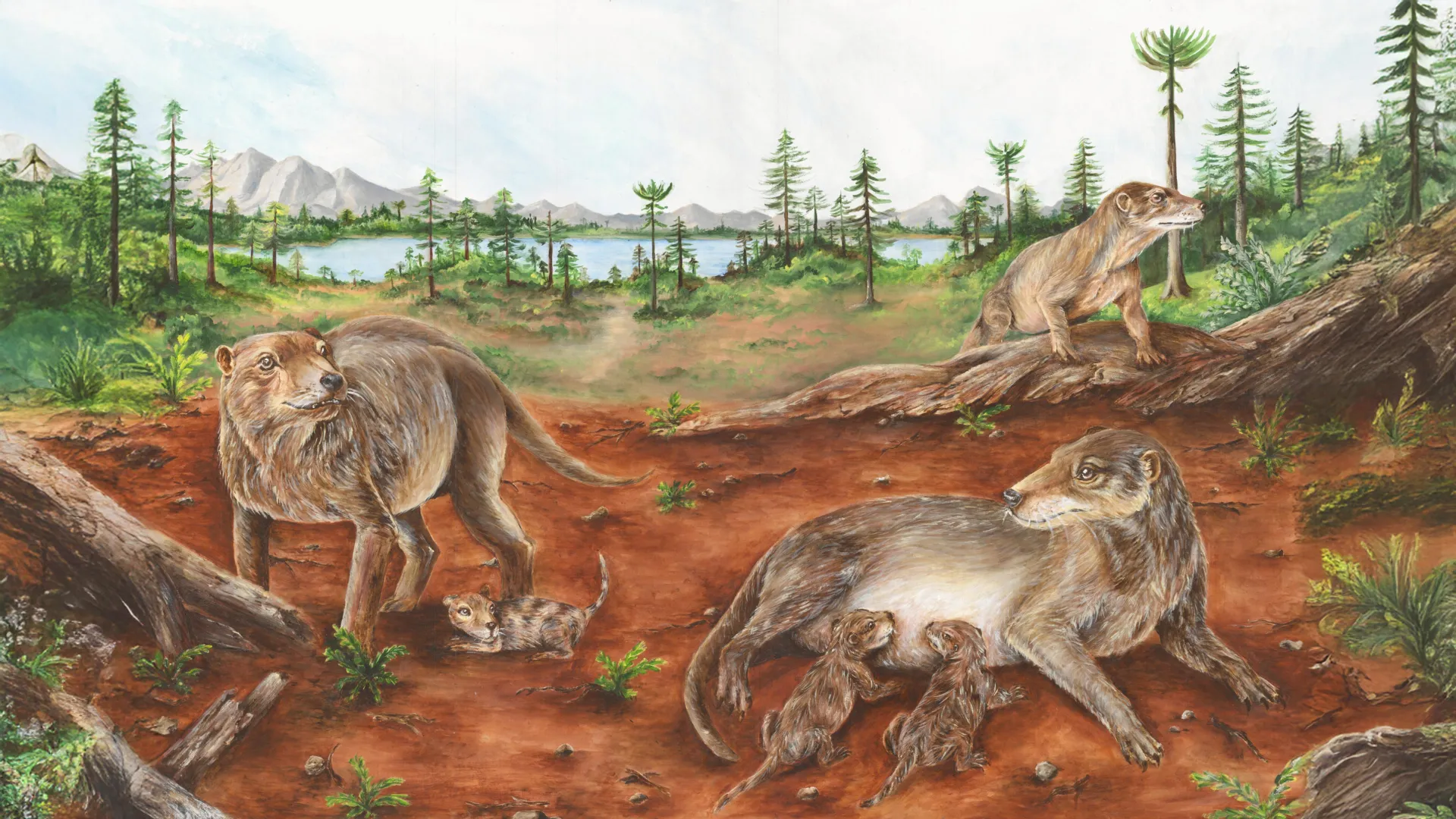
The timeline of mammalian reproductive evolution has undergone a radical reassessment following a groundbreaking paleontological discovery in northwestern Argentina. According to a landmark study published in the journal Frontiers in Mammal Science, researchers have uncovered compelling, first-of-its-kind evidence indicating that certain cynodonts—the advanced mammal-like reptiles that served as precursors to true mammals—may have practiced viviparity, giving birth to live young rather than laying eggs.
This revelation centers on Chiniquodon theotonicus, a carnivorous cynodont that roamed South America approximately 236 million years ago during the Triassic period. Lead author Dr. Leandro Gaetano, a paleontologist affiliated with Argentina’s National Scientific and Technical Research Council (CONICET), noted that this finding pushes the suspected origin of live birth within the mammalian lineage back by an estimated 95 to 90 million years.
For decades, evolutionary biologists assumed that the transition from oviparity (egg-laying) to viviparity (live birth) occurred much later in the evolutionary sequence, closely tied to the emergence of true mammals during the Jurassic or Cretaceous periods. However, the microscopic analysis of fossilized bone structures in C. theotonicus challenges this long-standing paradigm, suggesting that sophisticated reproductive strategies evolved far earlier than previously documented.
Unlocking the Microscopic Archive of the Triassic
The investigation began unexpectedly during a postgraduate paleohistology course. Researchers examining thin sections of a fully grown C. theotonicus fossil under a microscope noticed an unusual, distinct growth mark deeply embedded within the bone’s internal architecture.
In modern vertebrate biology, such features are routinely identified as neonatal lines. These microscopic growth rings form in bones or teeth as a direct physiological response to the abrupt, intense metabolic and structural acceleration that occurs immediately after birth. When an animal transitions from the protected, resource-regulated environment of an egg or a uterus into the outside world, its growth trajectory shifts dramatically, leaving a permanent chemical and structural signature in its skeletal tissues.
To verify whether this structural anomaly genuinely represented a neonatal line rather than a pathological defect or a seasonal hibernation mark, the research team developed a novel analytical framework. They calculated the estimated body mass of the individual at the time of birth—inferred from the position and characteristics of the neonatal line—and contrasted it with the estimated body mass of the adult animal at the time of its death.
Armed with these metrics, the team compiled a massive comparative dataset. They cross-referenced their findings against standardized body mass data drawn from thousands of extant (living) vertebrate species, encompassing placental mammals, marsupials, non-avian reptiles, and birds.
"Whether mammalian ancestors were egg-laying or viviparous has been considered an inscrutable mystery," Dr. Gaetano explained regarding the methodological challenge. "We came up with a somewhat ingenious set of methods to get at something very difficult to analyze in the fossil record."
A Newborn of Exceptional Proportions
The quantitative results of the study provided a striking contrast between the prehistoric cynodont and modern egg-laying species. By utilizing detailed geometric measurements of the fossilized long bones, the researchers calculated that the specific C. theotonicus specimen weighed approximately 1.7 kilograms at birth and reached an adult weight of roughly 12 kilograms before its death.
This translates to a neonate-to-adult body mass ratio of approximately 14 percent. In other words, a newborn C. theotonicus accounted for nearly one-seventh of its eventual mature body weight.
To evaluate the significance of this ratio, the researchers compared it against contemporary classes of animals. Modern reptiles—such as snakes, turtles, and crocodilians—exhibit entirely different reproductive metrics. For instance, reptile species with adult body masses ranging between 8 kilograms and 14.5 kilograms typically produce hatchlings weighing between 9 grams and 53 grams. This results in an exceptionally low neonate-adult body mass ratio of roughly 0.1 percent to 0.6 percent.
Avian species demonstrate similarly modest relative newborn sizes. Large birds such as cranes, pelicans, and vultures that maintain adult weights between 8 kilograms and 21.5 kilograms yield hatchlings ranging from 110 grams to 357 grams, translating to body mass ratios between 1.3 percent and 4.5 percent.
In stark contrast, modern placental mammals of comparable adult sizes (8 kilograms to 15 kilograms) regularly produce significantly heavier neonates. Their newborns can range from 35.5 grams to 1.87 kilograms, pushing neonate-adult mass ratios as high as 18.77 percent.
As a prime comparative example, the bay duiker antelope gives birth to single offspring whose birth weights align closely with the calculated neonatal mass of C. theotonicus. When the research team filtered out non-placental mammals—such as monotremes (which lay eggs) and marsupials (which give birth to underdeveloped, highly altricial young that mature in a pouch)—the fossil cynodont clustered directly alongside modern placental mammals, completely separating itself from the statistical profiles of modern reptiles and birds.
Evolutionary Pressures of the Triassic World
The emergence of such an advanced reproductive strategy during the Triassic period aligns with the severe ecological pressures that characterized the era. The Triassic began in the immediate aftermath of the Permian-Triassic extinction event—often referred to as the "Great Dying"—which wiped out over 90 percent of marine species and approximately 70 percent of terrestrial vertebrate species.
Senior author Adriana Mancuso, a CONICET researcher specializing in terrestrial ecosystem evolution, emphasized the role of environmental volatility in shaping these traits. "Cynodonts thrived in the Triassic, a period of recovery and restructuring of ecosystems after one of the most devastating mass extinctions in life history," Mancuso noted.
This post-extinction recovery phase was defined by intense competition for dwindling resources, aggressive predatory pressures, and a broader global trend toward arid climates marked by strong seasonal fluctuations. In such a volatile landscape, investing heavily in internal gestation offered distinct evolutionary advantages.
Unlike eggs left unprotected in nests, which remain vulnerable to environmental desiccation, rapid temperature swings, and opportunistic predators, embryos developing within a maternal body are shielded from external climatic extremes. The metabolic stability provided by viviparity likely served as a critical survival mechanism for proto-mammals navigating the harsh landscapes of the early-to-mid Mesozoic era.
Re-evaluating the Cynodont Lineage
Co-author María Miceli Baró, a graduate student at the University of Buenos Aires, highlighted the rarity of the find. "In cynodonts, embryonic tissues were never observed before, let alone a neonatal line," Miceli Baró stated. "Through its analysis, we found that a trait that is generally linked to evolutionary success was present in animals long before true mammals originated."
For generations of paleontologists, soft tissues and embryonic records have been virtually nonexistent in the deep fossil record of pre-mammalian synapsids. Because soft tissues decay rapidly and gestational structures rarely fossilize, researchers were forced to rely on indirect inferences, generally assuming that advanced reproductive modes emerged concurrently with lactation and complex mammary glands in true mammals.
The identification of a neonatal line in Chiniquodon theotonicus disrupts this linear narrative. It suggests that physiological and reproductive innovations did not arrive all at once in a neat package with the first true mammals, but rather accumulated incrementally across millions of years within the broader synapsid lineage.
Broader Implications and Future Research Directions
While Chiniquodon theotonicus provides the first robust empirical anchor for early cynodont viviparity, the scientific community remains cautious. Researchers emphasize that additional fossil specimens preserving similar histological markers must be analyzed before live birth can be definitively declared a widespread trait among all advanced cynodonts.
Nevertheless, the implications of the study extend far beyond a single species. If viviparity was already established in lineages dating back 236 million years, it opens the door to the possibility that other physiological traits traditionally associated exclusively with crown-group mammals—such as specialized thermoregulation, high metabolic rates, and complex parental care behaviors—may have roots extending much deeper into the Paleozoic-Mesozoic transition.
"It is very well possible that C. theotonicus does not represent an isolated case of viviparity among cynodonts," Dr. Gaetano concluded. "It could be evidence of the general switch from laying eggs to giving birth to live young early on in the mammalian lineage. But we need more evidence to test this hypothesis. Still, it looks like some cynodonts were in fact very similar to present-day mammals."
As paleontologists continue to apply advanced histological and bone-mapping techniques to existing museum collections and newly excavated Triassic fossil beds, our understanding of how ancient mammalian ancestors brought their young into the world continues to evolve, pushing the boundaries of deep-time biology.
