
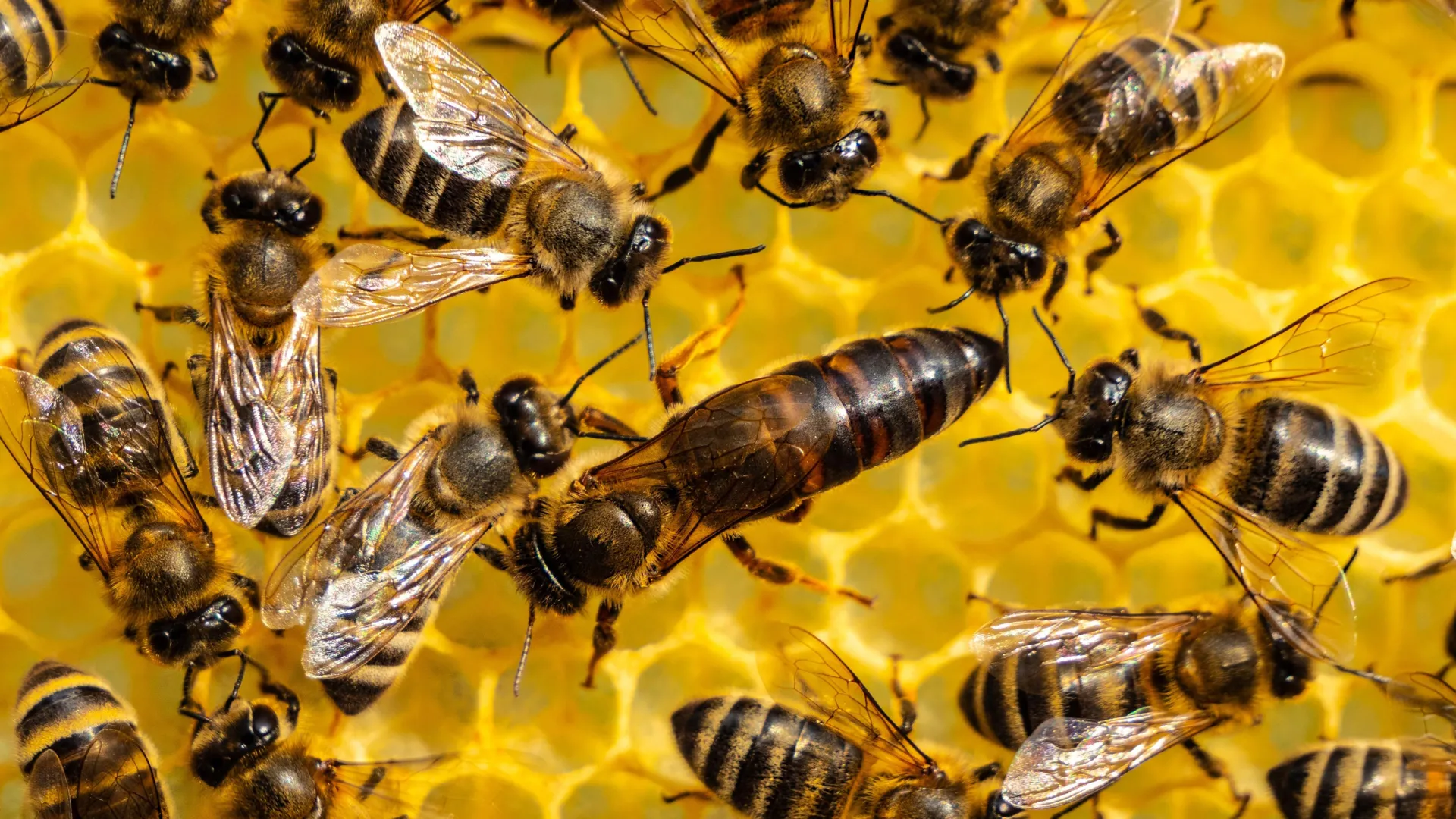
The delicate architecture of a honeybee colony relies on a complex, collaborative system of defense, labor, and biological maintenance. For generations, entomologists and apiarists understood that worker bees served as the primary firewall against environmental hazards, filtering out toxins, heavy metals, and agricultural chemicals before these substances could infiltrate the core of the hive. However, groundbreaking new research published in the journal Current Biology has revealed that the colony’s monarch possesses a secretive and hazardous survival mechanism of her own. When environmental toxins overwhelm the filtration capabilities of her attendants, the queen bee engages in a process known as maternal offloading, systematically transferring accumulated pesticides directly into her developing eggs to preserve her own life.
This discovery marks the first time scientists have documented this specific internal detoxification strategy in honeybees. Led by a team at the University of California, Davis, in close collaboration with the Lawrence Livermore National Laboratory (LLNL) and the United States Department of Agriculture’s Agricultural Research Service (USDA-ARS), the study reshapes our fundamental understanding of how agrochemicals permeate entire bee colonies over time. By tracking the precise pathways of chemical accumulation through the Queen, her ovaries, the wax infrastructure, and the brood, researchers have uncovered a hidden mechanism that may help explain the insidious, delayed collapse of honeybee populations worldwide—a phenomenon that has troubled agricultural scientists and commercial beekeepers for decades.
Unraveling the Limits of Worker Bee Filtration
To fully appreciate the significance of maternal offloading, one must examine the traditional hierarchy of protection within a honeybee hive. Worker bees, which are sterile females, assume virtually all operational duties outside and inside the hive, including foraging, nursing larvae, grooming the queen, and preparing food. Historically, scientists believed that worker bees acted as an effective chemical shield. When foragers return from agricultural fields laden with nectar and pollen tainted by synthetic pesticides, worker bees process, ingest, and metabolize these substances, theoretically preventing toxic loads from reaching the vital centers of the hive, particularly the queen.
Yet, this biological buffer has distinct limits. According to Angela Encerrado-Manriquez, the study’s lead author and a recent Ph.D. graduate from UC Davis, those limits are frequently tested and ultimately breached in modern agricultural landscapes. "In our study, pesticides began to accumulate in queens over time, suggesting that worker filtration capacity can be overwhelmed," Encerrado-Manriquez explained. As agricultural intensity rises and bees encounter persistent chemical cocktails in their foraging zones, the sheer volume of contaminants floods the hive’s defensive systems.
When worker bees can no longer filter out the influx of toxins, the chemical burden shifts inward. The queen, sequestered deep within the hive and fed constantly by her attendants, slowly absorbs these poisons into her tissues. To prevent acute toxicity and imminent death, the queen initiates maternal offloading. By shunting the toxic load into her reproductive cells, she prioritizes her immediate survival at the direct expense of the next generation.
Inside the Laboratory: Simulating Hive Dynamics with Nanocolonies
Studying the internal chemical dynamics of a living, functioning honeybee colony presents immense logistical and technical challenges. To overcome these hurdles, the research team designed an innovative experimental model: miniature systems dubbed "nanocolonies." Each nanocolony consisted of a conical plastic container featuring a netted bottom, carefully engineered to replicate the functional social structure and microclimate of a standard hive. Each unit housed exactly one queen bee alongside a cohort of 60 worker bees.
To track the movement of chemicals with pinpoint accuracy, the researchers introduced controlled diets containing methyl parathion, a widely recognized organophosphate insecticide. Crucially, the pesticide was tagged with a low-level radioactive marker. This radioactive labeling enabled the team to trace the exact trajectory of the chemical molecules as they passed from the food supply through the worker bees, into the hive matrix, and ultimately into the queen’s body and her eggs.
The experiment ran over a sustained monitoring timeline to observe how filtration efficiency evolved over a multi-day period. On the very first day of exposure, worker bees demonstrated a remarkably high efficiency, successfully filtering out approximately 95 percent of the incoming pesticide and diverting it safely away from the queen into the honeycomb matrix. However, as the days progressed and the chemical load mounted, that protective efficiency began to degrade. By the tenth day of continuous exposure, the worker bees’ filtration capacity dropped to 86 percent. This measurable decline provided empirical proof of system saturation, illustrating how chronic, low-level pesticide exposure gradually erodes the colony’s internal defenses.
Cutting-Edge Technology: BioAMS and Low-Level Detection
A major breakthrough of this study lay in its methodological precision, made possible by the advanced technological capabilities of the Lawrence Livermore National Laboratory. Traditional toxicology methods often struggle to detect minute concentrations of chemicals in biological samples without destroying the tissue or lacking the necessary sensitivity. To bypass these limitations, LLNL scientists utilized Accelerator Mass Spectrometry, specifically a biological application known as BioAMS.
Bruce Buchholz, an LLNL scientist and co-author of the study, emphasized the importance of this technology in achieving realistic, ecologically valid results. "With BioAMS, we can trace very low levels of a pesticide," Buchholz noted. "The pesticide concentrations we used were not lethal and were environmentally relevant to that seen in nature."
By employing BioAMS, the researchers could measure radioactive isotope traces down to the atomic level. This sensitivity allowed them to detect minute quantities of methyl parathion within the queen’s ovaries, hemolymph, and newly laid eggs without needing to administer massive, unrealistic doses of the poison. Consequently, the findings reflect real-world exposure scenarios that honeybees routinely encounter when foraging near treated agricultural fields, orchards, and monoculture crop systems.
Broader Agricultural and Ecological Implications
The implications of maternal offloading extend far beyond academic toxicology; they strike at the heart of global agricultural productivity and food security. Honeybees are premier pollinators, responsible for pollinating roughly one-third of the human diet, including vital fruit, nut, and vegetable crops. Commercial agriculture depends heavily on the stability and vitality of managed honeybee colonies, which are routinely transported across the United States to pollinate massive monocultures such as California almonds.
Sascha Nicklisch, senior author of the paper and an associate professor in the UC Davis Department of Environmental Toxicology, highlighted the precarious tipping point that chemical accumulation represents for a hive. "When pesticides accumulate to the extent that the queen bee has eggs that are so loaded they may no longer develop properly, there could be a tipping point," Nicklisch warned. "There may be a slow creeping effect of chemical accumulation that will contribute to delayed colony collapse."
Unlike acute poisoning events—where entire apiaries die off rapidly following a localized pesticide overspray—maternal offloading introduces a subtler, more insidious threat. A queen bee is an extraordinary biological engine, capable of producing between 1,500 and 2,000 eggs every single day to maintain the massive workforce required for the colony’s survival. If a significant percentage of those eggs are heavily contaminated with maternal toxins, embryonic development fails, hatching rates plummet, and the resulting larvae may exhibit developmental defects, reduced lifespans, or impaired neurological function.
Over time, this invisible attrition outpaces the birth rate of the colony. The adult worker population ages and dies off without a robust, healthy generation of replacement workers to take their place. The colony experiences a gradual, confounding decline that standard field inspections may fail to diagnose immediately, ultimately culminating in what apiarists recognize as delayed colony collapse or depiliation.
Future Research Horizons and Collaborative Efforts
While this study provides groundbreaking insights into the internal toll of agrochemicals on honeybee queens, it also opens up an expansive frontier of necessary follow-up research. Scientists currently face several unanswered questions regarding the long-term ecological dynamics of maternal offloading.
Key areas targeted for future investigation include determining the exact duration over which a queen can continuously transfer chemical contaminants into her eggs before her own reproductive organs suffer permanent damage. Researchers also aim to discover whether this offloading behavior varies significantly depending on the chemical class of the pesticide—comparing organophosphates like methyl parathion with systemic insecticides such as neonicotinoids, which have become ubiquitous in modern agriculture. Furthermore, scientists need to evaluate the downstream survival rates and behavioral competencies of the offspring that inherit this chemical burden.
The successful execution of this complex study was made possible through an interdisciplinary partnership. Alongside Nicklisch and Encerrado-Manriquez from UC Davis, the research team included Julia Fine and Eliza Litsey from the USDA-ARS, as well as David Baliu-Rodriguez, Sean Leonard, and Bruce Buchholz from LLNL. Financial and institutional support for the project was provided by the USDA’s National Institute of Food and Agriculture through its Non-Assistance Cooperative Agreement program, the PAm-Costco USA Scholarship program, and the University of California National Laboratory Fees Research Program, with work at LLNL conducted under the auspices of the U.S. Department of Energy.
As regulatory bodies, apiarists, and integrated pest management planners grapple with the realities of modern chemical agriculture, these findings underscore the urgent need for more holistic approaches to crop protection. Protecting the honeybee colony requires looking past the immediate health of the foraging workforce and safeguarding the biological foundation of the hive. As the UC Davis research demonstrates, even the queen—the ultimate guarantor of the hive’s future—is actively fighting a chemical war of attrition from within, trading the health of her own progeny for the fleeting preservation of her reign.
