
The intricate world of avian communication extends far beyond melodic songs and alarm calls, venturing into the rhythmic percussive sounds that echo through forests and suburban woodlands. This fascinating realm, often overlooked by casual observers, is one where a discerning ear can differentiate between species based solely on their unique drumming patterns – a challenge enthusiastically embraced and elucidated by renowned ornithologist, author, and conservationist Kenn Kaufman. As the esteemed field editor for Audubon magazine, Kaufman serves as a national treasure, his life’s work dedicated to the meticulous observation, extensive research, and generous sharing of knowledge about birds. His profound understanding makes him the go-to authority for Audubon staff grappling with perplexing bird questions, and now, through the "Ask Kenn" column, this unparalleled expertise is extended to the broader birding community. Readers are invited to submit their avian queries via Facebook or email, with the prospect of receiving a comprehensive, insightful, and often delightfully humorous response from Kaufman himself, a tradition cherished by the editors for many years.
One such intriguing question recently posed to Kaufman delves into the feasibility of identifying woodpecker species purely through their drumming. While it is true that various arboreal birds, including nuthatches and chickadees, tap on wood to forage for hidden insects or to excavate and enlarge nesting cavities, their activities typically involve slower, more deliberate strikes. The rapid, resonant drumroll, a characteristic sound reverberating through the woods, unequivocally signals the presence of a woodpecker. This percussive communication is distinct from foraging or nesting efforts; it is a deliberate performance, often executed on surfaces chosen for their acoustic amplification, such as a hollow dead branch or even a metal pole. Far from a mere byproduct of feeding, woodpecker drumming serves as a vital form of communication, mirroring the territorial songs of passerines. It is employed to assert dominion over a specific territory, to attract a potential mate, or to maintain contact between members of a breeding pair. Given that multiple woodpecker species frequently inhabit the same forest ecosystems, they have evolved species-specific drumming patterns that enable conspecific recognition – a biological imperative that simultaneously offers a unique opportunity for human observers to learn and distinguish these varied calls of the wild.
The Science Behind the Drum: Communication and Territory
Woodpecker drumming is a fascinating subject of study in ornithology, revealing much about avian social structures and communication strategies. Unlike the vocalizations produced by the syrinx, drumming is a mechanical sound, yet its function is remarkably similar to that of bird song. It is primarily a territorial advertisement, a declaration of ownership over a specific area rich in resources, and a signal to potential rivals to steer clear. Simultaneously, it acts as a powerful beacon for potential mates, conveying information about the drummer’s fitness and presence. In species where both sexes drum, it can also facilitate pair bonding and coordinate activities between partners.
The choice of drumming substrate is critical. Woodpeckers instinctively seek out resonant surfaces that will carry their percussive messages furthest through the forest canopy. This might be a dead limb with a hollow core, a fence post, or even man-made structures like metal downspouts or utility poles, which can produce surprisingly loud and far-reaching sounds. The energy expenditure involved in these rapid-fire drumming sessions is considerable, underscoring the evolutionary importance of this behavior for survival and reproduction. Ornithologists have observed that drumming intensity and frequency often peak during the breeding season, aligning with the heightened need for territorial defense and mate attraction. Studies on species like the Downy Woodpecker have shown that males with more robust drumming displays often secure better territories and attract mates more successfully, highlighting the selective pressures that have shaped these intricate percussive patterns over millennia.
Discerning Distinct Rhythms: A Guide to Woodpecker Identification
The ability to distinguish woodpecker species by their drumming is a skill honed through careful listening and practice. North America, home to a diverse array of woodpeckers, offers an excellent learning ground for this auditory challenge.
Hairy vs. Downy: A Tale of Two Taps
Perhaps the most common and often confusing pair for novice birders are the Hairy Woodpecker (Leuconotopicus villosus) and the Downy Woodpecker (Dryobates pubescens). These two species share striking physical similarities, leading to frequent misidentification based on sight alone. However, their drumming patterns offer a clear distinction. The Hairy Woodpecker, the larger of the two, produces a rapid-fire burst, typically comprising around 26 beats within a single, emphatic second. This intense, almost continuous drumming often sounds like an angry buzz or a prolonged rattle, with individual strikes blending into a sustained sound. In contrast, the Downy Woodpecker, noticeably smaller, delivers a shorter and significantly slower drum. Its pattern typically lasts less than one second, consisting of approximately 12 to 17 distinct beats, resulting in a gentler, more spaced-out sound. With dedicated practice, differentiating between these two ubiquitous forest residents becomes an achievable and rewarding skill, enhancing one’s appreciation for their nuanced communication.
The Powerful Percussion of the Pileated Woodpecker
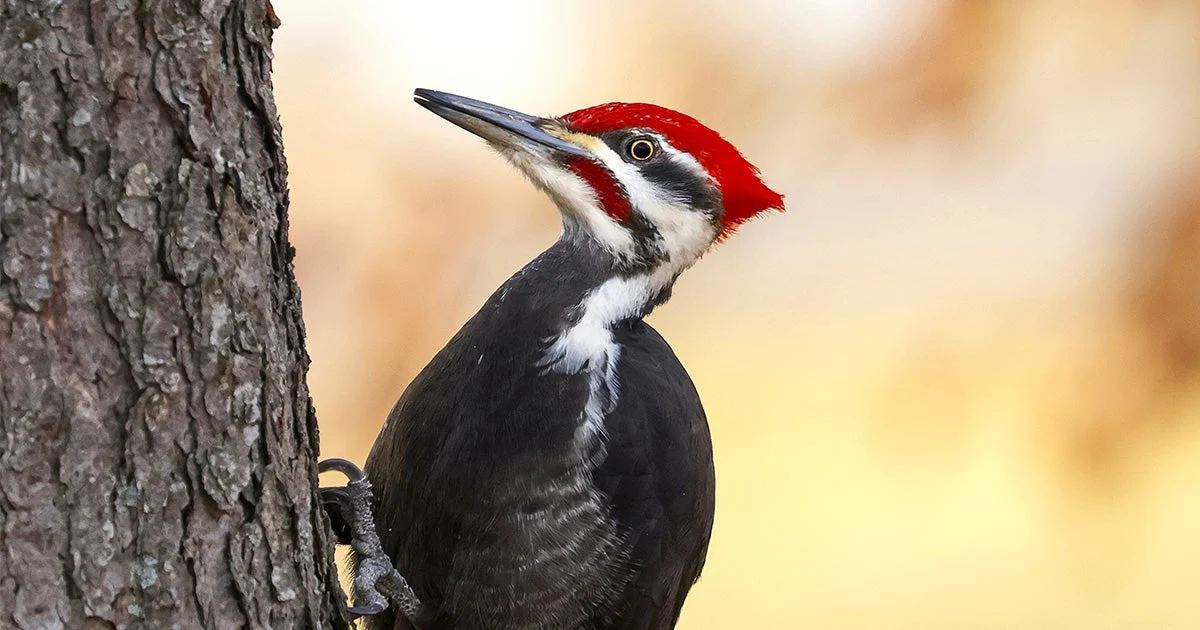
The majestic Pileated Woodpecker (Dryocopus pileatus), the largest woodpecker in North America, commands attention not only with its striking appearance but also with its powerful drumming. Its drumming pattern shares a slower beat count with the Downy Woodpecker, averaging around 15 beats per second, but its sheer volume and extended duration typically exceed one second, making it unmistakably distinct. A hallmark of the Pileated’s drumming is its characteristic cadence: it often starts strong, gradually speeds up, and then subtly softens or fades towards the end, creating a distinctive impression of trailing off. This "decelerando and diminuendo" effect provides a crucial auditory clue for identification.
Northern and Montane Specialists: The Fading Echoes
Similar to the Pileated, the American Three-toed Woodpecker (Picoides dorsalis) and the Black-backed Woodpecker (Picoides arcticus) exhibit a drumming pattern that also fades at the end. These two species, less common and typically found in the colder, higher-altitude forests of northern and montane regions, share this peculiar auditory signature. Their drumming, while perhaps not as boisterous as the Pileated’s, still carries this distinctive trailing-off quality, providing a consistent identifier for those venturing into their specialized habitats. Their presence often indicates old-growth or fire-affected forests, where their foraging for wood-boring beetle larvae is crucial for forest health.
The Staccato Signature of Sapsuckers
Among all woodpecker species, sapsuckers possess arguably the most distinctive drumming patterns. Yellow-bellied Sapsucker (Sphyrapicus varius), Red-naped Sapsucker (Sphyrapicus nuchalis), and Red-breasted Sapsucker (Sphyrapicus ruber) are closely related and share a similar staccato drumming style. Their drumming is characterized by a rapid initial burst followed by a series of irregular single or double knocks. This unique rhythm can be audibly transcribed as TRRRRRR, TR TR TR, T-T, TT, T-T. This erratic, almost jazzy pattern is highly diagnostic. Sapsuckers are also unique in their feeding behavior, drilling neat rows of sap wells in tree bark to consume the sugary sap and any insects trapped within, a behavior that might contribute to their specialized communication. The Williamson’s Sapsucker (Sphyrapicus thyroideus), while a close relative, exhibits a slightly different variation. After the initial drumroll (TRRRRRR), its subsequent knocks are also composed of multiple rapid strikes, but these are more widely spaced as the pattern progresses: TRRRRRR, TRRR TRRR TRRR, TRR, TRR, TR. This slight but discernible difference allows for precise identification even within the sapsucker genus.
The Interplay of Drumming and Vocalizations
Some woodpecker species integrate vocal calls with their drumming, providing an additional layer of complexity and identification cues. This dual communication strategy enhances their ability to convey messages across their territories.
Red-bellied Woodpecker and its Southwestern Kin
The Red-bellied Woodpecker (Melanerpes carolinus) of eastern North America offers a compelling example. Its drumming is relatively slow, akin to the Downy, with approximately 13 to 17 beats packed into less than a second. However, a key identifier is its tendency to intersperse these drumrolls with loud, distinctive calls, often described as a rolling "churr" or a "kwirr." This combination of percussive and vocal communication makes its presence easily recognizable. Its southwestern relatives, the Golden-fronted Woodpecker (Melanerpes aurifrons) and the Gila Woodpecker (Melanerpes uropygialis), exhibit the same fascinating behavior, utilizing both drumming and characteristic calls to mark territory and attract mates in their arid habitats.
The Long Drum and Yammering Song of the Northern Flicker
The Northern Flicker (Colaptes auratus) presents another excellent case study in multimodal communication. Its drumming is moderately fast but often relatively long, frequently lasting almost two seconds and comprising up to 30 beats. This extended drumming serves the same territorial and mate-attracting purposes as the percussive displays of other species. Crucially, between these drumrolls, flickers frequently emit a loud, distinctive "yammering" or "wicka-wicka-wicka" call, which serves as their primary song. This combination of a sustained drum and a unique vocalization makes the Northern Flicker one of the more straightforward woodpecker species to identify by sound alone.
Mastering the Art of Auditory Identification: Resources and Implications
Learning to identify these varied drumming patterns requires patience and dedicated effort, particularly because one often hears these sounds without the benefit of a visual confirmation of the bird. The challenge, however, is immensely rewarding, adding a profound dimension to one’s engagement with the natural world. To facilitate this learning process, numerous resources are available.
For home study and practice, two excellent and highly reliable online sources are indispensable: the Macaulay Library at the Cornell Lab of Ornithology and the independent website Xeno-canto. Both platforms host vast collections of bird sound recordings from around the globe. By searching for a specific woodpecker species, users can access dozens, if not hundreds, of high-quality recordings captured by professional ornithologists and citizen scientists alike. Listening to multiple recordings of the same species under varying conditions can help internalize the nuances of their drumming patterns, preparing the listener for real-world encounters. Many modern birding apps also integrate sound libraries, allowing for on-the-go reference and comparison in the field.
The ability to identify woodpeckers by sound alone has significant implications beyond personal enjoyment. It contributes to a deeper understanding of avian ecology and aids in conservation efforts. By monitoring changes in drumming patterns or the presence/absence of certain species through soundscapes, citizen scientists can provide valuable data to ornithological studies. This information helps researchers track population trends, understand habitat use, and assess the impact of environmental changes on these crucial forest inhabitants. Woodpeckers play vital ecological roles, from excavating cavities that are then used by dozens of other bird and mammal species (making them "keystone" or "ecosystem engineers") to controlling insect populations, particularly wood-boring pests. Therefore, understanding their distribution and health through all available cues, including their distinctive drumming, is critical for forest ecosystem management and biodiversity conservation.
This fascinating pursuit of identifying "head-banging birds" through their unique percussive communications is a truly enriching endeavor. It transforms a walk in the woods from a purely visual experience into a multi-sensory immersion, fostering a deeper connection with the avian world. As Kenn Kaufman and the editors of Audubon underscore, it’s a fun identification challenge that will undoubtedly enhance your time spent outdoors, opening your ears to a symphony of sounds previously unheard. This detailed exploration, originally featured in the Spring 2026 issue of Audubon, stands as a testament to the enduring quest for knowledge about the natural world and the invaluable contributions of experts like Kenn Kaufman, empowering enthusiasts to further their understanding and appreciation of avian life. Readers interested in receiving the print magazine and supporting such insightful content are encouraged to become members by making a donation today.
