
In an era increasingly defined by the pursuit of hyper-sharpness and technical flawlessness in photography, Mohammad Murad, a renowned wildlife photographer from Kuwait, has consciously forged a distinct path. His artistic vision transcends mere documentation, instead embracing motion, intricate light play, and profound emotion to interpret and express the vibrant narratives unfolding within the wild. Murad’s wildlife photography serves as a deeply personal language, communicating not just the subjects themselves, but the very essence of their movement and how they are illuminated by nature’s ever-changing palette. This approach invites viewers into the stories he perceives, fostering a connection that resonates far beyond a static image.

Blurring Boundaries: The Expressive Language of Motion

Murad’s artistic evolution began with a transformative moment, a pivotal experience that redefined his understanding of photography’s potential. He vividly recalls an encounter with a flock of cormorants gliding across water. Driven by a nascent curiosity, he experimentally lowered his camera’s shutter speed. The immediate result was a revelation: the scene dissolved from a series of individual birds into a fluid, living painting, its contours and energy rendered by the sweeping arcs of wings and the gentle ripples on the water. This incident cemented his realization that photography could extend beyond a mere static record; it possessed the capacity to pulse with life and kinetic energy.

Since that epiphany, Murad has meticulously refined techniques such as slow shutter speeds, panning, and Intentional Camera Movement (ICM). These are not merely technical choices but fundamental tools in his artistic lexicon, enabling him to imbue his work with an undeniable sense of vitality and dynamism. Slow shutter speeds, for instance, capture the trajectory of movement, transforming subjects like galloping zebras or racing gazelles into streaks of energy against blurred backdrops, conveying the urgency and speed of their flight. Panning, a technique where the camera moves horizontally with a moving subject, keeps the subject relatively sharp while blurring the background, emphasizing its motion. ICM involves deliberate camera movement during a long exposure, resulting in abstract, painterly effects that distill the essence of a scene rather than its precise details. For Murad, these methods are integral to narrating the ceaseless pulse of the natural world, allowing the viewer to feel the movement rather than just see it.

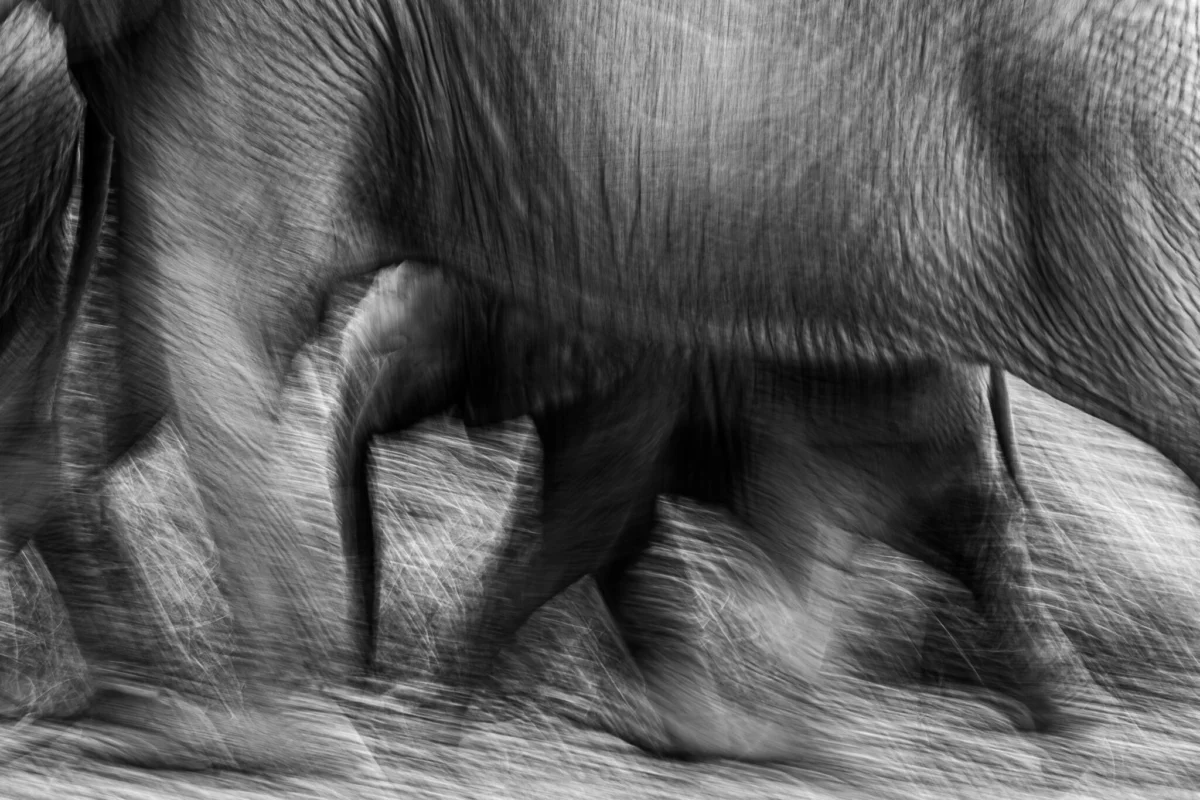
One striking example of this approach is his photograph of zebras fleeing a cheetah hunt. By employing a slow shutter speed, Murad transforms the individual animals into a unified blur of stripes, emphasizing their collective panic and the raw, instinctual flight for survival. Similarly, images of gazelles streaking across the Mara plains or a lone Grant’s gazelle walking gracefully are rendered with backgrounds softened by motion blur, highlighting the subjects’ elegant, unhindered movement. Even the powerful, pillar-like legs of an elephant, often depicted in static grandeur, are captured with motion blur, revealing their strength and the rhythmic cadence of their steps. This deliberate artistic choice challenges conventional expectations of wildlife photography, prioritizing emotional resonance and the impression of life over absolute sharpness.

Light as Storyteller: Crafting Mood and Emotional Depth

Beyond motion, Murad views light not merely as an illuminator but as a primary storyteller, a dynamic force capable of shaping mood and emotion within his frames. He has developed an acute sensitivity to how varying light conditions can transform a scene. Golden hour light, for instance, can soften rugged landscapes, imbuing them with a warm, ethereal glow. Shadows are skillfully utilized to introduce tension, mystery, or a sense of quiet contemplation. Backlight, a technique often challenging to master, becomes a poetic tool in Murad’s hands, silhouetting subjects and turning an ordinary bird into an emblem of fragile beauty or a hyena at sunset into a solitary, iconic figure.

Murad allows the available light to dictate his exposure and overall mood, consistently transforming familiar scenes into something mysterious, sublime, or deeply emotive. He often dedicates hours to patiently waiting for the precise quality of light to filter through a landscape or illuminate a subject. This patience is not driven by a desire for technical perfection, but by an unwavering commitment to capturing the scene honestly—to convey how it feels. For example, a white (pied) wagtail enveloped by flying mosquitoes at sunset becomes a study in ethereal beauty, with the sun positioned behind the subject to create a captivating, glowing backdrop. Similarly, a full-bellied hyena wandering at sunset, or a herd of wildebeest pausing after a predator encounter, are imbued with dramatic intensity by the warm, yellow glow of the setting sun, enhancing the narrative of resilience and survival. This deliberate interplay with light demonstrates Murad’s philosophy: to let light itself sculpt the story, adding layers of meaning and emotional depth that might otherwise be missed.

Foxes Under Kuwait’s Streetlights: An Urban Symphony

One of Murad’s most compelling series offers a unique glimpse into the lives of Arabian red foxes in an unexpected setting: the urban landscape of Kuwait City. Specifically captured near the Doha shore, this series showcases the delicate coexistence of wildlife and city life, with the vibrant glow of streetlights and car lights reflecting off the sea. To achieve the distinctive rim lighting that defines these images, Murad ingeniously employed two small handheld flashlights, patiently waiting for a mother fox to unearth food she had meticulously hidden for her cubs. This innovative technique allowed him to capture the magical glow of the urban night, creating a surreal backdrop that highlights these rare and intimate moments of urban wildlife.

The creation of this series was a testament to Murad’s extraordinary dedication and ethical approach to wildlife photography. For over two months, he visited the foxes’ den four days a week, spending countless hours after sunset observing their routines. Initially maintaining a respectful distance, he gradually earned the trust of the fox family. This slow, patient process led to an astonishing level of acceptance: the foxes began to approach his gear, even licking his camera and feet as he sat quietly. This profound experience resonated deeply with Murad, not only because he, like the fox family, is a father to five children, but because it instilled in him a profound sense of responsibility for their protection and well-being. The photographs, such as the Arabian red fox cub gazing into the camera with streetlights creating a beautiful bokeh, or two kits exploring the night, digging for hidden treasure, stand as powerful reminders of nature’s resilience and adaptability in human-dominated environments, and the critical role humans play in their protection. The images serve as an urban symphony, a visual narrative of survival and connection against the backdrop of metropolitan glow.

Lessons from the Wild: Adaptability and Serendipity

Murad’s photographic expeditions have spanned diverse and often challenging global terrains, from the arid deserts of Kuwait to the frigid expanses of Mongolia and Iceland, and the vast plains of Tanzania and Kenya. Each journey has served as a crucible, imparting invaluable lessons in patience, adaptability, and an openness to the unexpected. Encounters with lost luggage, fierce arctic winds, and extreme temperatures – as low as -34°C in Mongolia – have not been deterrents but rather teachers in disguise. These experiences underscore a fundamental truth for Murad: nature operates on its own terms, rarely presenting the "perfect" moment in a predictable fashion. Consequently, he has learned that the most profound and authentic images often emerge when one ceases to attempt to control every variable and instead allows the scene to unfold naturally. This philosophy of moving with nature, rather than against it, is central to his creative process.

In the remote Hornstrandir Nature Reserve in Iceland, accessible only by a rugged boat journey, Murad captured an Arctic fox peacefully napping behind snow-covered dry plants, its nose tucked under its tail, looking directly into his lens. His objective was to fill the frame without disturbing the animal, a testament to his respectful approach. Another image from Hornstrandir shows an Arctic fox walking alone, embodying the untouched tranquility of a land isolated since the 1950s. These experiences highlight the importance of being present, observant, and responsive to the fleeting opportunities nature presents.

Perhaps one of his most challenging and rewarding expeditions was to the Altai Mountains of Mongolia, where he endured brutal temperatures to photograph the elusive snow leopard. Often referred to as "nature’s ghost," the snow leopard is a critically endangered predator, perfectly camouflaged against its rocky, lichen-covered habitat. Murad’s rare glimpse of this magnificent creature, blending seamlessly with the fiery orange lichens and rugged rocks, was an awe-inspiring reward for his perseverance. This image not only captures the animal’s exquisite beauty but also serves as a potent reminder of its vulnerability and the urgent need for global conservation efforts. Such encounters, born from endurance and serendipity, reinforce Murad’s belief in the wisdom of letting nature guide the photographic process.

Beyond the Visible: Finding Your Creative Voice

At the very core of Mohammad Murad’s photography lies an unyielding desire to convey more than just what the eye perceives. His ambition is for his images to be felt – to resonate deeply on an emotional level with the viewer. This aspiration drives his continuous experimentation with techniques that extend beyond conventional photographic norms. He strives to translate the inherent fragility of a bird in mid-flight, the stoic resilience of a migrating herd, or the silent, intricate dialogue between predator and prey. Murad’s body of work is not merely about showcasing wildlife; it is an endeavor to share a profound interpretation of life itself, in all its raw beauty and complexity.

He passionately advocates for fellow photographers to liberate themselves from the relentless pursuit of technical perfection, encouraging them instead to trust their creative instincts and embrace their own unique artistic voices. He believes that true artistry emerges when one steps away from rigid rules and allows intuition to lead. An example of this is his slow shutter speed capture of seagulls in flight along Kuwait’s seaside, which transforms them into an abstract, almost fiery blur of wings – a mystical representation of motion and energy rather than a sharp depiction of individual birds. Another deeply personal piece shows a lion roaming the African wilderness, which Murad identifies with, seeing himself in its role of protecting territory and building a family in a "stunning, wild heaven" where he truly found himself.

His photograph of a baby elephant and its mother in Tanzania, also taken with a slow shutter speed, is described as more than a moment; it’s a reinvention of the scene, adding mystery and expressing his inner self. Like a violinist playing a personal melody, Murad views photography as a medium to share his story, intentionally leaving room for the viewer’s own interpretation. Even an abstract shot of a Greater Crested Tern colony on Kubbar Island, captured with slow shutter speeds and upward camera movement, is framed as "painting with light" and a quest to capture "the mystical oneness of our universe." These images embody his philosophy that when worry and judgment fade, creativity blooms, allowing for a deeper, more evocative connection with nature.

Conclusion: The Journey Continues

For Mohammad Murad, photography is an infinite journey, devoid of a final destination. It is an intricate dance, a delicate balance between the contrasting forces of light and shadow, motion and stillness, technical precision and the unpredictable currents of chance. Through each meticulously crafted image, he endeavors to draw viewers into this captivating dance, inviting them to feel the vibrant, undeniable heartbeat of the world. Every frame he captures is imbued with a piece of his own evolving story – his triumphs over challenges, his profound sense of wonder, and his deep, abiding respect for the natural world.

Murad’s distinctive artistic vision and his unwavering commitment to conveying emotion and narrative over mere technical accuracy serve as a powerful inspiration. His work encourages not only fellow photographers but all who encounter his art to look beyond the surface, to seek out their own unique rhythm within the wild, and to perceive photography not merely as a craft or a means of documentation, but as an ever-evolving, deeply personal conversation with the boundless wonders of nature. As a Canon EMEA Ambassador and an award-winning photographer, Mohammad Murad continues to push the boundaries of wildlife photography, creating images that challenge perceptions and foster a deeper emotional connection to the planet’s magnificent biodiversity.
