
The 2026 Costa Rica avian expedition, a comprehensive 15-day survey of the nation’s diverse microclimates, concluded this week with the documentation of hundreds of bird species, including several rare and endangered endemics. Led by ornithological expert Jose Pablo Castillo and supported by Eagle-Eye Tours, the expedition spanned the country’s ecological corridors, from the mangrove-lined Central Pacific coast to the high-altitude Talamanca cloud forests and the Caribbean lowlands. The findings underscore Costa Rica’s status as a critical global biodiversity hotspot and highlight the success of the nation’s long-standing conservation and sustainable tourism models.

Phase I: Central Valley and the Pacific Transition Zone
The expedition commenced in the Central Valley, where researchers and birding enthusiasts conducted an initial survey of the Hotel Bougainvillea’s botanical gardens. Despite overcast conditions and heavy rainfall, the team recorded several key species indicative of the region’s urban-adjacent biodiversity, including the Lesson’s Motmot and the Mottled Owl. A significant observation occurred during the late afternoon as four species of swifts, including the uncommon Spot-fronted Swift, were documented utilizing the pre-storm thermal drafts.

As the team moved toward the Central Pacific coast, the transition from coffee plantations to coastal mangroves provided a clear view of how elevation and humidity dictate species distribution. In the Caldera region, the survey identified the Mangrove Hummingbird, a species currently listed as endangered by the IUCN due to habitat loss. The presence of the Hook-billed Kite and the Northern Scrub Flycatcher further confirmed the ecological health of the local wetlands.

The study reached a pivotal point at Carara National Park, a critical biological transition zone between the dry forests of the northwest and the humid forests of the south. Here, the team documented the Tropical Royal Flycatcher and the Black-hooded Antshrike. The biodiversity in this region is unique because it serves as the northern or southern limit for many species, creating a high-density overlap of avian life.

Phase II: The Osa Peninsula and Golfo Dulce Endemism
Continuing south to the Osa Peninsula, the expedition focused on the Danta Lodge and the Rincón River. The Osa Peninsula is often described by National Geographic as "the most biologically intense place on Earth," and the expedition’s findings supported this claim. The team recorded the Yellow-billed Cotinga, a near-endemic species whose survival is closely tied to the integrity of the mangrove-rainforest interface.

In the La Gamba region, located within the buffer zone of Piedras Blancas National Park, steady bird activity allowed for the documentation of the Riverside Wren and the Sapphire-throated Hummingbird. These observations are significant for regional data sets, as they track the population stability of species within the Golfo Dulce forest reserve. The expedition also noted the presence of various primates, including the Central American Squirrel Monkey, which serves as an indicator species for forest connectivity.

Phase III: High-Altitude Specialists of the Talamanca Range
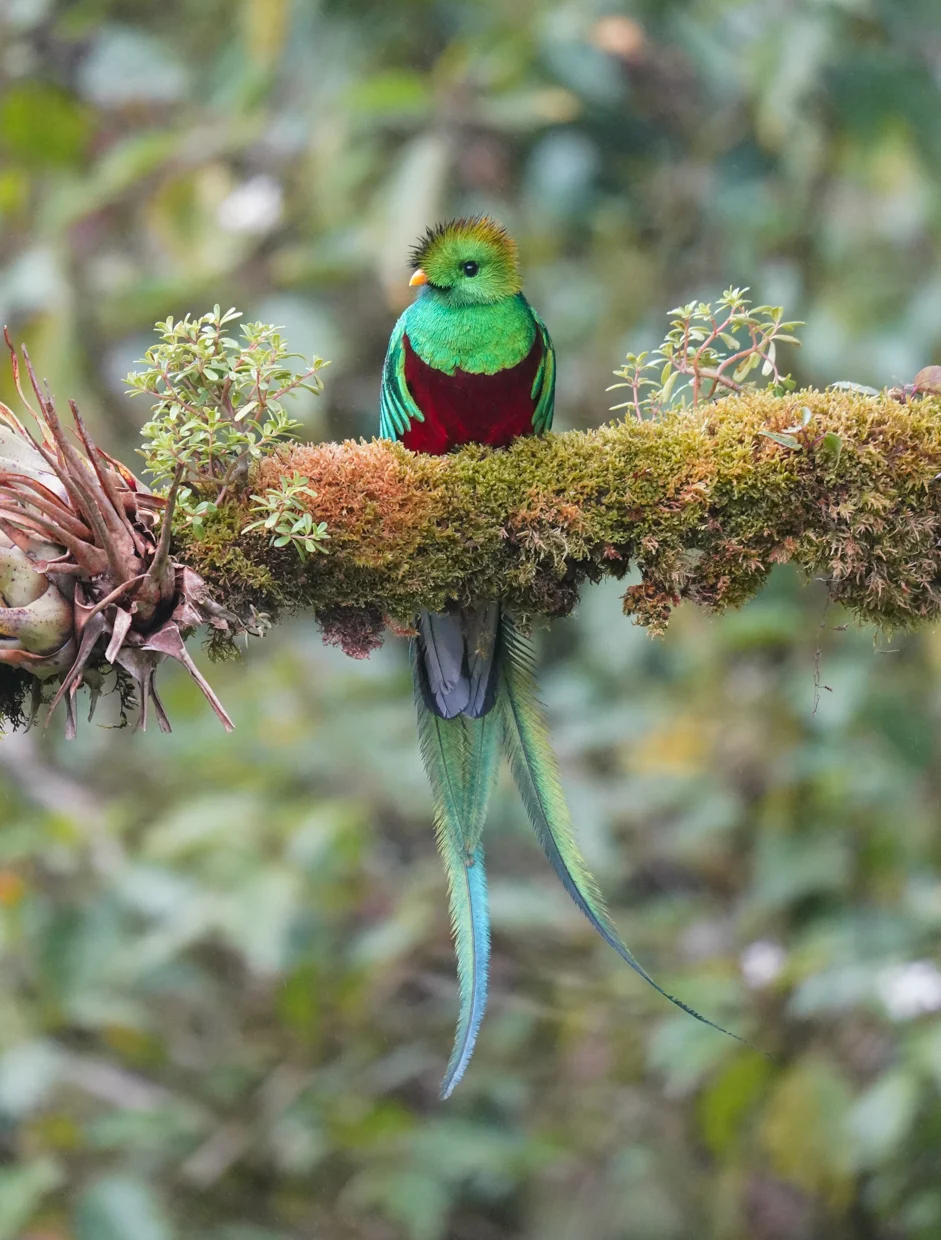
The third phase of the journey involved a steep ascent into the Talamanca Mountains, specifically the San Gerardo de Dota region. This area is characterized by cool montane oak forests and high-elevation páramo. The expedition successfully located the Resplendent Quetzal, a bird of deep cultural and ecological significance. A pair was observed actively nesting, providing an opportunity for the team to record behavioral data regarding their natural history and reproductive cycles.

Further up at Cerro Buena Vista, at an elevation exceeding 3,000 meters, the survey identified the Volcano Junco and the Timberline Wren. These species are restricted to high-altitude habitats and are particularly vulnerable to the shifting temperature gradients caused by climate change. The clear visibility at the summit also allowed for a survey of the "Los Crestones" rock formations near Cerro Chirripó, the highest peak in Costa Rica, providing a geographical context for the isolation that drives endemism in these highlands.

Phase IV: Caribbean Lowlands and Sustainable Agriculture Models
Descending toward the Caribbean lowlands, the expedition visited Paraíso de Cartago to examine the relationship between agriculture and biodiversity. A survey of a local 11-hectare organic coffee farm revealed a staggering record of over 300 bird species. This data serves as a primary example of how shade-grown, organic coffee production can support high levels of wildlife, including the endemic Cabanis’s Ground-Sparrow.

The team then moved to the La Selva Biological Station, a world-renowned research facility managed by the Organization for Tropical Studies. Despite inclement weather, the team documented the Green Ibis and the Broad-billed Motmot. La Selva’s 1,600 hectares of protected rainforest are vital for long-term scientific studies on tropical ecology, and the expedition’s presence there allowed for a synthesis of citizen science with established academic research.

In the Sarapiquí region, the team witnessed a massive raptor migration. Thousands of Turkey Vultures, accompanied by Swainson’s Hawks and Broad-winged Hawks, were observed moving north. This phenomenon is a critical annual event that demonstrates the importance of Costa Rica as a migratory corridor for birds traveling between North and South America.

Phase V: Wetland Dynamics and the Northern Frontier
The final stages of the expedition took place in the northern wetlands of Caño Negro and Medio Queso near the Nicaraguan border. These freshwater systems are among the most important in Central America for migratory waterbirds. Utilizing boat-based surveys, the team recorded the American Pygmy Kingfisher, the Sungrebe, and the Black-collared Hawk.

A notable highlight in this region was the observation of the Tayra, an elusive member of the weasel family, foraging in the canopy. Such sightings are rare and indicate a healthy, low-disturbance environment. The documentation of the Nicaraguan Seed-Finch and its fledglings provided evidence of successful breeding seasons in the wetland periphery, a region often pressured by agricultural expansion.

Final Observations and Rare Species Documentation
The expedition’s final days in the Arenal and San Ramón regions yielded some of the most significant sightings of the entire journey. At the Arenal Lodge, the team observed a juvenile Ornate Hawk-Eagle attempting to hunt at fruit feeders, providing rare photographic evidence of the predatory behavior of young raptors.

In the forests of San Ramón, the team successfully tracked an army ant swarm. These swarms create a unique micro-ecosystem where "ant-following" birds gather to feast on insects flushed out by the ants. This led to the observation of the Ocellated Antbird and, most significantly, three Rufous-vented Ground-Cuckoos. The Ground-Cuckoo is one of the most difficult birds to find in the Neotropics, and its presence is a hallmark of a pristine and complex forest floor ecosystem.

Broader Impact and Conservation Implications
The 2026 expedition concluded at the Hotel Robledal with the recording of the Spot-breasted Oriole, bringing the final species count to a level that confirms the resilience of Costa Rica’s protected areas. Expedition leader Jose Pablo Castillo expressed gratitude to the participants and the local guides, noting that the data collected would be uploaded to global databases like eBird to assist in ongoing conservation efforts.

"The success of this tour is a testament to the dedication of the local communities and the robustness of the national park system," a spokesperson for the expedition stated. "By documenting these species across various elevations and habitats, we provide the necessary data to justify the continued protection of these corridors."

The expedition also highlighted the economic impact of birding tourism. By utilizing local lodges, hiring regional guides, and visiting family-run farms, the group demonstrated how eco-tourism provides a viable economic alternative to extractive industries. As climate change continues to threaten tropical ecosystems, the information gathered during these 15 days will serve as a baseline for future studies on species migration and habitat adaptation.

The data from the eBird trip report (Feb 15 – Mar 3, 2026) will be reviewed by ornithologists to track population trends. The expedition’s findings reinforce the necessity of maintaining "biological bridges" between fragmented forests to ensure the genetic diversity and survival of Costa Rica’s avian population. With the conclusion of this survey, the focus now shifts to long-term monitoring and the expansion of protected wetlands in the northern territories.
